

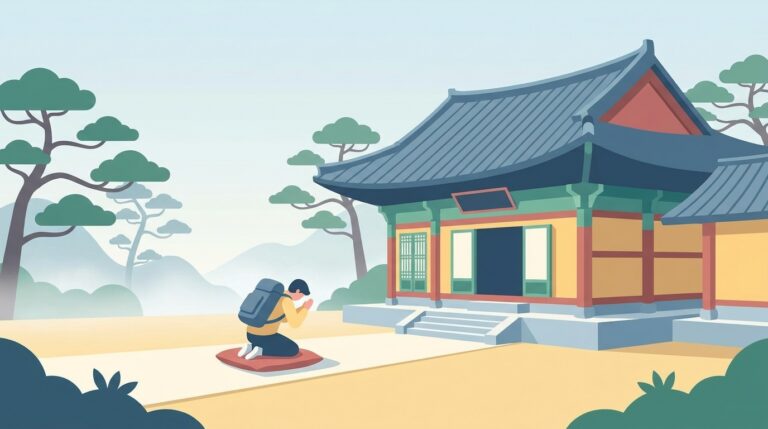
Finding Peace in Every Bow: The Ultimate Guide to 108 Bows and Temple Stay Korean
Phase 1: Empathy (Story-Driven Opening)
안녕하세요! 매일한글 에디터입니다. (Annyeonghaseyo! I’m your Daily Hangul editor.)
Picture this: It’s 5:30 AM in a misty mountain temple nestled deep in Gangwon-do. The resonant chime of the temple bell (beomjong) cuts through the crisp autumn fog. Your smartphone has been tucked away in your dorm cubby since yesterday afternoon. You are kneeling on a thick navy meditation cushion (bangseok), dressed in roomy temple-stay garments. Your knees ache slightly, and your breath comes a little quicker than usual. Around you, monks and fellow travelers bow in unison—knees to mat, hands raised, forehead touching the floor, standing back up in one fluid rhythm.
At first, your mind races with the chaos of everyday life: work deadlines, unanswered messages, anxious thoughts about the future. But somewhere around the 45th bow, something shifts. The constant chatter in your head begins to quiet down. With every single rise and fall, the weight on your shoulders lifts. As many of our students have shared after their first temple retreat: “With every bow I made, the worries and distracting thoughts filling my head quietly settled down.”
Experiencing a Korean temple stay (templestay) and undertaking the ritual of 108 bows (baekpalbae) is one of the most transformative cultural experiences you can have in Korea. But when the monk gently pours you a cup of warm lotus tea during chadam (tea talk) and asks how the practice felt, how do you express this profound inner transformation in natural, intermediate (B1) Korean? Today, we will guide you through the exact expressions, cultural nuances, and etiquette you need to turn this unforgettable spiritual journey into deeply meaningful conversations.
Phase 2: Core Expressions Deep Dive
Let’s unpack three powerful expressions that capture the essence of meditation and mindfulness.
1. 한 배 한 배 절을 올리다 (Han bae han bae jeoreul ollida)
- Pronunciation: [Han-bae-han-bae jeo-reul ol-li-da] (Sounds like “Hahn-bay-hahn-bay juhl-eul ohl-lee-dah”)
- Meaning: Literally “to offer bows one bow by one bow.” Figuratively: To perform prostrations mindfully and sincerely, treating each bow as a sacred individual act rather than rushing through a chore.
- K-Culture Moment: You often hear this solemn phrase in historical K-Dramas (sageuk) or documentaries when characters seek penance, express deep filial gratitude, or pray for recovery at remote mountain hermitages.
- Editor’s Insight: The counter 배 (bae) is specifically used for Buddhist bows or deep ancestral prostrations. Notice the verb 올리다 (ollida, “to raise/offer honorifically”) instead of just 하다 (hada, “to do”). Using 절을 올리다 adds deep sincerity and respect to your speech.
- Situation Spectrum: Casual: ⚠️ (Sounds too grand for casual friends unless being deeply poetic) | Semi-formal: ✅ | Formal: ✅
- 🤔 Think About It: In English, we often say “doing 108 bows” like a fitness set. Why do you think Korean uses the honorific verb “to offer” (올리다) even when referring to self-reflection?
2. 잡념이 차분하게 가라앉다 (Jamnyeomi chabunhage garaanta)
- Pronunciation: [Jam-nyeom-i cha-bun-ha-ge ga-ra-an-ta] (Sounds like “Jahm-nyum-ee chah-boon-hah-geh gah-rah-ahn-tah”)
- Meaning: Literally “distracting thoughts sink quietly.” Figuratively: Mental clutter settling like silt to the bottom of a calm pond.
- K-Culture Moment: In modern lifestyle shows like I Live Alone (나 혼자 산다), when stressed celebrities run to a temple stay to escape urban burnout, they sigh contentedly over tea and say this exact phrase.
- Editor’s Insight: 잡념 (jamnyeom) combines 잡 (miscellaneous/scattered) and 념 (thoughts). The verb 가라앉다 evokes physical settling, not aggressive elimination. You are not fighting your stress; you are allowing it to rest naturally.
- Situation Spectrum: Casual: ✅ | Semi-formal: ✅ | Formal: ✅
- 🤔 Think About It: Notice the imagery: thoughts are treated like physical particles floating in water. How does this visual shift change the way you perceive stress?
3. 머릿속을 비우다 (Meorissogeul biuda)
- Pronunciation: [Meo-rit-ssog-eul bi-u-da] (Sounds like “Muh-reet-ssog-eul bee-oo-dah”)
- Meaning: Literally “to empty the inside of one’s head.” Figuratively: To clear one’s mind, reboot, or achieve mental clarity.
- K-Culture Moment: Frequently used by K-pop idols when asked in variety shows what they do on their days off to recover from grueling world tours: “아무 생각 없이 머릿속을 비우고 싶었어요” (“I just wanted to empty my mind without thinking”).
- Editor’s Insight: 비우다 (biuda) is an active transitive verb. In Korean wellness culture, emptying is prized just as much as filling. Before you can gain new wisdom, your mind must be made empty (비움의 미학 – the aesthetics of emptying).
- Situation Spectrum: Casual: ✅ | Semi-formal: ✅ | Formal: ✅
- 🤔 Think About It: Western productivity often stresses “refocusing” or “optimizing thoughts.” How does “emptying” offer a different psychological release?
Phase 3: Textbook Korean vs. Real Korean
Situation 1: Explaining how you felt after completing the 108 bows
- 📖 교과서 한국어 (Textbook):
108배를 해서 힘들었지만 보람 있었습니다.
(Baekpalbaereul haeseo himdeureotjiman boram isseotseumnida.)
“I did 108 bows so it was hard, but it was worthwhile.” - 🗣️ 진짜 한국어 (Real-life Native):
다리는 조금 후들거리는데, 머리는 신기할 정도로 개운해졌어요.
(Darineun jogeum hudeulgeorineunde, meorineun singgihal jeongdoro gaeunhaejyeosseoyo.)
“My legs are shaking a bit, but my head feels astonishingly refreshed and clear.” - 💡 왜 다를까? (Why the difference?):
Textbooks love using abstract summary words like 보람 있다 (meaningful/worthwhile). Native speakers, however, pair visceral bodily sensations (후들거리다 – trembling legs) with vivid emotional releases (개운하다 – crisp, refreshed clarity).
Situation 2: Talking about sitting for early dawn meditation (참선)
- 📖 교과서 한국어 (Textbook):
명상을 할 때 모든 걱정을 잊을 수 있습니다.
(Myeongsangeul hal ttae modeun geokjeongeul ijeul su isseumnida.)
“When doing meditation, one can forget all worries.” - 🗣️ 진짜 한국어 (Real-life Native):
새벽 공기 마시면서 멍때리니까 잡생각이 싹 날아가더라고요.
(Saebyeok gonggi masimyeonseo meong-ttaerinikka japsaenggagi ssak naragadeoragoyo.)
“Zoning out in the crisp dawn air completely blew away all my random clutter.” - 💡 왜 다를까? (Why the difference?):
In modern Korean conversation, 멍때리다 (to zone out / space out peacefully) has transformed from a slang term into a widely accepted wellness concept. Combined with the adverb 싹 (completely/cleanly), it sounds far more natural than the stiff textbook verb 잊다 (to forget).
Phase 4: K-Culture Deep Dive & Non-Verbal Manners
4-1. 눈치 (Nunchi) & Temple Manners
- 합장 (Hapjang – Palm-to-Palm Greeting): When you pass a monk, temple worker, or fellow guest anywhere on temple grounds, do not shake hands or give an energetic Western wave. Bring your palms together flat in front of your chest at heart level, tilt your upper body slightly forward (about 30 degrees), and offer a quiet nod with a soft smile. Keep your elbows gently drawn to your sides.
- Silent Steps (묵언 – Mugeon): Temples are sanctuaries of stillness. Walk softly by placing your heel down first, rolling to the ball of your foot without stamping or dragging your sandals. When stepping across the wooden threshold (문턱) of the main Buddha hall (대웅전), never step directly onto the wooden raised sill. Always step clean over it. Stepping on the threshold is traditionally believed to bring bad luck and damages the ancient timber.
4-2. The Modern Boom of Temple Healing Culture
In South Korea, temple stays are not solely religious pilgrimages for devout Buddhists. Millions of young office workers, university students, and international travelers book weekends at temples to escape the notorious 빨리빨리 (ppalli-ppalli, hurry-hurry) culture of urban Seoul. It represents 힐링 (healing) and 쉼 (rest). Here, nobody asks about your job, your relationship status, or your salary. Monastic meals (발우공양 – Baru-gongyang) teach you to eat every grain of rice in complete silence, washing the bowls with pickled radish and warm water at the end, demonstrating zero food waste and boundless respect for nature.
Phase 5: Real-Life Roleplay Scenario
Setting: A sunlit wooden tea room overlooking the pine forest at Woljeongsa Temple. Monk Hye-an (혜안 스님) is pouring pale yellow lotus tea into a celadon cup for Liam, an exchange student experiencing his first temple stay.
스님 (Sunim):
(따뜻한 미소로 찻잔을 건네며)
리암 씨, 아침 108배 하느라 고생 많으셨어요. 다리는 좀 괜찮으세요?
(Liam ssi, achim baekpalbae haneura gosaeng maneusyeosseoyo. Darineun jom gwaenchaneuseyo?)
Liam, you worked so hard during the 108 bows this morning. How are your legs feeling?
🎭 Hands the tea bowl with both hands and tilts head gently.
리암 (Liam):
(두 손으로 찻잔을 받으며)
네, 스님. 솔직히 50배 넘어가면서는 허벅지가 터질 것 같았어요.
(Ne, seunim. Soljiki osip-bae neomeogamyeonseoneun heobeokjiga teojil geot gatasseoyo.)
Yes, Sunim. To be honest, once I passed 50 bows, I felt like my thighs were going to explode!
🎭 Chuckles sheepishly, rubbing his quadriceps.
스님 (Sunim):
(허허 웃으며 찻주전자를 내려놓는다)
하하, 다들 처음엔 그렇죠. 몸이 힘들 때 마음은 어땠나요?
(Haha, dadeul cheoeumen geureochyo. Momi himdeul ttae maeumeun eottaennayo?)
Haha, everyone feels that way at first. What was happening in your mind while your body was working so hard?
🎭 Looks calmly into Liam’s eyes, fully listening.
리암 (Liam):
신기하게도 한 배 한 배 절을 올릴 때마다 머릿속을 채우고 있던 걱정과 잡념이 차분하게 가라앉았어요.
(Singgihagedo han bae han bae jeoreul ollil ttaemada meorissogeul chaeugo itdeon geokjeonggwa jamnyeomi chabunhage garaantasseoyo.)
Curiously, with every single bow I offered, the worries and random thoughts crowding my head quietly settled down.
🎭 Sits upright, breathing in the scent of the tea.
스님 (Sunim):
절은 나를 낮추고 번뇌를 내려놓는 수행이지요. 아주 훌륭하게 비워내셨습니다.
(Jeoreun nareul natchugo beonnoereul naeryeononneun suhaeng-ijiyo. Aju hullyunghage biwonaesyeosseumnida.)
Bowing is a spiritual practice of lowering oneself and putting down worldly attachments. You have emptied your mind wonderfully.
🎭 Nods slowly in deep appreciation.
리암 (Liam):
서울에 있을 땐 생각이 너무 많아서 잠도 안 왔는데, 오늘 밤엔 푹 잘 수 있을 것 같아요.
(Seoure isseul ttaen saenggagi neomu manaseo jamdo an wanneunde, oneul bamen puk jal su isseul geot gatayo.)
When I was in Seoul, I had so many thoughts that I couldn’t sleep, but I feel like I’ll sleep soundly tonight.
🎭 Takes a small sip of tea and sighs in deep relief.
스님 (Sunim):
차 한 모금 천천히 드시면서, 이 고요한 순간을 온전히 느껴보세요.
(Cha han mogeum cheoncheonhi deusimyeonseo, i goyohan sunganeul onjeonhi neukkyeoboseyo.)
Drink your tea slowly, sip by sip, and feel this peaceful moment completely.
🎭 Fills Liam’s cup once more with fragrant tea.
리암 (Liam):
(가볍게 합장하며)
네, 스님. 따뜻한 말씀 감사합니다. 마음이 정말 편안해졌어요.
(Ne, seunim. Ttatteutan malsseum gamsahamnida. Maeumi jeongmal pyeon-anhaejyeosseoyo.)
Yes, Sunim. Thank you for your kind words. My heart feels truly at peace.
🎭 Lowers his head slightly in gratitude.
🔀 Interactive Scenario Fork
When the monk asks: “절을 하면서 어떤 생각이 드셨나요?” (What thoughts crossed your mind while bowing?), how will you answer?
- Option A: “처음엔 숨이 찼는데, 한 배 한 배 절을 올릴 때마다 마음이 정말 차분해졌어요.”
👉 Feedback [BEST]: Elegant, humble, and grammatically impeccable. The monk will praise your mindfulness and deep understanding of Korean Buddhist practice. - Option B: “다리가 너무 아파서 중간에 도망치고 싶었어요.”
👉 Feedback [RISK]: Very candid and will probably make the monk laugh! However, it focuses purely on physical complaint rather than your inner emotional shift. Good with friends, slightly crude for a monastery tea ceremony. - Option C: “너무 힘들어서 시간 낭비인 것 같아요.”
👉 Feedback [BAD]: Inconsiderate and offensive. Dismissing a spiritual tradition as a “waste of time” (시간 낭비) violates basic cultural etiquette.
Phase 6: 10-Second Emotion Shadowing Drill
Practice reading these out loud. Pay attention to pauses marked by / and tune your voice to the emotional guideposts:
[😌 고요하고 진솔하게 - Calm and Sincere]
한 배 한 배 / 절을 올릴 때마다 / 머릿속 잡념이 / 차분하게 가라앉았어요.
(Han bae han bae / jeoreul ollil ttaemada / meorissok jamnyeomi / chabunhage garaantasseoyo.)-
[🙏 온 마음을 다해 겸손하게 - Deeply Humble]
힘든 줄도 모르고 / 오롯이 제 호흡에만 / 집중할 수 있었어요.
(Himdeun juldo moreugo / orosi je hoheubeman / jipjunghal su isseotseumnida.) -
[🌿 한숨 돌리며 개운하게 - Relieved and Refreshed]
머릿속을 꽉 채우던 고민들이 / 눈 녹듯이 / 스르륵 사라졌어요.
(Meorissogeul kkwak chaeudeon gomingdeuri / nun nokdeusi / seureureuk sarajyeosseoyo.)
Phase 7: K-Culture Mini Dictionary
-
108배 (Baekpalbae)
Literal translation: 108 Bows.
Practical Context: In Buddhism, human beings possess 108 worldly desires and agonies (번뇌 – beonnoe). Each full prostration is performed to extinguish one agony, humbling the ego and purifying the spirit. -
발우공양 (Baru-gongyang)
Literal translation: Monastic Bowl Offering.
Practical Context: The traditional communal eating ritual. You are given four nested wooden bowls (발우). Meals are eaten in complete silence, without spilling a drop, finishing by rinsing every bowl with pickled radish (단무지) and warm water so that nothing is thrown away. -
차담 (Chadam)
Literal translation: Tea and Conversation.
Practical Context: A cozy, informal question-and-answer tea session between temple guests and an ordained monk. It’s the highlight of any temple stay, where participants ask personal life questions, discuss anxiety, or explore meditation philosophy. -
방하착 (Banghachak)
Literal translation: Laying Down What You Hold.
Practical Context: A core Zen Buddhist principle frequently inscribed on temple stone tablets. It means unburdening oneself: letting go of greed, lingering pride, attachments, and anxiety that you stubbornly carry in your head.
Phase 8: Traveler’s Survival Kit
Survival Expressions TOP 3
- “공양 시간은 몇 시인가요?” (Gongyang siganeun myeot si-ingayo?)
“What time is the monastic meal served?”
Pro Tip: Temples strictly maintain breakfast around 6:00 AM, lunch at 11:30 AM, and dinner at 5:00 PM. Arriving late is considered disrespectful. - “절하는 법을 다시 한번 가르쳐 주실 수 있나요?” (Jeolhaneun beobeul dasi hanbeon gareuchyeo jusil su innayo?)
“Could you please show me the bowing method once more?”
Pro Tip: If you forget the posture (kneeling, touching forehead, turning hands palm-up to lift the Buddha’s feet), temple coordinators are delighted to guide you patiently. - “사찰 내에서 사진 촬영 가능한가요?” (Sachal nae-eseo sajin chwaryeong ganeunghangayo?)
“Is photography allowed inside the temple grounds?”
Pro Tip: You may photograph outdoor pagodas and mountain paths, but never photograph monks without permission or take photos inside the Buddha prayer hall during active prayer.
Editor’s Travel Note
- Booking: You can reserve official authentic programs across Korea through the Official Templestay Reservation Portal. Choose between Experiential Templestay (structured with 108 bows and crafts) or Rest-oriented Templestay (freestyle meditation and forest walks).
- Navigation & Transportation: Mountain temples often require local shuttle buses from regional terminals. Make sure to download and use the KakaoMap Navigation App for real-time rural bus schedules, as foreign map apps rarely display precise country routes in Korea.
Phase 9: “One Step Deeper” (Reflective Essay)
In contemporary society, lowering your body to the ground is frequently mistaken for surrender, humiliation, or weakness. But in the Korean meditative tradition, 절 (jeol, bowing) is the ultimate act of liberation. When you touch your forehead to the wooden floorboards 108 times, you are not subordinating yourself to a statue; you are physically lowering your stubborn ego (아만 – aman) below the level of the earth. In that stillness between rising and falling, you realize that your worries do not define you—they are simply passing weather. Emptiness in Korean thought is not absence; it is room for peace.
💬 Your Turn: Have you ever experienced an activity—whether yoga, hiking, or sitting quietly in nature—where your thoughts settled like sediment? How do you say “clearing my head” in your native language? Share your thoughts in the comments below!
Phase 10: FAQ & Avoiding Misunderstandings
Q: Can non-Buddhists or secular travelers participate in 108 bows during a temple stay?
A: Absolutely! Korean temple stays welcome people of all faiths, spiritual backgrounds, and atheists alike. Nobody tests your religious beliefs. You can treat 108 bows purely as mindful calisthenics, physical grounding, and breathing meditation. If bowing violates your personal religious convictions, you can simply sit quietly on your cushion in silent meditation.
Q: What if my knees hurt and I can’t complete all 108 bows?
A: Never force your body to the point of injury. In temple philosophy, listening honestly to your body is part of mindfulness. If your knees hurt, simply remain seated in the half-lotus (가부좌) position with your hands folded in 합장 (Hapjang), counting the bows in your heart alongside the sound of the wooden chime (목탁 – moktak).
Q: Is speaking completely forbidden during meals (발우공양)?
A: Yes. Silent contemplation (묵언) is observed throughout the entire formal meal. This allows you to taste each ingredient, acknowledge the sun and rain that nourished the vegetables, and thank the people who prepared your food. If you need water or more soup, monastic assistants use silent hand gestures rather than spoken words.
🚨 흔한 실수 (Common Mistakes) Notice Board
- Stepping on the temple door sill: Never plant your foot directly on the wooden threshold (문턱). Step over it cleanly in one step.
- Greeting with a standard handshake or high-five: When meeting monks or temple masters, refrain from physical contact. Always greet with two hands pressed together (합장) and a polite bow.
- Leaving leftover food in your bowl: Temple food is sacred energy. Take only what you can finish down to the last grain of rice.
Phase 11: Action Mission & Engagement
- 🥉 Bronze Mission (Solo Practice): Stand in your living room, take three deep breaths, and recite out loud 3 times: “한 배 한 배 절을 올릴 때마다 마음이 차분해졌어요.” Pay attention to your intonation and breath.
- 🥈 Silver Mission (Social Share): Share a photo of your favorite calming spot or morning cup of tea on Instagram or Threads. Caption it using today’s key phrase: “머릿속 잡념을 차분하게 가라앉히는 시간 🍵” and tag @DailyHangul.
- 🥇 Gold Mission (Real-Life Application): Next time you feel overwhelmed by emails or city noise, step outside, take a 5-minute silent walk, and tell a Korean friend or your language tutor: “산책하면서 머릿속을 깨끗하게 비우고 왔어요.”
🎮 K-Culture Mission: Watch an episode of a Korean variety show featuring a temple retreat (such as Three Meals a Day or I Live Alone). Spot the exact moment the cast eats 사찰음식 (temple food) and note down the adjectives they use to describe the tranquil taste!
Phase 12: Interactive Quiz Challenge
Test how much temple wisdom you’ve absorbed today! Select your answers and click to reveal explanations.
Question 1: Situation Judgment
You are sitting for tea with a monk after dawn meditation. You want to describe how peaceful and settled your noisy mind feels. Which sentence is the most natural and polite?
* (A) 머리가 아파서 빨리 서울로 가고 싶어요.
* (B) 한 배 한 배 절을 올릴 때마다 잡념이 차분하게 가라앉았어요.
* (C) 108배를 너무 많이 해서 허리가 부러졌어요.
🔍 Check Answer & Explanation
Correct Answer: (B)
Explanation: (B) perfectly captures the mindfulness and intermediate Korean expression for calming mental distractions. (A) and (C) are blunt complaints that fail to reflect the reflective purpose of the tea conversation.
Question 2: Fill-in-the-Blank
Fill in the missing particle and word:
“절을 하면서 머릿속을 깨끗하게 ( ) 싶었어요.” (I wanted to cleanly empty my head while bowing.)
* (A) 비우고 (bi-u-go)
* (B) 채우고 (chae-u-go)
* (C) 버리고 (beo-ri-go)
🔍 Check Answer & Explanation
Correct Answer: (A) 비우고
Explanation: The natural collocation for clearing your mind in Korean is 머릿속을 비우다 (to empty one’s head). 채우다 means to fill, which is the exact opposite, and 버리다 (to throw away) is not typically paired directly with 머릿속.
Question 3: Temple Etiquette True or False
Statement: When entering the main prayer hall (대웅전), it is good manners to step firmly on the center of the wooden doorstep threshold (문턱) to show respect for the building’s craftsmanship.
* (A) True
* (B) False
🔍 Check Answer & Explanation
Correct Answer: (B) False
Explanation: You must never step onto the wooden threshold (문턱). Step over it. Stepping on the sill wears down the timber and is traditionally considered bad luck in Korean architecture.







