

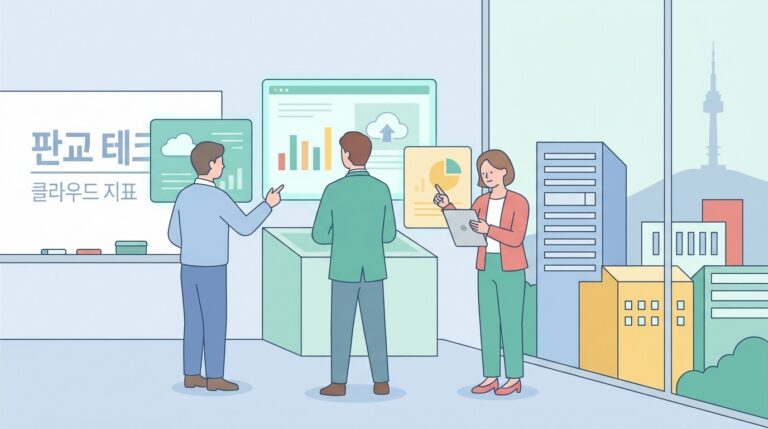
When Your AWS Bill Doubles: How to Lead a Cloud Cost TF in Natural Korean
Phase 1: Empathy (Story-Driven Opening)
안녕하세요! It is your Daily Hangul editor and your personal Pangyo culture navigator!
Picture this: You are working as a cloud engineer at an energetic Korean tech startup nestled in the bustling alleys of Pangyo Techno Valley—Korea’s very own Silicon Valley. Last month was phenomenal; your company’s live commerce app went viral after a famous K-pop idol casually flexed using it on their livestream. User traffic went through the roof! Thanks to your auto-scaling setup, the servers did not crash once. You felt like an absolute rockstar.
Then, the first week of the new quarter rolls around. The monthly AWS cloud bill lands in your team lead’s inbox… and it is double the previous quarter’s budget. The chat notifications suddenly light up with urgent pings. Your team lead rushes out of an executive boardroom clutching an iced Americano like a lifeline. Before you can even finish your morning coffee, you hear: “우리 인프라 비용 절감 TF 꾸려야겠어요!” (We need to assemble an infrastructure cost-reduction task force!).
Facing a sudden surge in cloud expenditures while keeping infrastructure resilient is one of the most relatable rites of passage in Korean tech. However, pitching FinOps strategies, explaining auto-scaling thresholds, and negotiating resource downsizing in intermediate Korean can feel like defusing a bomb in high honorifics. Don’t worry! Based on real-world feedback from global engineers working in Korea, this guide will walk you through native-level B2 Korean expressions to master cloud cost optimization and shine in corporate meetings.
Phase 2: Core Expressions Deep Dive
Here are three indispensable expressions you will hear and use when tackling unexpected cloud spikes:
1. 서버 비용이 두 배로 뛰었어요 (Seo-beo bi-yong-i du bae-ro ttwieo-sseoyo)
- Pronunciation: [Seo-beo bi-yong-i du bae-ro ttwieo-sseoyo] (Pronunciation tip: “ttwieo” sounds like jumping off a tight trampoline—a sharp, aspirated pop!)
- Meaning: Literal: “The server cost jumped twice.” / Real nuance: “Our cloud bill doubled out of nowhere!”
- K-Culture Moment: You will hear this exact sentence in tech-themed K-dramas (like Start-Up) during an emergency boardroom scene when the founders realize their success came with a terrifying infrastructure bill.
- Editor’s Insight: The verb 뛰다 (ttwida) literally means “to run” or “to jump.” Koreans frequently use it for prices, exchange rates, and bills to convey sudden, shocking upward momentum.
- Situation Spectrum: Casual: ⚠️ (Use 반말 뛰었어) | Semi-formal: ✅ | Formal: ✅
- 🤔 Think About It: In English, we often say costs “skyrocketed” or “shot up.” In Korean, using a physical action verb like “jumped” makes the speaker’s emotional surprise much more tangible. How do you describe unexpected financial spikes in your native language?
2. 비용 절감 TF를 꾸렸어요 (Bi-yong jeol-gam ti-ep-eu-reul kku-ryeo-sseoyo)
- Pronunciation: [Bi-yong jeol-gam ti-ep-eu-reul kku-ryeo-sseoyo] (Pronunciation tip: “kku-ryeo” rhymes with packing a sturdy backpack—quick and firm!)
- Meaning: Literal: “We packed/assembled a cost reduction TF.” / Real nuance: “We’ve formed a dedicated strike team to slash operating costs.”
- K-Culture Moment: Whenever an unexpected hurdle hits a Korean company, management immediately forms a TF (Task Force). Being named to a TF means late-night pizza sessions and high visibility with leadership.
- Editor’s Insight: The verb 꾸리다 (kkurida) traditionally means to pack a bundle or assemble a household. Using it with “TF” implies gathering diverse specialists into a tight-knit, agile unit for a shared mission.
- Situation Spectrum: Casual: ⚠️ | Semi-formal: ✅ | Formal: ✅
- 🤔 Think About It: Notice how loanwords like “TF” (Task Force) blend seamlessly with pure Korean verbs. Why do you think Korean workplaces prefer dynamic military/agile terms like “TF” over simple committee names?
3. 오토스케일링 임계치를 재조정해야 합니다 (O-to-seu-kei-lling im-gye-chi-reul jae-jo-jeong-hae-ya ham-ni-da)
- Pronunciation: [O-to-seu-kei-lling im-gye-chi-reul jae-jo-jeong-hae-ya ham-ni-da] (Pronunciation tip: Give “im-gye-chi” crisp dental clicks on the ‘ch’ sound).
- Meaning: Literal: “We must readjust the auto-scaling threshold values.” / Real nuance: “We need to fine-tune our scale-out and scale-in triggers so we stop wasting money on idle nodes.”
- K-Culture Moment: The definitive line dropped by the pragmatic, glasses-wearing senior DevOps architect during an architecture review sprint.
- Editor’s Insight: Hanja-based terms like 임계치 (臨界値 – threshold) and 재조정 (再調整 – readjustment) elevate your technical credibility immediately. Finishing with -해야 합니다 signals decisive, professional ownership.
- Situation Spectrum: Casual: 🚫 | Semi-formal: ⚠️ | Formal: ✅
- 🤔 Think About It: Contrast the casual tone of explaining a technical bug with the formal weight of prescribing an architectural fix. How does code-switching to Sino-Korean vocabulary change your perceived authority?
Phase 3: Textbook Korean vs. Real Korean
| Context | 📖 Textbook Korean | 🗣️ Real-World Korean |
|---|---|---|
| 1. Announcing the need to optimize cloud spend | 클라우드 서비스 요금을 확인하고 비용을 낮추는 방안을 모색합시다. (Geu-ra-u-deu seo-bi-seu yo-geum-eul hwak-in-ha-go bi-yong-eul nat-chu-neun bang-an-eul mo-saek-hap-si-da.) | AWS 비용 너무 터져서 인프라 다이어트 좀 해야겠어요. (Ei-deob-beul-yu-e-seu bi-yong neo-mu teo-jyeo-seo in-peu-ra da-i-eo-teu jom hae-ya-get-seo-yo.) |
| 💡 Why is it different? | Native tech workers rarely say “클라우드 서비스 요금.” Instead, they name the cloud provider directly (AWS, GCP) and use vibrant workplace slang like 터지다 (to blow up/burst) and 인프라 다이어트 (infrastructure diet) to evoke urgency without sounding robotic. | |
| 2. Explaining automated scaling under sudden traffic | 사용자가 많아지면 서버를 자동으로 늘리도록 설정했습니다. (Sa-yong-ja-ga man-a-ji-myeon seo-beo-reul ja-dong-eu-ro neul-li-do-rok seol-jeong-haet-seum-ni-da.) | 트래픽 몰릴 때 오토스케일링 팍팍 돌게 세팅해 뒀어요. (Teu-rae-pik mol-ril ttae o-to-seu-kei-lling pak-pak dol-ge se-tting-hae dwo-sseo-yo.) |
| 💡 Why is it different? | Real engineers use onomatopoeia like 팍팍 (briskly, aggressively) and verbs like 돌다 (to spin/run) instead of stiff grammatical constructions like “자동으로 늘리도록 설정했습니다.” |
Phase 4: K-Culture Deep Dive & Non-Verbal Manners
4-1. Nunchi (눈치) & Gestures in the FinOps War Room
When delivering the news that cloud infrastructure costs doubled, Nunchi (situational intuition) is everything:
* The Double-Handed Tablet Pass: If you are presenting cloud billing dashboards on a tablet or laptop screen, guide the screen toward your manager using both hands, gently lowering your chin.
* Softening the Blow: Never open a cost review meeting with direct accusation (e.g., “누가 인스턴스 켜 놨어요?” – Who left the instances running?). Instead, preface your findings with shared accountability: “트래픽 급증 대응은 성공적이었으나, 비용 측면에서 보완할 점이 있습니다” (Our traffic surge response was successful, but there are areas to refine regarding costs).
* The Empathetic Head Tilt: When the tech lead sighs and reaches for their temple, offer a slight nod of acknowledgment before presenting your solutions. Korean engineering meetings respect solutions far more than excuses.
4-2. The Pangyo Culture Code: The “Pangyo Dip” and Sugar Recharging
In Korean tech hubs like Pangyo, Gasan Digital Complex, and Teheran-ro, cost-cutting initiatives are framed as “Sprint Tasks.” When a TF is assembled, it is customary for the team to do a group 커피 수혈 (coffee blood transfusion)—ordering large quantities of iced Americanos or sweet vanilla lattes (아바라) to survive deep-dive metric analyses. Food and drinks function as emotional buffers before tackling daunting cloud invoices.
Phase 5: Real-Life Roleplay Scenario
Setting: A glass-walled conference room at an IT startup in Pangyo. 10:30 AM on a Monday.
Characters:
* You (Alex): Mid-level DevOps / Cloud Engineer.
* Min-woo (민우 팀장님): Infrastructure Team Lead, holding an oversized tumbler, visibly stressed.
민우 팀장님: 알렉스 씨, 지난달 AWS 청구서 봤어요? 전 분기 대비 비용이 두 배로 뛰었어요.
(Alex ssi, ji-nan-dal ei-deob-beul-yu-e-seu cheong-gu-seo bwa-sseoyo? Jeon bun-gi dae-bi bi-yong-i du bae-ro ttwieo-sseoyo.)
“Alex, did you see last month’s AWS bill? The cost doubled compared to the previous quarter.”
🎭 [이마를 짚으며 텀블러를 내려놓는다 / Massaging his forehead and putting down his tumbler]
You: 네, 팀장님. 트래픽 폭주로 오토스케일링 인스턴스가 풀로 돌면서 비용이 과다 청구되었습니다.
(Ne, tim-jang-nim. Teu-rae-pik pok-ju-ro o-to-seu-kei-lling in-seuteon-seu-ga pul-lo dol-myeon-seo bi-yong-i gwa-da cheong-gu-doe-eot-seum-ni-da.)
“Yes, Team Lead. Due to the traffic spike, auto-scaling instances ran at full capacity, resulting in overcharges.”
🎭 [태블릿 모니터를 팀장님 쪽으로 살짝 돌리며 / Gently pivoting the tablet monitor toward him]
민우 팀장님: 경영진 쪽에서도 이대로 가면 영업이익 다 깎아먹는다고 바로 TF 꾸리라네요. 대책이 있을까요?
(Gyeong-yeong-jin jjok-e-seo-do i-dae-ro ga-myeon yeong-eop-i-ik da kkak-a-meok-neun-da-go ba-ro ti-ep kku-ri-ra-ne-yo. Dae-chaek-i iss-eul-kka-yo?)
“Management says our operating profits will evaporate at this rate, and told us to form a TF right away. Do we have a countermeasure?”
🎭 [의자를 앞으로 당겨 앉으며 / Leaning forward in his chair intently]
You: [인터랙티브 분기점! Choose your response below] 👇
🔀 Your Move: How will you answer Min-woo?
- Option A: “서버 끄면 서비스 멈추니까 그냥 경영진한테 예산 더 올려달라고 하시죠.” (Since the service stops if we turn off servers, let’s just ask management to raise the budget.)
- Option B: “유휴 자원 먼저 정리하고, 오토스케일링 임계치 재조정 및 예약 인스턴스(RI) 구매로 30% 절감 가능합니다.” (We can trim idle resources first, readjust auto-scaling thresholds, and secure a 30% cut through Reserved Instances.)
- Option C: “비용 많이 나오는 개발 서버 전부 오늘 자정부터 일괄 삭제하겠습니다.” (I will delete all expensive development servers starting at midnight tonight.)
💡 Decision Feedback:
- Option A (Risk): 🚨 Dangerous career move! Dismissing budget constraints breaks teamwork harmony and shows a lack of business acumen.
- Option B (Best Choice): 🏆 Spot on! You acknowledge business realities, identify specific technical fixes (idle resources, auto-scaling triggers, RI), and provide a concrete reduction target (30%).
- Option C (Bad): ⚠️ Catastrophic panic move! Deleting shared team environments without consensus will infuriate developers and paralyze deployments.
Phase 6: 10-Second Emotion Shadowing Drill
Practice these lines out loud with the designated emotional nuances and cadence breaks (/ marks a natural pause):
- [😅 침착하게 현실 인정하기 / Calmly acknowledging the situation]
서버 비용이 / 전 분기 대비 / 두 배로 뛰어서 / 솔직히 많이 당황했습니다.
(Seo-beo bi-yong-i / jeon bun-gi dae-bi / du bae-ro ttwieo-seo / sol-jik-hi man-i dang-hwang-haet-seum-ni-da.)
“Our server costs / doubled compared to last quarter / so honestly / I was quite taken aback.” -
[🔥 자신감 있고 명확한 해결책 제시 / Confident and decisive presentation of solution]
오토스케일링 임계치를 재조정하면 / 트래픽 폭주도 막고 / 비용도 30% 아낄 수 있습니다!
(O-to-seu-kei-lling im-gye-chi-reul jae-jo-jeong-ha-myeon / teu-rae-pik pok-ju-do mak-go / bi-yong-do sam-sip-peo-sen-teu a-kkil su iss-seum-ni-da!)
“If we readjust the auto-scaling thresholds / we can handle traffic spikes / while saving 30% on costs!” -
[🤝 협업과 결의 다지기 / Team bonding and shared commitment]
TF 팀원들과 함께 / 이번 주 안으로 / 유휴 인스턴스부터 / 싹 정리하겠습니다.
(Ti-ep tim-won-deul-gwa ham-kke / i-beon ju an-eu-ro / yu-hyu in-seuteon-seu-bu-teo / ssak jeong-ri-ha-get-seum-ni-da.)
“Together with the TF members / within this week / starting with idle instances / we will clean everything up completely.”
Phase 7: K-Culture Mini Dictionary
- 인프라 다이어트 (In-peu-ra da-i-eo-teu)
- Meaning: Infrastructure Diet (Cloud Cost Optimization / FinOps).
- Usage: Used widely across Korean tech companies to describe identifying oversized compute instances, deleting unattached storage volumes, and rightsizing architecture.
- TF팀 / 태스크포스 (Ti-ep-tim / Tae-seu-keu-po-seu)
- Meaning: Task Force Team.
- Usage: A cross-functional, project-specific task unit created to solve an urgent corporate headache before being dissolved once targets are reached.
- 트래픽 폭주 (Teu-rae-pik pok-ju)
- Meaning: Sudden traffic stampede / viral traffic spike.
- Usage: Commonly used in marketing and engineering retrospectives when unexpected media coverage or marketing campaigns overwhelm server capacities.
- 품의서 (Pum-ui-seo)
- Meaning: Formal internal authorization document / approval proposal.
- Usage: If your TF decides to purchase AWS Savings Plans or Reserved Instances (RI), you must write a “품의서” for senior leadership approval.
Phase 8: Survival Kit for Tech Professionals in Korea
Top 3 Workplace Tech Expressions:
- 유휴 자원 먼저 정리할게요. (Yu-hyu ja-won meon-jeo jeong-ri-hal-ge-yo.)
- Pro Tip: “I will clean up the idle resources first.” Say this to immediately reassure anxious project managers.
- 예산 한도 알람을 걸어 두겠습니다. (Ye-san han-do al-ram-eul geol-eo du-get-seum-ni-da.)
- Pro Tip: “I will configure budget limit alerts.” Essential for preventing billing surprise shocks.
- 오토스케일링 정책 공유해 드릴게요. (O-to-seu-kei-lling jeong-chaek gong-yu-hae deu-ril-ge-yo.)
- Pro Tip: “I will share the auto-scaling policy document with you.” Professional way to bring engineers and managers onto the same page.
Editor’s Travel & Expat Workplace Note:
If you are commuting to Pangyo or Gangnam’s tech corridors, keep the following mobile workflow apps ready: download the 네이버 지도 앱 다운로드 to navigate complex corporate campus basements and check express bus arrival intervals (especially the Sinbundang line). For exchanging business contacts at tech meetups, install the 리멤버 앱 다운로드 to scan Korean business cards cleanly without manual typing.
Phase 9: “One Step Deeper” (Cultural Reflection)
In Western software cultures, cost management is often delegated to an individual FinOps engineer or automated governance bot. In Korean corporate culture, however, an unexpected billing spike triggers collective responsibility. The immediate impulse to establish a TF (Task Force) highlights the foundational value of communal solidarity (우리가 남이가 – “We are all in this together”). When your Korean team faces a crisis, leadership does not just seek an automated solution; they look for shared dedication, agile unity, and proactive human ownership.
💬 Your Turn: Has your team ever faced an unexpected project spike or sudden budget crisis? How would you propose fixing it in your team’s workplace culture? Leave your thoughts in Korean or English in the comments below!
Phase 10: FAQ & Common Mistakes
Q: Can I use the English term “FinOps” in Korean office meetings?
A: Absolutely! Most Korean tech companies in Pangyo and Gangnam actively use “FinOps” (핀옵스), “클라우드 비용 최적화” (cloud cost optimization), and “인프라 다이어트” interchangeably.
Q: What is the polite way to tell a colleague they left an expensive GPU server running?
A: Avoid direct blame like “왜 안 껐어요?” (Why didn’t you turn it off?). Instead, use a polite inquiry: “혹시 사용 중이신 GPU 인스턴스 작업 완료되셨으면 중지 부탁드려도 될까요?” (If your work on the GPU instance is completed, could I kindly ask you to stop it?).
Q: Is “TF” considered formal business Korean?
A: Yes, “TF” or “TF팀” is universally recognized across startups and major conglomerates (chaebols) alike in official meeting minutes, emails, and organizational charts.
🚨 Common Mistakes Board:
- ❌ Mistake 1: Calling every operational expense “돈” (money) in formal presentations (e.g., 돈 줄여야 해요).
- Correct Action: Use formal business vocabulary like 비용 절감 (cost reduction) or 지출 최적화 (expenditure optimization).
- ❌ Mistake 2: Using 반말 (informal speech) when explaining technical fixes to teammate peers in front of managers.
- Correct Action: Maintain semi-formal -해요 / -습니다 endings in conference rooms even with peers.
- ❌ Mistake 3: Saying “제가 다 알아서 끌게요” (I will just turn off whatever by myself).
- Correct Action: Server shutdowns affect downstream services. Always state: “사전 공지 후 점검 시간에 정리하겠습니다” (I will clean them up during maintenance after prior notice).
Phase 11: Action Missions
- 🥉 Bronze Mission (Solo Mastery): Practice saying “서버 비용이 전 분기 대비 두 배로 뛰었어요” three times in front of your mirror with an authentic Pangyo tech lead expression.
- 🥈 Silver Mission (Social Sharing): Write a 2-sentence mock Slack status update in Korean announcing your cloud cost TF using
#인프라다이어트and tag@DailyHangul. - 🥇 Gold Mission (Real-World Application): In your next tech meeting or mock technical interview, present your solution using the Hanja vocabulary “임계치 재조정” (threshold readjustment).
- 🎮 K-Culture Mission: Watch an episode of a Korean workplace or startup drama (e.g., Start-Up or Search: WWW) and spot how often characters use the word “TF” when an emergency hits!
Phase 12: Interactive Quiz Challenge
Test your knowledge with these three practical workplace challenges!
1. Situation Judgment Quiz:
Your AWS bill surged 100% due to a sudden traffic influx. Which phrase demonstrates the best professional demeanor when speaking to your team lead?
* (A) “어쩔 수 없네요. 서버 비용 비싸니까 서비스 닫죠.”
* (B) “트래픽 폭주로 인스턴스가 늘어났는데, 임계치 재조정 TF 꾸려서 최적화하겠습니다.”
* (C) “제 담당 서버는 문제없으니 다른 파트에 물어보세요.”
🔍 Click to Reveal Answer & Feedback
Correct Answer: (B)
Explanation: Option (B) demonstrates clear situational awareness, takes proactive ownership, and proposes structured teamwork using professional terms (트래픽 폭주, 임계치 재조정, TF 꾸리기). Options (A) and (C) show defeatism and evading responsibility.
2. Fill-in-the-Blank Quiz:
Fill in the missing native Korean verb for “surged/jumped”:
* 지난 분기 대비 클라우드 비용이 두 배로 [ ].
🔍 Click to Reveal Answer & Feedback
Correct Answer: 뛰었어요 (or 뛰었습니다)
Explanation: The verb 뛰다 expresses dramatic upward changes in costs and figures.
3. True or False Cultural Quiz:
In Korean corporate terminology, assembling a “TF” means assigning only one person to resolve a minor recurring task.
* [ True / False ]
🔍 Click to Reveal Answer & Feedback
Correct Answer: False
Explanation: A “TF” (Task Force) in Korean business culture is an agile, cross-functional crisis-response team gathered to tackle significant corporate challenges together.







