

Phase 1: Empathy & Real-Life Story
안녕하세요! 매일한글 에디터입니다.
Picture this: You just landed at Incheon after a long flight and checked into a cozy boutique hotel in Seoul. You wake up hungry, dreaming of hot Korean abalone porridge and fresh side dishes. But panic strikes—is breakfast until 9:00 AM or 10:00 AM?
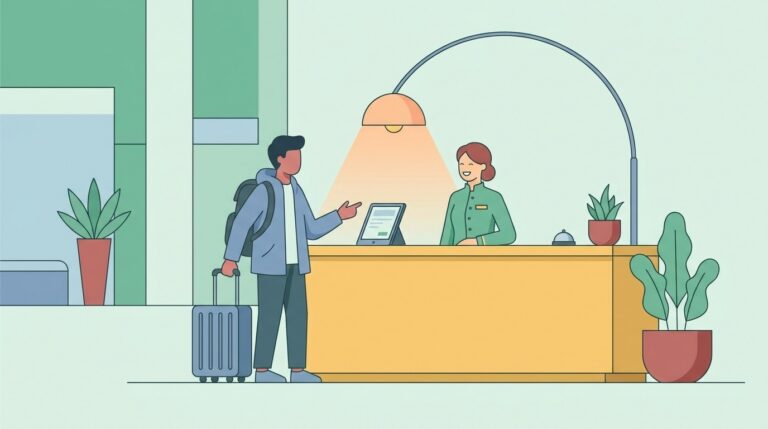
You walk to the front desk, but freeze because you don’t know the right words. Don’t worry! In this A1 beginner guide, you’ll master the exact sentence native Koreans use to ask about hotel breakfast hours. Based on feedback from our Daily Hangul learners, this simple phrase guarantees you never miss a morning meal in Korea.
Phase 2: Core Expressions Deep Dive
1. 조식은 몇 시부터 몇 시까지예요? (Josigeun myeot sibuteo myeot sikkajiyeyo?)
- Pronunciation: [Jo-shig-eun myeot shi-boo-teo myeot shi-kkah-jee-ye-yo?] (Think of myeot sounding like the English word “mutt” with a soft ‘t’, and kkaji like “catchy” with a sharp ‘k’.)
- Meaning: Literal: “As for breakfast, from what time until what time is it?” / Nuance: “What are the breakfast hours?”
- K-Culture Moment: In the K-Drama King the Land, Gu Won’s premier luxury hotel staff explains facility timings with this exact polite phrasing to high-profile guests.
- Editor’s Insight: Break this superpower sentence into building blocks: 조식 (breakfast) + 몇 시 (what time) + ~부터 (from) + ~까지 (until) + ~예요 (polite ‘is/are’). You can use this formula for anything with opening hours!
- Situation Spectrum:
- Casual (Friends): 🚫
- Semi-formal (Hotel reception / Cafes): ✅
- Formal (Official business): ✅
- 🤔 Think About It: In English, we usually ask “What are the breakfast hours?” but Korean thought structure loves pinpointing the start and finish lines: from when to when. Why do you think Korean emphasizes the boundary times so clearly?
2. 조식 포함이에요? (Josik poham-ieyo?)
- Pronunciation: [Jo-shik po-hahm-ee-ye-yo?] (Rhymes smoothly with “ham” in English: po-hahm.)
- Meaning: Literal: “Is breakfast inclusion?” / Nuance: “Is breakfast included in my room booking?”
- K-Culture Moment: Popular travel YouTubers visiting a traditional Hanok hotel in Jeonju often ask this at check-in to know whether morning meals will be served to their door.
- Editor’s Insight: The word 포함 (poham) comes from Chinese characters meaning “to include.” Add ~이에요 (is it?), and you have an instant, high-efficiency question.
- Situation Spectrum:
- Casual: 🚫
- Semi-formal: ✅
- Formal: ✅
- 🤔 Think About It: In Korean hotels, room rates are often split strictly between “Room Only” and “Package with Breakfast”. Asking this upfront avoids unexpected dining charges on your credit card!
3. 어디서 먹을 수 있어요? (Eodiseo meogeul su isseoyo?)
- Pronunciation: [Eo-dee-seo meo-geul soo ee-sseo-yo?] (The first sound Eo is like the ‘u’ in “cup”.)
- Meaning: Literal: “Where can I eat?” / Nuance: “Where is breakfast served?”
- K-Culture Moment: Tourists checking into boutique hotels in Myeongdong asking which floor holds the dining hall.
- Editor’s Insight: The grammar pattern ~(으)ㄹ 수 있어요 means “can do something.” Asking “Where can I eat?” sounds much warmer and more natural for a beginner than stiffly asking for the restaurant location.
- Situation Spectrum:
- Casual: 🚫
- Semi-formal: ✅
- Formal: ✅
- 🤔 Think About It: Notice how Korean places the location particle ~에서/서 (at/in) right after the question word 어디 (where). It puts the place first because finding the destination is the priority.
Phase 3: Textbook Korean vs. Real Korean
Scenario 1: Inquiring About Breakfast Hours
- 📖 교과서 한국어 (Textbook): 조식 운영 시간이 어떻게 되십니까? (Josik unyeong sigani eotteoke doesimnikka? – “How does the breakfast operation time become?”)
- 🗣️ 진짜 한국어 (Real-Life): 조식 몇 시까지예요? (Josik myeot sikkajiyeyo? – “Until what time is breakfast?”)
- 💡 왜 다를까?: While the textbook phrase is ultra-formal, travelers mostly care about not oversleeping! Native speakers naturally drop particles and zero in on the cutoff time.
Scenario 2: Asking if Breakfast is Included
- 📖 교과서 한국어 (Textbook): 아침 식사가 예약에 포함되어 있습니까? (Achim siksaga yeyage pohamdoeeo itseumnikka?)
- 🗣️ 진짜 한국어 (Real-Life): 조식 포함인가요? (Josik pohamingayo?)
- 💡 왜 다를까?: Hotels prefer the term 조식 over 아침 식사, and the ending ~인가요? softens the question, making you sound friendly rather than demanding.
Phase 4: K-Culture Deep Dive & Non-Verbal Manners
4-1. 눈치 (Nunchi) & Front Desk Gestures
- Two-Hand Rule (두 손): When receiving your room card key or breakfast coupons, always receive them with both hands or hold your right wrist with your left hand. This non-verbal gesture shows immense respect to the hospitality worker.
- The Gentle Head Nod (목례 – Mok-rye): When asking 조식은 몇 시부터 몇 시까지예요?, tilt your head forward slightly (about 15 degrees) with a soft, appreciative smile. It immediately communicates good manners and lowers any language barrier tension.
4-2. The Cultural Phenomenon of “Hocance” (호캉스)
In South Korea, luxury hotel vacations are known as 호캉스 (Hotel + Vacance). For Koreans, the centerpiece of a great Hocance is undeniably the morning buffet! Expect a fusion spread where Western staples like croissants and omelets sit proudly alongside hot beef seaweed soup (미역국), warm abalone porridge (전복죽), and fresh kimchi.
Phase 5: Real-Life Roleplay Scenario
- Setting: Front Desk of a modern hotel in Myeongdong, 8:30 PM.
- Characters: Alex (A1 Korean learner, a bit tired after sightseeing) & Minji (Friendly front desk concierge).
- Minji: 체크인 도와드리겠습니다. 예약자분 성함이 어떻게 되시나요? (Chekeuin dowadeurigetseumnida. Yeyakjabun seonghami eotteoke doesinayo?)
🎭 [Smiling warmly, resting hands neatly on the counter]
“I can assist with check-in. May I have your reservation name?” -
Alex: 알렉스 스미스예요. 체크인할게요. (Allekkseu Seumiseuyeyo. Chekeuinhalgeyo.)
🎭 [Handing over passport using both hands]
“I’m Alex Smith. Checking in, please.” -
Minji: 확인되었습니다. 1004호 카드키 여기 있습니다. (Hwagindoeeotseumnida. Cheon-sa-ho kadeuki yeogi itseumnida.)
🎭 [Passing the key card sleeve with two hands]
“Confirmed! Here is your card key for room 1004.” -
Alex: 감사합니다! 그런데, 조식은 몇 시부터 몇 시까지예요? (Gamsahamnida! Geureonde, josigeun myeot sibuteo myeot sikkajiyeyo?)
🎭 [Inquiring with a friendly, curious expression]
“Thank you! By the way, what are the breakfast hours?” -
Minji: 조식은 아침 7시부터 10시까지예요. 마지막 입장은 9시 30분입니다. (Josigeun achim ilgop-sibuteo yeol-sikkajiyeyo. Majimak ipjangeun ahop-si samsip-bun-imnida.)
🎭 [Pointing politely to the information sheet with an open palm]
“Breakfast is from 7:00 AM to 10:00 AM. Last entry is at 9:30 AM.” -
Alex: 어디서 먹을 수 있어요? (Eodiseo meogeul su isseoyo?)
🎭 [Looking toward the elevator guide board]
“Where is breakfast served?” -
Minji: 2층 레스토랑으로 가시면 됩니다. (I-cheung reseutorang-euro gasimyeon doemnida.)
🎭 [Gesturing toward the main elevators with a welcoming smile]
“You can go to the restaurant on the 2nd floor.” -
Alex: 네, 알겠습니다. 감사합니다! (Ne, algetseumnida. Gamsahamnida!)
🎭 [Giving a short, polite bow]
“Yes, understood. Thank you so much!”
🔀 Interactive Choice Point
Imagine it is 9:25 AM the next morning. You rushed downstairs without your jacket. What should you say to the dining room staff?
* Option A: “지금 가도 먹을 수 있어요?” (Jigeum gado meogeul su isseoyo? – Can I still eat if I go in now?)
👉 Best Choice! Polite, natural, and checks if you beat the last-entry cutoff.
* Option B: “밥 줘요!” (Bap jwoyo! – Give me food!)
👉 Bad Choice! Super blunt and sounds demanding, like talking to an older sibling.
* Option C: “조식 끝났어요?” (Josik kkeunnatseoyo? – Has breakfast ended?)
👉 Risk Choice! Grammatically fine, but if they say “Yes,” you miss the chance to ask if you can grab coffee or pastries to go.
Phase 6: 10-Second Emotion Shadowing Drill
Practice these lines aloud! Follow the slashes (/) for natural rhythm and breathing.
- Line 1 [😊 Bright & Polite Tone]
조식은 / 몇 시부터 / 몇 시까지예요?
(Josigeun / myeot sibuteo / myeot sikkajiyeyo?) -
Line 2 [🤔 Inquiring & Gentle Tone]
제 방 예약에 / 조식 / 포함이에요?
(Je bang yeyage / josik / poham-ieyo?) -
Line 3 [😌 Relieved & Grateful Tone]
아침 7시부터군요! / 감사합니다.
(Achim ilgop-sibuteogunyo! / Gamsahamnida.)
Phase 7: K-Culture Mini Dictionary
- 조식 (Josik) | Hotel Breakfast | Sino-Korean noun reserved for breakfast buffets and hotel-catered meals, contrasting with everyday 아침밥 (home-cooked breakfast).
- 호캉스 (Hocance) | Hotel Staycation | A portmanteau of Hotel + Vacance; refers to unwinding in a hotel where the breakfast buffet is an essential highlight.
- 마지막 입장 (Majimak Ipjang) | Last Entry | The absolute cutoff time to enter the dining hall, typically 30 minutes before closing.
- 객실 번호 (Gaeksil Beonho) | Room Number | The 3- or 4-digit room number the server asks for at the breakfast restaurant entrance.
Phase 8: Traveler’s Survival Kit
Top 3 Breakfast Survival Phrases
- 조식 쿠폰 있어요? (Josik kupon isseoyo?) — “Do you have breakfast coupons?”
Pro Tip: Some hotels still issue physical paper vouchers instead of scanning your digital keycard. - 몇 층이에요? (Myeot cheung-ieyo?) — “Which floor is it?”
Pro Tip: Korean elevators use 지하 (Jiha / B) for basements and 층 (Cheung) for floors above ground. - 포장도 돼요? (Pojangdo dwaeyo?) — “Can I take it to go?”
Pro Tip: Perfect if you have an early morning bus tour to Nami Island or the DMZ!
Editor’s Travel Note
Before stepping out, search your hotel name directly inside the Naver Map App for travelers to check nearby morning bakeries in case you miss hotel breakfast. Also, keep your paper room key jacket handy; restaurant staff glance at the handwritten room number to verify your package!
Phase 9: “한 발 더 깊이” (Cultural Reflection)
In Korean culture, food is the ultimate language of care and hospitality. The classic greeting “밥 먹었어요?” (“Did you eat?”) shows that looking after someone’s meals is synonymous with caring for their well-being. When a Korean hotel serves breakfast, it’s viewed as the defining touch of their hospitality—ensuring travelers start their journey with full bellies and warm energy.
💬 Your Turn: What Korean breakfast item are you dying to try first at your hotel: comforting abalone porridge (전복죽) or savory beef seaweed soup (미역국)? Tell us in the comments!
Phase 10: FAQ & Mistake Prevention
Q: Can I say “아침 (Achim)” instead of “조식 (Josik)”?
A: Yes! Native speakers will completely understand “아침은 몇 시까지예요?”. However, 조식 is the industry-standard word seen on keycard jackets and hotel signs.
Q: How do I tell the restaurant staff my room number?
A: State your number followed by -호예요 (-ho-yeyo). For room 502, say “오백이호예요 (O-baek-i-ho-yeyo)”.
Q: What if I have allergies to certain ingredients?
A: Simply say the ingredient plus 못 먹어요 (mot meogeoyo – “I cannot eat”). For example: “땅콩 못 먹어요” (I cannot eat peanuts).
🚨 흔한 실수 (Common Mistakes) 경고판
- Mistake: Asking “몇 시까지 시작해요?” (When does it start until?)
Correct Action: Keep start and finish separate: use 몇 시부터 (from what time) and 몇 시까지 (until what time). - Mistake: Showing your room key card with one finger pointed at the desk.
Correct Action: Present the key card or voucher using both hands with a gentle nod. - Mistake: Arriving 5 minutes before the buffet closes and expecting full service.
Correct Action: Always ask for the 마지막 입장 (last entry) time—food stations often close 20 minutes before the official end.
Phase 11: Action Missions
- 🥉 Bronze Mission (Solo Practice): Stand in front of your mirror and practice saying “조식은 몇 시부터 몇 시까지예요?” three times with a bright travel smile.
- 🥈 Silver Mission (Social Connection): Share a photo of your morning meal on social media with the hashtag
#조식몇시까지예요and tag@DailyHangul. - 🥇 Gold Mission (Real-World Test): At your next hotel or guesthouse stay, ask the front desk clerk in Korean about breakfast hours without glancing at your notes!
- 🎮 K-Culture Mission: Watch an episode of a hotel K-Drama (such as King the Land) and count how many times staff use polite sentence endings like ~십니까 and ~세요.
Phase 12: Interactive Quiz Challenge
Quiz 1. Situation Judgment
You arrive at the front desk at 8:00 AM and want to know when breakfast service finishes. What do you ask?
A) 조식 먹어라!
B) 조식 몇 시까지예요?
C) 밥 어디 있어?
👉 Click to Reveal Answer & Explanation
Correct Answer: B
Explanation: 조식 몇 시까지예요? is the natural, polite way to ask when breakfast ends. Option A is an impolite command, and Option C is informal banmal suited only for very close friends.
Quiz 2. Fill-in-the-Blank
Complete the sentence with the correct particles for “from” and “until”:
조식은 7시____ 10시____예요.
👉 Click to Reveal Answer & Explanation
Correct Answer: 부터 / 까지
Explanation: ~부터 means “from” (starting point in time), and ~까지 means “until/to” (ending point in time).
Quiz 3. True or False
If a hotel states breakfast runs until 10:00 AM, you can arrive at 9:55 AM and enjoy the full buffet without any issues.
👉 Click to Reveal Answer & Explanation
Correct Answer: False
Explanation: Most Korean hotels enforce a 마지막 입장 (last entry) rule, usually 30 minutes prior to closing (around 9:30 AM), after which food stations are cleaned and packed up.







