

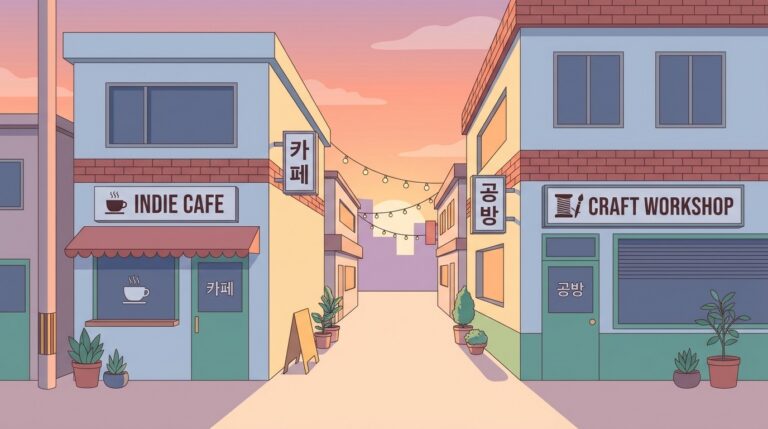
Phase 1: Empathy & Storytelling Opening
안녕하세요! 매일한글 에디터입니다. (Hello! I’m your Daily Hangul editor.)
Have you ever returned to a magical, hidden alleyway in Seoul—perhaps that tiny hand-drip cafe in Yeonnam-dong or an indie ceramic studio tucked behind Seongsu-dong’s red-brick factories—only to find it vanished? In its place stands a glittering global fashion flagship or a sterile chain convenience store. If your heart sank, you experienced the bittersweet sting of modern Korean urban culture: the rapid cycle of alley revitalization and subsequent gentrification.
In Seoul, neighborhoods like Garosu-gil, Gyeongnidan-gil, Yeonnam-dong, and Seongsu-dong were originally brought to life by hungry young artists, indie roasters, and passionate local creators. But as soon as Instagram discovers the vibe and crowds surge, property values and commercial rents skyrocket. The tragic irony? The very visionaries who gave the street its soul can no longer afford to stay.
As an intermediate (B2) Korean learner, moving beyond simple textbook ordering and being able to discuss social issues like urban change, community identity, and gentrification will make your conversations with Korean peers infinitely deeper. Based on countless discussions with our learners who felt tongue-tied when their Korean friends lamented over their favorite neighborhood spots closing down, this guide will equip you with natural, nuanced vocabulary to discuss the living, breathing soul of Korea’s urban alleys.
Phase 2: Core Expressions Deep Dive
1. 둥지 내몰림 (한글)
- Pronunciation: [Dung-ji nae-mol-lim] (Think: “doong-jee” like a cozy bird nest, followed by “nae-mol-lim” like being nudged out)
- Meaning: Literal: “Being driven out of one’s nest” | Nuance: The native Korean expression for gentrification, emphasizing displacement and vulnerability.
- K-Culture Moment: Seen frequently in indie documentaries, social editorials, and dramas like My Mister (나의 아저씨), where old neighborhood spaces face corporate redevelopment.
- Editor’s Insight: While Koreans understand the loanword 젠트리피케이션 (jenteuripikeisyeon), the poetic term 둥지 내몰림 evokes deep emotional sympathy. It visualizes small shopkeepers as birds losing their home branches.
- Situation Spectrum: Casual (⚠️ slightly poetic) / Semi-formal (✅) / Formal (✅)
- 🤔 Think About It: Does your native language view gentrification as purely economic progress, or does it also evoke the imagery of losing a biological shelter (“nest”)?
2. 임대료가 치솟다 (한글)
- Pronunciation: [Im-dae-ryo-ga chi-sot-da] (Im-dae-ryo sounds like “eam-day-ryo”, chi-sot-da rhymes with “she-soat-dah”)
- Meaning: Literal: “Rent soars upward” | Nuance: Skyrocketing commercial rent rising unnaturally fast without warning.
- K-Culture Moment: In Itaewon Class (이태원 클라쓰), Park Sae-ro-yi confronts the harsh reality of aggressive building owners dramatically hiking up lease costs to push out tenants.
- Editor’s Insight: The prefix 치- adds a sudden, forceful upward movement (like 치솟다, 치솟는 물가). It captures the helplessness felt by independent shopkeepers.
- Situation Spectrum: Casual (✅) / Semi-formal (✅) / Formal (✅)
- 🤔 Think About It: Notice how Korean verbs attach directional prefixes to illustrate dynamic societal pressure.
3. 골목상권의 개성 (한글)
- Pronunciation: [Gol-mok-sang-gwon-ui gae-seong] (Gol-mok = alley, sang-gwon = commercial district, gae-seong = unique individuality)
- Meaning: Literal: “Individual personality of alleyway commerce” | Nuance: The authentic, indie vibe of mom-and-pop shops and local creators that mega-malls can never duplicate.
- K-Culture Moment: Variety shows like Baek Jong-won’s Alley Restaurant (백종원의 골목식당) constantly debate how to preserve this very spirit.
- Editor’s Insight: 개성 (individuality) is the exact antidote to 프랜차이즈 (franchises). When Koreans praise a neighborhood, they don’t say it’s clean; they say 골목상권 개성이 살아있다 (the alley’s character is alive).
- Situation Spectrum: Casual (⚠️ a bit academic) / Semi-formal (✅) / Formal (✅)
- 🤔 Think About It: How does your culture balance chain convenience with neighborhood authenticity?
Phase 3: Textbook Korean vs. Real Korean
Scenario 1: Expressing that rent went up crazy high and drove out original shops
- 📖 교과서 한국어 (Textbook): 이 지역의 임대료가 너무 많이 상승하여 기존 상인들이 이전했습니다. (I jiyeogui imdaeryoga neomu mani sangseunghayeo gijon sangindeuri ijeonhaesseumnida. / The commercial rent of this area rose significantly, so existing merchants relocated.)
- 🗣️ 진짜 한국어 (Real Korean): 여기 월세가 미친 듯이 올라서, 원래 있던 터줏대감 가게들 다 쫓겨났어요. (Yeogi wolsega michin deusi ollaseo, wonlae itdeon teojutdaegam gagedeul da jjotgyeonasseoyo. / The rent soared insanely here, so all the veteran anchor shops got kicked out.)
- 💡 왜 다를까? (Why the difference?): Real Koreans describe landlords raising rent as aggressive (미친 듯이 치솟다) and call long-standing shops 터줏대감 (teojutdaegam, guardian spirit or fixture of a place) to express emotional affection.
Scenario 2: Laments over a neighborhood losing its artistic vibe to corporate pop-up stores
- 📖 교과서 한국어 (Textbook): 상업화로 인해 골목의 고유한 분위기가 다소 변질되었습니다. (Sangeophwaro inhae golmogui goyuhan bunwigiga daso byeonjildoeeosseumnida. / Due to commercialization, the alley’s distinct atmosphere has somewhat changed.)
- 🗣️ 진짜 한국어 (Real Korean): 옛날 힙한 감성은 싹 사라지고, 죄다 대기업 팝업스토어만 들어찼네요. (Yennal hiphan gamseongeun ssak sarajigo, joeda daegieop papeopseuto-eoman deureochan-neyo. / That old hip vibe vanished completely, and now it’s packed wall-to-wall with giant corporate pop-up stores.)
- 💡 왜 다를까? (Why the difference?): Conversational Korean relies on flavorful adverbs like 싹 (ssak, completely swept clean) and 죄다 (joeda, every single one) to emphasize collective frustration.
Phase 4: K-Culture Deep Dive & Non-verbal Manners
4-1. 눈치 (Nunchi) & Body Language in Independent Alleys
When visiting indie boutiques, micro-bakeries, and local creator studios in spots like Seongsu, Euljiro, or Mangwon, respect the creator’s boundary:
* The Subdued Sigh & Nod: When an owner mentions they might be relocating soon, never say “Oh, congrats on moving!” Instead, furrow your eyebrows slightly, let out a soft “아이고… (Aigo…)”, and nod with gentle eyes. In Korea, acknowledging the landlord burden without being overly intrusive is peak nunchi.
* Brand Bag Awareness: Avoid ostentatiously waving giant luxury shopping bags from massive department stores right in front of a struggling local artisan’s craft stand. It subtly signals insensitivity to local craftsmanship.
4-2. Cultural Code: The Lifecycle of Seoul’s “-Gil” (-길) Culture
Korean urban geography moves at breakneck speeds. Notice how trendy spots evolve:
1. Garosu-gil (신사동 가로수길): Started as a quiet bohemian promenade for interior designers; overtaken by global fast-fashion brands and cosmetic mega-stores in the 2010s.
2. Gyeongnidan-gil (경리단길): Pioneered by craft beer brewers and multicultural bistros near Itaewon; devastated when aggressive rents forced early creators out.
3. Seongsu-dong (성수동): Repurposed handmade shoe factories into the “Brooklyn of Seoul”, now wrestling with maintaining local identity amidst an onslaught of luxury beauty pop-ups.
This cycle is called 젠트리피케이션의 덫 (the gentrification trap). Recognizing this lifecycle allows you to empathize with locals who mourn the fleeting lifespans of their creative sanctuary.
Phase 5: Real-Life Roleplay Scenario
Setting: A warm, ceramics-scented studio cafe in an alleyway behind Yeonnam-dong.
Characters:
* 민서 (Min-seo): Independent potter & cafe owner running her studio for 6 years.
* You: A regular customer noticing “For Lease” flyers posted across the alley.
Turn 1 (You):
사장님, 골목 어귀에 임대 현수막이 부쩍 많이 붙었네요?
(Sajangnim, golmok eoguie imdae hyeonsumagi bujjeok mani buteon-neyo?)
🎭 행동 지문: [Looking out the window with concern, holding a warm mug with both hands]
“Boss, there are suddenly so many ‘For Lease’ banners at the alley entrance?”
Turn 2 (민서):
아, 보셨어요? 지난달부터 건물주들이 재계약 때 월세를 두 배씩 부르고 있거든요.
(A, bosyeosseoyo? Jinandalbuteo geonmuljudeuri jaegye-yak ttae wolseleul du baessik bureugo itgeodeunyo.)
🎭 행동 지문: [Smiling faintly with a tired sigh, wiping the pottery wheel]
“Ah, you noticed? Since last month, landlords have been demanding double rent upon lease renewal.”
Turn 3 (You):
두 배나요? 여긴 젊은 로컬 크리에이터들이 일궈 놓은 상권인데 너무하네요.
(Du baenayo? Yeogin jeolmeun rokeol keurieiteodeuri ilgwo noeun sanggwoninde neomuhaneyo.)
🎭 행동 지문: [Widening eyes in shock, speaking with quiet indignation]
“Double? This commercial district was built from scratch by young local creators—that’s too harsh.”
Turn 4 (민서):
유동 인구가 늘어나니까 대기업 프랜차이즈들이 권리금을 얹어서 들어오겠다고 하나 봐요.
(Yudong inguga neureonanikka daegieop peuraenchaijeudeuri gwonligeumeul eonjeoseo deureo-ogettago hana bwayo.)
🎭 행동 지문: [Looking wistfully around her studio walls]
“Now that foot traffic surged, big corporate franchises are offering hefty key money premiums to push their way in.”
Turn 5 (You):
결국 전형적인 둥지 내몰림이네요… 사장님 공방도 계약 기간 아직 남으셨어요?
(Gyeolguk jeonhyeongjeogin dungji naemollimineyo… Sajangnim gongbangdo gyeyak gigwan ajik nameusyeosseoyo?)
🎭 행동 지문: [Leaning forward slightly, lowering voice in sincere worry]
“So it’s textbook gentrification after all… Do you still have time left on your workshop’s lease?”
Turn 6 (민서):
올가을까지예요. 임대료가 치솟아서 버티기 힘들 것 같아 외곽 쪽 골목을 알아보고 있어요.
(Olga-eulkkajiyeyo. Imdaeryoga chisot-aseo beotigi himdeul geot gata oegwak jjok golmogeul arabogo isseoyo.)
🎭 행동 지문: [Carefully setting down a freshly shaped clay cup]
“Until this autumn. Rent skyrocketed so fast that holding out seems impossible; I’m scouting alleys on the city outskirts.”
Turn 7 (You):
이 골목의 고유한 개성이 사라지는 것 같아 단골로서 정말 속상해요.
(I golmogui goyuhan gaeseongi sarajineun geot gata dangollosseo jeongmal soksanghaeyo.)
🎭 행동 지문: [Placing a supportive hand on the counter with a reassuring nod]
“As a regular, it breaks my heart to see this alley lose its authentic identity.”
Turn 8 (민서):
그렇게 말씀해 주시니 큰 위로가 되네요. 끝까지 좋은 작품 만들며 버텨볼게요!
(Geureoke malsseumhae jusini keun wiroga doeneyo. Kkeutkkaji joeun jakpum mandeulmyeo beotyeobolgeyo!)
🎭 행동 지문: [Smiling warmly with renewed determination]
“Hearing you say that brings me immense comfort. I’ll stay resilient and keep making beautiful work until the very end!”
🔀 Interactive Decision Point (What would you say next?)
- Choice A (Best): “사장님 어디로 이전하시든 SNS로 꼭 공지해 주세요. 제가 일등으로 찾아갈게요!” (Wherever you relocate, please announce it on Instagram. I’ll be your very first customer!)
- Feedback: Perfect empathy! In Korea, pledging loyalty to an artist’s brand over physical location is the greatest gift to an artisan facing relocation.
- Choice B (Risk): “그냥 건물주랑 세게 싸우거나 법원에 소송 거시는 건 어때요?” (Why don’t you just fight hard with the landlord or sue them in court?)
- Feedback: Risky! Commercial lease protection laws (상가건물 임대차보호법) have specific grace periods, but public confrontation often exacerbates emotional exhaustion for solo makers.
- Choice C (Bad): “그럼 여기 나중에 스타벅스 들어오면 좋겠네요!” (Then it would be nice if a Starbucks opened here later!)
- Feedback: Painful! Praising corporate chains directly to an evicted artisan reveals a total lack of nunchi.
Phase 6: 10-Second Emotion Shadowing Drill
Practice reading these out loud, observing pauses (/) and emotional cues:
[🥺 안타깝고 속상하게 - With deep heartbreak & sympathy]
“젊은 예술가들이 / 애써 일궈 놓은 골목인데, / 임대료 때문에 쫓겨나다니 / 너무 안타까워요.”
(Jeolmeun yesuljadeuri / aesseo ilgwo noeun golmoginde, / imdaeryo ttaemune jjotgyeonadani / neomu antakkawoyo.)
(“Young artists built this alley with sweat and tears / to be pushed out because of rent / is just so heartbreaking.”)-
[✊ 단호하고 공감하며 - Resolute, supportive & grounded]
“골목상권의 생명은 / 프랜차이즈가 아니라 / 이런 작은 로컬 가게들의 / 개성에 달려 있어요.”
(Golmoksanggwon-ui saengmyeongeun / peuraenchaijeuga anira / ireon jageun rokeol gagedeurui / gaeseonge dallyeo isseoyo.)
(“The lifeblood of alleyway culture / lies not in franchises / but in the distinct identity / of small local shops like this.”) -
[😊 다정하고 응원하듯 - Warm, cheering & encouraging]
“어디로 옮기시든 / 사장님만의 감성은 그대로니까 / 저는 무조건 / 계속 단골 할 거예요!”
(Eodiro omgisineun / sajangnimman-ui gamseongeun geudaeronikka / jeoneun mujogeon / gyesok dangol hal geoyeyo!)
(“Wherever you move / your personal aesthetic remains intact / so I am unconditionally / staying your regular customer!”)
Phase 7: K-Culture Mini Dictionary
- 터줏대감 (Teo-jut-dae-gam)
- Meaning: Original anchor resident / Fixture of a neighborhood.
- Usage: Used fondly to honor old bakeries, tailor shops, or dry cleaners that survived in an alley for 20+ years despite redevelopment waves.
- 핫플 (Hat-peul)
- Meaning: Short for “Hot Place” (trendy spot).
- Usage: Used widely on social media to describe places with long queues, though often used ironically when an area becomes too crowded to visit comfortably.
- 상생 (Sang-saeng)
- Meaning: Mutual coexistence / Win-win harmony.
- Usage: Frequently cited in policy debates where local governments, property owners, and creators seek legal caps on rent increases to thrive together.
- 권리금 (Gwon-li-geum)
- Meaning: Key money / Goodwill premium.
- Usage: The non-refundable cash paid from an incoming business to an outgoing tenant for the customer base, fixtures, and location value established by the previous owner.
Phase 8: Survival Kit for Travelers
Survival Phrases TOP 3
- “여기 원래 있던 독립 서점 어디로 갔는지 아세요?”
(Yeogi wonlae itdeon dongnip seojeom eodiro ganneunji aseyo?)
Pro Tip: Use this when looking for an indie bookstore that vanished from map pins. Neighbors often know the new address! - “이 골목만의 독특한 분위기가 오래 유지되면 좋겠어요.”
(I golmongman-ui dokteukhan bunwigiga orae yujidoemyeon jokesseoyo.)
Pro Tip: A classy, heartfelt compliment to say to independent cafe owners when leaving. - “대기업 팝업스토어 말고, 동네 로컬 공방 추천해 주실 수 있나요?”
(Daegieop papeopseuto-eo malgo, dongne rokeol gongbang chucheonhae jusil su innayo?)
Pro Tip: Excellent phrase for tourist information booths or neighborhood cafes to discover genuine makers.
Editor’s Travel Note
- Navigation Guide: When exploring evolving alleys, avoid outdated travel blog posts from two years ago. Always check live neighborhood updates via the [Naver Map app download] or search via the [KakaoMap route finder] using hashtags like
#골목투어or#로컬크리에이터. - Ethical Alley Exploration: Keep noise down in residential alleys (주택가), buy a cup of coffee or a postcard rather than just taking photos in front of indie storefronts, and support independent creators directly!
Phase 9: “One Step Deeper” (Reflective Essay)
In Korean society, the word 골목 (golmok, alleyway) carries a maternal warmth far distinct from western connotations of dark, dangerous backstreets. Historically, the Korean golmok was an extended communal living room where neighbors dried red peppers, shared kimchi, and watched each other’s children play. When hyper-capitalism re-labels these sacred communal arteries as mere commercial real estate assets, Koreans experience a profound collective grief. The struggle between rapid economic returns and the preservation of communal intimacy remains one of contemporary Seoul’s most poignant social questions.
💬 Your Turn: Has a beloved neighborhood in your hometown ever experienced dungji naemollim (nest eviction)? What did the community do to preserve its identity? Share your story in Korean or English in the comments below!
Phase 10: FAQ & Avoiding Misunderstandings (FAQ Schema)
Q: Is using the English word ‘Gentrification’ understood in Korea?
A: Yes! 젠트리피케이션 (jenteuripikeisyeon) is widely used in news, academic writing, and among educated young people. However, using 둥지 내몰림 (dungji naemollim) demonstrates much deeper linguistic sensitivity and intermediate-to-advanced cultural literacy.
Q: Why do Korean alley businesses move so frequently compared to the West?
A: Under Korean Commercial Building Lease Protection Law, small tenants previously had shorter guaranteed renewal protections (traditionally 5 years, recently extended to 10 years). Additionally, rapidly shifting consumer trends driven by social media mean neighborhood popularity peaks and drops much faster in Seoul than in European cities.
Q: Can I negotiate prices at indie craft shops in hip alleys?
A: Absolutely not! While bargaining is part of traditional market (전통시장) culture for raw produce, indie craft studios, designer showrooms, and artisan boutiques operate with fixed pricing. Attempting to haggle disrespects the artisan’s creative labor.
🚨 흔한 실수 (Common Mistakes) Warning Board
- Mistake: Assuming building owners (건물주) are universally loved heroes because of the joke “조물주 위에 건물주” (Above God is the landlord).
- Correct Action: Recognize that in neighborhood alleyway contexts, aggressive landlords (악덕 건물주) are heavily critiqued for destroying community culture.
- Mistake: Confusing 권리금 (gwonligeum, premium key money paid between tenants) with 보증금 (bojeunggeum, refundable rental deposit paid to the landlord).
- Correct Action: Keep them distinct; high gwonligeum often blocks young creators from entering established alleys.
- Mistake: Labeling every renovated alley as purely negative.
- Correct Action: Frame the discussion around 상생 (sangsaeng, coexistence) rather than completely resisting urban renewal.
Phase 11: Action Mission & Engagement
- 🥉 Bronze Level: Read the 3 Core Expressions aloud 5 times while recording your voice on your phone.
- 🥈 Silver Level: Find a post about Seongsu-dong or Yeonnam-dong on Instagram and write a supportive Korean comment: “골목의 개성이 잘 지켜지면 좋겠어요!” (I hope the alley’s distinct identity is well preserved!)
- 🥇 Gold Level: Next time you visit an independent coffee roaster or bookstore in Seoul, use the phrase: “여기 분위기만의 개성이 너무 좋아요.” (I love the unique identity of this atmosphere.)
- 🎮 K-Culture Mission: Watch Episode 5 of the K-drama Itaewon Class and identify the scene where Park Sae-ro-yi discusses lease renewals with his landlord. Pay attention to how rental rights are portrayed!
Phase 12: Interactive Quiz Challenge
1. Situation Judgment Quiz
Your favorite handcrafted jewelry shop in Euljiro is forced to shut down because the rent tripled in one year. Which phrase best captures your empathetic response?
(A) 축하드려요! 이제 더 큰 프랜차이즈로 바뀌겠네요!
(B) 정말 안타까워요. 전형적인 둥지 내몰림 현상이네요.
(C) 임대료가 치솟아서 건물주님 부자 되겠어요!
2. Fill in the Blank
“대기업 프랜차이즈가 들어오면서 이 거리만의 독특한 [ _______ ]이(가) 사라지고 있어요.”
(Hint: individuality / personality)
3. True or False Culture Quiz
True or False: In Korea, calling a shop’s owner a ‘터줏대감’ (teojutdaegam) is an insult implying they are old-fashioned and slow.
👉 Click to view answers and explanations
-
Answer: (B)
Explanation: Calling it a textbook case of 둥지 내몰림 (dungji naemollim) expresses sympathy. Options (A) and (C) lack nunchi and offend the displaced shopkeeper. -
Answer: 개성 (Gaeseong)
Explanation: 골목의 개성 (the alley’s distinct personality/character) is the core phrase used to describe what disappears when homogenization sets in. -
Answer: False
Explanation: 터줏대감 is a term of high respect and deep communal affection, honoring someone who has guarded and nurtured the roots of a neighborhood for decades.







