

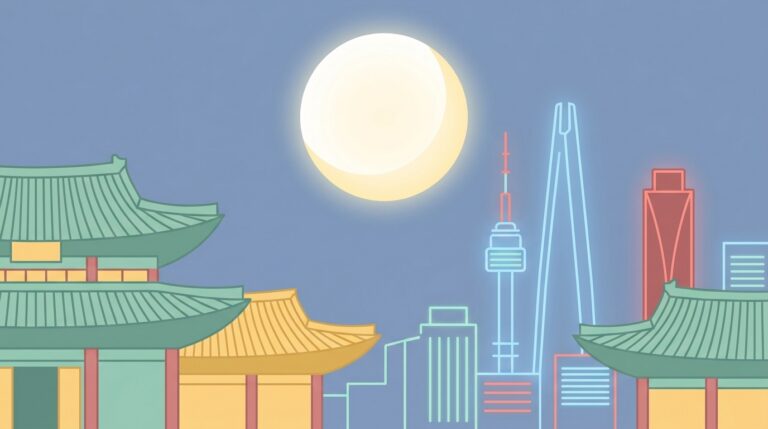
Mulberry Fields and Neon Lights: Master Korean Idioms Describing Rapid Change and Fleeting Time
Phase 1: Empathy (Opening Story)
안녕하세요! It’s your Daily Hangul editor and cultural navigator.
Imagine walking down the labyrinthine alleys of Euljiro, affectionately dubbed “Hipjiro” by Seoul’s youth. On your left stands a dusty, clattering acrylic cutting shop that has endured since 1974, smelling of vintage oil and iron shavings. On your right, glowing through a sleek glass facade, is an AI-driven futuristic cafe where a robotic arm serves cold brews beneath holographic art. You take a breath and think: How does a single city exist in two completely different centuries at the exact same second?
If you have ever tried to articulate this dizzying sense of temporal whiplash in Korean, you might have settled for basic textbook phrases like “서울이 정말 많이 변했어요” (Seoul has changed so much). But let’s be honest: at the C1 level, saying “things changed a lot” feels painfully inadequate. It fails to capture the poetry, the slight melancholy, and the profound historical weight of Korea’s rapid transformation.
Korea underwent what sociologists call “compressed modernization”—achieving in mere decades what took Western nations centuries. Because our history moved at lightning speed, the Korean language boasts a breathtaking repertoire of four-character idioms (사자성어, Sajeoseong-eo) specifically tailored to describe monumental shifts and the transience of time. Today, drawn from years of coaching advanced learners who struggled to articulate these complex social observations, we are going to unlock three philosophical idioms that will elevate your Korean from merely fluent to intellectually striking.
Phase 2: Core 3 Expressions In-Depth
1. 상전벽해 (桑田碧海)
- Pronunciation: [Sang-jeon-byeok-hae] (Sounds like “sahng-jun-byuk-heh”)
- Meaning: Mulberry fields (상전) turning into the vast blue ocean (벽해).
- Literal: Mulberry fields become the azure sea.
- Nuance: Radical, seismic transformation of an environment, skyline, or reality beyond recognition.
- K-Culture Moment: You will hear this in hit period dramas like Reborn Rich (재벌집 막내아들) or Reply 1988 (응답하라 1988) whenever characters stand before the dirt roads of 1970s Gangnam, knowing that barren farmland is destined to become the world’s most hyper-modern commercial district.
- Editor’s Insight: This is not just a casual “upgrade.” Use this when the change is so drastic that looking at an old photograph feels like looking at another planet.
- Situation Spectrum: Casual (⚠️ slightly elevated/poetic) | Semi-formal (✅) | Formal (✅)
- 🤔 Think About It: English speaks of “the only constant is change” or “waters under the bridge,” but Koreans look to the radical interchange between earth and deep water. How does your culture metaphorically measure historical change?
2. 격세지감 (隔世之感)
- Pronunciation: [Gyeok-se-ji-gam] (Sounds like “gyuk-seh-jee-gahm”)
- Meaning: A feeling (감) as if separated (격) by an entire generation or century (세).
- Literal: The feeling of generational isolation.
- Nuance: Nostalgic bewilderment when confronting how modern habits, technology, or morals have replaced the old world so fast that you feel like a time traveler.
- K-Culture Moment: When legendary 1st-generation K-pop idols watch 5th-generation groups filming high-tech TikTok choreography with virtual avatars and stage drones, they often shake their heads in awe and say: “격세지감이다, 진짜!”
- Editor’s Insight: Unlike 상전벽해, which focuses heavily on tangible physical landscapes, 격세지감 describes the internal psychological feeling of detachment from how the world currently functions.
- Situation Spectrum: Casual (✅ used playfully with older friends) | Semi-formal (✅) | Formal (✅)
- 🤔 Think About It: When was the last time you felt like an alien in your own generation? In Korean, that quiet existential pause is captured in a single four-character breath.
3. 온고지신 (溫故知新)
- Pronunciation: [On-go-ji-sin] (Sounds like “ohn-go-jee-shin”)
- Meaning: Warming up the old (온고) to learn and innovate the new (지신).
- Literal: Reviewing the old to know the new.
- Nuance: Grounding yourself in timeless, foundational values while executing agile, modern adaptation.
- K-Culture Moment: Seen in trend-setting brands that craft modern Hanbok for runway fashion shows or mix traditional Joseon court instruments with heavy hip-hop beats (like BTS’s Daechwita or traditional pansori fusion).
- Editor’s Insight: In an era of non-stop disruptions, Koreans admire those who don’t discard heritage blindly. Pair this idiom with modern strategies to express rooted innovation.
- Situation Spectrum: Casual (⚠️ sounds scholarly) | Semi-formal (✅) | Formal (✅)
- 🤔 Think About It: Does innovation require burning down the past, or does it require reviving its roots? 온고지신 argues that true modernity cannot exist without ancient soil.
Phase 3: Textbook Korean vs Real Native Korean
Situation 1: Visiting an old neighborhood that turned into a trendy hipster hotspot
- 📖 교과서 한국어 (Textbook Korean):
이곳이 정말 많이 변했군요. 세월이 참 빠릅니다.
(Igot-i jeongmal mani byeonhaetgunyo. Sewori cham ppareumnida.)
“This place has really changed a lot. Time is truly fast.” - 🗣️ 진짜 한국어 (Real Native Korean):
와, 여기 진짜 상전벽해다… 예전 모습이 1도 안 남아있네.
(Wa, yeogi jinjja sangjeonbyeokhaeda… Yejeon moseubi ildo an nama-inne.)
“Wow, this place underwent a total sea change… Not a single trace of the past remains.” - 💡 왜 다를까? (Why the difference?):
Advanced native speakers naturally weave classical idioms into colloquial syntax, blending 상전벽해 with casual contemporary street phrases like “1도 안 ~” (not even 1%) to evoke authentic disbelief.
Situation 2: Reflecting on rapid technological advancement
- 📖 교과서 한국어 (Textbook Korean):
기술 발전을 보니 세대 차이가 느껴집니다.
(Gisul baljeoneul boni sedae chaiga neukkyeojimnida.)
“Looking at technological progress, I feel a generational gap.” - 🗣️ 진짜 한국어 (Real Native Korean):
기술 발전 속도 보니까 격세지감이 확 드네.
(Gisul baljeon sokdo bonikka gyeokse-jigami hwak deune.)
“Watching how fast tech develops, a real sense of generational whiplash just rushes over me.” - 💡 왜 다를까? (Why the difference?):
Instead of the academic textbook verb 느껴지다 (to be felt), native Koreans use dynamic sensory markers like 확 들다 (to strike/surge over someone suddenly).
Phase 4: K-Culture Deep Dive & Non-Verbal Manners
4-1. 눈치 (Nunchi) & Non-Verbal Manners: Expressing Reverence without Sounding Pretentious
When using classical idioms (사자성어) in Korean conversations, your tone and physical presence matter immensely. If you utter 격세지감 with a rigid posture and booming voice, you risk sounding like a preaching elder (꼰대, Kkondae).
- The Nostalgic Gaze (아련한 시선): When remarking on 상전벽해 or 격세지감, momentarily shift your eyes to the middle distance—looking across the street or over a rooftop—before meeting your conversation partner’s eyes. This communicates philosophical contemplation rather than haughty lecturing.
- The Gentle Head Tilt & Sigh (미세한 고개 끄덕임과 한숨): Accompany your observation with a soft, appreciative half-smile and a quiet exhale. It shows you feel the transience of life deeply.
4-2. Cultural Code: The “Newtro” Phenomenon
Why are Gen Z and Millennials in Seoul so obsessed with 온고지신? In places like Ikseon-dong or Seongsu-dong, old car repair yards and traditional tile-roofed Hanoks are not razed to the ground; they are embraced under the concept of Newtro (뉴트로). In a society that advanced faster than almost any other in history, nostalgia serves as an emotional anchor. By preserving vintage typography, rough brick foundations, and retro signboards while introducing sleek high-tech amenities, Koreans cultivate psychological grounding amidst relentless change.
Phase 5: Real-Life Roleplay Scenario
Setting: A rooftop lounge overlooking the neon cityscape of Seongsu-dong at twilight.
Characters:
* Min-woo (민우): A 34-year-old tech entrepreneur balancing modern digital transformation with old-school corporate heritage.
* You: A visiting strategist and longtime friend of Min-woo.
[Dialogue]
- 민우: 🎭 (맥주 캔을 따며 테라스 너머 성수동 골목을 바라본다)
여기 10년 전만 해도 그냥 허름한 구두 공장 골목이었던 거 기억나?
(Yeogi simnyeon jeonman haedo geunyang heoreumhan gudu gongjang golmogieotdeon geo gieongna?)
“Remember when this area was nothing but rundown shoe factory alleys just ten years ago?” -
You: 🎭 (난간에 기대어 빌딩 숲을 내려다보며 감탄하듯 말한다)
당연히 기억나지. 진짜 상전벽해라는 말이 딱 어울린다.
(Dang-yeonhi gieongnaji. Jinjja sangjeonbyeokhaeraneun mari ttak eoulrinda.)
“Of course I remember. The phrase sangjeonbyeokhae truly fits this perfectly.” -
민우: 🎭 (살짝 헛웃음을 지으며 고개를 젓는다)
요즘 신입사원들 일하는 방식이나 쓰는 앱 보면 가끔 격세지감이 확 느껴져.
(Yojeum sinipsawondeul ilhaneun bangsik-ina sseuneun aep bomyeon gakkeum gyeokse-jigami hwak neukkyeojyeo.)
“When I see how the new junior recruits work and what apps they use, I honestly feel a sudden generational gap.” -
You: 🎭 (따뜻하게 미소 지으며 민우의 어깨를 툭 친다)
벌써 그런 말 하면 꼰대 소리 듣는다? 근데 시대가 너무 빠르긴 해.
(Beolsseo geureon mal hamyeon kkondae sori deunneunda? Geunde sidaega neomu ppareugin hae.)
“Start talking like that already and people will call you a kkondae! But seriously, the era really moves crazy fast.” -
민우: 🎭 (사뭇 진지한 표정으로 턱을 괴며)
맞아. 사업도 그래. 최신 트렌드만 좇다 보면 브랜드 본래 색깔을 잃어버리거든.
(Maja. Sa-eopdo geurae. Choesin teurendeuman jota bomyeon beuraendeu bollae saekkkareul ireobeorigeodeun.)
“Exactly. Business is the same. If you only chase the latest trends, you end up losing the brand’s original color.” -
You: 🎭 (공감하며 끄덕인다)
그래서 온고지신의 태도가 비즈니스에서도 가장 중요한 것 같아.
(Geuraeseo ongojisin-ui taedoga bijeuniseueseodo gajang jung-yohan geot gata.)
“That’s why I think an attitude of ongojisin is the most critical asset in business.” -
민우: 🎭 (눈을 번쩍이며 맥주 캔을 들어 올린다)
캬, 너 한국인 다 됐네! 본질을 지키면서 유연하게 바꾸는 게 진짜 실력이지.
(Kya, neo hanguk-in da dwaenne! Bonjireul jikimyeonseo yuyeonhage bakkuneun ge jinjja sillyeogiji.)
“Cheers, you’ve basically turned completely Korean! Guarding core identity while adapting flexibly—that is true mastery.” -
You: 🎭 (민우와 캔을 부딪치며 웃는다)
변화에 휩쓸리지 말고, 우리가 흐름을 이끌어 가자고!
(Byeonhwa-e hwipsseulliji malgo, uriga heureumeul ikkeureo gajago!)
“Instead of getting swept away by change, let’s steer the flow ourselves!”
🔀 Interactive Choice Point
If Min-woo asks you: “우리 다음 프로젝트 컨셉을 잡아야 하는데, 복고풍으로 갈까 아니면 완전 메타버스 최첨단으로 갈까?” (Should we go retro or full metaverse tech for our next project?)
- Choice A: “둘 다 버리고 요즘 대세인 AI 숏폼 영상에만 올인해!”
Feedback: ❌ Risk. Dismisses the philosophical nuance of keeping core identity. Sounds overly reactive to superficial trends. - Choice B: “과거의 헤리티지를 살리면서 첨단 기술을 입히는 온고지신 스타일로 기획해 보자.”
Feedback: 🌟 Best! Demonstrates sophisticated C1 vocabulary and deep cultural alignment with sustainable innovation. - Choice C: “그냥 상전벽해니까 아무거나 유행하는 거 따라가자.”
Feedback: ⚠️ Bad. Misapplies 상전벽해 as a casual adjective for decision-making rather than a descriptive state of monumental transformation.
Phase 6: 10-Second Emotional Shadowing Drill
Practice these lines out loud. Master the rhythm marked by / and absorb the emotional mindset indicated in brackets.
[🌅 아련하고 감회에 젖어 / Reflective & Wondering]
예전엔 조용한 골목이었는데, / 진짜 상전벽해다…
(Yeojenen joyonghan golmogieonneunde, / jinjja sangjeonbyeokhaeda…)
“It used to be a quiet alleyway, / but it’s truly a sea change…”-
[🕰️ 세월의 무상함을 느끼며 / Nostalgic & Bewildered]
디지털 세대랑 이야기하다 보면 / 절로 격세지감이 들어요.
(Dijiteol sedaerang iyagihada bomyeon / jeolro gyeokse-jigam-i deureoyo.)
“Whenever I chat with the digital generation, / I naturally feel generational whiplash.” -
[💡 단단한 확신과 혜안을 담아 / Grounded & Visionary]
변화가 빠를수록 / 온고지신의 지혜가 / 흔들리지 않는 중심이 되어줍니다.
(Byeonhwaga ppareulsurok / ongojisin-ui jihyega / heundeulliji anneun jungsiri doeeojumnida.)
“The faster the era shifts, / the wisdom of revisiting roots to invent the new / serves as our unshakeable center.”
Phase 7: K-Culture Mini Dictionary
-
상전벽해 (Sangjeonbyeokhae – 桑田碧海)
Trans: Mulberry fields turn into blue sea.
Usage: Employed in socio-economic debates, cityscape redevelopment discussions, and macro-level reflections on Korea’s postwar development. -
격세지감 (Gyeokse-jigam – 隔世之感)
Trans: Sensation of generational gulf.
Usage: Commonly used in workplace settings when comparing analog work styles of the 1990s/2000s with modern cloud/AI automated ecosystems. -
온고지신 (Ongojisin – 溫故知新)
Trans: Studying the past to illuminate the modern path.
Usage: Praised in branding, product design, culinary arts (fusion cuisine), and personal leadership development. -
압축성장 (Apchuk-seongjang)
Trans: Compressed economic growth.
Usage: A vital historical concept explaining why Koreans maintain an intense “ppalli-ppalli” (빨리빨리, fast-fast) work ethic coupled with an intense craving for vintage solace.
Phase 8: Traveler’s Survival Kit
Top 3 Real-Life Survival Phrases
- 여기가 예전엔 뭐였어요? (Yeogiga yejeonen mwoyeosseoyo?)
Meaning: “What did this place used to be in the past?”
Pro Tip: Use this when visiting trendy regenerated cafes in Mullae-dong or Seongsu-dong. Baristas love sharing neighborhood lore. - 옛날 느낌이 그대로 살아있네요. (Yennal neukkimi geudaero sara-inneyo.)
Meaning: “The vintage vibe has been preserved so well!”
Pro Tip: A polite compliment when stepping into retro-themed record bars or long-running heritage bakeries (노포, Nopo). - 상전벽해라는 말이 실감 나요. (Sangjeonbyeokhaeraneun mari silgam nayo.)
Meaning: “I can really feel the reality of the phrase sangjeonbyeokhae.”
Pro Tip: Say this to a local tour guide or older taxi driver as you pass through Dongdaemun Design Plaza (DDP) or Lotte World Tower for instant respect.
Editor’s Travel Note
When navigating modern Seoul, download the Naver Map App and utilize its “Past Street View (거리뷰 히스토리)” function. Standing in Gangnam or Mapo, you can slide the timestamp back to 2008 and watch the skyline transform on your smartphone screen in real-time. It turns every city stroll into an interactive museum of rapid history.
Phase 9: “One Step Deeper” (Reflective Essay)
In Western classical philosophy, the transience of time often leads to tragic resignation (Sic transit gloria mundi). However, in Korea, awareness of impermanence exists in dynamic tension with vitality. Because the peninsula suffered wars, colonial rule, and industrial upheavals within living memory, change is not considered a passive cosmic event; it is something Koreans have actively shaped, endured, and mastered.
Yet, this relentless drive forward leaves behind a quiet void. That is why four-character idioms are not dead relics of Confucius; they act as linguistic lifeboats. When you say 상전벽해, you validate the sweat and sacrifice of the previous generation who turned mud into skylines. When you say 온고지신, you commit to taking those hard-earned values into the next unpredictable era.
💬 Your Turn: In your home country or personal life, what is one thing that has undergone an absolute “상전벽해” over the last decade? Drop a sentence in the comments using your new idiom!
Phase 10: FAQ & Common Mistakes
Q: Can I use 상전벽해 to describe a person who got a new haircut or changed their style?
A: No! 상전벽해 is reserved for monumental, grand-scale transformations (entire regions, industries, social systems). For personal appearance or lifestyle glow-ups, use 환골탈태 (換骨脫胎, Hwangoltaltae), which means “shedding the old bones to be reborn.”
Q: Is 격세지감 only used by elderly people?
A: Not at all! While it used to be typical among older generations, Korean millennials and Gen Z frequently use it jokingly or ironically when seeing how quickly trends cycle (e.g., “Seeing kids not know what wired earphones are gives me serious 격세지감!”).
Q: What is the exact grammatical particle that pairs with 온고지신?
A: It is typically used with -의 as an adjectival noun (e.g., 온고지신의 자세, 온고지신의 정신) or with verbs like 실천하다 (to practice 온고지신).
🚨 흔한 실수 (Common Mistakes) Danger Board
- ❌ Mistake 1: Calling every small office change 상전벽해. (e.g., “Our desk arrangement is 상전벽해!”)
Correct Action: Use 분위기 전환 (change of atmosphere) instead. - ❌ Mistake 2: Using 격세지감 as an insult to say someone is outdated.
Correct Action: Remember that 격세지감 describes an internal feeling of awe or melancholy, not an aggressive critique of an older person. - ❌ Mistake 3: Pronouncing the Chinese character 해 in 상전벽해 as flat English “hay.”
Correct Action: Keep the vowel open and crisp like the short “e” sound in “bed” ([hae]).
Phase 11: Action Mission & Community Challenge
- 🥉 Bronze Mission (Solo Mastery): Stand in front of your mirror or open voice memos. Recite the 3 shadowing lines from Phase 6 with proper pauses (
/) and distinct emotional inflections. - 🥈 Silver Mission (Social Connection): Search Instagram or Twitter for the Korean hashtag #상전벽해 or #뉴트로. Leave a thoughtful 1-sentence comment on a photo of old Seoul: “옛 모습을 간직하면서도 세련된 온고지신의 멋이 느껴지네요!”
- 🥇 Gold Mission (Real-Life Application): In your next Korean language exchange or business meeting, use 온고지신 when proposing a balance between tried-and-true fundamentals and modern methods.
- 🎮 K-Culture Discovery Quest: Watch an episode of You Quiz on the Block (유 퀴즈 온 더 블럭) with host Yoo Jae-suk. Listen carefully for when he interviews veteran craftsmen or senior citizens—note how often he uses 격세지감 to validate their stories!
Phase 12: Interactive Quiz Challenge
Test your mastery of these idioms! Check your intuitions before opening the answers.
Quiz 1: Situational Judgment
You are presenting a marketing strategy for a traditional Korean pottery brand entering the global market using digital e-commerce and minimalist modern packaging. Which idiom best defines your campaign philosophy?
* A) 상전벽해 (Sangjeonbyeokhae)
* B) 온고지신 (Ongojisin)
* C) 격세지감 (Gyeokse-jigam)
Quiz 2: Fill in the Blank
Complete the dialogue below with the most natural expression:
A: “어릴 때 뛰놀던 허허벌판 시골 동네에 80층짜리 초고층 빌딩들이 들어섰더라고요.”
B: “와, 정말 ( )라는 표현 말고는 설명할 길이 없네요!”
Quiz 3: True or False (Culture Check)
True or False: In contemporary Korea, “Newtro” culture completely abandons classical values to replicate high-speed digital trends without any connection to history.
👉 Click here to reveal Answers & Explanations!
-
Answer: B) 온고지신 (Ongojisin)
Explanation: You are keeping the historical craft of Korean ceramics (the old) while delivering it through contemporary digital packaging and design (the new). -
Answer: 상전벽해 (Sangjeonbyeokhae)
Explanation: Transforming an empty barren field (허허벌판) into an 80-story skyscraper skyline is the ultimate real-world embodiment of mulberry fields turning into deep blue oceans. -
Answer: False
Explanation: Newtro is the very embodiment of 온고지신! It deliberately preserves vintage textures, nostalgic warmth, and analog architecture while blending them harmoniously with modern amenities and cutting-edge culture.







