

The Ultimate K-BBQ Finale: How to Order Fried Rice Like a True Seoulite
Phase 1: Empathy (Story Immersion Opening)
안녕하세요! 매일한글 에디터입니다.
Picture this: You are sitting in a bustling, smoky Korean BBQ restaurant in Hongdae on a Friday night. The grill in front of you has witnessed a glorious feast of crisp, golden pork belly (samgyeopsal). Your stomach is happily full, the charcoal is cooling down, and you might naturally think, “Well, time to ask for the bill.”
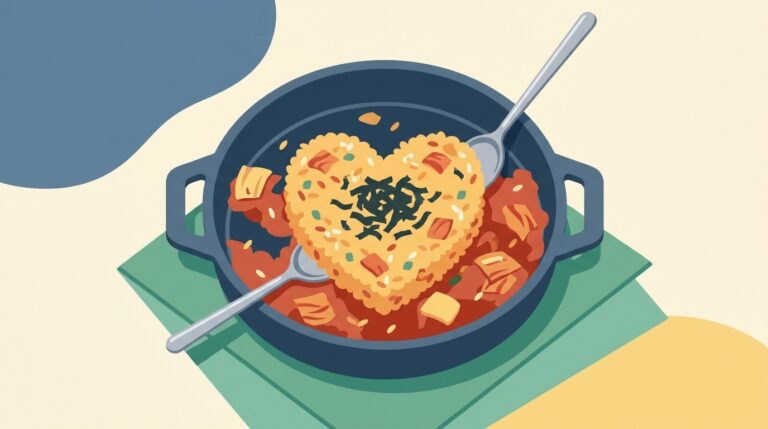
Wait! Look around your table. At the next booth, a group of college students calls the server over with a bright smile. The server arrives with a stainless steel bowl piled high with warm rice, bright red kimchi, fragrant perilla leaves, and a mountain of toasted seaweed flakes (gim). Using two metal spatulas, the server chops up the leftover pork slices right on the iron plate, turns up the heat, and presses the mixture down into a sizzling, heart-shaped disc. The aroma of toasted sesame oil instantly makes your mouth water all over again.
You want this so badly. But suddenly, your mind freezes. How do you say, “After we finish this meat, can you fry two servings of rice?” What if they clear the pan before you can speak? If you rely on rigid translation apps, you might end up saying something awkwardly robotic that confuses the busy server.
Don’t worry! That hesitation ends today. Based on real questions from hundreds of our beginner learners, this practical A2 guide will turn you into an effortless, confident K-BBQ pro. By the end of this lesson, you will know the exact timing, cultural table cues, and smooth phrases needed to conquer the ultimate “Korean dessert.”
Phase 2: Deep Dive into 3 Key Expressions
1. 고기 다 먹고 나서 볶음밥 2인분 볶아 주세요 (Gogi da meokgo naseo bokkeumbap i-inbun bokkeo juseyo)
- Pronunciation: [Go-gi da meok-go na-seo bok-keum-bap ee-in-boon bok-keo joo-seh-yo] (Sounds like: “Go-ghee da muck-go na-suh bo-kkoom-bap ee-een-boon bo-kkuh joo-say-yo”)
- Meaning: Literal: “After finishing all the meat, please stir-fry two servings of fried rice.” | Real Nuance: “We are almost done with our meat, so please prepare fried rice for two when we finish!”
- K-Culture Moment: Every K-Drama dinner scene where characters suddenly get a second wind of energy the second the rice hits the grill plate.
- Editor’s Insight: Notice the connector
~고 나서(~go naseo). It clearly specifies sequential timing: finish meat first, fry rice second. This prevents the server from rushing your grill while you’re still enjoying your meat. - Situation Spectrum: Casual ✅ | Semi-formal ✅ | Formal ⚠️
- 🤔 Think About It: In many Western dining contexts, carbs accompany meat simultaneously. Why do you think Korean cuisine often reserves rice as the grand finale cooked directly on the meat’s seasoned grill?
2. 남은 고기랑 같이 볶아 주세요 (Nameun gogi-rang gachi bokkeo juseyo)
- Pronunciation: [Na-meun go-gi-rang ga-chi bok-keo joo-seh-yo] (Pronounce ‘gachi’ just like the English word “got-chee”)
- Meaning: Literal: “Please stir-fry it together with the leftover meat.” | Real Nuance: “Keep those last few savory bits of grilled meat on the pan and chop them into our rice!”
- K-Culture Moment: A seasoned Korean friend urgently stopping you from eating the last two slices of meat, whispering: “Wait! Save those for the rice!”
- Editor’s Insight: The particle
~랑(~rang) means “with” or “and” in casual everyday speech. Pairing your fried rice with finely diced crisp pork elevates the flavor from good to unforgettable. - Situation Spectrum: Casual ✅ | Semi-formal ✅ | Formal ⚠️
- 🤔 Think About It: What does leaving specific morsels of food behind intentionally say about how Koreans view cooking as an evolving process at the table?
3. 치즈 사리 추가해 주세요 (Chijeu sari chugahae juseyo)
- Pronunciation: [Chee-jeu sa-ri choo-ga-hae joo-seh-yo] (Sounds like: “Chee-zeu sah-ree choo-gah-hay joo-say-yo”)
- Meaning: Literal: “Please add a cheese topping/noodle-style add-on.” | Real Nuance: “We want a decadent layer of melted mozzarella over our fried rice!”
- K-Culture Moment: When the server blankets the fried rice with mozzarella and covers it with an iron bowl for two minutes to achieve that glorious K-drama cheese pull.
- Editor’s Insight:
사리(sari) originally referred to extra noodle portions, but at modern BBQ spots,치즈 사리(chijeu sari) or simply치즈 추가(chijeu chuga) is the golden ticket to gourmet comfort food. - Situation Spectrum: Casual ✅ | Semi-formal ✅ | Formal 🚫
- 🤔 Think About It: Why has melted cheese become such a staple partner for spicy red Korean sauces over the past two decades?
Phase 3: Textbook Korean vs. Real Korean
Situation 1: Ordering the Fried Rice
- 📖 교과서 한국어 (Textbook Style):
“육류 섭취가 끝난 후에 볶음밥 2인분을 조리하여 주십시오.” (Yukryu seopchwiga kkeunnan hue bokkeumbap i-inbuneul jorihayeo jusipsio.) — “Please prepare two portions of fried rice after the ingestion of meat concludes.” - 🗣️ 진짜 한국어 (Real-life Korean):
“사장님, 여기 밥 2개만 볶아 주세요!” (Sajangnim, yeogi bap du-gae-man bokkeo juseyo!) — “Boss, could we please get two fried rices made right here!” - 💡 왜 다를까? (Why the difference?):
Locals replace the formal word볶음밥with simply밥(rice) and use the native counting unit개(gae – pieces/bowls) instead of인분(servings) when speaking casually to restaurant owners.
Situation 2: Asking for the Crispy Burnt Layer
- 📖 교과서 한국어 (Textbook Style):
“철판 바닥의 밥이 바삭해질 때까지 가열해 주시기 바랍니다.” (Cheolpan badagui babi basakhaejil ttaekkaji gayeolhae jusigi baramnida.) — “Please heat the pan until the bottom rice achieves a crisp consistency.” - 🗣️ 진짜 한국어 (Real-life Korean):
“누룽지 생기게 조금만 눌러 주세요!” (Nurungji saeggige jogeumman nulleo juseyo!) — “Please press it down a bit so we get some crunchy nurungji!” - 💡 왜 다를까? (Why the difference?):
누룽지(nurungji) is the beloved cultural term for scorched rice crust. Asking to “press it down” (눌러 주세요) shows you know the secret to BBQ perfection.
Phase 4: K-Culture Deep Dive & Non-Verbal Manners
4-1. 눈치 (Nunchi) & Table Gestures
At a Korean BBQ restaurant, timing is an art form driven by 눈치 (Nunchi – quick situational awareness):
* The Golden 3-Slice Rule: Never eat all the meat! Leave 3 to 4 pieces of pork or beef sitting on the edge of the grill. When the server arrives to make the rice, they will use scissors to chop these pieces into savory bacon-bit-sized flavor bombs.
* Calling the Staff: Don’t wave both arms frantically. Look for the small call button (벨 – bel) on the side of your table. Press it once with a gentle chime. If there is no bell, raise one hand halfway, make brief eye contact, and politely call out: “사장님!” (Sajangnim – Owner!) or “이모님!” (Imonim – Auntie!).
* The Spoon Rest: Once the rice is spread thin across the pan, do not touch it immediately! Let it sizzle undisturbed for 60 to 90 seconds. Tapping the bottom lightly with the back of your spoon lets you feel when the crust has formed.
4-2. The Cultural Code: “K-Dessert” (탄수화물 후식)
In Korea, there is a famous joke: “Koreans only eat meat as an appetizer for rice.”
Even after consuming hundreds of grams of pork, someone will invariably ask: “밥 볶을까?” (Bap bokkeulkka? – Shall we fry rice?). This grand finale is affectionately nicknamed “K-디저트” (K-Dessert). It represents unity and sharing: everyone digs their long metal spoons into the exact same pan, scraping up the crispy bottom layer (nurungji) together. It turns an individual dining experience into a warm, shared community ritual.
Phase 5: Real-World Roleplay Scenario
- Setting: “Dwaeji Kkum” (Pig Dream), a lively K-BBQ eatery near Sinchon station.
- Characters:
- Alex (알렉스): An eager foodie visiting Seoul for the first time.
- Imo-nim (이모님): The warm, speedy grill master and restaurant owner.
Turn 1: Alex
저기요, 이모님! 저희 고기 거의 다 먹었어요.
(Jeogiyo, imonim! Jeohui gogi geoui da meogeosseoyo.)
“Excuse me, Auntie! We are almost done with our meat.”
🎭 Gently raises a hand and gestures toward the grill with 3 slices remaining.
Turn 2: Imo-nim
아이고, 맛있게 잘 먹었네! 이제 밥 볶아 줄까?
(Aigo, mas-issge jal meogeonne! Ije bap bokkeo julkka?)
“Oh my, you ate so well! Shall I fry up some rice for you now?”
🎭 Smiles warmly while holding a tray of seasoned rice, perilla leaves, and seaweed flakes.
Turn 3: Alex
네! 고기 다 먹고 나서 볶음밥 2인분 볶아 주세요.
(Ne! Gogi da meokgo naseo bokkeumbap i-inbun bokkeo juseyo.)
“Yes! After we finish these last bites, please make two servings of fried rice.”
🎭 Points respectfully with an open palm toward the grill plate.
Turn 4: Imo-nim
그래, 남은 고기는 같이 잘라 넣어 줄까?
(Geurae, nameun gogineun gachi jalla neoeo julkka?)
“Sure thing, should I snip up the leftover meat into it as well?”
🎭 Clicks her kitchen tongs in anticipation.
Turn 5: Alex
네, 남은 고기랑 같이 볶아 주세요! 그리고 치즈도 추가해 주세요.
(Ne, nameun gogi-rang gachi bokkeo juseyo! Geurigo chijeudo chugahae juseyo.)
“Yes, please fry it with the leftover meat! And please add cheese too.”
🎭 Smiles excitedly with hands clasped together.
Turn 6: Imo-nim
탁월한 선택이야! 1분만 기다려요, 내가 맛있게 눌러 줄게.
(Tagwolhan seontaeg-iya! Ilbunman gidaryeoyo, naega mas-issge nulleo julge.)
“Excellent choice! Wait just one minute, I’ll press it down real crisp for you.”
🎭 Deftly chops the meat, tosses the rice, and spreads it into a neat flat layer.
Turn 7: Alex
우와, 냄새 진짜 최고예요! 감사합니다.
(Uwa, naemsae jinjja choegoyeyo! Gamsahamnida.)
“Wow, the aroma is truly incredible! Thank you so much.”
🎭 Gives a short, polite bow from the seat.
Turn 8: Imo-nim
불 껐으니까 바닥 긁어서 누룽지까지 싹싹 먹어요!
(Bul kkeosseunikka badak geulgeoseo nurungjikkaji ssakssak meogeoyo!)
“I turned off the flame, so scrape up that crispy crust and eat every single bite!”
🎭 Gives an encouraging nod before moving to the next grill.
🔀 Interactive Decision Point
The rice is spread on the pan and sizzling softly. The server walks away for a moment. What do you do next?
- Choice A: Immediately use your spoon to scoop up the soft rice from the center and blow on it.
- Choice B: Wait quietly for about 60 to 90 seconds until you hear a crackling sound, then scrape the bottom gently.
- Choice C: Turn the gas valve up to maximum heat on your own to make it cook faster.
* Decision Feedback:
  - Choice A [Risk]: You missed the best part! The rice will still taste good, but you lose the iconic crispy texture of the K-BBQ finale.
  - Choice B [BEST]: Pure perfection! Waiting allows the sesame oil and starch to create that crunchy golden crust (누룽지) without burning.
  - Choice C [Bad]: Danger! High heat on an already hot iron plate will char the seasoned seaweed flakes instantly, leaving a bitter, smoky taste.
Phase 6: 10-Second Emotion Shadowing Drill
Read each line aloud with the tagged emotion, paying close attention to natural pause markers (/):
[😊 Excitement & Respect]
사장님! / 고기 다 먹고 나서 / 볶음밥 2인분 볶아 주세요!
(Sajangnim! / Gogi da meokgo naseo / bokkeumbap i-inbun bokkeo juseyo!)-
[🤤 Hungry Craving]
남은 삼겹살이랑 / 김치도 같이 / 팍팍 넣어 주세요!
(Nameun samgyeopsal-irang / gimchido gachi / pak-pak neoeo juseyo!) -
[✨ Dreamy Delight]
치즈 사리 추가해서 / 바닥에 살짝 / 눌러 붙게 해 주세요!
(Chijeu sari chugahaeseo / badak-e saljjak / nulleo-beotge hae juseyo!)
Phase 7: K-Culture Mini Dictionary
- 인분 (Inbun) | Noun: Servings / Portions
The counter word for meals. Used with Sino-Korean numbers: 일인분 (1 serving), 이인분 (2 servings), 삼인분 (3 servings). At BBQ places, 2 servings of rice for a table of 2 to 3 people is standard. - 누룽지 (Nurungji) | Noun: Scorched/Crispy Rice Crust
The crunchy layer formed at the base of a hot stone pot or iron grill. In Korea, fighting over the last spoonful of nurungji is an expression of true culinary love. - 이모님 (Imo-nim) | Honorific Noun: Respected Auntie / Restaurant Staff
Literally “maternal aunt,” used warmly across Korean casual diners to address middle-aged female staff members with affection and polite familiarity. - 후식 (Husik) | Noun: Dessert / Post-meal Dish
While Western dessert focuses on sugar and pastries, Korean savory husik includes cold noodles (naengmyeon), fermented soybean stew (doenjang-jjigae), and fried rice (bokkeumbap).
Phase 8: Survival Kit for Travelers
Top 3 Survival Phrases
- 1. 불판 좀 갈아 주세요 (Bulpan jom gara juseyo)
Pronunciation: [Bool-pan jom gah-rah joo-seh-yo]
Pro Tip: Use this if your grill is blackened before the rice stage. “Please change the grill plate.” - 2. 밥 몇 개 볶을까요? (Bap myeot gae bokkeulkkayo?)
Pronunciation: [Bap myut geh bo-kkool-kkah-yo?]
Pro Tip: Hear this from the server? They’re asking: “How many portions of rice shall I fry?” Reply simply with “두 개요!” (Du gaeyo – Two, please!). - 3. 덜 맵게 해 주세요 (Deol maepge hae juseyo)
Pronunciation: [Duhl maep-geh hae joo-seh-yo]
Pro Tip: Sensitive to spice? Kimchi fried rice can pack heat. Say this to ask for a milder flavor.
Editor’s Travel Note
When venturing out into Seoul’s culinary scene, make sure you download the Naver Map Navigation Guide before your trip; foreign map apps often lack updated Korean store hours and real-time reviews. When you visit popular BBQ streets in Mapo or Euljiro, you may encounter digital waitlists; use the CatchTable Korea Reservation Guide to book your spot in advance. Remember: tipping does not exist in Korea, but handing your payment card with both hands at the front counter is a lovely sign of respect!
Phase 9: “One Step Deeper” (Reflective Question)
In many global dining cultures, a meal is centered on personal plates, where dividing portions cleanly is a sign of good manners. Korean BBQ, however, culminates in a single communal iron pan where everyone rests their spoons on the exact same surface. This reflects 정 (Jeong)—the invisible bond of warmth, shared hardship, and collective joy. Sharing fried rice isn’t just about finishing leftovers; it transforms dining companions into a bonded circle.
💬 Your Turn: Have you ever shared a dish cooked directly at your table in another culture? How does the idea of sharing one big pan of crispy fried rice with your friends make you feel? Let us know in the comments below!
Phase 10: FAQ & Avoiding Misunderstandings
Q: Can you order fried rice at every single Korean BBQ restaurant?
A: Not quite! Fried rice can only be made on flat cast-iron pans, stone plates (dolpan), or convex grill plates. If the meat is cooked directly over open wire mesh above open charcoal embers (seoksoe), the rice would fall through into the coals. In those restaurants, order a bowl of Doenjang-jjigae (soybean paste stew) and a separate bowl of rice instead!
Q: Is 1 serving (일인분) enough for two people?
A: Yes! Since you already ate meat, fried rice portions are quite generous. As an unwritten rule, ordering one portion less than your total number of diners (e.g., ordering 1 serving for two people, or 2 servings for three people) is usually the sweet spot.
Q: Can I make the fried rice myself if the server is too busy?
A: If the staff delivers the bowl of prepared rice and ingredients to your table instead of cooking it, that is your green light to take the tongs and spatulas and mix it yourself! Just remember to keep the heat at medium and press it flat.
🚨 흔한 실수 (Common Mistakes) Warning Board
- ❌ Mistake 1: Eating all the meat before ordering fried rice.
Correct Action: Save 3–4 juicy slices on the side of your grill so the server can chop them into your rice. - ❌ Mistake 2: Scraping the non-stick coating off lightweight pans with metal spoons.
Correct Action: Only scrape firmly if it is a heavy cast iron or stone plate. On delicate Teflon pans, scoop gently! - ❌ Mistake 3: Calling the server by shouting “야!” (Ya! – Hey!).
Correct Action: Press the table bell or say politely: “여기요~” (Yeogiyo) or “사장님~” (Sajangnim).
Phase 11: Action Mission & Engagement
- 🥉 Bronze Level: Stand in front of your mirror and practice saying: “사장님, 볶음밥 2인분 볶아 주세요!” smoothly in under 3 seconds.
- 🥈 Silver Level: Next time you order takeout or cook meat at home, leave 3 slices, fry your rice with kimchi and seaweed flakes, snap a picture, and post it on Instagram tagging
@DailyHangulwith#MyFirstKDessert! - 🥇 Gold Level: Visit a local Korean BBQ restaurant in your city, wait until the meat is done, press the bell, and order fried rice completely in Korean without looking at your notes!
🎮 K-Culture Mission: Watch any episode of the foodie drama Let’s Eat (식샤를 합시다) or a Korean YouTube BBQ vlog (like tzuyang or Hamzy). Spot the exact moment they transition from grilling meat to ordering fried rice, and listen for the word “누룽지”!
Phase 12: Interactive Quiz Challenge
Question 1 (Scenario Judgment)
You are dining with a friend at an authentic Korean BBQ place. You have two pieces of pork belly left. What is the most culturally savvy thing to do?
* A) Rapidly eat both pieces so the grill is empty for the rice.
* B) Throw them into the trash bin under the table.
* C) Leave them on the edge of the grill and ask the server to fry the rice together with them.
Question 2 (Fill-in-the-Blank)
Complete the sentence to order 2 portions of rice:
“고기 다 먹고 나서 볶음밥 ______ 볶아 주세요.”
* A) 한 병 (han byeong)
* B) 2인분 (i-inbun)
* C) 3마리 (sam-mari)
Question 3 (True or False)
True or False: In Korea, asking for fried rice after eating Korean BBQ is considered an appetizer.
* A) True
* B) False
👉 Click to reveal answers & explanations!
- Q1 Answer: C — Keeping a few slices of meat allows the server to dice them up into the fried rice, maximizing that mouthwatering savory flavor!
- Q2 Answer: B —
인분(inbun) is the correct Sino-Korean counter for meal portions. (A is for bottles, C is for animals!) - Q3 Answer: B (False) — It is affectionately referred to as the ultimate “K-Dessert” (후식), enjoyed at the very end of the meal!







