

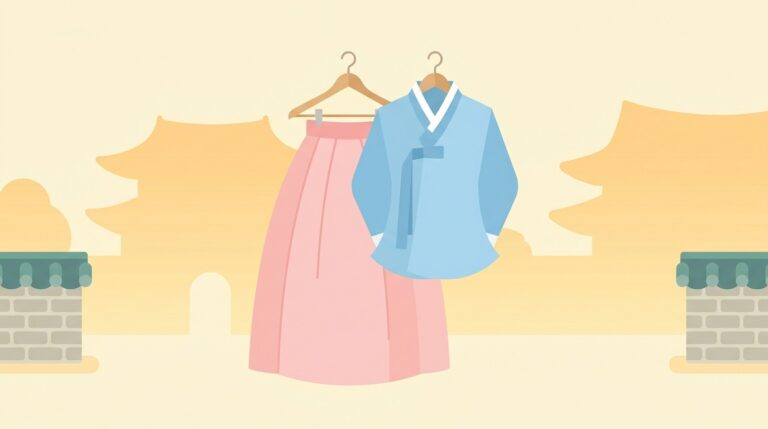
Master Your Hanbok Experience: How to Pick Your Dream Pastel Outfit in Easy A1 Korean
Phase 1: 공감 (A Warm, Story-Driven Welcome)
안녕하세요! 매일한글 에디터입니다. (Hello! I’m your Daily Hangul editor.)
Picture this: You step through the sliding glass doors of a bustling Hanbok boutique near Gyeongbokgung Palace. Outside, the morning breeze carries the scent of roasted street chestnuts and autumn leaves. Inside, you are greeted by an explosion of ethereal fabric: shimmering organza, gossamer pleats, and racks brimming with soft lilac, blush pink, and mint silk. Suddenly, a smiling shop stylist approaches you with measuring tape draped over her shoulder and asks: “어떤 스타일 찾으세요? (What style are you looking for?)”
Your mind goes completely blank. You want that dreamy, modern pastel set you saved on Instagram—the one that looks straight out of a whimsical historical K-drama like The King’s Affection. But how do you express that when your Korean is at absolute beginner (A1) level? Do you just point frantically at a mannequin?
Don’t worry for a second! Over my past ten years guiding international learners through Seoul’s historic alleys, I’ve seen countless first-timers freeze up in this exact scenario. Picking out traditional clothing shouldn’t feel like a high-stress language exam. With just a handful of three-word phrases, you can confidently tell your stylist what you want, ask for sizing advice, and step out into the palace courtyard feeling like royalty. Let’s make your dream Hanbok transformation effortless and fun!
Phase 2: 핵심 표현 3선 심층 분석 (3 Core Expressions Deep-Dive)
1. 파스텔 톤 치마 골랐어요 (Paseutel ton chima gollasseoyo)
- Pronunciation:
Paseutel ton chima gollasseoyo(Say it like: pah-seh-teul tone chee-mah goal-lah-ssuh-yo — imagine saying the English word “pastel”, followed by “tone”, and chanting “cheetah-ma” like a cheetah’s mama!) - Meaning: Literal: “Pastel tone skirt chose.” | Real Nuance: “I’ve chosen a pastel-colored skirt!”
- K-Culture Moment: Think of historical romance dramas where the lead actress chooses an understated, dreamy skirt for an undercover evening stroll under the lanterns.
- Editor’s Insight: In Korean Hanbok shops, you almost always choose the skirt (chima) first, and then find a matching top (jeogori). Using the past tense ending
-았어요/었어요signals to the staff: “I’m done with step one; guide me to step two!” - Situation Spectrum:
- Casual (Friends): ⚠️ 파스텔 톤 치마 골랐어 (Paseutel ton chima gollasseo)
- Semi-Formal (Shop staff / Politely friendly): ✅ 파스텔 톤 치마 골랐어요 (Paseutel ton chima gollasseoyo)
- Formal (Broadcast / Formal speech): 🚫 파스텔 톤 치마를 선택했습니다 (Paseutel ton chimareul seontaekhaesseumnida) (Too robotic for shopping!)
- 🤔 Think About It: In English, we usually describe the full outfit as a “dress”. In Korean, Hanbok is distinctly separated into two pieces (chima and jeogori). Why do you think Korean retains clear distinctions for upper and lower traditional garments?
2. 저고리 보여주세요 (Jeogori boyeojuseyo)
- Pronunciation:
Jeogori boyeojuseyo(Say it like: juh-go-ree bo-yuh-joo-seh-yo — rhyming ‘juh-go-ree’ with ‘category’, and ‘boy-uh-joo-seh-yo’ smooth and rounded.) - Meaning: Literal: “Jeogori, please show.” | Real Nuance: “Could you show me matching tops / jeogori?”
- K-Culture Moment: That classic moment when an attendant brings out an embroidered jacket with delicate mother-of-pearl buttons for a royal banquet.
- Editor’s Insight: The phrase
보여주세요(boyeojuseyo) comes from보다(to see) and주세요(please give). It’s one of the friendliest magic wands in the Korean language. Whenever you want someone to present an item for your consideration without sounding demanding, append보여주세요. - Situation Spectrum:
- Casual: ⚠️ 저고리 보여줘 (Jeogori boyeojwo)
- Semi-Formal: ✅ 저고리 보여주세요 (Jeogori boyeojuseyo)
- Formal: ✅ 저고리를 보여주시겠습니까? (Jeogorireul boyeojusigesseumnikka?)
- 🤔 Think About It: Notice how English often relies on conditional questions (“Could you perhaps show me…?”) to show politeness, whereas Korean uses honorific verb endings (
-주세요) directly on the main action!
3. 이거 잘 어울려요? (Igeo jal eoullyeoyo?)
- Pronunciation:
Igeo jal eoullyeoyo?(Say it like: ee-guh jahl uh-ool-lyuh-yo? — let the “uh-ool-lyuh” roll softly off your tongue with an upward lilt at the end.) - Meaning: Literal: “Does this match/fit well?” | Real Nuance: “Does this look good on me? / Do these colors go well together?”
- K-Culture Moment: When K-Pop idols go on a variety show in Hanbok and excitedly twirl around asking their members for outfit approval.
- Editor’s Insight:
어울리다(eoulrida) means to harmonize or blend in well. Koreans care deeply about visual and interpersonal harmony. Asking if something harmonizes is viewed as modest and stylish. - Situation Spectrum:
- Casual: ⚠️ 나 이거 잘 어울려? (Na igeo jal eoullyeo?)
- Semi-Formal: ✅ 이거 잘 어울려요? (Igeo jal eoullyeoyo?)
- Formal: ✅ 이것이 저에게 잘 어울립니까? (Igeosi jeoege jal eoullimnikka?)
- 🤔 Think About It: Rather than asking “Do I look pretty?” (which feels self-centered), Koreans ask if the garment harmonizes with them. Isn’t language fascinating in how it reflects cultural modesty?
Phase 3: 교과서 한국어 vs 진짜 한국어 (Textbook vs. Real Korean)
Situation 1: Asking the clerk for color suggestions
- 📖 교과서 한국어 (Textbook): 어느 색상이 제 피부 톤에 적합합니까? (Eoneu saeksangi je pibu tone jeokhaphumnikka? / Which hue is suitable for my skin tone?)
- 🗣️ 진짜 한국어 (Real Street Korean): 어떤 색이 더 예뻐요? (Eotteon saegi deo yeppeoyo? / Which color looks prettier?)
- 💡 왜 다를까? (Why the difference?): Real Koreans avoid academic terms like
색상(hue) or적합합니까(is it suitable). Natural conversation thrives on short, sensory adjectives like예뻐요(pretty) and everyday words like색(color).
Situation 2: Deciding on your final selection
- 📖 교과서 한국어 (Textbook): 저는 이 치마를 선택하겠습니다. (Jeoneun i chimareul seontaekhagesseumnida. / I shall select this skirt.)
- 🗣️ 진짜 한국어 (Real Street Korean): 이걸로 할게요! (Igeollo halgeyo! / I’ll go with this one!)
- 💡 왜 다를까? (Why the difference?):
~로 할게요(I’ll do/take this) is the quintessential shopping and ordering shortcut across South Korea, from boutique Hanbok ateliers to street-side Tteokbokki stalls.
Phase 4: K-Culture 딥다이브 & 비언어적 매너 (Deep-Dive & Cultural Manners)
4-1. 눈치 (Nunchi) & Body Gestures in Hanbok Shops
- Mind the Skirt Train: Traditional Hanbok skirts have multiple billowy layers supported by an underskirt (sokchima). When browsing racks, gently hold both sides of your skirt slightly elevated with two hands so it doesn’t drag along the floor. The staff will internally praise your nunchi (situational etiquette)!
- Holding the Jeogori: When showing the top to a stylist, hold it gently by the shoulder seams with both hands. In Korea, using two hands to hold an item signifies respect for the garment and the creator.
4-2. The Cultural Shift: Why Everyone Loves Pastel Hanbok
Historically, traditional Korean Hanbok utilized bold primary shades known as Obangsaek (오방색—white, black, blue, yellow, red), symbolizing natural elements and social ranks. But modern Korean youth and global travelers sparked a renaissance! Today’s trend embraces pastel tones—soft peach, sky blue, sage green, and lavender. This “modern fusion” Hanbok captures sunlight exquisitely in royal palace settings like Gyeongbokgung and Changdeokgung. Best of all: anyone wearing a Hanbok gets 100% free admission into all major royal palaces in Seoul!
Phase 5: 실전 롤플레이 시나리오 (Real-World Roleplay Scenario)
Setting: On a crisp Tuesday morning inside “Areumdaun Hanbok” near Anguk Station. The scent of aromatic wood fills the room. Mannequins showcase pastel silk ties.
Characters:
* 민지 (Minji): An experienced, warm Hanbok stylist wearing modern linen.
* 알렉스 (Alex): An enthusiastic A1 beginner traveler.
- Turn 1:
- 민지: 어서 오세요! 마음에 드는 치마 먼저 골라보세요. (Eoseo oseyo! Maeume deuneun chima meonjeo gollaboseyo. / Welcome! Please choose a skirt you like first.)
🎭 민지가 손으로 파스텔 톤 치마 코너를 가리키며 활짝 웃는다.(Minji points toward the pastel skirt section with an inviting smile.)
- Turn 2:
- 알렉스: 네! 저 파스텔 톤 치마 골랐어요. (Ne! Jeo paseutel ton chima gollasseoyo. / Yes! I picked a pastel-toned skirt.)
🎭 알렉스가 은은한 연분홍색 치마를 가리킨다.(Alex gently points at a soft blush pink skirt.)
- Turn 3:
- 민지: 어머, 정말 예쁘네요! 이제 위에 입을 옷 골라볼까요? (Eomeo, jeongmal yeppeuneyo! Ije wie ibeul ot gollabolkkayo? / Oh my, it’s truly pretty! Shall we pick a top to wear on top now?)
- Turn 4:
- 알렉스: 네, 저고리 보여주세요. (Ne, jeogori boyeojuseyo. / Yes, please show me the jeogori tops.)
🎭 알렉스가 양손을 모으며 다정하게 부탁한다.(Alex clasps hands gently and asks politely.)
- Turn 5:
- 민지: 이 흰색 저고리에 은은한 꽃무늬 어때요? (I heunsaek jeogorie euneunhan kkonmuni eottaeyo? / How about this white jeogori with subtle floral embroidery?)
🎭 민지가 옷걸이에 걸린 저고리를 치마 옆에 대어준다.(Minji holds the hanger next to the pink skirt.)
- Turn 6:
- 알렉스: 와! 이거 잘 어울려요? (Wa! Igeo jal eoullyeoyo? / Wow! Does this look good together?)
- Turn 7:
- 민지: 네, 치마 색이랑 찰떡이에요! 아주 화사해요. (Ne, chima saegirang chaltteogieyo! Aju hwasahaeyo. / Yes, it’s a match made in heaven with the skirt! So radiant.)
- Turn 8:
- 알렉스: 좋아요, 이걸로 할게요! (Johayo, igeollo halgeyo! / Great, I’ll go with this one!)
🎭 알렉스가 기분 좋게 고개를 끄덕인다.(Alex nods happily with confidence.)
🔀 Interactive Choice Point
Minji asks if you want a hair ribbon (daenggi) or a floral hairband: “머리띠 해드릴까요, 댕기 해드릴까요? (Shall I do a headband or a traditional daenggi braid ribbon?)” How do you respond?
- Option A: “댕기로 해주세요! (Daenggi-ro haejuseyo! / Traditional ribbon, please!)”
- Outcome (Best!): Stylist Minji beams and intricately braids your hair with the ribbon matching your skirt. Pure aesthetic perfection for your photos!
- Option B: “아무거나요. (Amugeonayo. / Whatever.)”
- Outcome (Bad): While grammatically understandable, it sounds blunt, disengaged, and slightly rude in Korean retail interactions.
- Option C: “머리 싫어요! (Meori sileoyo! / I hate hair!)”
- Outcome (Risk): You might mean “I don’t need hair styling,” but saying “I hate hair” sounds alarming and unintentionally comical to the stylist!
Phase 6: 10초 감정 섀도잉 드릴 (10-Second Emotion Shadowing Drill)
Practice these lines out loud! Use the emotional cues and pause slashes (/) to lock in native cadence.
[✨ 설레고 눈을 반짝이며 - Excited with shining eyes]- 저 / 파스텔 톤 치마 / 골랐어요!
Jeo / paseutel ton chima / gollasseoyo!- (I picked a pastel skirt!)
[🙏 정중하고 기대에 차서 - Polite & expectant]- 예쁜 저고리 / 보여주세요.
Yeppeun jeogori / boyeojuseyo.- (Please show me pretty jeogori tops.)
[🥰 조심스럽지만 기분 좋게 - Sweetly curious]- 이거 / 저한테 / 잘 어울려요?
Igeo / jeohante / jal eoullyeoyo?- (Does this suit me well?)
[🎉 결단력 있고 씩씩하게 - Decisive and cheerful]- 좋아요, / 이걸로 할게요!
Johayo, / igeollo halgeyo!- (Awesome, I’ll take this one!)
Phase 7: K-Culture 미니 사전 (Mini Culture Dictionary)
- 치마 (Chima) | Traditional wrap skirt worn high above the chest. Unlike Western hoop skirts, its fullness comes from soft pleating that flatters all body types.
- 저고리 (Jeogori) | The cropped upper jacket worn with Hanbok. Modern rental styles feature delicate lace, translucent sleeves, and pearl buttons.
- 속치마 (Sokchima) | The structured underskirt/petticoat. Always say yes if the shop offers a bell-shaped (ring-sokchima), as it keeps your pastel skirt floating gracefully off the pavement!
- 고름 (Goreum) | The coat strings tied at the front of the jeogori. Don’t worry about learning how to tie it yourself—shop assistants are experts and will tie a crisp, picture-perfect knot for you.
Phase 8: 여행자를 위한 생존 키트 (Traveler’s Survival Kit)
Top 3 Survival Phrases
- 이거 입어봐도 돼요? (Igeo ibeobwado dwaeyo?)
- Pronunciation: Ee-guh ee-buh-bwah-do dway-yo?
- Pro Tip: Use this before taking clothes into the dressing room. Some specialty premium Hanboks have a trying-on limit.
- 사진 찍어주실 수 있어요? (Sajin jjigeojusil su isseoyo?)
- Pronunciation: Sah-jeen jjee-guh-joo-sheel soo ee-ssuh-yo?
- Pro Tip: Staff members in rental shops are master photographers who know the exact angles that make the Hanbok look magnificent.
- 사물함 어디예요? (Samulham eodiyeyo?)
- Pronunciation: Sah-mool-hahm uh-dee-yay-yo?
- Pro Tip: You can store your backpack and winter coats in shop lockers so you can roam the palaces hands-free.
Editor’s Travel Note
Before stepping out, ensure you have set up transit navigation by visiting the official app store to [download the Naver Map application on your smartphone], as Google Maps often fails to offer pedestrian walking routes inside Seoul’s royal palaces. When visiting Gyeongbokgung Palace, remember that the palace is closed on Tuesdays, while nearby Changdeokgung is closed on Mondays! Don’t wear high heels—traditional Korean cobblestones and packed dirt grounds demand comfortable flats or sneakers, which can easily be hidden under your voluminous skirt.
Phase 9: “한 발 더 깊이” (One Step Deeper)
In many global cities, wearing centuries-old traditional garb in broad daylight might feel like wearing a theatrical costume. But in central Seoul, wearing Hanbok is an active, vibrant cultural communion. When you stroll through Bukchon Hanok Village or the royal throne halls in your pastel skirt, elderly locals will give you warm smiles, and palace guards will nod in greeting. Hanbok bridges generations, welcoming travelers not as mere spectators, but as active participants in Korea’s living history.
💬 Your Turn: If you could pick any color combination for your palace photoshoot, would you go with dreamy pastels (like pastel pink and mint) or traditional bold royal colors (like deep crimson and navy)? Let me know in the comments below!
Phase 10: FAQ & 오해 방지 (FAQ Schema & Common Pitfalls)
Q: Can men also wear pastel colors, or are pastels just for women’s skirts?
A: Absolutely! Modern men’s Hanbok coats (dopo or baeja) look stunning in pastel sky-blue, dove-gray, and soft lavender. In fact, matching couple pastel sets are the most popular rental choice in Seoul today!
Q: Do I need to wear my own clothes underneath the Hanbok?
A: For skirts, you will wear a lightweight underskirt (sokchima), so you should wear light shorts or leggings underneath. For the top, a collarless white or skin-toned t-shirt is ideal so it doesn’t poke out through the neck of your jeogori.
Q: Is Hanbok rental offensive or cultural appropriation?
A: Not at all! Koreans genuinely love and celebrate seeing international guests wear Hanbok. The Korean government actively encourages it by granting free palace admission to anyone wearing Hanbok with pride.
🚨 Common Mistakes (흔한 실수) Warning Board
- Mistake: Tying your own goreum (chest ribbon) backwards.
- Correct Action: Don’t tie it yourself! Ask the staff: “리본 묶어주세요 (Ribon mukkeojuseyo / Please tie the ribbon for me).”
- Mistake: Lifting the skirt all the way up to your knees when climbing palace stairs.
- Correct Action: Gently pinch just the outer front layer of your skirt at hip level and lift it 2-3 inches.
- Mistake: Addressing the shop staff as “언니 (Eonni)” when you are male or older than them.
- Correct Action: Use the polite, universal term “사장님 (Sajangnim / Shop owner)” or simply make eye contact and say “저기요 (Jeogiyo / Excuse me).”
Phase 11: 액션 미션 & 참여 유도 (Action Missions)
- 🥉 Bronze Mission (Solo Practice): Stand in front of your mirror with an outfit you like and say aloud 3 times:
파스텔 톤 치마 골랐어요!(Paseutel ton chima gollasseoyo!). - 🥈 Silver Mission (Social Share): Save a photo of your favorite K-drama Hanbok scene to your Instagram Story and caption it with:
저고리 보여주세요!Tag a friend you want to visit Seoul with. - 🥇 Gold Mission (Live Action): On your next trip to Seoul, enter a Hanbok rental shop and complete your skirt selection without uttering a single word of English!
- 🎮 K-Culture Mission: Watch an episode of a historical drama (like Love in the Moonlight or Alchemy of Souls) and spot the moment a character refers to clothes as ot (옷) or chima (치마)!
Phase 12: 인터랙티브 퀴즈 챌린지 (Interactive Quiz Challenge)
Test your new skills before packing your bags!
Quiz 1. Situation Challenge
You found a gorgeous lilac skirt, and now you want the stylist to bring you a matching jacket. What do you say?
* (A) 저고리 보여주세요 (Jeogori boyeojuseyo)
* (B) 치마 사물함 어디예요? (Chima samulham eodiyeyo?)
* (C) 파스텔 톤 싫어요 (Paseutel ton sileoyo)
👉 Click to see the answer and explanation!
Correct Answer: (A)
Explanation: 저고리 보여주세요 translates to “Please show me the jeogori (top).” Option (B) asks where the skirt locker is, and (C) means you dislike pastel tones!
Quiz 2. Fill-in-the-Blank
Complete the sentence to ask if the outfit matches you well:
* “이거 잘 ________?” (Does this look good on me?)
👉 Click to see the answer and explanation!
Correct Answer: 어울려요 (eoullyeoyo)
Full Sentence: “이거 잘 어울려요? (Igeo jal eoullyeoyo?)”
Explanation: The verb 어울리다 means to suit, harmonize, or go well together.
Quiz 3. True or False Culture Check
- Statement: Wearing a traditional or modern Hanbok allows you to enter Gyeongbokgung Palace without paying for an admission ticket.
👉 Click to see the answer and explanation!
Correct Answer: True! (O)
Explanation: The Cultural Heritage Administration of Korea offers free admission to all historical royal palaces in Seoul for anyone properly attired in Hanbok!







