

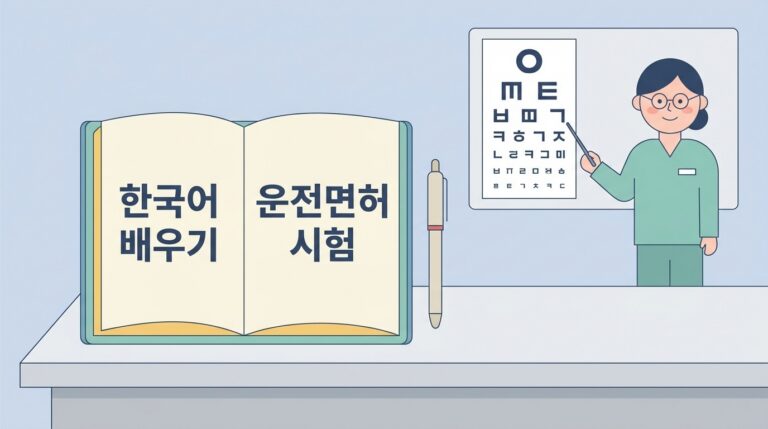
Conquering the Driver’s License Medical Check: Your Friendly Guide to the Aptitude & Vision Test
Phase 1: Empathy (Story-Driven Opening)
안녕하세요! 매일한글 에디터입니다. (Hello! It is your Daily Hangul editor.)
Imagine stepping into the buzzing Seobu or Gangnam Driver’s License Examination Office (운전면허시험장) in Seoul. You came armed with your foreign driver’s license, apostilled certificate, and passport, feeling ready to conquer the license exchange process. But before you can even take a number ticket for the main counter, the security guide points you downstairs to a lively, sterile room: the 신체검사장 (physical examination room).
Suddenly, you are standing in a fast-moving queue. The nurse is clicking a metal pointer against an eye chart (시력 검사표), shouting directions like “오른쪽!” (Right!) and “위!” (Up!), while handing you a book filled with multi-colored dotted circles for color blindness. If you’ve watched K-dramas like Hospital Playlist or workplace comedies, you know Korean administrative and medical staff move with laser-focused efficiency. For foreigners, this rapid-fire environment can cause an instant panic freeze: Wait, how do I say I’m wearing contact lenses? How do I describe which side of the circle is open?
Don’t worry! This comprehensive guide is built directly from real expat hurdles and feedback from hundreds of our Daily Hangul learners. By mastering just a few targeted phrases, you will breeze through the vision check, color identification, and basic aptitude test without missing a beat.
Phase 2: Core Expressions Deep Dive
1. 적성검사 받으러 왔어요. (Jeokseonggeomsa badeureo wasseoyo.)
- Pronunciation: [Jeok-seong-geom-sa ba-deu-reo wa-sseo-yo] (Sounds like juck-sung-gum-sah bah-deu-raw wah-so-yo)
- Meaning: “I came to take the aptitude test.” (Literal: Aptitude test to receive I came.)
- K-Culture Moment: Think of the classic scene where an eager rookie walks into an office reception desk with nervous determination. Stating your exact purpose instantly sets the administrative pace.
- Editor’s Insight: In Korea, “적성검사” (aptitude test) in the context of driving refers primarily to the mandatory physical screening—especially vision, hearing, and color differentiation. Saying this directly when you step into the medical room tells the staff precisely why you are there.
- Situation Spectrum: Casual 🚫 | Semi-formal ✅ | Formal ✅
- 🤔 Think About It: In English, we often say “I need to get my eyes checked for my license.” In Korean, stating the administrative purpose category (적성검사) comes first. Why do you think Korean public services categorize actions by bureaucratic terms?
2. 렌즈 낀 채로 검사해도 되나요? (Lenjeu kkin chaero geomsa-haedo doenayo?)
- Pronunciation: [Len-jeu kkin chae-ro geom-sa-hae-do doe-na-yo] (Sounds like len-jeu kkeen chay-ro gum-sah-hay-doh dway-nah-yo)
- Meaning: “Can I take the test while wearing contact lenses?” (Literal: Lenses put-on state while test can I do?)
- K-Culture Moment: The moment you stand in front of the Landolt eye chart and realize you forgot to tell the staff your 20/20 vision is courtesy of daily disposable contacts!
- Editor’s Insight: Koreans distinguish between natural vision (나안시력) and corrected vision (교정시력). Driving license standards allow corrected vision, but the nurse must check the “교정” box on your paperwork so your license accurately reflects that you drive with corrective lenses.
- Situation Spectrum: Casual ⚠️ | Semi-formal ✅ | Formal ✅
- 🤔 Think About It: Notice the grammatical form “-(으)ㄴ 채로” (while remaining in the state of). How does expressing continuous states in Korean differ from English prepositions like “with” or “in”?
3. 오른쪽 위가 뚫려 있어요. (Oreunjjok wiga ttullyeo isseoyo.)
- Pronunciation: [O-reun-jjok wi-ga ttul-lyeo i-sseo-yo] (Sounds like oh-reun-jjoak wee-gah ttool-lyuh ee-ssuh-yo)
- Meaning: “The top right side is open.” (Literal: Right top side is punctured/open.)
- K-Culture Moment: The medical assistant taps the classic Landolt C ring on the illuminated wall chart with a long pointer stick.
- Editor’s Insight: Korean eye exams for driver’s licenses rarely use alphabet letters. Instead, they use numbers or the Landolt C ring (a broken circle). The key verb here is “뚫리다” (to be punctured or open). Stating the broken direction cleanly proves your eyesight immediately.
- Situation Spectrum: Casual ⚠️ | Semi-formal ✅ | Formal ✅
- 🤔 Think About It: Instead of saying “the gap is on the right,” Korean speakers often use passive descriptions of space (“it is open on…”). How does this affect spatial awareness when communicating?
Phase 3: Textbook Korean vs. Real Korean
Situation 1: Telling the examiner you wear glasses or lenses
- 📖 교과서 한국어: “저는 안경과 시력 교정용 콘택트렌즈를 착용하고 있습니다.” (Jeoneun an-gyeong-gwa siryeok gyojeong-yong kontaekteulenjeureul chak-yonghago itsseumnida. – I am wearing glasses and vision-correcting contact lenses.)
- 🗣️ 진짜 한국어: “저 안경 썼어요.” (Jeo an-gyeong sseosseoyo. – I’m wearing glasses.) / “렌즈 꼈어요.” (Lenjeu kyeosseoyo. – I have lenses in.)
- 💡 왜 다를까?: While textbooks love formal sino-korean verbs like 착용하다 (to wear/equip), native Koreans use dedicated, everyday verbs depending on the item: 안경을 쓰다 (put on glasses) and 렌즈를 끼다 (insert contact lenses).
Situation 2: Asking which counter to visit after the physical check
- 📖 교과서 한국어: “신체검사가 완료되었으니 이제 어느 부서로 이동해야 합니까?” (Sinche-geomsaga wanlyodoe-eosseuni ije eoneu buseoro idong-haeya hamnikka? – Since the physical exam is complete, to which department should I move now?)
- 🗣️ 진짜 한국어: “이거 끝나면 몇 번 창구로 가요?” (Igeo kkeutnamyeon myeot beon chang-guro gayo? – When this is done, which window number do I go to?)
- 💡 왜 다를까?: Korean license offices run entirely on numbered service counters (창구). Real people don’t ask for departments; they ask for the specific counter number (몇 번 창구).
Phase 4: K-Culture Deep Dive & Non-Verbal Manners
4-1. 눈치 (Nunchi) & Gestures in the Exam Room
- The Two-Handed Document Hand-off: Always hand your application form and Alien Registration Card (ARC) with both hands or with your left hand lightly touching your right forearm. This subtle sign of respect keeps the examiner friendly and patient.
- Point and Speak: When looking at the Landolt chart, don’t just speak. Point your finger simultaneously in the direction of the opening (e.g., pointing up while saying “위쪽!”). Administrative rooms can be noisy, and visual confirmation speeds up the process.
- Fast-Paced Readiness: Have your eye-covering paddle (차폐기) ready in your hand before sitting on the examination stool. Korean test administrators appreciate applicants who are alert and ready.
4-2. Cultural Code: The Rhythm of Korean Administrative Speed (빨리빨리)
In Korea, government and licensing procedures are optimized for incredible speed. A physical aptitude test rarely takes more than two to three minutes from entry to exit. Don’t mistake the examiner’s brisk cadence for rudeness—it is their professional duty to ensure nobody waits in line longer than necessary. Responding promptly with clear, short answers is considered the highest form of administrative courtesy.
Phase 5: Real-World Roleplay Scenario
Setting: The Medical Examination Room (신체검사장) at Seoul Western Driver’s License Center. Nurse Park is managing the queue efficiently.
- 간호사 박: 다음 분, 신청서 주시고 여기 앉으세요. (Daeum bun, sincheongseo jusigo yeogi anjeuseyo.)
- 🎭 Taking the paper quickly and signaling the stool.
- “Next person, please hand me your application and take a seat here.”
- 알렉스: 안녕하세요. 적성검사 받으러 왔어요. (Annyeonghaseyo. Jeokseonggeomsa badeureo wasseoyo.)
- 🎭 Handing the form with both hands and sitting down.
- “Hello. I am here for the aptitude test.”
- 간호사 박: 네, 시력 검사부터 할게요. 혹시 렌즈 끼셨어요? (Ne, siryeok geomsa-buteo halgeyo. Hoksi lenjeu kkisyeosseoyo?)
- 🎭 Prepares the pointer stick and looks at the vision chart.
- “Okay, we will start with the vision test. Are you wearing contact lenses by any chance?”
- 알렉스: 네, 렌즈 낀 채로 검사해도 되나요? (Ne, lenjeu kkin chaero geomsa-haedo doenayo?)
- 🎭 Nods politely while picking up the eye cover paddle.
- “Yes, can I take the test with my lenses on?”
- 간호사 박: 네, 교정시력으로 적어드릴게요. 오른쪽 눈 가리고, 짚는 곳 말해보세요. (Ne, gyojeong-siryeogeuro jeogeodeurilgeyo. Oreunjjok nun garigo, jipneun got malhaeboseyo.)
- 🎭 Taps a circle on line 0.8 on the board.
- “Yes, I will record it as corrected vision. Cover your right eye and name what I point to.”
- 알렉스: 왼쪽이 뚫려 있어요. (Oenjjogi ttullyeo isseoyo.)
- 🎭 Looks closely and points left with his finger.
- “The left side is open.”
- 간호사 박: 잘하셨어요. 이번엔 이 책 보세요. 여기 가운데 적힌 숫자 보이세요? (Jalhasyeosseoyo. Ibeonen i chaek boseyo. Yeogi gaunde jeokhin sutja boiseyo?)
- 🎭 Flips open the Ishihara color blindness book displaying a circle of dots.
- “Well done. Now look at this book. Do you see the number written in the center here?”
- 알렉스: 네, 74로 보여요! (Ne, chilsipsaro boyeoyo!)
- 🎭 Smiles with relief as the nurse stamps the application form.
- “Yes, it looks like 74!”
🔀 Interactive Choice: What should Alex ask next before leaving the room?
- Choice A: “이거 끝나면 외국 면허 교환 창구로 가면 되나요?” (Igeo kkeutnamyeon oeguk myeonheo gyohwan chang-guro gamyeon doenayo?)
- Feedback: [Best! ⭐] Precise, polite, and clarifies the exact next administrative step.
- Choice B: “저 시력 1.0 넘었는지 확인해 줄 수 있어요?” (Jeo siryeok il-jeom-yeong neomeotneunji hwaginhae jul su isseoyo?)
- Feedback: [Risk ⚠️] Too casual (half-talk/반말 tone). Asking in informal speech to an official causes awkwardness.
- Choice C: “면허증 지금 바로 여기서 줘요?” (Myeonheojeung jigeum baro yeogiseo jwoyo?)
- Feedback: [Bad ❌] The physical exam room only stamps medical clearance; they do not print or issue the actual licenses.
Phase 6: 10-Second Emotion Shadowing Drill
Practice these natural sentences using the rhythmic slashes / as your breathing and pitch pauses!
[😊 자신감 있고 명확하게 - Confident and clear]- 적성검사 / 받으러 왔어요! (Jeokseonggeomsa / badeureo wasseoyo!)
- “I came / for the aptitude test!”
[👀 차분하고 공손하게 - Calm and polite]- 안경 낀 채로 / 검사해도 되나요? (An-gyeong kkin chaero / geomsa-haedo doenayo?)
- “With my glasses on / may I take the test?”
[🎯 신속하고 정확하게 - Swift and precise]- 아래쪽 / 오른쪽 위가 / 뚫려 있어요. (Araejjok / oreunjjok wiga / ttullyeo isseoyo.)
- “Bottom / top right / is open.”
Phase 7: K-Culture Mini Dictionary
- 신체검사장 (Sinche-geomsa-jang) | Physical Examination Room
- Usage: The specific room inside licensing centers or designated hospitals where eyes, hearing, and color sight are evaluated.
- 교정시력 (Gyojeong-siryeok) | Corrected Vision
- Usage: Your eyesight measured while wearing glasses or contacts. The nurse will mark this on your test slip.
- 색채식별 (Saekchae-sikbyeol) | Color Identification / Discrimination
- Usage: Checking whether an applicant can distinguish traffic light colors (red, amber, green) via dotted number charts.
- 면허교환 (Myeonheo-gyohwan) | License Exchange
- Usage: The formal legal procedure where an eligible foreign driver’s license is exchanged for an official Korean Driver’s License.
Phase 8: Expat Survival Kit
Top 3 Survival Phrases
- “시력 검사 먼저 받나요?” (Siryeok geomsa meonjeo bannayo?)
- Translation: Do I take the vision test first?
- Pro Tip: Use this at the main entrance guidance desk if you aren’t sure whether to pull a number ticket or visit the clinic first.
- “도장 어디서 받아요?” (Dojang eodiseo badayo?)
- Translation: Where do I get the approval stamp?
- Pro Tip: Ensures you don’t walk out of the clinic room without the official physical check approval stamp.
- “카드 결제 돼요?” (Kadeu gyeolje dwaeyo?)
- Translation: Can I pay by card?
- Pro Tip: The physical check has a separate fee (approx. 6,000 KRW); all license center clinics accept Korean debit/credit cards.
Editor’s Travel & Expat Note
Before heading out, download the Naver Map navigation application to find the nearest Driver’s License Examination Center (운전면허시험장) rather than a regular police station, because on-site medical check clinics are only located in major exam centers! Also, visit the official Safe Driving KoROAD Portal to verify if your home country’s license requires an Embassy Certificate or Apostille prior to arrival.
Phase 9: One Step Deeper (Reflective Thought)
In many Western cultures, a medical check involves personal small talk, a relaxed timeline, and step-by-step hand-holding. In South Korea, efficiency in public institutions is considered a core civic virtue. When staff process your vision test in ninety seconds, it isn’t coldness; it is their commitment to honoring everyone’s precious time in a densely populated nation. Embracing this communal rhythm allows you to experience Korean society from the inside out.
💬 Your Turn: Have you ever experienced an administrative or medical procedure abroad that moved at warp speed? What surprised you the most about Korean public services? Share your thoughts below!
Phase 10: FAQ & Common Mistakes
Q: What eyesight score is required to pass the Korean driver’s license aptitude test?
A: For a standard Class 2 Ordinary License (2종 보통), you need a combined vision of at least 0.5 (decimal) across both eyes. For a Class 1 Ordinary License (1종 보통), you need 0.8 or higher combined, with neither eye falling below 0.5. Both can be achieved with glasses or lenses.
Q: Can I bring a health checkup result from my regular neighborhood hospital instead?
A: Yes! If you had a national health checkup (국민건강검진) within the last two years, your vision results are usually linked automatically to the KoROAD computer system, and you may skip the physical exam room entirely.
Q: What happens if I fail to identify the numbers in the color blindness book?
A: If you cannot read the dotted numbers, the examiner will show you actual traffic lights (red, green, amber lamps) to confirm whether you can distinguish essential road signals.
🚨 Common Mistakes Alert
- Mistake: Removing contact lenses in the restroom before the test.
- Correct Action: Keep them in! Just inform the examiner: “렌즈 꼈어요” (I’m wearing lenses). They test corrected vision.
- Mistake: Forgetting small payment for the physical exam.
- Correct Action: The aptitude exam fee is paid separately right inside the clinic room. Bring a payment card.
- Mistake: Leaving the room without the official red stamp on the form.
- Correct Action: Always verify that the examiner has stamped “합격” (Pass) before heading to the license exchange counter.
Phase 11: Action Missions
- 🥉 Bronze Mission (Solo Practice): Stand in front of your mirror with an object covering one eye. Say out loud in Korean: “위쪽, 아래쪽, 오른쪽, 왼쪽!” three times within 5 seconds.
- 🥈 Silver Mission (Community Share): Write down your preferred eye gear in Korean in the comments: “저는 안경을 써요” (I wear glasses) or “저는 렌즈를 껴요” (I wear contacts).
- 🥇 Gold Mission (Real Life Application): At your next visit to a Korean optician (안경원) or license office, greet the staff and declare your purpose using: “시력 검사 받으러 왔어요!”
🎮 K-Culture Mission: Watch an episode of a Korean medical drama or YouTube vlog about getting a Korean driver’s license. Count how many times you spot the word “검사” (examination/test)!
Phase 12: Interactive Quiz Challenge
1. Situational Judgment
You are standing in front of the eye chart, and the examiner points to a circle with a break at the bottom. What is the most natural way to respond?
* A) 아래가 뚫려 있어요. (Araega ttullyeo isseoyo.)
* B) 밑바닥이 없습니다. (Mitbadagi eopseumnida.)
* C) 아래쪽을 보세요. (Araejjogeul boseyo.)
2. Fill-in-the-Blank
Fill in the missing particle/verb: “안경을 낀 ( ) 검사해도 되나요?” (Can I take the test while wearing my glasses?)
3. True or False
In Korea, you must take off your prescription glasses when taking the driver’s license vision test. (True / False)
👉 Click to reveal answers & explanations!
- Answer: A) 아래가 뚫려 있어요.
- Explanation: Stating that the bottom is open (“뚫려 있어요”) is the exact natural idiom used during Landolt ring checks.
- Answer: 채로 (chaero)
- Explanation: “-(으)ㄴ 채로” expresses taking an action while remaining in the current physical state.
- Answer: False
- Explanation: You can keep your glasses or contacts on; your license will simply record it as corrected vision (교정시력).
- Explanation: You can keep your glasses or contacts on; your license will simply record it as corrected vision (교정시력).







