

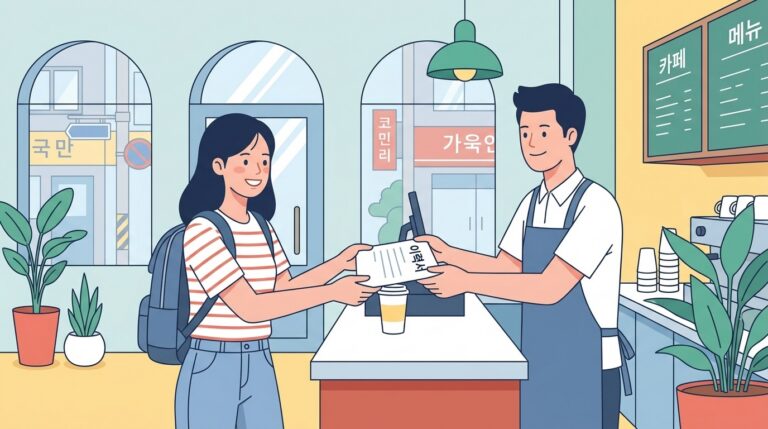
Phase 1: Empathy (Story-driven Opening)
안녕하세요! 매일한글 에디터입니다. (Hello! This is your Daily Hangul editor!)
Imagine this: You are standing in front of a cozy cafe tucked away in a bustling street of Hongdae. The intoxicating aroma of freshly ground espresso beans wafts through the air, and through the glass window, you see the manager busily steaming milk. Your palms feel a little clammy. Tucked into your neat canvas tote is a freshly printed resume. You step forward, the shop bell chiming ting-ting, and the entire counter team turns to look at you.
Your heart skips a beat. You’ve memorized your grammar, but suddenly you freeze: Do I say ‘Annyeonghaseyo’ or is that too casual? How do I say I have an interview without sounding like a robotic translation app?
If you’ve ever felt that pit in your stomach, take a deep breath. Walking into your first part-time job (alba, 알바) interview in Korea is a rite of passage, not just for foreigners, but for every young Korean college student too. Over the past five years, our Daily Hangul learners have successfully landed shifts at major chains like CU, GS25, Mega Coffee, and indie roasteries across Seoul. Today, we’re unlocking the exact phrasebook and cultural etiquette you need to make the boss say, “When can you start?”
Phase 2: Top 3 Core Expressions
1. 안녕하세요! 오늘 오후 2시 아르바이트 면접 보러 온 김지수입니다.
- Pronunciation: Annyeonghaseyo! Oneul ohu dusi areubaiteu myeonjeop boreo on Kim Jisu-imnida. (Say myeon-jeop like “me-un” + “jup” in jump)
- Meaning: Literal: “Hello! Today afternoon 2 o’clock part-time interview to see came Kim Jisu am.” / Natural: “Hello! I’m Jisu Kim, here for the 2 PM part-time job interview today.”
- K-Culture Moment: Picture every K-Drama lead walking into a convenience store counter to start their youth comeback arc.
- Editor’s Insight: The pattern
~러 온 [Name]입니다(~reo on …-imnida) smoothly explains your identity and your purpose in one crisp sentence. Using~입니다shows instant respect for the workplace. - Situation Spectrum: Casual 🚫 | Semi-formal ⚠️ | Formal ✅
- 🤔 Think About It: In English, we often say “I have an interview.” Why do you think Koreans use the verb “to see/watch an interview” (면접을 보다)?
2. 이력서 가지고 왔습니다.
- Pronunciation: Iryeokseo gajigo watseumnida. (I-ryeok-seo: sounds like “e-ryuck-saw”)
- Meaning: Literal: “Resume having come.” / Natural: “I brought my resume.”
- K-Culture Moment: The moment in Fight for My Way when characters nervously hand over a crisp plastic folder containing their paper resume.
- Editor’s Insight: Even if you submitted your application online via Albamon, bringing a neat physical printout (이력서) signals extraordinary preparedness and maturity.
- Situation Spectrum: Casual 🚫 | Semi-formal ⚠️ | Formal ✅
- 🤔 Think About It: Handing an item over to an elder or boss in Korea is never just about words—what body language must accompany this phrase?
3. 시간 조율 가능합니다.
- Pronunciation: Sigan joyul ganeunghamnida. (Jo-yul: sounds like “choh-yool”)
- Meaning: Literal: “Time adjustment is possible.” / Natural: “My schedule is flexible / I can adjust my hours.”
- K-Culture Moment: In cafe management dramas, the hero wins the boss’s favor by offering to cover busy holiday shifts.
- Editor’s Insight: Cafe and mart owners cherish reliability and flexibility. Uttering this phrase elevates you above candidates who have rigid time slots.
- Situation Spectrum: Casual 🚫 | Semi-formal ✅ | Formal ✅
- 🤔 Think About It: Joyul (조율) literally means tuning a musical instrument. How does “tuning time” reflect Korean teamwork harmony?
Phase 3: Textbook Korean vs. Real Korean
Situation 1: Announcing Your Arrival at the Counter
- 📖 교과서 한국어 (Textbook): 저는 오늘 면접 시험을 치르기 위해 이곳에 방문했습니다. (Jeoneun oneul myeonjeop siheomeul chireugi wihae igose bangmunhaetseumnida. – I visited this place to take an interview examination.)
- 🗣️ 진짜 한국어 (Real-World): 안녕하세요 사장님, 2시 알바 면접 보러 왔는데요! (Annyeonghaseyo sajangnim, dusi alba myeonjeop boreo wanneundeyo! – Hello boss, I’m here for the 2 o’clock part-time interview!)
- 💡 왜 다를까? Textbook Korean sounds like a written deposition. In real life, addressing the owner as 사장님 (Sajangnim) with the soft ending ~왔는데요 creates a polite yet warm human connection.
Situation 2: Inquiring When You Can Start
- 📖 교과서 한국어 (Textbook): 저는 어느 날짜부터 노동을 개시해야 합니까? (Jeoneun eoneu naljjabuteo nodongeul gaesihaeya hamnikka? – From which date must I commence labor?)
- 🗣️ 진짜 한국어 (Real-World): 언제부터 출근하면 될까요? (Eonjebuteo chulgeunhamyeon doelkkayo? – When would you like me to start coming in?)
- 💡 왜 다를까? Words like 노동 개시 sound like legal statutes! Natural Korean workplaces use 출근 (chulgeun, arriving at work) and the soft inquisitive ~하면 될까요?.
Phase 4: K-Culture Deep Dive & Non-Verbal Manners
4-1. Nunchi (눈치) & Interview Body Language
In Korea, your interview begins the second your foot crosses the doorway:
1. The Two-Handed Handover (두 손 전달): Never slide your resume across the counter with one hand like a poker dealer. Hold the document with both hands, thumbs securing the top edges, text facing the manager so they can read it immediately, accompanied by a polite 15-degree bow.
2. The Sightline Rule: Don’t stare unblinkingly into the manager’s eyes; soften your gaze between their forehead and eyes to demonstrate attentiveness without confrontation.
3. Post-Interview Exit: When the interview ends, push your chair back in neatly. Say “감사합니다! 조심히 들어가세요!” (Thank you! Take care!) and bow before opening the exit door.
4-2. Cultural Code: The Sacred “Alba (알바)” Culture
In Western countries, part-time jobs are often viewed strictly as transactional hourly work. In Korea, 알바 (derived from the German word Arbeit) represents youth grit, community solidarity, and independence. If you watch slice-of-life K-Dramas like Record of Youth or My Liberation Notes, characters bond deeply with their 사장님 (boss) and fellow part-timers (알바 동료). Demonstrating that you understand common hospitality phrases—like saying “어서오세요!” (Welcome!) with energy—proves you can represent their business proudly.
Phase 5: Real-World Roleplay Scenario
- Setting: “Cafe Haru”, a sunny neighborhood cafe in Sinchon, Seoul.
- Characters:
- Manager Park (박 사장님): A friendly but meticulous cafe owner in his 40s wearing a brown linen apron.
- Alex (알렉스): International university student applying for the weekend barista/counter shift.
Turn 1
알렉스: 안녕하세요! 오늘 오후 2시 아르바이트 면접 보러 온 알렉스입니다. 🎭 (두 손을 모으고 밝은 미소로 15도 인사)
(Annyeonghaseyo! Oneul ohu dusi areubaiteu myeonjeop boreo on Alekseu-imnida.)
Alex: Hello! I am Alex, here for the 2 PM part-time job interview today. (Clasps hands and bows 15 degrees with a bright smile)
Turn 2
박 사장님: 아, 알렉스 씨 반가워요! 저쪽 창가 자리에 앉으세요.
(A, Alekseu ssi bangawoyo! Jeojjok chang-ga jarie anjeuseyo.)
Manager Park: Ah, nice to meet you, Alex! Please have a seat at that window table.
Turn 3
알렉스: 감사합니다! 사장님, 여기 이력서 가지고 왔습니다. 🎭 (이력서를 양손으로 공손히 건넨다)
(Gamsahamnida! Sajangnim, yeogi iryeokseo gajigo watseumnida.)
Alex: Thank you! Boss, I brought my resume here. (Hands over the resume politely with both hands)
Turn 4
박 사장님: 오, 한국어 실력이 꽤 좋네요! 카페 일 해본 적 있어요?
(O, hangugeo sillyeogi kkwae jonneyo! Kape il haebon jeok isseoyo?)
Manager Park: Oh, your Korean is quite impressive! Have you worked at a cafe before?
Turn 5
알렉스: 고향 카페에서 1년 동안 일했습니다. 커피 추출과 포스(POS) 계산 모두 자신 있습니다!
(Gohyang kape-eseo ilnyeon dongan ilhaetseumnida. Keopi chuchulgwa poseu gyesan modu jasin itseumnida!)
Alex: I worked at a cafe in my home country for a year. I am confident in both brewing coffee and operating the cash register!
Turn 6
박 사장님: 좋네요. 주말 오전 9시부터 오후 3시까지 근무인데, 시간 괜찮아요?
(Jonneyo. Jumal ojeon ahopsibuteo ohu sesikkaji geunmu-inde, sigan gwaenchanayo?)
Manager Park: Sounds great. The shift is weekends from 9 AM to 3 PM. Does that schedule suit you?
Turn 7
알렉스: 네, 문제없습니다! 필요하시면 평일 저녁에도 시간 조율 가능합니다.
(Ne, munjeeopseumnida! Piryohasimyeon pyeong-il jeonyeogedo sigan joyul ganeunghamnida.)
Alex: Yes, no problem at all! If needed, I can also adjust my schedule for weekday evenings.
Turn 8
박 사장님: 든든하네요! 다음 주 월요일부터 같이 일해볼까요? 🎭 (만족스럽게 웃으며 악수를 청한다)
(Deundeunhaneyo! Daeum ju woryoilbuteo gachi ilhaebolkkayo?)
Manager Park: How reassuring! Shall we start working together from next Monday? (Smiles with satisfaction and offers a handshake)
🔀 Interactive Choice Branch
Manager Park says: “손님이 음료를 쏟았을 때 어떻게 대처할 건가요?” (What will you do if a customer spills a drink?)
- Option A: “손님에게 걸레를 주고 직접 닦으라고 하겠습니다.” (I will give the rag to the customer and tell them to wipe it.)
- ❌ Result [Bad]: Immediate disqualification! In Korean customer service, the staff takes full responsibility for cleaning up immediately with sincere reassurance.
- Option B: “괜찮으신지 먼저 확인하고, 바로 새 음료로 다시 만들어 드리겠습니다.” (I’ll check if they are okay first, and immediately make them a fresh drink.)
- 🌟 Result [Best]: Top candidate score! Showing proactive care (괜찮으세요?) before worrying about the spill demonstrates high emotional quotient (EQ).
- Option C: “사장님한테 전화해서 어떻게 해야 하는지 물어보겠습니다.” (I’ll call the boss and ask what to do.)
- ⚠️ Result [Risk]: Shows honesty, but implies you cannot handle small, common cafe incidents independently during a rush hour.
Phase 6: 10-Second Emotion Shadowing Drill
Repeat each line aloud, pausing at the slash (/) and channeling the stated mood:
[😊 밝고 자신감 있게 / Bright & Confident]
안녕하세요! / 오늘 오후 2시 / 아르바이트 면접 보러 온 김지수입니다.
(Annyeonghaseyo! / Oneul ohu dusi / areubaiteu myeonjeop boreo on Kim Jisu-imnida.)-
[🤝 정중하고 믿음직스럽게 / Polite & Trustworthy]
이력서 가지고 왔습니다! / 꼼꼼하게 읽어봐 주세요.
(Iryeokseo gajigo watseumnida! / Kkomkkomhage ilgeobwa juseyo.) -
[🔥 열정적이고 의욕 넘치게 / Enthusiastic & Eager]
언제든 불러주시면 / 시간 조율 가능합니다!
(Eonjedeun bulleojusimyeon / sigan joyul ganeunghamnida!)
Phase 7: K-Culture Mini Dictionary
- 알바 (Alba) | Noun | Short for 아르바이트 (part-time job). Commonly used in everyday conversation: “나 오늘 편의점 알바 가야 해” (I have to go to my convenience store shift today).
- 시급 (Sigeup) | Noun | Hourly wage. Korea sets a mandatory national minimum hourly wage every year. Always check if the posted 시급 matches legal guidelines.
- 대타 (Daeta) | Noun | Shift cover / substitute worker. A lifesaver word: “내일 대타 구해줄 수 있어?” (Can you find someone to cover my shift tomorrow?).
- 주휴수당 (Juhyusudang) | Noun | Weekly holiday pay allowance. A legal benefit in Korea paid to employees working over 15 hours a week without missing scheduled days.
Phase 8: Expat & Traveler Survival Kit
Top 3 On-Site Survival Phrases
- 열심히 배우겠습니다! (Yeolsimhi baeugetseumnida!)
- Meaning: “I will learn diligently!”
- Pro Tip: Use this whenever you lack experience. Korean bosses prioritize an eager learning mindset above perfection.
- 보건증 발급받았습니다. (Bogeonjeung balgeupbadatseumnida.)
- Meaning: “I have obtained my hygiene health certificate.”
- Pro Tip: Food/beverage jobs legally require a 보건증 (Bogeonjeung). Having it ready beforehand guarantees instant brownie points.
- 외국인등록증 여기 있습니다. (Oegugindeungnokjeung yeogi itseumnida.)
- Meaning: “Here is my Alien Registration Card (ARC).”
- Pro Tip: Legally working in Korea requires appropriate visa permissions (e.g., D-2 part-time work permit). Always carry your ARC.
Editor’s Travel Note
Before stepping out, ensure you have your route mapped on the Naver Map navigation application. Arriving exactly 10 minutes early is the golden rule in Korea; arriving even 2 minutes late (지각) is often an automatic rejection. Download the Albamon job hunting platform to search for foreigner-friendly listings using tags like 외국인가능 (foreigners welcome).
Phase 9: “One Step Deeper” (Cultural Reflection)
In many Western workplaces, an interview is an assessment of technical hard skills and contract terms. In Korea, however, a neighborhood workplace operates much like an extended family or tight-knit crew. When an owner interviews you, they are looking for 눈치 (situational awareness) and 성실함 (sincerity/diligence). The question they ask in their heart is not just “Can you steam milk?” but “Can I trust this person when I leave the store to pick up supplies?”
💬 Your Turn: In your home country, what is the single most important impression an applicant must leave during a part-time job interview? How does it differ from Korea’s emphasis on promptness and humble enthusiasm? Let us know in the comments below!
Phase 10: FAQ & Avoiding Misunderstandings
Q: Can international students legally work part-time jobs in Korea?
A: Yes! If you are on a D-2 (study abroad) or D-4 (language training) visa, you can work part-time after obtaining immigration permission (시간제 취업 허가). You need your school coordinator’s signature and the employer’s contract before working.
Q: What should I wear to a cafe or convenience store interview?
A: Wear neat “smart casual” attire. Avoid gym wear, sandals, or flashy graphic tees. A crisp collared shirt, neat trousers or dark jeans, and clean sneakers communicate respect and hygiene.
Q: What if I don’t understand the manager’s question during the interview?
A: Never guess or nod blankly! Politely say: “죄송하지만 다시 한번 말씀해 주시겠습니까?” (Pardon me, could you please say that one more time?). Korean employers appreciate honest communication over pretend comprehension.
🚨 Common Mistakes (흔한 실수) Warning Board
| Mistake | Why it hurts your chances | Correct Action |
|---|---|---|
| Handing resume with one hand | Viewed as dismissive or impolite. | Hand it over with both hands, bowing slightly. |
| Arriving right on the dot (e.g., exactly at 2:00 PM) | Considered late if you are still taking off your coat. | Arrive 10 minutes early and announce your presence 5 minutes before. |
| Saying “안녕” (Annyeong) upon entering | Drops honorifics completely in a business setting. | Always say clearly: “안녕하세요!” |
Phase 11: Action Mission & Engagement
- 🥉 Bronze Mission (Solo Practice): Stand in front of your bathroom mirror. Practice the phrase “안녕하세요! 면접 보러 온 [Your Name]입니다” 5 times while bowing at a 15-degree angle.
- 🥈 Silver Mission (Audio Check): Record your voice on your smartphone performing the Phase 6 Shadowing Drill. Listen to check if your ending tones sound upbeat and confident.
- 🥇 Gold Mission (Real Life Application): Next time you walk into a Korean store or restaurant, greet the staff using two hands when receiving your receipt or card, saying “감사합니다, 수고하세요!”.
- 🎮 K-Culture Mission: Watch an episode of a cafe/youth K-Drama (like Coffee Prince or Itaewon Class) and spot when a character hands an item using two hands!
Phase 12: Interactive Quiz Challenge
1. Situational Judgment:
You have arrived at the cafe for your 2:00 PM interview at 1:50 PM. What is the most appropriate action?
(A) Sit quietly at a table and order a drink without saying anything until 2:00 PM.
(B) Approach the counter staff, greet them politely, and say you are here for the 2:00 PM interview.
(C) Call the manager and complain that nobody greeted you at the door.
2. Fill in the Blank:
“사장님, 필요하시면 다음 주에 시간 ____________ 가능합니다.” (I can adjust my schedule next week if needed.)
(A) 요리 (Cooking)
(B) 조율 (Adjustment/Tuning)
(C) 쇼핑 (Shopping)
3. True or False:
In Korea, it is considered polite and casual to slide your paper resume across the table with your left hand while smiling. (True / False)
👉 Click to view Answers & Explanations
-
Answer: (B)
Explanation: Arriving 10 minutes early and introducing yourself politely to the counter team shows professional etiquette and situational awareness. -
Answer: (B) 조율
Explanation: 시간 조율 (schedule adjustment) is the idiomatic standard expression for discussing workplace availability. -
Answer: False
Explanation: Never hand items with one hand in an interview! Always use two hands (두 손) to show respect.







