

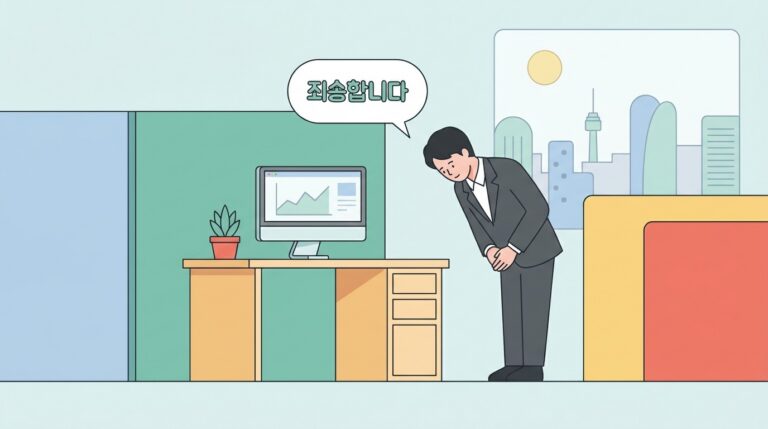
When You Want to Crawl into a Mouse Hole: Vivid Korean Idioms for Shock and Mortification
Phase 1: 공감 (Story-Driven Opening)
안녕하세요! 매일한글 에디터입니다. Have you ever accidentally sent an unfinished draft directly to a high-profile client, or accidentally hit “Reply All” with an internal joke that ruined your team’s hard work? In that split second, cold sweat pours down your spine, your hands tremble, and your heart plummets to your stomach. You don’t just feel “sorry”; you feel completely crushed by guilt toward your teammates.
In standard Korean classes, learners are taught textbook lines like “정말 부끄러웠어요” (I was very embarrassed) or “너무 놀랐어요” (I was so startled). But when real disaster strikes in a Korean office or social circle, those dry words sound flat—almost unbothered! To show genuine remorse and mirror the deep cultural weight of teamwork, native speakers immediately tap into evocative, physical idioms: feeling like you want to shrink into a mouse hole (쥐구멍에라도 들어가고 싶다), feeling your heart drop straight to the floor (가슴이 철렁하다), or feeling your liver shrink into a tiny bean (간이 콩알만 해지다).
Having coached non-native professionals in Seoul for over a decade, I can assure you: knowing how to articulate dread and humble self-awareness is the ultimate milestone of intermediate (B2) fluency. Let’s dive deep into these vivid idioms so you can express your emotions authentically and navigate any Korean social crisis with total confidence!
Phase 2: 핵심 표현 3선 심층 분석 (Top 3 Core Expressions)
1. 쥐구멍에라도 들어가고 싶다 (Jwigumeong-e-rado deureogago sipda)
- Pronunciation: [Jwi-gu-meong-e-ra-do deu-reo-ga-go sip-da] (Sounds like “G-goo-mung-eh-rah-doh dew-ruh-gah-go sheep-dah”)
- Meaning: Lit. “I want to crawl into a rat/mouse hole if there is one” → Actual Nuance: Mortified, dying of embarrassment, wishing the ground would swallow you whole.
- K-Culture Moment: Seen frequently in office K-Dramas like Misaeng (Incomplete Life) when a rookie blunders in front of executives and hides behind the breakroom partition in pure agony.
- Editor’s Insight: The particle “-라도” (even / at least) emphasizes pure desperation. Even a filthy, microscopic rodent hole sounds better than facing people right now!
- Situation Spectrum: Casual ✅ | Semi-formal ✅ | Formal ⚠️ (Acceptable in formal reflection or apologies if accompanied by polite grammar, e.g., “쥐구멍에라도 들어가고 싶은 심정입니다”)
- 🤔 Think About It: In your native tongue, do you “wish the ground would swallow you,” or do you physically hide? Why do Koreans specifically imagine shrinking into a tiny animal’s burrow?
2. 가슴이 철렁하다 (Gaseumi cheolleonghada)
- Pronunciation: [Ga-seu-mi cheol-reong-ha-da] (Sounds like “Gah-seu-mee chul-lung-hah-dah”; the “cheol-reong” sounds like a heavy weight dropping into deep water)
- Meaning: Lit. “My chest clanks / sloshes downwards” → Actual Nuance: One’s heart sinks; a sudden visceral drop in the chest caused by terrible surprise or dread.
- K-Culture Moment: When a K-Drama parent gets a sudden call from the hospital or a manager receives an emergency system error notification at 2 AM.
- Editor’s Insight: This expresses sudden, sharp shock paired with foreboding anxiety. It is more instantaneous and alarming than simple worry (걱정).
- Situation Spectrum: Casual ✅ | Semi-formal ✅ | Formal ✅ (Universally recognized and empathetic across all registers)
- 🤔 Think About It: Notice how Korean attaches psychological distress directly to physical organs (the chest, heart, and liver). What internal organs express fear in your culture?
3. 간이 콩알만 해지다 (Gani kong-alman haejida)
- Pronunciation: [Ga-ni kong-al-man hae-ji-da] (Sounds like “Gah-nee kong-ahl-mahn heh-jee-dah”)
- Meaning: Lit. “One’s liver shrinks to the size of a soybean” → Actual Nuance: Scared stiff; frightened out of one’s wits; terrified to the point of timidity.
- K-Culture Moment: When Korean variety show cast members enter a haunted house on Running Man and screech at every moving shadow.
- Editor’s Insight: In traditional Korean and East Asian medicine, the liver (간) governs courage and boldness. When fear overwhelms you, your massive courage organ withers into a harmless little soybean (콩알)!
- Situation Spectrum: Casual ✅ | Semi-formal ✅ | Formal 🚫 (Too descriptive and slightly self-deprecating for stiff corporate boardrooms)
- 🤔 Think About It: In English, we say someone has “a lot of nerve” or “no guts.” How does viewing the liver as the seat of bravery change your perspective on Korean emotional metaphors?
Phase 3: 교과서 한국어 vs 진짜 한국어 (Textbook vs. Real-Life Korean)
Situation 1: Owning up to a team blunder
- 📖 교과서 한국어: 제 실수 때문에 팀원들에게 정말 미안하고 창피했습니다. (Je silsu ttaemune tim-wondeurege jeongmal mianhago changpihaetseumnida. / Because of my mistake, I was very sorry and embarrassed toward the team members.)
- 🗣️ 진짜 한국어: 제 실수로 팀 전체에 피해를 줘서 진짜 쥐구멍에라도 들어가고 싶은 심정이었어요. (Je silsu-ro tim jeonche-e pihae-reul jwoseo jinjja jwigumeong-e-rado deureogago sipeun simjeong-ieosseoyo. / Because my blunder harmed the whole team, I honestly felt like crawling into a mouse hole.)
- 💡 왜 다를까?: While the textbook version is grammatically correct, using the idiomatic phrase “쥐구멍에라도 들어가고 싶은 심정” demonstrates emotional vulnerability, humility, and acute awareness of communal responsibility.
Situation 2: The moment an email bounce-back or error alarm rings
- 📖 교과서 한국어: 오류 메시지를 보고 깜짝 놀랐습니다. (Oryu mesijireul bogo kkamjjak nollasseumnida. / I was startled when I saw the error message.)
- 🗣️ 진짜 한국어: 시스템 경고창이 뜨는 순간 가슴이 철렁 내려앉았어요. (Siseutem gyeonggochang-i tteuneun sungan gaseumi cheolleong naeryeoanjasseoyo. / The second the system warning popped up, my heart sank completely.)
- 💡 왜 다를까?: Adding 내려앉다 (to collapse downward) after 철렁 paints an irresistible sensory picture of physical shock that dry textbook adverbs like 깜짝 can never match.
Phase 4: K-Culture 딥다이브 & 비언어적 매너 (Deep Dive & Non-Verbal Manners)
4-1. 눈치 (Nunchi), Face, and Body Language
When you commit a blunder that affects others in Korea, words alone are insufficient. Non-verbal codes show whether you truly understand the gravity of your action:
* The Head Dip & Gaze: Never maintain unwavering, assertive eye contact when admitting fault. Lower your chin slightly and cast your eyes downward at a 45-degree angle. Staring directly into a senior’s eyes during an apology can be misread as defiance.
* The Two-Handed Clasp: Keep both hands clasped neatly in front of your lower torso (the polite gongsu posture) rather than in your pockets or crossed over your chest.
* The Sigh of Self-Reflection: A quiet, respectful sigh followed by “면목이 없습니다” (I have no face to present) signals deep contrition.
4-2. Cultural Code: The Burden of “민폐” (Minpye)
In individualistic societies, a mistake at work is often analyzed as an isolated procedural failure. In Korea’s communal culture, however, causing unnecessary trouble for colleagues (민폐를 끼치다) triggers immense internal guilt. The horror isn’t just about getting penalized; it’s about making your teammates stay late or endure scolding on your behalf. That’s why “동료들 볼 면목이 없다” (having no face to show coworkers) and “쥐구멍에 들어가고 싶다” are used constantly—they show you value team harmony above personal ego.
Phase 5: 실전 롤플레이 시나리오 (Roleplay Simulation)
Setting: The open-plan office of a marketing agency in Yeouido, Seoul.
Characters:
* Manager Park (박 팀장): Stern, meticulous, but fair-minded team lead.
* Minji (김민지): Senior peer who quietly supports you.
* You (Alex): Assistant Manager who accidentally uploaded last month’s confidential pricing sheet to a public folder.
- Turn 1 (Manager Park): 🎭 (Staring sharply at his monitor, clicking furiously) 알렉스 씨, 지금 공유 폴더에 올라간 견적서 파일… 이거 지난달 대외비 버전 아니에요? (Alex-ssi, jigeum gong-yu poldeo-e ollagan gyeonjeokseo pail… igeo jinandal daeoebi beojeon anieyo? / Alex, the quotation file uploaded to the shared drive… isn’t this last month’s confidential version?)
- Turn 2 (You): 🎭 (Eyes widening in horror, standing up swiftly) 네? 설마요… 어, 어떡하지… (Ne? Seolmayo… eo, eotteokhaji… / Pardon? No way… oh, what should I do…)
- Turn 3 (Manager Park): 🎭 (Taking off his glasses and rubbing his forehead) 벌써 협력사 세 곳에서 다운로드했어요. 이번 프레젠테이션 수치 다 노출됐습니다. (Beolsseo hyeomnyeoksa se goseseo daunrodeuhaesseoyo. Ibeon peurejenteisyeon suchi da nochuldwaesseoyo. / Three partner firms have already downloaded it. All our presentation figures are exposed.)
- Turn 4 (You): 🎭 (Bowing head deeply, hands folded) 팀장님, 정말 죄송합니다. 메일 알림 보고 순간 가슴이 철렁 내려앉았습니다. (Timjangnim, jeongmal joesonghamnida. Meil allim bogo sungan gaseumi cheolleong naeryeoanjasseumnida. / Manager, I am so sorry. The moment I saw the notification, my heart sank completely.)
- Turn 5 (Minji): 🎭 (Whispering as she checks the server logs) 일단 클라우드 링크부터 즉시 비활성화할게요. 추가 유출은 막아야 해요. (Ildan keulla-udeu ringkeubuteo jeuksi bihwal-seong-hwahalgeyo. Chuga yuchureun mag-aya haeyo. / I’ll immediately disable the cloud link first. We must block further leaks.)
- Turn 6 (You): 🎭 (Looking at Minji and Manager Park with sincere contrition) 제 부주의로 팀 전체에 큰 피해를 드려 동료들 볼 면목이 없습니다. 진짜 쥐구멍에라도 들어가고 싶은 심정입니다. (Je buju-ui-ro tim jeonche-e keun pihaereul deuryeo dongnyodeul bol myeonmogi eopseumnida. Jinjja jwigumeong-e-rado deureogago sipeun simjeong-imnida. / Due to my carelessness, I caused great trouble for the entire team; I have no face to show my colleagues. I feel so mortified I want to crawl into a mouse hole.)
- Turn 7 (Manager Park): 🎭 (Sighing, then nodding calmly) 이미 벌어진 일이니까 자책만 하지 말고, 즉시 협력사에 정정 메일 보내고 수습합시다. (Imi beoreojin irinikka jachaekman haji malgo, jeuksi hyeomnyeoksa-e jeongjeong meil bonaego suseuphapsida. / It has already happened, so don’t just self-blame; let’s immediately send a correction email to partners and fix this.)
- Turn 8 (You): 🎭 (Nodding resolutely) 네! 바로 수정안 작성해서 보고드리겠습니다! (Ne! Baro sujeongan jakseonghaeseo bogodeurigesseumnida! / Yes! I will draft the correction plan and report right away!)
🔀 Interactive Decision Point
How would you respond right after Manager Park points out the fatal mistake?
- Option A: “팀장님, 하지만 민지 씨가 저한테 파일 확인하라고 귀띔도 안 해줬잖아요!” (Manager, but Minji didn’t even tip me off to verify the file!)
- Option B: “팀장님, 제 불찰입니다. 가슴이 철렁했는데, 바로 제가 책임지고 수정 조치하겠습니다.” (Manager, it is my fault. My heart dropped, and I will take responsibility and execute corrective measures immediately.)
- Option C: “하하, 실수할 수도 있죠. 다음부터 잘할게요~” (Haha, mistakes happen! I’ll do better next time~)
Feedback:
* Option A is [BAD]: Blaming a coworker to dodge accountability guarantees total loss of trust in any Korean corporate environment.
* Option B is [BEST]: Admits emotional accountability (가슴이 철렁하다), owns the error humbly (제 불찰), and proposes immediate solutions.
* Option C is [HIGH RISK]: Treating communal damage lightly will make senior colleagues view you as insolent and devoid of professional 눈치.
Phase 6: 10초 감정 섀도잉 드릴 (10-Second Emotion Shadowing)
Practice reading these sentences aloud, pausing precisely at the / marks to mirror native speech cadence.
[😱 충격과 공포로 떨리는 목소리로]
“경고창을 보자각 / 가슴이 철렁 / 내려앉았어요!”
(Gyeonggochang-eul bojakgak / gaseumi cheolleong / naeryeoanjasseoyo! / The moment I saw the warning pop-up / my heart / sank completely!)-
[🥺 고개 숙이며 극도로 미안하고 창피하게]
“팀원들에게 민폐를 끼쳐서 / 쥐구멍에라도 들어가고 싶은 / 심정이에요.”
(Tim-wondeurege minpyereul kkichyeoseo / jwigumeong-e-rado deureogago sipeun / simjeong-ieyo. / Because I burdened the team / I feel like crawling into / a tiny mouse hole.) -
[🥶 식은땀을 닦으며 가슴을 쓸어내리듯]
“팀장님이 부르시는데 / 갑자기 간이 콩알만 해졌어요.”
(Timjangnimi bureusineunde / gapjagi gani kong-alman haejyeosseoyo. / When the team leader called my name / suddenly my courage shrank to a soybean.)
Phase 7: K-Culture 미니 사전 (Mini Dictionary)
-
면목 (Myeonmok) | Face / Honor / Dignity
Usage: Rooted in Hanja (面目 – face and eyes). When you say “면목이 없다“, it literally means “I have no face to present before you.” It represents the highest order of humble apology in professional and personal contexts. -
눈치 (Nunchi) | Social Tact / Situational Intuition
Usage: Reading the unspoken atmosphere. Lacking nunchi (눈치가 없다) when a colleague is stressed or after making a blunder makes you appear selfish. -
민폐 (Minpye) | Nuisance / Inconvenience to Others
Usage: Derived from causing harm to the public. In phrases like “민폐를 끼치다“, it highlights the supreme taboo of burdening your community or team. -
멘붕 (Menbung) | Mental Breakdown (Slang)
Usage: Short for 멘탈 붕괴 (mental collapse). Used casually with close peers when an error overwhelms your ability to think clearly.
Phase 8: 여행자를 위한 생존 키트 (Traveler’s Survival Kit)
Even when traveling rather than working in Seoul, blunders happen—spilling your Americano on someone’s coat or dropping your passport on the subway!
Top 3 Survival Expressions
- 어떡해요, 죄송합니다! (Eotteokhaeyo, joesonghamnida!)
Pro Tip: Exclaiming “어떡해요!” shows immediate, empathetic distress before bowing into your apology. - 제가 실수했어요. (Jega silsuhaesseoyo.)
Pro Tip: Cleanly acknowledges “I made a mistake” without making excuses. - 도와주셔서 정말 다행이에요. (Dowajusyeoseo jeongmal dahaeng-ieyo.)
Pro Tip: Use this when a kind local helps you recover lost items; it means “It is such a relief thanks to your help!”
Editor’s Travel Note
If you ever lose your phone or transit card on the Seoul Metro, don’t panic. Quickly check the station code and search lost property using the 네이버 지도 길찾기 바로가기 subway hub locator. If you need a quick ride while recovering from an emergency blunder, rely on the 카카오 T 택시 호출 다운로드 service for transparent routing and cashless payment.
Phase 9: 한 발 더 깊이 (One Step Deeper)
In Western communication, individual autonomy is celebrated, and errors are frequently framed as individual learning moments. In Korea, however, relational selfhood (우리 – we/us) sits at the foundation of emotional communication. When you blunder, your identity is not detached from your team’s collective standing. Using vivid physical idioms like 쥐구멍에 들어가고 싶다 or 가슴이 철렁하다 serves a deep relational purpose: it shows your peers that their stress is physically felt within your own body. Empathy in Korea isn’t just cognitive agreement; it is shared somatic resonance.
💬 Your Turn: Have you ever experienced a moment at work or school where you wished a mouse hole would open up under your feet? Share your story in the comments below using today’s idioms!
Phase 10: FAQ & 오해 방지 (FAQ & Common Mistakes)
Q: Can I use “쥐구멍에 들어가고 싶다” when laughing with friends about a goofy mistake?
A: Absolutely! It works perfectly in lighthearted banter. For example: “어제 노래방에서 부른 노래 영상 봤는데, 진짜 쥐구멍에라도 들어가고 싶더라!” (I watched the video of me singing at karaoke yesterday, and I honestly wanted to crawl into a mouse hole!).
Q: What is the difference between “가슴이 철렁하다” and “심장이 쿵쾅거리다”?
A: 가슴이 철렁하다 indicates sudden dread, shock, or a sinking feeling (bad news, dropping something valuable). In contrast, 심장이 쿵쾅거리다 denotes a rapid, pounding heartbeat from excitement, heavy running, or romantic attraction toward someone.
Q: Is “간이 콩알만 해지다” rude to say to a boss?
A: You should avoid saying your boss made your liver small, but you can certainly use it self-deprecatingly about yourself: “팀장님 발표 직전에 간이 콩알만 해져서 혼났습니다” (Right before the presentation, my liver shrank to a bean from pure nerves).
🚨 Common Mistakes Board
- ❌ Mistake 1: Translating “My heart broke” directly as “내 심장이 부서졌다” when an error occurs.
Correct Action: Use 가슴이 철렁 내려앉았다 for sudden dread, or 가슴이 아프다 for emotional sorrow. - ❌ Mistake 2: Using 쥐구멍 (mouse hole) without the particle -라도.
Correct Action: Always keep 쥐구멍에라도 intact; that little -라도 conveys the nuance of “even a tiny mouse hole would do!” - ❌ Mistake 3: Smiling brightly while saying “면목이 없습니다.”
Correct Action: Maintain a solemn, humble expression. Smiling while admitting a communal blunder creates severe non-verbal dissonance.
Phase 11: 액션 미션 & 참여 유도 (Action Missions)
- 🥉 Bronze Level: Practice saying 가슴이 철렁했어요 5 times in front of the mirror with genuine shock on your face.
- 🥈 Silver Level: Write a 2-sentence journal entry describing a past embarrassing blunder using 쥐구멍에라도 들어가고 싶은 심정 and post it on your study Instagram or language exchange app.
- 🥇 Gold Level: In your next conversation or Korean tutoring session, describe a suspenseful movie scene using both 가슴이 철렁하다 and 간이 콩알만 해지다.
🎮 K-Culture Mission: Watch episode 1 of the drama Misaeng (미생). Spot the moments when the interns make procedural blunders. Notice their posture, gaze, and expressions when apologizing to their senior managers!
Phase 12: 인터랙티브 퀴즈 챌린지 (Interactive Quiz)
Test your mastery of today’s expressions!
- [Situation Judgment] You accidentally spilled red soup on your coworker’s white desk pad. Which expression best captures your mortification toward them?
- A) 날아갈 것 같아요 (I feel like flying)
- B) 쥐구멍에라도 들어가고 싶은 심정이에요 (I feel like crawling into a mouse hole)
- C) 간이 배 밖으로 나왔어요 (My liver came out of my belly)
- [Fill-in-the-Blank] 시험 결과를 확인하려는 순간, 너무 긴장해서 가슴이 ( ____ ) 내려앉았다.
- A) 콩알
- B) 철렁
- C) 쥐구멍
- [True or False] Saying “동료들 볼 면목이 없다” means you are angry at your colleagues and refuse to look at their faces.
- (True / False)
👉 Click to reveal answers & detailed explanations!
- Answer: B | 쥐구멍에라도 들어가고 싶은 심정이에요 conveys deep embarrassment and mortification. (Option C actually means being recklessly overly bold!)
- Answer: B (철렁) | The classic compound idiom for a sinking heart is 가슴이 철렁 내려앉다.
- Answer: False | 면목이 없다 means you are so deeply remorseful and embarrassed by your own fault that you feel you have no rightful face/honor to stand proudly before them!







