

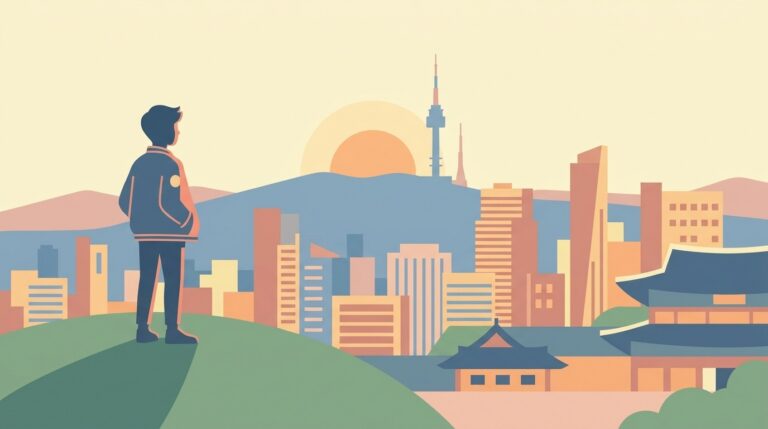
Phase 1: Empathy (스토리 몰입형 오프닝)
안녕하세요! 매일한글 에디터입니다.
Imagine this scene: You have spent three sleepless weeks preparing a complex bilingual presentation for your Korean company’s quarterly review, or perhaps you just completed an intense 15-kilometer charity trail hike along Seoul’s Fortress Wall on Mount Inwang. The grueling challenge is behind you. Your Korean colleague leans back, exhales a long breath of steam into the chilly evening air, and asks warmly: “기분이 어때요? (Gibuni eottaeyo? / How do you feel?)”
In that split second, your brain scrambles for vocabulary. You smile and say, “아주 기뻐요! (Aju gippeoyo! / I’m very happy!)” Your colleague smiles back, but a tiny spark of emotional connection vanishes into the Seoul night. While grammatically correct, “기쁘다” flattens your complex, layered human experience into a 2D cartoon. Did you feel quiet pride from overcoming hardship? Were your eyes welling up with awe? Did you feel a sudden, cathartic lightness in your chest as the lingering burden vanished? Or was it the encouraging sensation that your future path looks brighter?
In natural C1-level Korean, joy is never one-size-fits-all. When you master the delicate nuances separating 뿌듯하다 (quiet, earned fulfillment), 벅차오르다 (breathtaking, overwhelming awe), 고무적이다 (promising, morale-boosting momentum), and 후련하다 (unburdened catharsis), you instantly cross the bridge from an articulate foreigner to someone who understands the very heartbeat of Korean emotional expression.
Phase 2: 핵심 표현 3선 심층 분석
1. 뿌듯하다 (Ppudeuthada)
- Pronunciation: [Ppu-deut-ha-da] (Pronounce the initial double-p with a tense pop like ‘spring’, glide into a grounded ‘deut’ similar to ‘good’ without the ‘g’, and finish on an open ‘ha-da’).
- Meaning: Literal: Swollen full / puffed up. Actual Nuance: A deep, quiet warmth of self-worth and inner fulfillment derived from your own hard-earned effort or doing good for others.
- K-Culture Moment: In the beloved medical drama Hospital Playlist, when Dr. Chae Song-hwa sits quietly in her office past midnight with a cup of warm barley tea, smiling softly after saving a patient through a ten-hour surgery.
- Editor’s Insight: You do not feel 뿌듯하다 when you win the lottery or receive an accidental discount. It requires “effort + value” (보람). It represents wholesome pride that does not boast outwardly, but makes your chest feel comfortably full.
- Situation Spectrum: Casual: ✅ | Semi-formal: ✅ | Formal: ✅
- 🤔 Think About It: Does your native tongue have a word for “pride” that is completely stripped of ego or arrogance? How does Korean language protect personal fulfillment from turning into boastfulness?
2. 벅차오르다 (Beokchaoreuda)
- Pronunciation: [Beok-cha-o-reu-da] (Start with a punchy ‘beok’ like ‘buck’, transition to an explosive ‘cha’, then let ‘o-reu-da’ lift like a wave washing ashore).
- Meaning: Literal: To surge beyond capacity. Actual Nuance: Emotional overwhelm where joy, gratitude, or triumph is so grand that your chest physically cannot contain it, bringing you to the verge of tears.
- K-Culture Moment: At the MAMA Awards or Melon Music Awards, when a K-Pop group hears their name called for “Album of the Year” after years of anonymous trainee hardship, clutching the trophy with trembling hands and tear-filled eyes.
- Editor’s Insight: Be cautious: the root verb 벅차다 on its own can mean “beyond one’s capacity / exhausting” (e.g., 힘에 벅차다). However, when combined with 오르다 (to rise), it almost universally becomes a sublime, breathtaking sensation of transcendent joy.
- Situation Spectrum: Casual: ✅ | Semi-formal: ✅ | Formal: ✅ (Often used in speeches, memoirs, and moving celebrations)
- 🤔 Think About It: Why does Korean describe intense triumph through words of “overflowing weight” rather than simple lightness? Have you experienced joy so heavy it almost felt like sorrow?
3. 고무적이다 (Gomujeogida)
- Pronunciation: [Go-mu-jeo-gi-da] (A resonant ‘go’, smooth ‘mu’, followed by a rhythmic, crisp ‘jeo-gi-da’).
- Meaning: Literal: To encourage by beating a drum (鼓舞). Actual Nuance: Inspiring, highly encouraging, and morale-boosting—especially in strategic, professional, or academic settings.
- K-Culture Moment: In corporate dramas like Misaeng (Incomplete Life) or Start-Up, when an executive reviews a pilot product’s retention metrics and delivers a firm, reassuring nod to the anxious development team.
- Editor’s Insight: You would never use 고무적이다 for finishing a delicious meal. It belongs in contexts where tangible positive signs instill hope, energize a group, and validate long-term collective strategy.
- Situation Spectrum: Casual: ⚠️ (Can sound playfully academic among close peers) | Semi-formal: ✅ | Formal: ✅
- 🤔 Think About It: Western business settings often rely on casual words like “Awesome!” or “Exciting!” Why does Korean professional culture prefer an analytical adjective like 고무적이다 to validate hard work?
Phase 3: 교과서 한국어 vs 진짜 한국어
Situation 1: After submitting a grueling master’s thesis or completing a year-long project
- 📖 교과서 한국어: “마침내 논문 제출을 끝내서 아주 기쁘고 행복합니다.” (Machimnae nonmun jechuleul kkeunnaeseo aju gippeugo haengbokhamnida. / I am very happy and glad that I finally submitted my thesis.)
- 🗣️ 진짜 한국어: “드디어 제출하고 나니까 십 년 묵은 체증이 내려간 것처럼 속이 다 후련해요!” (Deudieo jechulhago nanikka sip nyeon mugeun chejeungi naeryeogan geotcheoreom sogi da huryeonhaeyo! / Now that it’s submitted, it feels like a decade-old indigestion just cleared away—my chest feels completely unburdened and refreshed!)
- 💡 왜 다를까?: Textbook Korean relies on broad emotional states like “기쁘다” or “행복하다.” Native speakers reach for somatic, bodily release descriptors like 후련하다 (cathartic unburdening) when chronic psychological tension finally dissolves.
Situation 2: Reporting promising early metrics to your team leader
- 📖 교과서 한국어: “새로운 서비스 결과가 우리에게 큰 기쁨을 줍니다.” (Saeroun seobiseu gyeolgwaga uriege keun gippeumeul jumnida. / The new service result gives us great joy.)
- 🗣️ 진짜 한국어: “초기 반응이 예상치를 훨씬 웃돌아서 팀 분위기상 대단히 고무적인 상황입니다.” (Chogi baneungi yesangchireul hwolssin utdoraseo tim bunwigisang daedanhi gomujeogin sanghwang-imnida. / Early customer reaction far exceeds our projections, making this an exceptionally encouraging development for our team’s morale.)
- 💡 왜 다를까?: In advanced corporate and institutional environments, personal emotional words sound naive. Describing circumstances as 고무적이다 demonstrates mature professional perspective and collective optimism.
Phase 4: K-Culture 딥다이브 & 비언어적 매너
4-1. 눈치(Nunchi) & 제스처
Expressing intense joy in Korean cultural spaces requires sophisticated calibration between authentic warmth and modest restraint (겸손):
* When feeling 뿌듯하다: Avoid high-fiving the entire room or pumping your fist in someone’s face. Instead, place one hand gently against your upper chest or stroke the back of your neck with a quiet, grounded smile. This non-verbal cue signals: “I am deeply satisfied with our work, but I stay humble.”
* When feeling 벅차오르다: It is customary to break eye contact briefly, gaze upward while inhaling, or lightly press both hands to your collarbones. This acknowledges that the emotional volume has surpassed your immediate composure.
* When feeling 고무적이다: In a meeting, an upright posture accompanied by slow, decisive nodding communicates that you are motivated and ready for the next strategic phase.
4-2. 문화 코드 분석: The Architecture of Joy from ‘한(恨)’ to ‘흥(興)’
Korean culture’s rich taxonomy of positive emotion cannot be divorced from its history of endurance (인내). Joy is rarely experienced as a frivolous, detached phenomenon; it is almost always the hard-won redemption of struggle. That is why 보람 (worthwhile meaning) is central to self-worth. When a long, agonizing ordeal ends, the joy isn’t just excitement—it is 후련함 (the purge of worry). When collective effort bears fruit, the joy isn’t just fun—it is 벅차오름 (a tidal swell of shared tears and gratitude). Understanding this turns your vocabulary from memorized flashcards into cultural literacy.
Phase 5: 실전 롤플레이 시나리오
Setting: A dynamic tech studio in Seongsu-dong, Seoul. It is 8:30 PM on the evening following the global beta release of their new app.
Characters:
* 팀장 민석 (Team Leader Min-seok): A sharp, supportive product lead with ten years of startup battle scars.
* You (Learner): Senior UX researcher who spent months refining the product’s localized experience.
민석: “이번 글로벌 베타 테스트 지표 확인했어? 해외 유저 유입률이 첫날부터 목표치의 세 배를 찍었더라고.” (Ibeon geullobeol beta teseuteu jipyohwaginhaesseo? Hae-oe yujeo yuimnyuri cheonnambuteo mokpyochieui se baereul jjigeotdeorago. / Did you check the global beta test metrics? Overseas user acquisition hit three times our target on day one.) 🎭 [모니터를 가리키며 담담하지만 감출 수 없는 미소를 짓는다]
You: “네, 팀장님! 지난 석 달 동안 팀원들과 밤새우며 고민했던 순간들이 스쳐 지나가면서 가슴이 벅차올라요.” (Ne, timjangnim! Jinan seok dal dongan tim-wondeulgwa bamsae-umyeo gomimhaetdeon sungandeuri seuchyeo jinagamyeonseo gaseumi beokchaollayo. / Yes, Team Leader! Remembering all those sleepless nights we debated together over the past three months, my chest swells with deep emotion.) 🎭 [두 손을 가슴에 얹고 깊은 숨을 내쉬며]
민석: “맞아. 초기 기획 단계에서는 다들 반신반의했는데, 시장 반응이 이 정도면 정말 고무적인 출발이지.” (Maja. Chogi gihoek dangyeeoseoneun dadeul bansinban-uihaenneunde, sijang baneungi i jeongdomyeon jeongmal gomujeogin chulbariji. / Indeed. In early planning everyone was skeptical, but with market reaction like this, it is truly an encouraging beginning.) 🎭 [서류철을 덮으며 안도하는 고개 끄덕임]
You: “네, 론칭 직전까지 알 수 없는 버그 때문에 정말 피가 마르는 줄 알았는데, 큰 산 하나를 넘고 나니 속이 다 후련합니다.” (Ne, ronching jikjeonkkaji al su eomneun beogeu ttaemune jeongmal piga mareuneun jul aranneunde, keun san hanareul neomgo nani sogi da huryeonhamnida. / Yes, fixing unpredictable bugs right before launch was nerve-wracking, but having overcome that massive hurdle, I feel such an immense sense of relief.) 🎭 [어깨에 묵직했던 힘을 완전히 빼며]
민석: “정말 수고 많았어. 네가 끝까지 포기하지 않고 사용자 피드백을 집요하게 분석해 준 덕분이야.” (Jeongmal sugo manasseo. Nega kkeutkkaji pogihaji anko sayongja pideubaegeul jibyohage bunseokhae jun deokbuniya. / You worked so hard. It’s thanks to your relentless analysis of user feedback without giving up.) 🎭 [어깨를 가볍게 툭 쳐주며 진심 어린 눈빛으로]
You: (Branching Interactive Point — How do you respond?)
민석: “좋아! 이 고무적인 기세를 몰아서 다음 주 쇼케이스도 멋지게 밀어붙여 보자고. 오늘 저녁 삼겹살은 내가 쏜다!” (Joa! I gomujeogin giseleul moraseo da-eum ju syokeiseudo meotjige mireobutyeo bojago. Oneul jeonyeok samgyeopsareun naega ssonda! / Awesome! Let’s ride this encouraging momentum and make next week’s showcase spectacular. Tonight’s pork belly is on me!) 🎭 [유쾌하게 지갑을 꺼내 흔들며]
You: “감사합니다, 팀장님! 오늘만큼은 밤샘 걱정 없이 뿌듯한 마음으로 푹 쉬겠습니다!” (Gamsahamnida, timjangnim! Oneulmankeumeun bamsaem geokjeong eopsi ppudeutan ma-eumeuro puk swigessumnida! / Thank you, Team Leader! Tonight at least, I’ll rest thoroughly with a deeply fulfilled heart without worrying about all-nighters!) 🎭 [활짝 웃으며 가볍게 목례한다]
🔀 인터랙티브 분기점 (Choose your response for Turn 6):
- Option A: “동료들이 믿고 받쳐준 덕분이죠. 제 노력이 팀에 작은 보탬이 된 것 같아 참 뿌듯합니다.” (Dongnyodeuri mitgo batchyeojun deokbun-ijyo. Je noryeogi time jageun botaemi doen geot gata cham ppudeuthamnida.)
- Outcome: [Best Choice] Superb C1 balance. It attributes structural success to the team while honoring your authentic inner fulfillment (뿌듯하다).
- Option B: “제가 데이터 천재라서 다 해결한 거라 지금 너무 신나고 기쁩니다!” (Jega de-iteo cheonjaeraseo da haegyeolhan geora jigeum neomu sinnago gippeumnida.)
- Outcome: [Bad Choice] Sounds self-aggrandizing and flippant. It undermines collective camaraderie and relies on generic, elementary descriptors.
- Option C: “그냥 운이 좋았을 뿐이라 저한테는 아무런 감흥도 없습니다.” (Geunyang uni joasseul ppunira jeohanteneun amureon gamheungdo eopseumnida.)
- Outcome: [Risk Choice] Excessive self-deprecation dampens the celebratory atmosphere and unintentionally trivializes your coworkers’ mutual hard work.
Phase 6: 10초 감정 섀도잉 드릴
Practice these lines aloud. Focus on the emotional cues and pauses indicated by the slash (/):
[😊 뿌듯하고 잔잔한 자부심]
“작은 프로젝트였지만 / 제 손으로 끝까지 완성해 내서 / 마음이 참 뿌듯해요.” (Jageun peurojekteuyeotjiman / je soneuro kkeutkkaji wanseonghae naeseo / ma-eumi cham ppudeuthaeyo. / Even though it was a small project / completing it with my own hands to the end / makes my heart feel genuinely fulfilled.)-
[🥺 벅차오르는 감격과 뭉클함]
“무대 위에 선 순간 / 지난 시간들의 고생이 떠올라 / 가슴이 벅차올랐습니다.” (Mudae wie seon sungan / jinan sigandeureui gosaengi tteoolla / gaseumi beokchaollassumnida. / The moment I stood on stage / remembering the hardships of past times / an overwhelming surge of emotion filled my chest.) -
[💼 진지하고 희망찬 비즈니스 톤]
“이번 분기 지표 개선은 / 조직 전체의 사기 진작에 / 대단히 고무적인 성과입니다.” (Ibeon bungi jipyo gaeseoneun / jojik jeonche-eui sagi jinjage / daedanhi gomujeogin seongkwa-imnida. / This quarter’s metric improvements / for boosting our entire organization’s morale / are an exceptionally encouraging achievement.) -
[💨 무거운 짐을 내려놓은 홀가분함]
“마지막 시험까지 다 치르고 나니까 / 얹혔던 게 싹 내려간 듯 / 속이 다 후련하네요.” (Majimak siheomkkaji da chireugo nanikka / eonhyeotdeon ge ssak naeryeogan deut / sogi da huryeonhaneyo. / Having finished the final exam / as if an old knot melted away / I feel completely relieved and light.)
Phase 7: K-Culture 미니 사전 (핵심 키워드 4개)
- 보람 (Boram) | The rewarding fruit of effort | The psychological and ethical value earned by doing something worthwhile. Essential partner to 뿌듯하다 (e.g., “보람을 느끼다”).
- 벅차다 (Beokchada) | To be full to bursting / overwhelming | When used neutrally/negatively, it describes tasks beyond one’s strength. When paired as 벅차오르다, it denotes tears of emotional ecstasy.
- 후련하다 (Huryeonhada) | Cathartically unburdened | The crisp, refreshing sensation when anxiety, lingering obligations, or long-held grudges disappear.
- 고무적 (Gomujeok) | Morale-boosting / Encouraging | A Sino-Korean noun/determiner used in professional discourse to denote a circumstance that inspires future confidence and forward progress.
Phase 8: 여행자를 위한 생존 키트
서바이벌 표현 TOP 3:
- “산 정상에 오르니까 진짜 뿌듯하네요!” (San jeongsang-e oreunikka jinjja ppudeuthaneyo! / Reaching the mountain peak feels truly fulfilling!)
- Pro Tip: Use this when climbing Namsan or Bukhansan with local hiking buddies. It shows you value the physical perseverance.
- “드디어 비자 문제 해결하고 나니 속이 후련해요.” (Deudieo bija munje haegyeolhago nani sogi huryeonhaeyo! / Having finally sorted out my visa issues, I feel so relieved!)
- Pro Tip: Perfect for venting with foreign-exchange colleagues after grueling administrative paperwork in Mokdong Immigration Office.
- “다행히 날씨가 갤 기미가 보여서 참 고무적입니다.” (Dahaenghi nalssiga gael gimiga boyeoseo cham gomujeogimnida. / Fortunately, seeing signs of the weather clearing up is very encouraging.)
- Pro Tip: Drops of sophisticated vocabulary in travel planning will impress Korean travel guides and tour organizers.
Editor’s Travel Note:
When hiking in Korea, navigating complex public transit is half the battle. Skip Google Maps—which offers limited transit walkthroughs in Korea—and install the Naver Map navigation mobile application. When taking long-distance trains from Seoul to Busan, make your reservations easily via the Korail Talk official train ticket booking app. Arriving on time without getting lost will leave you feeling genuinely 뿌듯하다!
Phase 9: “한 발 더 깊이” (생각 질문)
In Western languages, happiness is frequently categorized as an individualistic, hedonistic state—something you “acquire” or feel in personal isolation. Korean emotional adjectives, however, reflect an interconnected web of social duties and shared labor. We feel 뿌듯하다 not because we are better than someone else, but because our sweat produced genuine meaning. We describe news as 고무적이다 because optimism is an energy that propels our community forward. Korean joy is not a static snapshot; it is the kinetic release of shared endurance.
💬 Your Turn: Think about your recent achievements in studying Korean. Which emotion describes your journey best today: Are you feeling 뿌듯하다 from reading this comprehensive guide, or 후련하다 from conquering these elusive nuances? Tell us your story in the comments below!
Phase 10: FAQ & 오해 방지 (FAQ Schema)
Q: Can I use ‘뿌듯하다’ when someone hands me a surprise birthday present?
A: No. Receiving an unexpected gift brings excitement or thankfulness (기쁘다, 감사하다), but not 뿌듯하다. 뿌듯하다 requires your own input of labor, dedication, or righteous conduct. You feel 뿌듯하다 when you meticulously plan a surprise birthday celebration for a friend and watch their face light up.
Q: What is the difference between ‘시원하다’ and ‘후련하다’?
A: 시원하다 primarily describes physical coolness, relief from thirst, soothing soup temperatures, or mild relaxation. 후련하다 is almost exclusively psychological and cathartic—it means an oppressive worry, secret, or pending obligation has vanished from your consciousness.
Q: Is ‘고무적이다’ ever used in casual spoken slang among university students?
A: Usually only as witty, playful banter. If your friend is studying for a blind date and mentions their crush texted back in 30 seconds, replying: “그거 대단히 고무적인 시그널인데? (Geugeo daedanhi gomujeogin sigeuneorinde? / That’s a highly encouraging strategic signal!)” creates an ironic, mock-serious comedic effect.
🚨 흔한 실수 (Common Mistakes) 경고판:
- Mistake 1: Saying “오늘 복권에 당첨돼서 너무 뿌듯해요” (I feel so 뿌듯 because I won the lottery).
- Correct Action: Use 기뻐요 or 신나요. You didn’t work for lottery luck!
- Mistake 2: Using 벅차오르다 for everyday casual amusement, like watching a funny YouTube cat video.
- Correct Action: Reserve 벅차오르다 for profound, momentous occasions that stir your heart to its depths.
- Mistake 3: Using 고무적이다 to comfort an individual crying in grief.
- Correct Action: 고무적이다 is analytical and forward-looking. Use compassionate interpersonal phrases like 힘내세요 or 곁에 있어 줄게요.
Phase 11: 액션 미션 & 참여 유도
- 🥉 Bronze Mission (Solo Shadowing): Record yourself reading the 4 sentences from Phase 6 on your smartphone. Focus on matching the rhythmic pauses and breathing dynamics.
- 🥈 Silver Mission (SNS Sharing): Write a one-sentence Korean journal entry on Threads or Instagram using either 뿌듯하다 or 후련하다 about a goal you finished today. Tag
#DailyHangul! - 🥇 Gold Mission (Real Conversation): Next time your Korean tutor or friend asks about your week, skip “좋았어요” and deliberately use: “이번 주에 밀린 일들을 다 끝내서 속이 정말 후련해요!”
🎮 K-Culture Mission: Watch the final episode of your favorite drama (like Itaewon Class or Twenty-Five Twenty-One). Listen for characters using 후련하다 as long conflicts close, or 벅차다 during climactic triumphs!
Phase 12: 인터랙티브 퀴즈 챌린지
1. 상황 판단 (Situational Judgment)
Your project group just secured second-round angel investment after demonstrating an exceptional prototype. What is the most natural corporate phrasing to describe this event?
* A) 팀원 모두가 너무 후련해서 잠이 듭니다.
* B) 투자 유치는 사업 확장을 위해 대단히 고무적인 결과입니다.
* C) 아무 노력도 안 했는데 뿌듯한 하루네요.
2. 빈칸 채우기 (Fill-in-the-Blank)
“주말 동안 방 청소와 빨래를 모두 마치고 책상 앞에 앉으니 마음이 참 ( ).”
* (힌트: 보람 있고 스스로 대견하여 가슴이 훈훈한 상태)
3. True / False 문화 퀴즈
- Q: 벅차다 can mean both “overwhelmingly joyful (벅차오르다)” and “physically/mentally exhausting (힘에 벅차다)” depending on grammatical coupling and context. (T / F)
정답 및 해설 확인하기 (Click to reveal answers)
- 상황 판단 정답: B
- 해설: An investment milestone signaling future success is a textbook scenario for 고무적이다. Option A incorrectly pairs relief with sleep in a pitch context, and Option C contradicts the definition of 뿌듯하다 (which requires genuine effort).
- 빈칸 채우기 정답: 뿌듯하다 (or 뿌듯해요 / 뿌듯합니다)
- 해설: Cleaning your living space with your own hands brings modest, wholesome self-satisfaction and productive fulfillment.
- True / False 정답: True (T)
- 해설: 벅차다 signifies capacity being exceeded. When an ordeal exceeds your energy, it means “too demanding” (벅차다); when joy fills your chest to overflowing, it becomes 가슴이 벅차오르다.







