

Crafting Your Signature Scent: Sensory Korean for Niche Perfume Workshops
Phase 1: Empathy & Immersion Opening
안녕하세요! 매일한글 에디터입니다. (Hello! This is your Daily Hangul editor.)
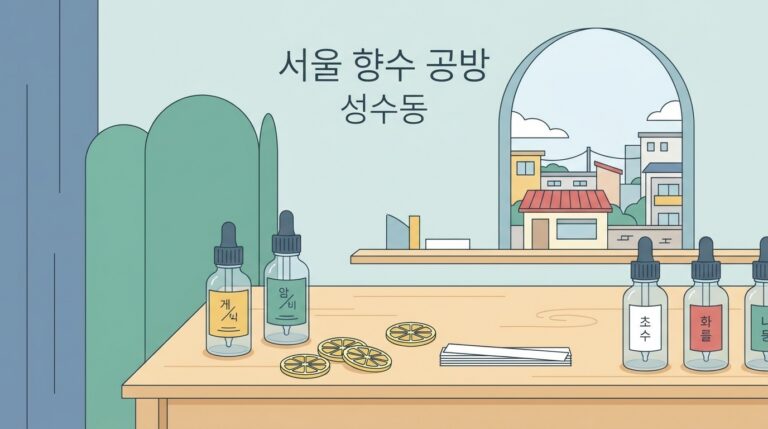
Picture this: you are walking down an idyllic, brick-paved alley in Seongsu-dong or Hannam-dong, Seoul’s trendiest creative hubs. You step down into a softly lit niche perfumery atelier. The air is alive with the whispering crackle of cedarwood, dried vetiver, and delicate florals. A friendly perfumer (조향사, johyangsa) in a linen apron greets you and lays out three pristine white blotter strips (시향지, sihyangji).
You lift the first strip to your nose. It hits you instantly—a sparkling, mouthwatering burst of Sicilian bergamot and pink pepper that tingles your senses. You want to express this precise sensation: how it pops open with energy, how it tickles the top of your nose with crisp vibrance. But your mind freezes. You panic and mutter: “이거… 좋아요. 레몬 냄새?” (Igeo… joayo. Lemon naemsae? / “This is… good. Lemon smell?”). The perfumer smiles warmly, but you feel that sting of frustration. You knew what you felt, yet the vivid sensory nuance was trapped behind textbook vocabulary.
Describing fragrances in Korean is an art form. Unlike English, which often relies on Latinate descriptors or chemical names, Korean boasts an extraordinarily rich palette of synesthetic, mimetic sensory words (의성어 and 의태어). When you can articulate how a top note (탑 노트) sparkles or leaves a piquantly crisp punch, you unlock a deeper layer of cultural sophistication. Today’s guide is built straight from the field notes of intermediate learners who transformed their studio experience from awkward nodding into nuanced, creative artistic collaboration. Let’s bottle that magic together!
Phase 2: Deep Dive into 3 Core Sensory Expressions
1. 상큼하게 터지다 (Sang-keum-ha-ge teo-ji-da)
- Pronunciation: [Sang-keum-ha-ge teo-ji-da] (Think of sang like “song” with an ah, keum like “come” with your teeth together, and teojida sounding like “tuh-jee-dah”).
- Meaning: Literal: “To burst sour-sweetly/freshly.” Nuance: Describing a fizzy, zesty citrus explosion that instantly awakens the palate or nose.
- K-Culture Moment: You will hear this constantly on beauty talk shows like Get It Beauty or vlogs where K-pop idols unveil their personal fragrance pouches (왓츠인마이백). When introducing a summer Eau de Cologne, they describe the opening as “상큼하게 톡 터지는 느낌” (sang-keum-ha-ge tok teo-ji-neun neu-kkim).
- Editor’s Insight: 상큼하다 is far more delicate than 시다 (sour/acidic). While 시다 might make your face scrunch up like eating a raw lime, 상큼하다 evokes clean vitality, like biting into a chilled mandarin orange slice on a warm afternoon.
- Situation Spectrum: Casual ✅ | Semi-formal ✅ | Formal ⚠️
- 🤔 Think About It: English uses visual metaphors for scent (“bright”, “sharp”), but Korean often uses tactile-kinetic action verbs like 터지다 (to burst). Why do you think Korean expresses dynamic movement when describing an aroma?
2. 알싸하다 (Al-ssa-ha-da)
- Pronunciation: [Al-ssa-ha-da] (Pronounce the double ss with tight, tense breath: Ahl-SSA-ha-dah).
- Meaning: Literal: “To be pleasantly pungent / tingling / piquantly sharp.” Nuance: A crisp, peppery tingle that clears your nasal passages without burning them.
- K-Culture Moment: While foodies use this to praise freshly ground garlic or mustard greens in K-food shows, perfumers use it to pinpoint pink pepper, cardamom, or ginger top notes.
- Editor’s Insight: This word captures that sophisticated “kick.” If a perfume is purely citrus, it might smell like dish soap or generic room spray; adding an 알싸한 핑크페퍼 note gives it an edgy, high-end niche character.
- Situation Spectrum: Casual ✅ | Semi-formal ✅ | Formal ✅
- 🤔 Think About It: How does your native language distinguish between painful spiciness and pleasant aromatic tingling? Notice how Korean divides 매콤하다 (culinary spicy), 얼큰하다 (deep/warm broth spicy), and 알싸하다 (nasal, tingling spicy).
3. 코끝을 스치다 (Ko-kkeut-eul seu-chi-da)
- Pronunciation: [Ko-kkeut-eul seu-chi-da] (Ko like “cold”, kkeut with a tense k and flat vowel, seu-chee-dah).
- Meaning: Literal: “To graze the tip of one’s nose.” Nuance: To catch a subtle, fleeting, delicate whiff of scent that dances past rather than overpowering you.
- K-Culture Moment: A staple trope in K-Dramas (such as Guardian: The Lonely and Great God or My ID is Gangnam Beauty). When the female or male lead walks past on a rainy crosswalk, their scent 코끝을 스치며 sparks an unforgettable memory.
- Editor’s Insight: In Korean aesthetics, an overpowering scent is considered rude (민폐). Describing a fragrance note as something that 코끝을 스친다 praises its polite, airy diffusion.
- Situation Spectrum: Casual ✅ | Semi-formal ✅ | Formal ✅
- 🤔 Think About It: In what ways does your culture value projection (leaving a heavy trail) versus subtlety (intimate radius) when wearing fragrance?
Phase 3: Textbook Korean vs. Real Native Korean
Situation 1: Describing the initial burst of citrus top notes
- 📖 Textbook Korean:
“이 향수는 레몬 향이 강하게 납니다.”
(I hyang-su-neun lemon hyang-i gang-ha-ge nap-ni-da. / “This perfume smells strongly of lemon.”) - 🗣️ Real Native Korean:
“뿌리자마자 시트러스 향이 상큼하게 팡 터지네요!”
(Ppu-ri-ja-ma-ja si-teu-reo-seu hyang-i sang-keum-ha-ge pang teo-ji-ne-yo! / “Right after spraying, the citrus note bursts open so refreshingly!”) - 💡 Why the difference? Textbook phrasing relies on the flat verb 나다 (to smell/occur) and adverb 강하게 (strongly), which sounds clinical. Native Korean speakers at B2 level use temporal connective -자마자 (as soon as) paired with sensory adverbs like 상큼하게 and mimetic flair (팡).
Situation 2: Expressing that a spicy/pepper note isn’t too overpowering
- 📖 Textbook Korean:
“후추 냄새가 나쁘지 않고 조금 맵습니다.”
(Hu-chu naem-sae-ga na-ppeu-ji an-ko jo-geum maep-seum-ni-da. / “The pepper smell is not bad and is a little spicy.”) - 🗣️ Real Native Korean:
“핑크페퍼 특유의 알싸한 느낌이 과하지 않고 은은해요.”
(Ping-keu-pe-peo teuk-yu-ui al-ssa-han neu-kkim-i gwa-ha-ji an-ko eun-eun-hae-yo. / “The characteristic piquant tingle of pink pepper isn’t overwhelming; it’s pleasantly subtle.”) - 💡 Why the difference? 냄새 (naemsae) can sometimes carry a negative or foul connotation (like body odor or garbage), whereas 향 (hyang) or 느낌 (feeling) elevates the item. Saying something is 은은하다 (soft, delicately lingering) instantly conveys aesthetic taste.
Phase 4: K-Culture Deep Dive & Non-Verbal Manners
4-1. Nunchi & Atelier Etiquette
When testing fragrances in an artisanal workshop in Seoul:
1. The Gentle Fan (부채질 제스처): Never shove the 시향지 (blotter) straight into your nostrils. Hold it about 5 to 10 centimeters away and wave it gently toward your nose. Inhaling too forcefully right away can numb your olfactory receptors and shows a lack of patience.
2. The 30-Second Rule: Korean perfumers will explicitly caution: “알코올이 날아갈 때까지 5초만 기다려 주세요” (Please wait 5 seconds for the alcohol to evaporate). Never smell the blotter the exact millisecond after misting.
3. Olfactory Fatigue & The Coffee Bean Reset: If your nose feels blocked, do not blow your nose loudly inside the quiet atelier. Look for the small jar of roasted coffee beans on your tray, cup your hands lightly around it, and inhale deeply while making polite eye contact with the artisan.
4-2. The “Niche Scent” (니치 향수) Boom in Korea
In contemporary Korean urban culture, perfume is no longer just hygiene—it is an extension of personal identity known as one’s “인생향수” (life perfume) or “살냄새” (sal-naem-sae, natural skin scent). The mainstream appeal of generic luxury designer perfumes has shifted dramatically toward bespoke, small-batch indie perfume houses in neighborhoods like Seongsu, Bukchon, and Yeonnam. Korean youth seek scents that convey understated elegance: woody, herbal, and delicate citrus notes that match clean, minimalist fashion.
Phase 5: Real-Life Roleplay Scenario
Setting: A sunlit, botanical-filled perfume studio near Seoul Forest. You are sitting at a dark walnut blending desk with Master Perfumer Soyul (소율).
Character Profile: Soyul is gentle, perceptive, and passionate about natural botanical essences.
Turn 1
* 🎭 조향사 소율: “안녕하세요! 오늘 어떤 분위기의 나만의 향수를 만들고 싶으세요?”
(An-nyeong-ha-se-yo! O-neul eo-tteon bu-nwi-gi-ui na-man-ui hyang-su-reul man-deul-go sip-eu-se-yo?)
Translation: “Hello! What kind of mood would you like to capture in your signature perfume today?”
🎭 Action: Hands you a warm cup of barley tea and places three numbered glass droppers in front of you.
Turn 2
* 🎭 Alex (You): “처음 뿌렸을 때 기분이 좋아지는 상큼한 향이었으면 좋겠어요.”
(Cheo-eum ppu-ryeoss-eul ttae gi-bun-i jo-a-ji-neun sang-keum-han hyang-i-eoss-eu-myeon jok-gess-eo-yo.)
Translation: “I’d love a refreshing, zesty scent that lifts my mood the moment it’s sprayed.”
Turn 3
* 🎭 조향사 소율: “좋아요! 그렇다면 탑 노트로 시트러스나 스파이시 계열을 추천해 드릴게요. 이 시향지 한번 맡아보시겠어요?”
(Jo-a-yo! Geu-reoh-da-myeon tap no-teu-ro si-teu-reo-seu-na seu-pa-i-si gye-yeol-eul chu-cheon-hae deu-ril-ge-yo. I si-hyang-ji han-beon mat-a-bo-si-gess-eo-yo?)
Translation: “Great! In that case, I recommend citrus or spicy families for the top notes. Would you like to smell this blotter strip?”
🎭 Action: Dips a blotter into bergamot oil and waves it once before offering it to you.
Turn 4
* 🎭 Alex (You): “와, 베르가못 향이 상큼하게 팡 터지네요! 전혀 답답하지 않아요.”
(Wa, be-reu-ga-mot hyang-i sang-keum-ha-ge pang teo-ji-ne-yo! Jeon-hyeo dap-dap-ha-ji an-a-yo.)
Translation: “Wow, the bergamot note bursts open so refreshingly! It doesn’t feel stifling at all.”
🎭 Action: Holds the strip a hand’s breadth away, closing eyes to savor the vapor.
Turn 5
* 🎭 조향사 소율: “맞아요. 보통 첫 15분에서 30분 동안 퍼지는 탑 노트에는 이런 감귤류가 제격이죠. 여기에 약간의 반전을 주면 어떨까요?”
(Maj-a-yo. Bo-tong cheot sip-o-bun-e-seo sam-sip-bun dong-an peo-ji-neun tap no-teu-e-neun i-reon gam-gyul-ryu-ga je-gyeok-i-jyo. Yeo-gi-e yak-gan-ui ban-jeon-eul ju-myeon eo-tteol-kka-yo?)
Translation: “Exactly. For the top notes that diffuse during the first 15 to 30 minutes, citrus like this is ideal. How about adding a little unexpected twist?”
Turn 6
* 🎭 Alex (You): “반전이요? 조금 더 유니크한 향을 더할 수 있을까요?”
(Ban-jeon-i-yo? Jo-geum deo yu-ni-keu-han hyang-eul deo-hal su iss-eul-kka-yo?)
Translation: “A twist? Could we add something a bit more unique?”
Turn 7
* 🎭 조향사 소율: “그럼 알싸한 핑크페퍼를 한 방울 섞어보세요. 시트러스의 상큼함을 확 살려주거든요.”
(Geu-reom al-ssa-han ping-keu-pe-peo-reul han bang-ul seokk-eo-bo-se-yo. Si-teu-reo-seu-ui sang-keum-ham-eul hwak sal-lyeo-ju-geo-deun-yo.)
Translation: “Then try blending in one drop of piquant pink pepper. It really makes the citrus freshness pop.”
Turn 8
* 🎭 Alex (You): “정말이네요! 알싸한 느낌이 코끝을 스치면서 훨씬 세련되게 느껴져요.”
(Jeong-mal-i-ne-yo! Al-ssa-han neu-kkim-i ko-kkeut-eul seu-chi-myeon-seo hwol-ssin se-ryeon-doe-ge neu-kkyeo-jyeo-yo.)
Translation: “You’re so right! The tingling touch grazing my nose makes it feel significantly more sophisticated!”
🔀 Interactive Decision Branch
Now it’s your turn to choose the next top note modifier with Soyul. What will you say?
- Option A: “향이 너무 세서 머리가 아파요. 다른 거 없어요?” (The smell is way too strong and gives me a headache. Don’t you have anything else?)
- Option B: “상큼한 향은 좋은데, 너무 달콤한 느낌보다는 쌉싸름한 자몽 향으로 갈 수 있을까요?” (I like the fresh scent, but rather than something overly sweet, could we lean toward a pleasantly bitter grapefruit note?)
- Option C: “그냥 선생님이 제일 유명한 걸로 알아서 타 주세요.” (Just mix whatever is most famous for me, teacher.)
Feedback:
* Option A (Risk): While honest, phrasing it bluntly as 머리가 아파요 (headache) can sound abrasive in an artistic collaboration. A softer alternative is: “조금 더 은은한 계열로 맡아볼 수 있을까요?” (Could I sample something slightly softer?).
* Option B (Best! ⭐): Phenomenal! Using 쌉싸름하다 (pleasantly bittersweet) shows B2-level command of Korean food/fragrance descriptors and collaborates respectfully with the artist.
* Option C (Bad): Perfume workshops in Korea emphasize self-expression (나만의 취향). Asking them to “just make whatever is famous” negates the custom experience.
Phase 6: 10-Second Emotion Shadowing Drill
Practice matching cadence and tone with the pauses marked by /.
[🍋 상쾌하고 설레게 - Crisp & Excited]
“뿌리자마자 / 시트러스 향이 / 상큼하게 팡 터져요!”
(Ppu-ri-ja-ma-ja / si-teu-reo-seu hyang-i / sang-keum-ha-ge pang teo-jyeo-yo!)-
[✨ 세련되고 호기심 가득하게 - Refined & Curious]
“알싸한 핑크페퍼 향이 / 코끝을 기분 좋게 / 스치네요.”
(Al-ssa-han ping-keu-pe-peo hyang-i / ko-kkeut-eul gi-bun jo-ke / seu-chi-ne-yo.) -
[🤔 깊이 고민하며 진지하게 - Thoughtful & Discerning]
“첫 15분 동안은 / 달콤하기보다는 / 약간 쌉싸름했으면 좋겠어요.”
(Cheot sip-o-bun dong-an-eun / dal-kom-ha-gi-bo-da-neun / yak-gan ssap-ssa-reum-haess-eu-myeon jok-gess-eo-yo.)
Phase 7: K-Culture Mini Dictionary
-
잔향 (Jan-hyang)
Literal: Remaining scent | Translation: Base note / Dry-down
Usage: The final scent lingering on clothing or skin hours later. In Korea, people judge quality perfumes based on how clean the 잔향 is: “이 향수는 잔향이 진짜 예술이야” (The dry-down of this perfume is true art). -
착향 (Chak-hyang)
Literal: Attaching fragrance | Translation: Skin testing
Usage: Testing perfume directly on your skin rather than paper. Everyone’s body temperature, sebum, and natural skin musk change the notes: “시향지에 뿌릴 때랑 직접 착향했을 때 느낌이 완전히 달라요” (It feels totally different on paper compared to when skin-tested). -
시향지 (Si-hyang-ji)
Literal: Fragrance trial paper | Translation: Scent strip / Blotter
Usage: The small paper strip used to test top and middle notes safely. -
인생향수 (In-saeng-hyang-su)
Literal: Life perfume | Translation: Signature / Holy-grail perfume
Usage: The compound noun formed by attaching 인생 (life) to a noun, denoting the ultimate favorite you will wear forever.
Phase 8: Traveler’s Survival Kit
Top 3 On-Site Survival Phrases
- “시트러스 계열 탑 노트 추천해 주실 수 있나요?”
(Si-teu-reo-seu gye-yeol tap no-teu chu-cheon-hae ju-sil su inn-a-yo?)
Pro Tip: Use this to bypass sugary florals if you prefer clean bergamot, yuzu, or lemon. - “알코올 냄새가 날아갈 때까지 잠깐 기다릴게요.”
(Al-ko-ol naem-sae-ga nar-a-gal ttae-kkaji jam-kkan gi-da-ril-ge-yo.)
Pro Tip: Saying this demonstrates high etiquette, signaling to the perfumer that you appreciate proper scent appreciation. - “손목에 착향해 봐도 될까요?”
(Son-mok-e chak-hyang-hae bwa-do doel-kka-yo?)
Pro Tip: Essential before finalizing your formula! Scent profiles transform wildly against skin chemistry.
Editor’s Travel Note
- Booking: Niche perfume ateliers in Seongsu, Hongdae, and Hannam almost always require advance reservation. Search on the Naver Map app booking service using keywords like 원데이 향수 공방 (One-day perfume workshop).
- Sensory prep: Do not wear scented body lotion or hand cream on the day of your class! It clashes with the delicate top notes you are blending.
Phase 9: Going Deeper (한 발 더 깊이)
In the Korean worldview, sensory descriptors are rarely separated into rigid compartments. Sensory adjectives flow freely between the kitchen, the garden, and artistic craft. The word 상큼하다 is applied interchangeably to crunchy kimchi, fresh citrus, and cheerful human personalities (상큼한 아이돌). Meanwhile, 알싸하다 connects the nasal burn of garlic at a barbecue table directly to the chic edge of pink pepper in a glass perfume vial. By mastering sensory Korean, you aren’t just learning fragrance vocabulary—you are attuning your mind to how Korean culture harmonizes the physical senses with emotional warmth and balance.
💬 Your Turn: Which top note suits your personality best: a sparkling citrus (상큼한 시트러스) or a zesty, tingling pepper (알싸한 페퍼)? Tell us in the comments below using one of today’s new Korean expressions!
Phase 10: FAQ & Common Pitfalls
Q: Can I use “냄새” instead of “향” when speaking with the perfumer?
A: It is much better to use 향 (hyang) or 향기 (hyang-gi). While 냄새 (naemsae) technically means smell/odor, native speakers frequently use it for food, sweat, or unpleasant odors (e.g., 발냄새 – foot odor). In an atelier or cosmetic shop, stick strictly to 향 (e.g., 레몬 향, 자몽 향).
Q: What is the difference between “상큼하다” and “새콤하다”?
A: Both refer to sour-sweetness, but 새콤하다 leans more toward taste (like pickled radishes or sour candy), whereas 상큼하다 emphasizes refreshing, mood-lifting cleanliness (like a morning breeze, fresh citrus zest, or a vibrant smile).
Q: How do I say “base note” and “middle note” in Korean?
A: You can use the English loanwords directly as 미들 노트 (mi-deul no-teu) and 베이스 노트 (be-i-seu no-teu), or use the native aesthetic term 잔향 (jan-hyang) to describe the lingering base scent.
🚨 Common Mistakes Warning Board
- Mistake: Saying “이 향수 매워요!” (This perfume is spicy like chili pepper!)
Correction: Perfumes aren’t culinary spicy. Use “알싸한 느낌이 있어요” (It has a piquant, tingling feel). - Mistake: Sniffing immediately after the mist drops on the paper.
Correction: Wait at least 5 to 10 seconds for alcohol dispersion, then gently flutter the strip. - Mistake: Using 독하다 (poisonous/overly harsh) without softening it.
Correction: Instead of “향이 너무 독해요”, say “향이 조금 진해서, 더 은은한 걸 맡아보고 싶어요” (The scent is a bit intense, so I’d love to try something softer).
Phase 11: Action Missions
- Bronze Mission (Solo Practice): Stand in front of your vanity mirror. Pick up your personal fragrance, spray it on your wrist, and recite out loud: “뿌리자마자 상큼하게 터지는 탑 노트가 좋아요!”
- Silver Mission (Social Learning): Take a photo of your favorite citrus fruit, perfume, or scented candle. Post it on Instagram or Threads with the caption: “오늘의 향: 알싸하고 상큼한 느낌! #매일한글 #향수공방”.
- Gold Mission (Real Field Execution): Visit an Olive Young or perfume boutique in Korea (or your local Asian beauty store). Walk up to a tester strip and say to the clerk: “혹시 시트러스 계열의 은은한 향수 있나요?”
🎮 K-Culture Bonus Mission: In the next K-Drama you watch, listen closely during shopping, makeover, or romance scenes. Can you catch characters describing someone’s scent with 향 or 은은하다?
Phase 12: Interactive Quiz Challenge
1. Situation Check
You want to tell the perfumer that you love how the pink pepper gives a pleasant, zesty tingle at the very beginning. Which sentence is most natural?
– A) 고추 냄새가 매워서 좋아요.
– B) 핑크페퍼 특유의 알싸한 느낌이 마음에 들어요.
– C) 후추 향이 입에서 터지네요.
2. Fill-in-the-Blank
“뿌리자마자 처음 15분 동안 ________ 터지는 베르가못 향이 매력적이에요.”
(Hint: Refreshingly, zestily)
3. Cultural True or False
In Korean scent culture, it is considered polite to immediately touch the wet perfume blotter strip directly against your nose bridge to catch the strongest aroma. (True / False)
👉 Click here to reveal answers and explanations!
-
Answer: B
Explanation: 알싸한 느낌 is the precise sensory term for peppery notes. Option A (고추 냄새) sounds like chili peppers in soup, and Option C implies you are tasting ground black pepper in your mouth! -
Answer: 상큼하게
Explanation: 상큼하게 터지다 is the golden collocated phrase used to describe bright citrus top notes. -
Answer: False
Explanation: Touching the blotter strip to your skin or nose can contaminate your olfactory receptors and transfer raw fragrance oil directly onto your skin before the alcohol evaporates. Keep it 5–10 cm away and fan gently!







