

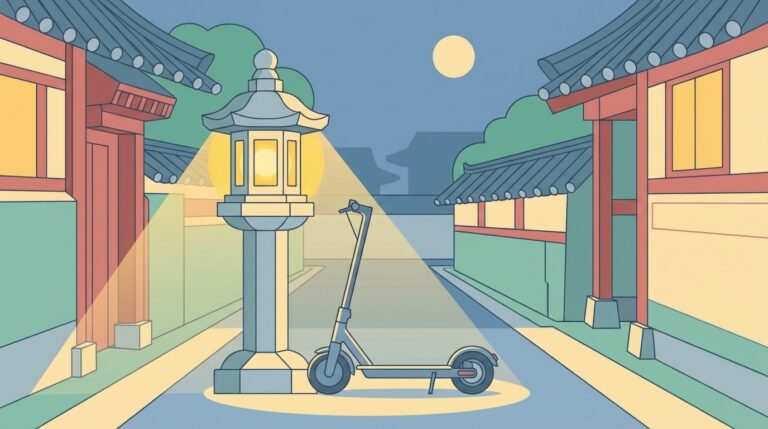
Riding an E-Scooter Drunk in Korea? Why It Counts as a Real DUI
Phase 1: 공감 (Story Immersion Opening)
안녕하세요! 매일한글 에디터입니다.
Picture this: It is 1:00 AM on a buzzing Friday night in Hongdae. You and your friends just finished a mouthwatering feast of Korean barbecue and a couple of somaek (soju + beer) rounds. The subway has stopped running, the taxi queues stretch around the block, and suddenly you spot an app-based electric kickboard (전동 킥보드) parked under a neon streetlamp. Someone in your group giggles, “Hey, why not just zoom home on that? It’s basically walking on wheels!”
Stop right there. In South Korea, hopping on that e-scooter after having even one drink isn’t just an innocent shortcut—it is treated under the Road Traffic Act exactly like getting behind the wheel of an SUV while intoxicated. One breath test can lead to heavy criminal fines, points, and even the immediate suspension or cancellation of your driver’s license (면허 취소).
Many of our international learners share stories of being caught completely off guard by this strict regulation. By mastering the phrases in today’s guide, you won’t just stay on the right side of Korean traffic laws; you’ll also possess the exact, natural vocabulary to intervene and keep your friends safe on a night out.
Phase 2: 핵심 표현 3선 심층 분석 (3 Core Expressions)
1. 킥보드도 음주 운전이에요. (Kikbodeudo eumju unjeonieyo.)
- Pronunciation: [Kik-boh-deu-doh eum-joo oon-jeon-ee-yeh-yo] (Rhymes roughly with “Eum” as in “hum”, “joo” as in “June”)
- Meaning: “Even kickboards count as drunk driving.”
- K-Culture Moment: In modern Korean youth dramas or police procedurals, you often see young professionals running into sudden roadside breathalyzer checkpoints (음주 단속) right outside nightlife alleys.
- Editor’s Insight: Adding the particle
-도(-do, meaning ‘also/even’) directly emphasizes that personal mobility (PM) devices aren’t exempt toys; they carry the full legal weight of a motorized vehicle. - Situation Spectrum:
- Casual: ✅ (킥보드도 음주 운전이야)
- Semi-formal: ✅ (킥보드도 음주 운전이에요)
- Formal: ✅ (전동 킥보드 역시 음주 운전에 해당합니다)
- 🤔 Think About It: In your home country, are motorized micro-mobility scooters treated like bicycles or licensed motor vehicles? How does this influence nighttime street safety?
2. 면허 취소될 수도 있어요. (Myeonheo chwisodoel sudo isseoyo.)
- Pronunciation: [Myeon-heo chwee-soh-dwel soo-doh eess-eo-yo]
- Meaning: “Your driver’s license could get revoked.”
- K-Culture Moment: Used frequently by alarmed friends grabbing a friend’s sleeve when they pull out their phone to scan a scooter QR code.
- Editor’s Insight:
-ㄹ 수도 있다expresses a realistic, impending possibility (“might/could”). Note that in Korea, an e-scooter DUI revokes your actual automobile driver’s license—foreign licenses and international driving permits included! - Situation Spectrum:
- Casual: ✅ (면허 취소될 수도 있어)
- Semi-formal: ✅ (면허 취소될 수도 있어요)
- Formal: ✅ (면허가 취소될 수 있습니다)
- 🤔 Think About It: Notice how Korean uses soft possibility endings (
-수도 있어요) to give a firm warning without sounding confrontational.
3. 차라리 택시를 잡자. (Charari taeksireul japja.)
- Pronunciation: [Chah-rah-ree taek-see-reul jahp-jah]
- Meaning: “Let’s grab a taxi instead / Let’s rather hail a cab.”
- K-Culture Moment: The classic line spoken in Hongdae or Gangnam around 2 AM when someone wants to prevent a bad late-night decision.
- Editor’s Insight: “차라리” (charari) is an essential B1 connective adverb meaning “rather” or “preferably out of limited options.” It suggests that even if catching a cab is inconvenient or pricey, it is vastly better than breaking the law.
- Situation Spectrum:
- Casual: ✅ (차라리 택시 잡자)
- Semi-formal: ✅ (차라리 택시를 타요)
- Formal: ⚠️ (택시를 이용하시는 편이 낫습니다)
- 🤔 Think About It: Using “차라리” redirects the conversation toward a constructive solution instead of lingering on what the person cannot do.
Phase 3: 교과서 한국어 vs 진짜 한국어 (Textbook vs. Real Korean)
Situation 1: Warning someone that riding while tipsy is an offense
- 📖 교과서 한국어: 전동 킥보드 음주 운전은 법률 위반입니다. (Jeondong kikbodeu eumju unjeoneun beomnyul wiban-imnida. / “Operating an electric scooter under the influence is a legal violation.”)
- 🗣️ 진짜 한국어: 킥보드도 음주 단속 걸려! (Kikbodeudo eumju dansok geollyeo! / “You’ll get busted for drunk driving on a kickboard too!”)
- 💡 왜 다를까?: Native speakers use the verb “걸리다” (geollida – to be caught/snagged) instead of stiff legal terminology like “법률 위반” in daily spoken Korean.
Situation 2: Suggesting an alternative rather than risking danger
- 📖 교과서 한국어: 위험하므로 대중교통을 이용합시다. (Wiheomhameuro daejung-gyotongeul iyonghapsida. / “Because it is hazardous, let us make use of public transit.”)
- 🗣️ 진짜 한국어: 위험해, 그냥 걸어가거나 택시 타자. (Wiheomhae, geunyang georeogageona taeksi taja. / “It’s dangerous, let’s just walk or split a cab.”)
- 💡 왜 다를까?: Friends use connective words like “그냥” (just) and informal suggestions (
-자) to sound cooperative rather than instructional.
Phase 4: K-Culture 딥다이브 & 비언어적 매너 (Culture Deep Dive)
4-1. 눈치 (Nunchi) & Gestures
When a friend reaches for an electric kickboard after drinking, do not just stay silent. In Korea, showing real friendship (정, Jeong) includes actively stopping someone from committing a harmful mistake. Lightly tap their shoulder or step gently in front of the scooter’s handlebar while saying your line. Avoid pointing aggressively at them; instead, point your thumb over your shoulder toward the road to look for a taxi or open the Kakao T app together.
4-2. Cultural Code: The Rise of “Kick-rani” (킥라니)
Koreans coined the slang word 킥라니 (Kik-rani), a portmanteau of “Kickboard” and “Gorani” (고라니, the Korean water deer known for leaping suddenly into oncoming traffic). Because reckless riders caused sidewalk injuries, public opinion shifted dramatically. Korean police regularly set up nighttime roadblocks targeting scooters alongside cars. Zero-tolerance policy means riding without a helmet or after even one beer will earn you public disapproval and legal penalties.
Phase 5: 실전 롤플레이 시나리오 (Interactive Roleplay)
Scene: Outside an exit near Gangnam Station at 1:30 AM. Minho (민호), slightly rosy-cheeked, pulls out his smartphone and walks toward a lime-colored e-scooter.
- 민호: 와, 지하철 끊겼네. 저기 킥보드 있다! 저거 타고 가야겠다. (Wa, jihacheol kkeunkyeonne. Jeogi kikbodeu itda! Jeogeo tago gayagetda.)
🎭 Pulls out phone to scan the scooter’s barcode with a tipsy grin.
“Whoa, the subways are done. Hey, there’s an e-scooter! I should ride that home.” -
You: 민호야, 잠깐만! 술 마셨잖아. (Minhoya, jamkkanman! Sul masyeotjana.)
🎭 Placing a gentle hand on Minho’s wrist to halt the scan.
“Minho, wait a second! You had drinks tonight.” -
민호: 맥주 두 잔밖에 안 마셨어! 완전 멀쩡해. (Maekju du janbakke an masyeosseo! Wanjeon meoljjeonghae.)
🎭 Chuckles and waves his hand dismissively.
“I only had two beers! I’m completely sober.” -
You: 킥보드도 음주 운전이에요. 단속 걸리면 면허 취소돼요. (Kikbodeudo eumju unjeonieyo. Dansok geollyimyeon myeonheo chwisodoeyo.)
🎭 Speaking with a serious, caring expression.
“Kickboards count as drunk driving too. If you get caught in a checkpoint, your license gets revoked.” -
민호: 진짜? 자동차만 해당되는 거 아니었어? (Jinjja? Jadongchaman haedangdoeneun geo anieosseo?)
🎭 Eyes widening in surprise as he pauses his app.
“Really? Wasn’t that rule only for actual cars?” -
You: 아니에요. 자동차랑 똑같이 처벌받아요. 벌금도 엄청 세요. (Anieyo. Jadongcharang ttokgachi cheobeolbadayo. Beolgeumdo eomcheong seyo.)
🎭 Shaking head firmly to emphasize the gravity.
“No. You receive the exact same punishment as a car driver. The fines are huge too.” -
민호: 큰일 날 뻔했네… 그럼 우리 이제 어떻게 가지? (Keun-il nal ppeonhaenne… Geureom uri ije eotteoke gaji?)
🎭 Puts his phone back into his coat pocket with a sigh of relief.
“That could have been a disaster… How do we get home now then?” -
You: 차라리 택시를 잡거나 심야 버스 타자. 내가 앱으로 부를게. (Charari taeksireul japgeona simya beoseu taja. Naega aebeuro bureulge.)
🎭 Opens the ride-hailing app with a warm smile.
“Let’s rather grab a taxi or catch a late-night bus. I’ll call one on my app.”
🔀 인터랙티브 분기점 (Choose Your Action)
What would you say if Minho insists, “It’s only a 5-minute ride on the sidewalk!”?
- Choice A (Best): “인도로 타는 것도 불법이고, 다치면 정말 큰일 나. 내가 택시비 보탤게, 택시 타자.” (Riding on the sidewalk is also illegal, and if someone gets hurt it’s disastrous. I’ll chip in for the taxi, let’s take a cab.)
Feedback: Perfect! Addressing both legal points (sidewalks are forbidden for PMs) and offering a team solution. - Choice B (Risk): “그럼 조심해서 천천히 타고 가.” (Then just ride slowly and carefully.)
Feedback: Risky! Encouraging a friend to commit a serious offense exposes them to police checkpoints, license loss, and severe accidents. - Choice C (Bad): “그럼 둘이 같이 타고 갈까?” (Shall we both ride it together then?)
Feedback: Disaster! Tandem riding (2 people on 1 scooter) is also heavily penalized with dedicated fines in Korea.
Phase 6: 10초 감정 섀도잉 드릴 (Shadowing Drill)
Practice matching these sentences to real emotional situations using the pause marks (/).
[🚨 단호하고 걱정스럽게 - Firm and concerned]
“안 돼! / 킥보드도 / 음주 운전이야!”
(An dwae! / Kikbodeudo / eumju unjeoniya!)
No way! / Even a kickboard / is drunk driving!-
[🙅♂️ 정색하며 경고할 때 - Dead serious warning]
“한 잔만 마셔도 / 면허 정지나 / 취소 처분 받아.”
(Han janman masyeodo / myeonheo jeongjina / chwiso cheobun bada.)
Even after one drink / your license gets suspended / or revoked. -
[🚕 안도하며 부드럽게 해결책 제시 - Relieved and helpful]
“위험하니까 / 차라리 / 카카오 택시 부르자.”
(Wiheomhanikka / charari / Kakao taeksi bureuja.)
Since it’s dangerous / let’s rather / call a Kakao Taxi instead.
Phase 7: K-Culture 미니 사전 (Mini Dictionary)
- 음주 단속 (Eumju dansok) | DUI Crackdown / Checkpoint
Usage: Roadside operations where officers test blood-alcohol concentration (BAC). The legal limit in Korea is a strict 0.03%. - 킥라니 (Kik-rani) | Reckless scooter rider
Usage: Humorous yet critical slang comparing reckless electric scooter drivers to wild deer darting out in front of traffic. - 면허 취소 (Myeonheo chwiso) | Driver’s license revocation
Usage: The complete nullification of one’s driving privileges, requiring re-testing after a disqualification period. - 심야 버스 (Simya beoseu) [올빼미 버스] | Late-night “Owl Bus”
Usage: Seoul’s designated night bus network operating between 11:30 PM and 6:00 AM, marked with an ‘N’ prefix (e.g., N13).
Phase 8: 여행자를 위한 생존 키트 (Traveler’s Survival Kit)
서바이벌 표현 TOP 3
- 이거 타면 면허 날아가요! (Igeo tamyeon myeonheo naragayo!)
Pro Tip: “날아가다” (to fly away) is colorful slang for losing your license instantly. - 헬멧 없으면 벌금 나와요. (Helmet eopseumyeon beolgeum nawayo.)
Pro Tip: Riding without an approved safety helmet incurs a 20,000 KRW fine on the spot. - 택시 같이 타고 가자. (Taeksi gachi tago gaja.)
Pro Tip: Friendly and persuasive way to pool rides late at night.
Editor’s Travel Note
Before stepping out for dinner and drinks in Seoul or Busan, set up your transit apps. Ensure you review our detailed guide for [카카오 T 앱 다운로드 및 해외 카드 등록 방법] so you never find yourself stranded without a taxi. If cabs are fully booked in bustling nightlife districts, check the Seoul [네이버 지도 앱 실시간 심야 버스 확인] feature to track nearby ‘N’ buses!
Phase 9: “한 발 더 깊이” (Cultural Reflection)
In South Korea, communal safety and public trust form the backbone of urban life. Traffic regulations around personal mobility were updated rapidly because pedestrian rights—especially for children, the elderly, and late-night commuters—are viewed as an indispensable collective right. While some cultures view an e-scooter as harmless personal gear, Korean society classifies it as a mechanized vehicle with shared public responsibility. Keeping each other from drinking and riding is considered genuine care, not nosiness.
💬 Your Turn: In your home country, do police run DUI breathalyzer checkpoints for electric scooters and bicycles? How would you explain your local rule to a Korean friend visiting your hometown? Share your thoughts below!
Phase 10: FAQ & 오해 방지 (FAQ Schema)
Q: Can foreigners lose their home country’s driver’s license if caught on a kickboard in Korea?
A: Korean police will suspend or revoke your domestic Korean driving license or your International Driving Permit (IDP), preventing you from driving anywhere in Korea. In addition, serious criminal charges and fines can negatively impact your visa status and extension.
Q: Is riding an e-scooter on the sidewalk legal if I ride slowly?
A: No. Under Korean law, personal mobility devices must be ridden in designated bike lanes or on the far-right edge of general vehicle roads. Riding on pedestrian sidewalks is an infraction subject to fines, even when completely sober.
Q: What is the legal blood alcohol content (BAC) limit for electric scooters in Korea?
A: The legal limit is 0.03%, matching automobile DUI standards. Exceeding 0.03% leads to license suspension, while exceeding 0.08% leads to license cancellation alongside administrative fines up to 100,000 KRW (and higher penal fines if involved in an accident).
🚨 흔한 실수 (Common Mistakes) 경고판
- Mistake: Assuming only cars are stopped at DUI checkpoints.
Correct Action: Officers actively flag down electric kickboards near nightlife hubs. Never ride after consuming any alcohol. - Mistake: Sharing one scooter with a friend to get home quickly.
Correct Action: Tandem riding is strictly prohibited (40,000 KRW fine). Use public transit or walk. - Mistake: Riding without holding a valid driver’s license.
Correct Action: In Korea, you must possess at least a motorized bicycle license (원동기장치자전거면허) or regular driver’s license to unlock and operate rental kickboards.
Phase 11: 액션 미션 & 참여 유도 (Action Missions)
- Bronze Mission (Solo Shadowing): Practice saying “킥보드도 음주 운전이에요” three times out loud with clear intonation until you can say it in under 3 seconds.
- Silver Mission (Community Share): Leave a comment with your favorite alternative late-night transit method in Korea using the grammar 차라리 ~자 (e.g., 차라리 걸어가자).
- Gold Mission (Real-life Practice): Next time you watch a K-Drama or stroll around Seoul at night, spot whether riders are wearing helmets and staying off sidewalks!
🎮 K-Culture Mission: Look up news clips or YouTube shorts using the keyword “킥라니 단속” to see actual footage of how Korean police conduct PM roadside safety checks!
Phase 12: 인터랙티브 퀴즈 챌린지 (Interactive Quiz)
Q1. Situational Judgment
Your friend had a bottle of soju at dinner and wants to unlock an electric kickboard to travel 600 meters to their hotel. What is the most culturally and legally appropriate response?
(A) “천천히 인도 쪽으로 타고 가!” (Ride slowly along the sidewalk!)
(B) “헬멧만 쓰면 괜찮아.” (As long as you wear a helmet, it’s fine.)
(C) “절대 안 돼! 킥보드도 음주 운전으로 면허 취소돼.” (Never! Riding a kickboard drunk leads to license revocation.)
Q2. Fill in the Blank
“택시 잡기 힘들지만, 위험하니까 (______) 기다려서 심야 버스 타자.”
(Hint: B1 adverb meaning ‘rather’ or ‘preferably’)
Q3. True or False
In South Korea, you do not need any kind of driver’s license to ride an app-based shared electric kickboard. (True / False)
정답 및 해설 보기 (Click to view answers)
- Q1 Answer: (C)
Explanation: Riding after drinking any alcohol is illegal, regardless of distance or helmet use. - Q2 Answer: 차라리 (charari)
Explanation: “차라리” suggests choosing a better alternative under restrictive circumstances. - Q3 Answer: False
Explanation: A valid driver’s license or motorized bicycle license is mandatory by law to ride personal mobility devices in Korea.







