

Master Korean Bank Visits: Set Up Mobile Banking Like a Local
Phase 1: 공감 (Story Immersion Opening)
안녕하세요! 매일한글 에디터입니다. (Hello! I’m your Daily Hangul Editor!)
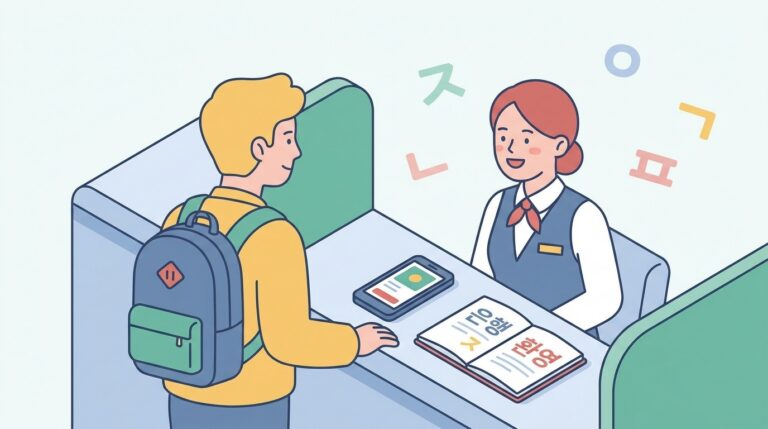
Picture this: You are standing inside a bustling bank branch in Sinchon or Gangnam. After waiting 20 minutes for your ticket number to flash on the LED board, you finally sit down at the counter. You successfully asked for a checking account (통장) and a debit card (체크카드). You are feeling like a true K-drama main character! But then, the teller looks up from her screen and asks: “모바일 뱅킹이랑 보안 매체도 지금 등록해 드릴까요?” (Would you like to register mobile banking and a security medium now?)
Suddenly, your mind goes blank. “Security medium? Mobile banking settings? Can’t I just download an app later at home?” In Korea, the answer is a resounding no! Setting up your mobile banking, digital certificate, and OTP device directly at the branch counter saves you weeks of bureaucratic headaches. Countless international students and travelers have told me they left the bank with a shiny card, only to discover they couldn’t transfer a single won on their phone because the security tokens were not authorized. Today, we are turning that anxiety into confidence with practical, beginner-friendly A2 expressions!
Phase 2: 핵심 표현 3선 심층 분석 (3 Core Expressions In-depth)
1. 모바일 뱅킹도 같이 신청할게요. (Mobile baengking-do gachi sincheonghalgeyo.)
- Pronunciation: [Mo-ba-il baeng-king-do ga-chi sin-cheong-hal-ge-yo] (Sounds like: Mo-bah-eel bang-king-doh gah-chee seen-chong-hahl-geh-yoh)
- Meaning: “I will apply for mobile banking as well.”
- K-Culture Moment: In modern Korean society, nobody carries bankbooks anymore. Saying this right after asking for an account ensures the teller prepares digital access documents immediately.
- Editor’s Insight: The particle -도 (-do) means “too” or “also,” and 같이 (gachi) means “together.” Using them together softens your statement and clearly shows you want bundled services in one visit.
- Situation Spectrum: Casual: 🚫 | Semi-formal: ⚠️ | Formal: ✅
- 🤔 Think About It: In your country, is mobile banking automatically activated, or do you have to request branch-level authentication like in Korea?
2. 보안 설정도 바로 쓸 수 있게 해 주세요. (Boan seoljeongdo baro sseul su itge hae juseyo.)
- Pronunciation: [Bo-an seol-jeong-do ba-ro sseul su it-ge hae ju-se-yo] (Sounds like: Boh-ahn soul-jong-doh bah-roh ss-ool soo eet-geh heh joo-seh-yoh)
- Meaning: “Please configure the security settings so I can use it right away.”
- K-Culture Moment: Tellers often assume foreigners might find app certificates tricky and might skip security token issuance unless specifically requested.
- Editor’s Insight: 바로 (baro) means “immediately/right away,” and -게 해 주세요 (-ge hae juseyo) means “please make it so that…”. This pattern is pure gold when you want quick, turnkey service.
- Situation Spectrum: Casual: 🚫 | Semi-formal: ⚠️ | Formal: ✅
- 🤔 Think About It: Why do you think Korea emphasizes multi-factor security setup in person before allowing digital transfers?
3. 비밀번호는 어디에 입력해요? (Bimilbeonhoneun eodie imnyeokhaeyo?)
- Pronunciation: [Bi-mil-beon-ho-neun eo-di-e im-nyeok-hae-yo] (Sounds like: Bee-meel-bon-ho-noon uh-dee-eh eem-nyuck-heh-yoh)
- Meaning: “Where do I enter my PIN/password?”
- K-Culture Moment: At Korean bank counters, there is a small shielded keypad (핀패드) on your side of the counter. The teller will never ask you to speak your 4-digit PIN aloud.
- Editor’s Insight: Asking this politely shows great manners and situational awareness, avoiding awkward moments where you hesitate while looking at the teller’s screen.
- Situation Spectrum: Casual: 🚫 | Semi-formal: ✅ | Formal: ✅
- 🤔 Think About It: How does keeping transaction passwords confidential on pin pads reflect privacy boundaries in Korean public spaces?
Phase 3: 교과서 한국어 vs 진짜 한국어 (Textbook vs. Real-Life Korean)
Situation 1: Requesting Mobile Banking Activation
- 📖 교과서 한국어 (Textbook): 모바일 뱅킹 서비스를 신청하고자 원합니다. (Mobile baengking seobiseureul sincheonghagoja wonhamnida. – “I desire to apply for mobile banking service.”)
- 🗣️ 진짜 한국어 (Real-Life): 모바일 뱅킹도 바로 되게 해 주세요. (Mobile baengking-do baro doege hae juseyo. – “Please set up mobile banking so it works right away.”)
- 💡 왜 다를까? (Why the difference?): Real bank customers speak efficiently. Dropping cumbersome formal literary endings in favor of the active 바로 되게 해 주세요 conveys natural ease without being rude.
Situation 2: Choosing Your Security Device
- 📖 교과서 한국어 (Textbook): 일회용 비밀번호 생성기(OTP)를 발급받겠습니다. (Ilhoeyong bimilbeonho saengseonggireul balgeupbatgetseumnida. – “I will receive an issuance of a one-time password generator.”)
- 🗣️ 진짜 한국어 (Real-Life): 카드형 OTP로 할게요. (Kadeuhyeong OTP-ro halgeyo. – “I’ll go with the card-type OTP.”)
- 💡 왜 다를까? (Why the difference?): Nobody says the long official Korean translation of OTP in real conversation. Everyone simply uses the loanword OTP (오티피), specifying either keychain-type (토큰형) or wallet-friendly card-type (카드형).
Phase 4: K-Culture 딥다이브 & 비언어적 매너 (Deep Dive & Body Language)
4-1. 눈치 (Nunchi) & Counter Etiquette
- The Two-Handed Document Pass: Whenever you hand over your passport, Alien Registration Card (외국인등록증), or signature pad stylus, always hold it with both hands or support your right elbow with your left hand. This subtle gesture instantly makes Korean service staff feel respected.
- The PIN Shield Lean: When the teller says “비밀번호 네 자리 눌러주세요” (Please press your 4-digit PIN), slightly lean forward to cover the keypad with your hand or posture. It demonstrates good civic manners and financial hygiene.
4-2. The Korean Digital Banking Ecosystem: “Palli-Palli” Speed
In Korea, settling bills with friends never involves counting cash or waiting three business days for bank wires. Using services like Toss or KakaoPay, people transfer money within three seconds. However, this blistering speed is backed by ironclad financial safety protocols regulated by the Financial Supervisory Service. When you register mobile banking at the desk, tellers help you generate a Financial Certificate (금융인증서) and link your Korean phone number. Taking care of this on day one is your ticket to ordering midnight fried chicken on Baemin and paying your utility bills smoothly!
Phase 5: 실전 롤플레이 시나리오 (Real-World Roleplay)
Setting: Hana Bank branch near Hongik University. Counter 3.
Characters: Bank Teller Min-ji (kind and sharp) & Customer Chris (a foreign exchange student).
- Teller Min-ji: 통장하고 체크카드 발급 끝났습니다. (Tongjanghago chekeukadeu balgeup kkeutnatseumnida.) [🎭 Smiles and hands over the blue document folder with both hands] — “The bankbook and debit card issuance is complete.”
- Chris: 감사합니다! 저, 모바일 뱅킹도 같이 신청할게요. (Gamsahamnida! Jeo, mobile baengking-do gachi sincheonghalgeyo.) [🎭 Nodding warmly] — “Thank you! Um, I will apply for mobile banking as well.”
- Teller Min-ji: 네! 폰으로 바로 이체하실 거죠? (Ne! Poneuro baro yichehasil geojyo?) [🎭 Looking up at the monitor and clicking] — “Sure! You plan to transfer money directly from your phone, right?”
- Chris: 네, 보안 설정도 바로 쓸 수 있게 해 주세요. (Ne, boan seoljeongdo baro sseul su itge hae juseyo.) [🎭 Leaning in attentively] — “Yes, please configure the security settings so I can use it right away.”
- Teller Min-ji: 보안카드로 드릴까요, 아니면 카드형 OTP로 드릴까요? (Boankadeuro deurilkkayo, animyeon kadeuhyeong OTP-ro deurilkkayo?) [🎭 Pointing to samples on the desk] — “Shall I give you a security card sheet, or a card-type OTP?”
- Chris: 카드형 OTP로 할게요! 지갑에 넣기 편해요. (Kadeuhyeong OTP-ro halgeyo! Jigabe neoki pyeonhaeyo.) [🎭 Touching the slim sample] — “I’ll go with the card-type OTP! It’s easy to fit in my wallet.”
- Teller Min-ji: 좋습니다. 여기 핀패드에 새 비밀번호 여섯 자리 눌러주세요. (Jotseumnida. Yeogi pinpaedeue sae bimilbeonho yeoseot jari nulleojuseyo.) [🎭 Gesturing to the shielded number pad] — “Great. Please enter a new 6-digit security PIN on the pin pad here.”
- Chris: 네, 입력했습니다. 앱에서 바로 로그인해 볼게요! (Ne, imnyeokhaetseumnida. Aebeseo baro rogeuinhae bolgeyo!) [🎭 Tapping PIN carefully with fingers covered] — “Yes, I’ve entered it. I will try logging in on the app right now!”
🔀 Interactive Decision Point
The teller asks: “공인인증서나 금융인증서도 오늘 바로 발급 도와드릴까요?” (Shall I help you issue a digital financial certificate right today?)
* Choice A: “네, 앱에서 바로 쓸 수 있게 도와주세요!” (Ne, aebeseo baro sseul su itge dowajuseyo!)
* Feedback (Best): Perfect! Having the teller assist you through the first SMS verification eliminates all digital certificate errors.
* Choice B: “아니요, 집에서 혼자 해볼게요.” (Aniyo, jibeseo honja haebolgeyo!)
* Feedback (Risk): Risky! Downloading certificates on your own requires Korean national identity verification steps that often fail without assistance.
* Choice C: “그게 뭐예요? 필요 없어요.” (Geuge mwoyeyo? Piryo eopseoyo!)
* Feedback (Bad): Too blunt and counterproductive! Without a certificate, you won’t be able to transfer money above petty limits.
Phase 6: 10초 감정 섀도잉 드릴 (10-Second Shadowing Drill)
Practice these lines out loud, pausing at the slashes (/):
[😊 Confident & Clear]
모바일 뱅킹도 / 같이 신청할게요! / 바로 쓸 수 있나요?
(Mobile baengking-do / gachi sincheonghalgeyo! / Baro sseul su innayo?)-
[🤔 Polite & Inquiring]
보안카드가 편해요, / 아니면 / 카드형 OTP가 더 좋아요?
(Boankadega pyeonhaeyo, / animyeon / kadeuhyeong OTP-ga deo joayo?) -
[🤝 Relieved & Courteous]
네! / 비밀번호 여섯 자리 / 지금 입력할게요.
(Ne! / Bimilbeonho yeoseot jari / jigeum imnyeokhalgeyo.)
Phase 7: K-Culture 미니 사전 (Mini Dictionary)
- OTP (오티피 / O-ti-pi): One-Time Password generator. In Korea, card-type OTPs cost about 5,000–10,000 won to issue, but they fit snugly in your wallet and work across multiple banks.
- 보안카드 (Boankadeu / Bo-an-ka-deu): A plastic grid card with 30–35 numbered codes. It is usually free, but requires manually entering 2-digit pairs during transfers.
- 체크카드 (Chekeukadeu / Che-keu-ka-deu): A debit card linked directly to your checking account. Essential for riding subways with T-Money functionality and getting instant cash-back points.
- 금융인증서 (Geumyung injeungseo / Geum-yung-in-jeung-seo): Cloud-based financial certificate. It replaces the old, clunky accredited certificates (공인인증서) and lets you log in via simple 6-digit PIN or biometrics.
Phase 8: 여행자를 위한 생존 키트 (Survival Kit for Travelers & Expats)
Top 3 Survival Phrases
- 한글: 영문 앱 지원되나요? (Yeongmun aep jiwondoenayo?)
- Pronunciation: Yeong-mun aep jee-won-dweh-nah-yoh?
- Pro Tip: Use this to verify if the bank’s mobile app offers a full English language toggle.
- 한글: 이체 한도 얼마예요? (Iche hando eolmayeyo?)
- Pronunciation: Ee-cheh hahn-doh uhl-mah-yeh-yoh?
- Pro Tip: New accounts for foreigners often start with a restricted “limit account” (한도제한계좌) of 300,000–1,000,000 won per day.
- 한글: 해외 결제도 돼요? (Hae-oe gyeoljedo dwaeyo?)
- Pronunciation: Hae-weh gyuhl-jeh-doh dweh-yoh?
- Pro Tip: Confirm whether your debit card has Visa or Mastercard capabilities for online overseas purchases.
Editor’s Travel Note
Before stepping into a branch, download the designated English banking platform: explore the Hana Bank Global mobile banking portal or Shinhan Sol Global app on your phone. Many branches also keep tablet devices where you can toggle English forms. Don’t forget your physical ARC, valid passport, and active Korean phone number (registered under your exact legal name)!
Phase 9: “한 발 더 깊이” (Cultural Reflection Essay)
Korean banking culture reflects an interesting paradox between hyper-technological convenience and ultra-strict collective vigilance. Because Korea was hit hard by voice-phishing (보이스피싱) scams over the past two decades, banks put rigorous barriers in place before handing you digital keys. Asking for security settings at the counter isn’t just an administrative chore; it is an initiation ritual into Korea’s trusted digital network. When the teller hands you that OTP card, you aren’t just getting an electronic token—you are being entrusted with seamless access to Korea’s cashless, high-speed economic playground.
💬 Your Turn: Have you ever experienced setting up a bank account in another country? How does the security setup process differ from what you do back home? Share your story in the comments below!
Phase 10: FAQ & 오해 방지 (FAQ Schema & Pitfalls)
Q: Can I register for mobile banking on the app after returning home without visiting the counter?
A: For foreigners without a verified Korean Credit ID (공동인증서) or a telecom plan registered under an Alien Registration Number, doing it from home is extremely difficult. It is 10 times easier and faster to have the bank clerk set up mobile credentials and issue an OTP in person at the branch.
Q: What is the difference between a security card (보안카드) and an OTP?
A: A security card is a physical sheet printed with password coordinates, free of charge, but usually restricted to that specific bank. An OTP generates a fresh 6-digit code every minute, works across almost all Korean financial institutions, and has higher transfer limits.
Q: Why is my daily mobile transfer limit capped at 300,000 won?
A: Korean banks automatically assign new foreign accounts as “restricted limit accounts” (한도제한계좌) to combat financial fraud. To raise the limit, you will need to bring proof of employment, tax records, or an apartment lease agreement after a few months of active use.
🚨 Common Mistakes Board (흔한 실수 TOP 3)
- Mistake: Signing your signature inconsistently.
Correct Action: Use the exact signature seen on your passport, or register a personal seal (도장) if requested. - Mistake: Assuming your phone plan name doesn’t matter.
Correct Action: Your phone carrier name must match your ARC name letter-for-letter (spacing and middle names included), or SMS security verifications will fail. - Mistake: Throwing away the temporary password paper slip.
Correct Action: Tellers give you a memo with a temporary user ID and activation deadline (usually 3 to 7 business days). Complete first login immediately on the spot!
Phase 11: 액션 미션 & 참여 유도 (Action Missions)
- 🥉 Bronze Mission (Solo): Stand in front of your mirror and practice saying: “모바일 뱅킹도 같이 신청할게요!” three times with a confident, polite smile.
- 🥈 Silver Mission (Social): Take a photo of a Korean bank sign (KB, Shinhan, Hana, Woori) and share it on Instagram or our community board with the tag:
#매일한글 #KoreanBankingGoals. - 🥇 Gold Mission (Real Life): When visiting a Korean bank or speaking with your Korean language partner, successfully request the card-type OTP: “카드형 OTP로 발급해 주세요.”
- 🎮 K-Culture Mission: Watch an episode of a workplace K-Drama like Misaeng or Start-Up, and spot whenever the characters mention transferring capital via “이체” (iche) or using security tokens!
Phase 12: 인터랙티브 퀴즈 챌린지 (Interactive Quiz)
1. Situational Judgment:
You want to activate your banking app so you can send money immediately. What should you tell the teller?
(A) 계좌 해지해 주세요. (Gyejwa haejihae juseyo.)
(B) 보안 설정도 바로 쓸 수 있게 해 주세요. (Boan seoljeongdo baro sseul su itge hae juseyo.)
(C) 현금 인출기 어디 있어요? (Hyeongeum inchulgi eodi isseoyo?)
2. Fill in the Blank:
“I want to apply for mobile banking as well.”
모바일 뱅킹____ 같이 신청할게요. (Hint: Particle meaning ‘also/too’)
3. True or False:
In Korea, it is polite to speak your 4-digit bank account PIN out loud to the teller so they can type it for you. (True / False)
👉 Click here for answers & explanations!
Answers:
1. (B) — (A) means “Please cancel my account,” and (C) means “Where is the ATM?”.
2. 도 (-do) — 모바일 뱅킹도 같이 신청할게요.
3. False — Never speak your PIN aloud! You should always enter it privately on the shielded counter pin pad (핀패드).






