

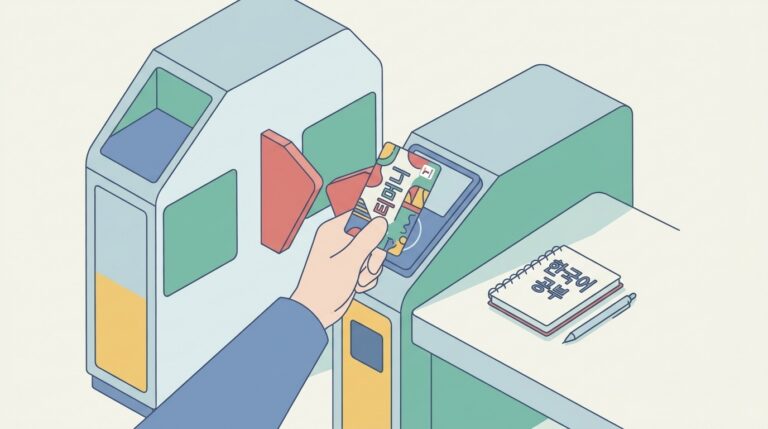
When Your T-Money Card Won’t Scan: The Panic-Free Seoul Subway Guide
Phase 1: Empathy (Storytelling Opening)
안녕하세요! (Annyeonghaseyo!) It’s your Daily Hangul editor and resident Seoul culture navigator here with you!
Picture this: It is 8:45 AM at Gangnam Station. The subway platform is bustling like a scene right out of a high-energy K-drama. Commuters are gliding effortlessly through the automated fare gates, swiping their cards in one seamless, rhythmic motion. You confidently step forward, tap your sleek T-Money card onto the sensor pad, and… BEEP-BEEP-BEEP!
A harsh red “X” flashes on the screen. The glass gates slam shut in front of you. A line of five busy commuters instantly piles up behind your backpack. You tap it again, harder this time. BEEP! Still nothing. Panic rises to your throat. You feel every single pair of eyes on you, your heart races, and you wonder: What do I say? Who do I call? Do I jump over? (Please don’t jump!)
Take a deep breath! Every single expat, traveler, and even native Seoulite has experienced this exact “turnstile freeze.” Based on feedback from hundreds of our beginner students at Daily Hangul, subway gate panic is the #1 public transit anxiety in Korea. But here is the good news: Korean subway stations are designed with foolproof safety nets, and with just three simple phrases, you will navigate this situation like a seasoned local.
Phase 2: Core 3 Expressions Breakdown
Here are the three essential magic phrases you need when the transit gates refuse to cooperate.
1. 카드가 안 찍혀요 (Kadeuga an jjikhyeoyo)
- Pronunciation: Kadeu-ga an jjik-hyeo-yo (Sounds like: “Kah-deu-gah an cheek-hyo-yo” — imagine saying “cheek” with a quick pop of air!)
- Meaning: Literal: “The card does not get stamped/scanned.” | Actual Nuance: “My card isn’t scanning.”
- K-Culture Moment: You will hear this in comedy-dramas whenever an awkward protagonist gets stuck at an automated parking booth or convenience store scanner.
- Editor’s Insight: Koreans use the verb 찍다 (jjikda – to stamp, print, or click a photo) for scanning cards. Adding 안 (an – not) makes it a soft, natural declaration that the machine is simply not reading the chip.
- Situation Spectrum: Casual: ⚠️ (Say: 안 찍혀) | Semi-formal/Polite: ✅ (카드가 안 찍혀요) | Formal: ✅ (카드가 찍히지 않습니다)
- 🤔 Think About It: Notice how Korean places the blame on the action (the card won’t scan) rather than pointing fingers at the machine or yourself. How does this indirectness reflect Korean politeness?
2. 도와주세요 (Dowajuseyo)
- Pronunciation: Do-wa-ju-se-yo (Sounds like: “Doh-wah-joo-say-yo” — smooth and flowing like gentle waves.)
- Meaning: Literal: “Please give help.” | Actual Nuance: “Please help me.”
- K-Culture Moment: The universal hero-call heard in virtually every K-drama emergency or romantic rescue scene.
- Editor’s Insight: Combining 돕다 (dopda – to help) with ~주세요 (juseyo – please give) creates the gold standard of polite requests. It is urgent without sounding demanding.
- Situation Spectrum: Casual: 🚫 (Sounds rude to strangers) | Semi-formal/Polite: ✅ (Universal everyday use) | Formal: ✅ (도와주시겠습니까?)
- 🤔 Think About It: Unlike English where “Help!” can sound like an extreme life-or-death crisis, 도와주세요 is completely standard for minor everyday troubles like stuck gates or heavy luggage.
3. 문 열어 주세요 (Mun yeoreo juseyo)
- Pronunciation: Mun yeo-reo ju-se-yo (Sounds like: “Moon yaw-raw-joo-say-yo” — say ‘moon’ softly without dragging the vowel.)
- Meaning: Literal: “Please open the door.” | Actual Nuance: “Could you open the gate for me, please?”
- K-Culture Moment: When characters rush across the station intercom trying to catch the last train of the night before curfew.
- Editor’s Insight: Subway turnstiles and side gates are referred to simply as 문 (mun – door/gate). When you are stuck on the wrong side, this is the exact phrase to speak into the station help intercom.
- Situation Spectrum: Casual: 🚫 | Semi-formal/Polite: ✅ | Formal: ✅ (문을 열어 주시겠습니까?)
- 🤔 Think About It: In Korean culture, clear functional requests with polite endings (~주세요) are appreciated because station staff value rapid, efficient problem-solving.
Phase 3: Textbook Korean vs. Real Korean
Situation 1: Calling for station attendant assistance
- 📖 Textbook Korean: 저를 좀 도와주십시오. (Jeoreul jom dowajusipsio. – “Please render me assistance.”)
- 🗣️ 진짜 (Real) Korean: 저기요, 도와주세요! (Jeogiyo, dowajuseyo! – “Excuse me, please help!”)
- 💡 왜 다를까? (Why the difference?): The textbook version is ultra-formal military/courtroom Korean. In daily public transit, a warm “저기요” (Excuse me) followed by “도와주세요” sounds friendly, urgent, and perfectly natural.
Situation 2: Explaining that the transit card doesn’t work
- 📖 Textbook Korean: 교통카드 시스템에 오류가 발생했습니다. (Gyotongkadeu siseuteme oryuga balsaenghaessseumnida. – “An error has occurred in the transportation card system.”)
- 🗣️ 진짜 (Real) Korean: 카드가 안 찍혀요. (Kadeuga an jjikhyeoyo. – “My card isn’t scanning.”)
- 💡 왜 다를까? (Why the difference?): Nobody uses technical jargon at the ticket barrier. Native speakers describe the tangible physical action: the card simply won’t “jjik” (scan).
Phase 4: K-Culture Deep Dive & Non-Verbal Manners
4-1. Nunchi (눈치) & Body Language at the Gate
If your card beeps with an error during peak commuting hours, fast Nunchi (situational awareness) saves the day:
* Step to the side immediately: Take one half-step back and gesture the person behind you forward with an open palm. Never stand frozen directly over the sensor trying twelve times.
* Two-Handed Courtesy: When handing your transit card or phone to a station agent, hold it with both hands (or support your right forearm with your left hand). This shows deep respect and immediately softens any language barrier.
4-2. The “Ppalli-Ppalli” (빨리빨리) Subway Code
Seoul’s subway system is one of the world’s most modern marvels, moving millions daily. The prevailing spirit is Ppalli-Ppalli (quick, efficient movement). When gates beep, travelers do not get angry at you; they are simply keyed into the collective flow. Beside every set of turnstiles, you will notice a wider gate designated for wheelchairs and luggage with a small circular intercom button labeled 호출 (Help/Call). Pushing that button connects you instantly to an agent who can open the gate remotely in two seconds flat!
Phase 5: Real-World Roleplay Scenario
Setting: Hongdae Station (Line 2). Friday evening. You tapped your T-Money card, but the gate turned red with error code “태그를 다시 하세요” (Please tap again). Station Agent Mr. Kim (김 주임님) is approaching from the information window.
- Turn 1 (You): 🎭 [Backing away from the gate, bowing head slightly]
저기요! 카드가 안 찍혀요.
(Jeogiyo! Kadeuga an jjikhyeoyo.)
“Excuse me! My card won’t scan.” - Turn 2 (Mr. Kim): 🎭 [Approaching briskly with a friendly nod]
네, 카드 한번 보여주시겠어요?
(Ne, kadeu hanbeon boyeojusigesseoyo?)
“Yes, could you show me your card for a moment?” - Turn 3 (You): 🎭 [Handing the T-money card forward using both hands]
여기요. 도와주세요.
(Yeogiyo. Dowajuseyo.)
“Here it is. Please help me.” - Turn 4 (Mr. Kim): 🎭 [Tapping the card on his handheld portable terminal]
아, 잔액이 부족해요. 충전하셨어요?
(A, janaegi bujokhaeyo. Chungjeonhasyeosseoyo?)
“Ah, insufficient balance. Did you reload it?” - Turn 5 (You): 🎭 [Eyes widening with realization]
아! 충전 안 했어요. 죄송합니다.
(A! Chungjeon an haesseoyo. Joesonghamnida.)
“Ah! I didn’t reload it. I’m sorry.” - Turn 6 (Mr. Kim): 🎭 [Smiling warmly, pressing the override button on the gate]
괜찮아요. 문 열어 드릴게요. 저기 기계에서 충전하세요.
(Gwaenchanhayo. Mun yeoreo deurilgeyo. Jeogi gigye-eseo chungjeonhaseyo.)
“It is okay. I will open the gate for you. Please recharge at that machine over there.” - Turn 7 (You): 🎭 [Walking through the open gate, bowing politely]
문 열어 주셔서 감사합니다!
(Mun yeoreo jusyeoseo kamsahamnida!)
“Thank you for opening the gate!” - Turn 8 (Mr. Kim): 🎭 [Waving lightly]
네, 조심히 가세요!
(Ne, josimhi gaseyo!)
“Yes, travel safely!”
🔀 Interactive Decision Point
When your card turns red at the gate, what do you do?
* Option A: Press the bell on the side gate and say politely: “저기요, 카드가 안 찍혀요. 도와주세요!”
* Feedback (Best): Perfect! The agent will check your card, diagnose the issue in seconds, and let you through.
* Option B: Duck down under the turnstile and slide through before anyone notices.
* Feedback (Risk): Major alarm sirens will go off! CCTV cameras cover every turnstile, and unauthorized crossing triggers a penalty fine of 30x the regular fare.
* Option C: Keep tapping your card violently against the sensor ten times while shaking the barrier.
* Feedback (Bad): The sensor will lock up, the commuters behind you will sigh, and you might scratch your card or phone screen.
Phase 6: 10-Second Emotion Shadowing Drill
Practice these lines out loud with the exact rhythm and feeling of a Seoul commuter!
[🥺 Flustered & Polite]
저기요… / 카드가 / 안 찍혀요.
(Jeogiyo… / kadeuga / an jjikhyeoyo.)-
[🙏 Earnest & Asking for Help]
어떻게 해요? / 도와주세요!
(Eotteoke haeyo? / Dowajuseyo!) -
[😊 Relieved & Grateful]
문 열어 주셔서 / 정말 감사합니다!
(Mun yeoreo jusyeoseo / jeongmal kamsahamnida!)
Phase 7: K-Culture Mini Dictionary
- 티머니 (T-money / Ti-meoni)
- Definition: Korea’s ubiquitous rechargeable smart transit card.
- Real-world usage: Used not only for all subways and city buses across Korea, but also accepted in taxis, convenience stores, and even street-vending lockers.
- 개찰구 (Gaechalgu / Gae-chal-gu)
- Definition: Ticket barrier, turnstile, or fare gate.
- Real-world usage: The physical gate where you scan your card. Station announcements will state: “개찰구를 통과해 주십시오” (Please pass through the ticket gate).
- 호출 벨 (Hochul bel / Ho-chul bel)
- Definition: Help call button located at turnstiles.
- Real-world usage: Located beside the wide wheelchair accessible side-gate. Push it once, and you are connected to the station booth speaker.
- 환승 (Hwanseung / Hwan-seung)
- Definition: Transit transfer.
- Real-world usage: Korean transit offers free or discounted transfers between buses and subways within 30 minutes, which is why tapping in and tapping out correctly is essential.
Phase 8: Traveler’s Survival Kit
Top 3 Survival Phrases for Subway Emergencies
- 티머니 충전 어디서 해요? (T-money chungjeon eodiseo haeyo?)
“Where do I recharge my T-money card?”
Pro Tip: Use this if your balance is zero and you cannot spot the multi-language automated kiosks. - 반대편으로 넘어가야 해요. (Bandaepyeoneuro neomeogaya haeyo.)
“I need to cross over to the opposite platform.”
Pro Tip: Trapped on the wrong directional platform? Don’t pay double! Push the help button and tell them this sentence; they will let you cross for free. - 카드가 먹통이에요. (Kadeuga meoktong-ieyo.)
“My card is completely unresponsive.”
Pro Tip: A colorful local phrase meaning something is totally dead/frozen.
Editor’s Travel Note
- Carry Cash for Top-Ups: Subway kiosk reload machines in Korea only accept Korean Won paper currency (no international credit cards!). Always keep a 10,000 KRW bill in your pocket.
- Subway App Navigation: Before setting out, ensure you review a detailed Naver Map transit guide or download the official “Subway Korea” app for real-time gate transfer directions and exit maps.
Phase 9: “One Step Deeper” (Reflective Question)
In many Western transit hubs, station staff stay strictly isolated behind bulletproof security glass, leaving commuters to fend for themselves with impersonal automated phone lines. Korean subway culture operates on a foundational civic trust called Jeong (정) combined with high civic accountability. When a commuter is stuck, station agents are expected—and genuinely eager—to assist quickly so the collective community moves smoothly.
💬 Your Turn: Have you ever experienced a moment where public transit overwhelmed you in another country? How do you think Korean subway stations compare to those in your hometown? Share your story in the comments below!
Phase 10: FAQ & Avoiding Misunderstandings
Q: What if I pressed the help button and the agent answers in fast Korean?
A: Stay calm! Take a breath and clearly say: “카드가 안 찍혀요, 도와주세요!” (Kadeuga an jjikhyeoyo, dowajuseyo!). The agent will immediately recognize the situation and will either unlock the barrier remotely or walk over to the gate to look at your card.
Q: Can I use Apple Pay or foreign Visa cards directly at Seoul subway gates?
A: Not at normal turnstiles. Most Seoul subway gates only accept domestic transit chips, physical T-Money/Cashbee cards, or the prepaid Climate Card (기후동행카드). Keep your physical T-Money card accessible!
Q: I tapped my card twice accidentally because the gate was slow. Will I be charged twice?
A: No. Korean transit scanners have an anti-double-charge block. If you tap again immediately on the same gate, it will display a warning sound and flash “Already tagged” rather than charging you double.
🚨 Common Mistakes Warning Board
- Mistake 1: Tapping your whole wallet or backpack against the scanner.
- Why it fails: Having two contactless cards together triggers an “Only tap one card” error (한 장의 카드만 대주세요).
- Correct Action: Keep your T-Money card in an individual slot or phone case slip.
- Mistake 2: Forgetting to tap out when exiting.
- Why it fails: Failing to tap out means losing your transfer discount and incurring the maximum distance surcharge on your next ride.
- Correct Action: Always verify that the green arrow lights up and displays your remaining balance upon exiting.
- Mistake 3: Climbing over the gate in a rush.
- Why it fails: It is illegal and considered fare evasion.
- Correct Action: Simply push the emergency bell (호출 벨) on the wheelchair gate—staff will open it with no penalty.
Phase 11: Action Missions & Community Challenge
- 🥉 Bronze Mission (Solo Practice): Stand before a mirror with your transit card. Practice tapping your card and speaking clearly: “카드가 안 찍혀요. 도와주세요!” three times with a confident tone.
- 🥈 Silver Mission (Social Share): Snap a photo of your cute T-Money card (or favorite station exit sign) and post it with the caption: “카드가 안 찍혀요! Ready for Seoul subways with Daily Hangul!”
- 🥇 Gold Mission (Real-life Execution): On your next trip to Korea, locate the red/silver 호출 (Help) intercom button at your departure station before entering, and explain its location to a travel companion.
🎮 K-Culture Mission: Watch any episode of a subway-based Korean drama (such as Catch the Ghost or Extraordinary Attorney Woo). Spot the exact moment passengers scan their cards at the turnstile and observe how smoothly they tap and walk!
Phase 12: Interactive Quiz Challenge
Test your readiness for the Seoul transit turnstile!
1. Situation Challenge:
You are at Myeongdong Station. You tap your card, the red light flashes, and the screen says your balance is insufficient. What is the most natural, polite way to ask for help?
* (A) 야, 문 열어! (Ya, mun yeoreo!)
* (B) 저기요, 카드가 안 찍혀요. 도와주세요. (Jeogiyo, kadeuga an jjikhyeoyo. Dowajuseyo.)
* (C) 카드가 고장났습니다. 돈 주세요. (Kadeuga gojangnasseumnida. Don juseyo.)
2. Fill-in-the-Blank:
When you need the attendant to unlock the side barrier gate, you say:
“문 ______ 주세요.” (Please open the gate.)
3. True or False:
If your T-Money card won’t scan, the best course of action is to hop over the barrier quickly before the security guard arrives. (True / False)
👉 Click to reveal answers & explanations!
-
Answer: (B)
Explanation: (B) combines the polite attention-getter 저기요 with our core phrases 카드가 안 찍혀요 and 도와주세요. (A) is rude, aggressive slang, while (C) bizarrely asks the attendant for money! -
Answer: 열어 (yeoreo)
Full Sentence: 문 열어 주세요. (Mun yeoreo juseyo. – Please open the gate.) -
Answer: False
Explanation: Hopping barriers triggers alarm sirens and carries heavy fines! Always press the side-gate help bell (호출 벨) instead.







