

Phase 1: Empathy (Immersion & The Vanishing Fourth Wall)
안녕하세요! 매일한글 에디터입니다. (Hello! This is your Daily Hangul Editor.)
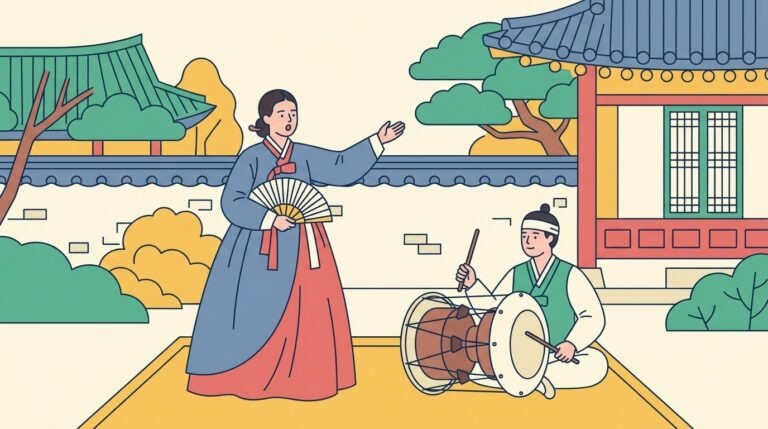
Picture this: You are seated on an indigo-dyed cushion at an open-air Hanok courtyard in Jeonju or the prestigious National Theater of Korea. The autumn evening air is crisp, lit by the amber glow of traditional paper lanterns. On stage stands a sorikkun (vocalist) clad in snowy ramie hanbok, clutching a folded bamboo fan, accompanied solely by a seated gosu (drummer) clasping a barrel-shaped buk. As an accomplished scholar of Korean language and culture, you know the drill—or so you think. You sit with your spine straight, breath held, observing the reverent, cathedral-like silence demanded by Western chamber concerts.
Suddenly, right in the middle of a wrenching cadenza, the drummer thumps the cowhide rim and barks out, “Eolssigu!” To your shock, an elderly gentleman in the third row roars back, “Jota!” You flinch, wondering if security will intervene. Instead, the singer’s eyes blaze with renewed fire, channeling the surge of collective resonance back into the vocal timbre. You realize you have just witnessed the ultimate artistic paradox: what would be considered a mortifying breach of decorum in a Western opera house is, in Korea, the very oxygen of the performance.
At a C2 proficiency level, mastering Korean transcends grammatical accuracy; it demands stepping inside the communal consciousness where the boundary between artist and spectator evaporates. This guide is forged from a decade of navigating traditional performing arts alongside foreign researchers and diplomats who feared “disturbing the peace.” By the end of this masterclass, you will wield the linguistic precision, rhythmic intuition, and cultural nunchi required to transform from a passive observer into an active co-creator of the pan (판, communal stage).
Phase 2: Core Expressions Deep Dive
1. 얼씨구! (Eolssigu!)
- Pronunciation: [Eol-ssi-gu] (Pronounce like “Earl-see-goo” with a sharp, buoyant glottal snap on ssi)
- Meaning:
- Literal: Archaic rhythmic expletive without semantic root.
- Nuance: “Right on!”, “Feel that groove!”, or “Magnificent!” An uninhibited burst of collective euphoria that validates the singer’s rhythmic surge.
- K-Culture Moment: In modern media, you’ll hear this when someone witnesses an outrageously confident move—such as in historical-comedy K-dramas when a commoner outwits a corrupt magistrate, or when trot singers amp up the crowd during an upbeat climax.
- Editor’s Insight: Eolssigu is not mere noise; it is an adrenaline injection. It is usually uttered when the rhythm (jangdan) shifts dynamically into Jungmori or Jajinmori. If you deliver it flatly, it ruins the pulse; it must ride the crest of the drumbeat like a surfer catching a wave.
- Situation Spectrum: Casual (✅) / Semi-formal (✅, in traditional arts spaces) / Formal (🚫, outside artistic or traditional gatherings)
- 🤔 Think About It: In Western theatre, the “fourth wall” protects an illusion. Why did Korean folk arts develop an imperative that actively commands the spectator to dismantle that wall?
2. 좋다! (Jota!)
- Pronunciation: [Jo-ta] (Pronounce as a crisp, aspirated “Cho-tah” where the ‘h’ sharpens the ‘t’)
- Meaning:
- Literal: “It is good.”
- Nuance: “Sublime!”, “Soul-stirring!” An exclamation of deep emotional resonance acknowledging an exquisite turn of vocal phrase (sori) or a poignant emotional confession.
- K-Culture Moment: When a contestant on traditional music crossover shows like Pungryu: Battle Between the Vocalists executes an impossibly resonant descending run, the master judges lean back, close their eyes, and exhale a resonant “Jota…”
- Editor’s Insight: While beginners know jota as a vanilla adjective, in Pansori it serves as a profound affirmation. Unlike Eolssigu, which celebrates rhythmic verve, Jota honors technical mastery, heartbreaking sorrow (han), or bittersweet relief.
- Situation Spectrum: Casual (✅) / Semi-formal (✅, in artistic and performance contexts) / Formal (🚫, standard corporate meetings)
- 🤔 Think About It: How does collapsing an adjective into an uninflected, exclamatory sentence root change the social hierarchy between speaker and listener?
3. 무대를 뒤집어놓으셨다 (Mudae-reul dwijibeo-no-eusyeotda)
- Pronunciation: [Mu-dae-reul dwi-ji-beo-no-eu-syeot-da] (“Moo-dae-reul dwee-jee-buh-noh-oo-syut-dah”)
- Meaning:
- Literal: “(They) completely turned the stage upside down.”
- Nuance: “They brought the house down!” or “They utterly stole the show!”
- K-Culture Moment: Immortalized by legendary comedian Park Mi-sun reacting to iconic stage performances, this phrase is the gold standard across K-pop commentary, variety shows (Hangout with Yoo), and traditional arts festivals.
- Editor’s Insight: Notice the root dwijipda (to flip inside out / invert). This connects directly to the core aesthetic of talchum (mask dance) and pansori: social satire (golgye) that flips the established patriarchal or aristocratic order upside down. When an artist flips the stage, they liberate the audience.
- Situation Spectrum: Casual (✅) / Semi-formal (✅) / Formal (⚠️, acceptable in creative critiques, avoid in academic dissertations)
- 🤔 Think About It: Consider the metaphor of “flipping” a stage versus the English idiom “bringing the house down.” What does each reveal about how physical architectural space is perceived?
Phase 3: Textbook Korean vs. Real Native Korean
Situation 1: Describing the spine-chilling synergy of the performance
- 📖 교과서 한국어 (Textbook Korean):
공연이 매우 감동적이었고 호흡이 잘 맞았습니다.
(Gongyeoni maeu gamdongjeogieotgo hoheubi jal majatseumnida.)
“The performance was very moving, and their coordination was well aligned.” - 🗣️ 진짜 한국어 (Real Native Korean):
소리꾼과 고수의 호흡이 기가 막혀서 순간 온몸에 닭살이 돋았어요.
(Sorikkungwa gosuui hoheubi giga makhyeoseo sungan onmome daksari dodasseoyo.)
“The synergy between the vocalist and the drummer was so sublime that I got full-body chills.” - 💡 왜 다를까? (Cultural Nuance): Textbook Korean treats the concert as an external spectacle. Educated native speakers talk about hoheup (respiratory pulse / shared breath) and visceral somatic reactions like daksal (goosebumps) because Pansori is an acoustic exchange of vital energy (gi).
Situation 2: Praising how the audience energized the room
- 📖 교과서 한국어 (Textbook Korean):
관객들이 환호성을 지르며 응원했습니다.
(Gwangakdeuri hwanhoseongeul jireumyeo eungwonhaetseumnida.)
“The audience members cheered loudly and rooted for them.” - 🗣️ 진짜 한국어 (Real Native Korean):
객석에서 적재적소에 추임새를 넣어주니까 판이 제대로 살아나더라고요.
(Gaekseogeseo jeokjaejeoksoe chuimsaereul neoeojunikka pani jedaero saranadeoragoyo.)
“Because the audience tossed in chuimsae at just the right junctures, the entire arena truly came alive.” - 💡 왜 다를까? (Cultural Nuance): High-level Korean uses the idiom pan-i salda (the stage/event comes alive) and jeokjae-jeokso (at the exact right place and time), portraying audience participation not as cheering from the sidelines, but as vital structural support.
Phase 4: K-Culture Deep Dive & Non-Verbal Manners
4-1. Nunchi & Breath Economy (눈치와 호흡의 미학)
In Pansori, vocalizing at the wrong split-second is considered artistic sacrilege. To master the art of chuimsae, your nunchi must tune into the sorikkun‘s respiratory arc.
* The Inhale (들숨, Deulsum): When the singer draws air for an explosive passage, maintain dead silence. Never interrupt a melodic ascent.
* The Resolving Crest (맺음, Maejeum): When the singer completes a poignant phrase or drops into a gutteral raspy register (suriseong), that is your cue. Lean your torso slightly forward, open your palms in an upward-receptive posture, and release your chuimsae on the exhalation.
* Physical Mirroring: Drum along mentally with your right index finger tapping your knee to mark the bak (accented beat of the jangdan). Nod your chin downward on strong beats—never tilt your head back indifferently.
4-2. The Yin and Yang of Korean Aesthetics: Bijangmi vs. Golgyemi
Traditional Korean performing arts are not monoliths of sorrow or comedy; they are defined by the dialectic tension between:
1. 비장미 (Tragic Grandeur / Sublime Pathos): Rooted in Han (한), the collective, internalized sorrow born of historical suffering, injustice, and mortality. You hear this in Simcheongga when the blind father wails for his drowned daughter.
2. 골계미 (Comic Wit / Satirical Ridicule): The instant the tragedy becomes unbearable, traditional art introduces earthy, bawdy humor (Heung, 흥) to lance the emotional boil. In Heungbuga, the villainous Nolbu cuts open a gourd only to be pelted by excrement and debt collectors.
This aesthetic DNA explains why modern Korean masterworks—such as Bong Joon-ho’s Parasite or Park Chan-wook’s Decision to Leave—pivot effortlessly from gut-wrenching tragedy to dark slapstick in a single scene. Understanding Pansori is understanding the narrative architecture of contemporary K-cinema.
Phase 5: Real-World Roleplay Scenario
Setting: An intimate performance at the Jeonju Intangible Cultural Heritage Center courtyard. A master singer and drummer are performing an excerpt from Sugungga (Song of the Underwater Palace).
Characters:
* You: A sophisticated international researcher of Korean folklore and theatre aesthetics.
* Master Park (박 명창): The 65-year-old virtuoso Sorikkun with a weathered, powerful voice.
* Master Choi (최 고수): The veteran drum master with rhythmic hawk eyes.
Turn 1
🎭 [Master Park concludes an intricate rhythmic narrative, lowering his fan with an intense look at the audience]
Master Park: “…토끼가 간을 배 밖에 내어놓았다는 말이 가당키나 하단 말인가!”
(…Tokkiga ganeul bae bakke naeonoeatdaneun mari gadangkhina hadan maringa!)
“…Could it possibly make sense that a rabbit leaves its liver outside its belly?!”
Turn 2
🎭 [Master Choi strikes the drum center with a heavy boom, leaning his head sideways]
Master Choi: “얼씨구! 그렇지!”
(Eolssigu! Geureochi!)
“Right on! That is it!”
Turn 3
🎭 [Catching the rhythmic syncopation precisely on the upbeat, you project your voice with centered resonance]
You: “좋~다! 잘한다!”
(Joh~da! Jalhanda!)
“Bravo! Spectacular!”
Turn 4
🎭 [Master Park’s eyes twinkle; he flashes his fan open with a sharp crack, visibly energized]
Master Park: “어허, 저기 푸른 눈의 선비가 우리 판의 소리를 제대로 알아듣는구나!”
(Eoheo, jeogi pureun nunui seonbiga uri panui sorireul jedaero aradeunneunguna!)
“Aha! That scholar over there with the blue eyes truly comprehends the sound of our pan!”
Turn 5
🎭 [Master Choi shifts the drumbeat into a rapid, galloping Jajinmori jangdan, chuckling]
Master Choi: “귀명창이 납셨으니, 소리판에 신명이 절로 붙는구먼!”
(Gwimyeongchangi napsyeosseuni, soripane sinmyeongi jeollo bunneungumeon!)
“Since a master-listener has graced us, the ecstatic spirit catches fire of its own accord!”
Turn 6
🎭 [You incline your upper body in respectful acknowledgment while keeping rhythmic pace with light hand gestures]
You: “명창님의 성음이 워낙 청아하여 귀가 호강할 따름입니다!”
(Myeongchangnimui seongeumi wonak cheong-ahayeo gwiga hoganghal ddareumimnida!)
“Your vocal grain is so pristine, Master, my ears are treated to pure luxury!”
Turn 7
🎭 [Master Park stamps his foot, sweeping his fan across the audience as he reaches the virtuosic apex]
Master Park: “그렇다면 내 오늘 이 마당에서 간이라도 다 빼어놓고 놀아보세!”
(Geureotamyeon nae oneul i madangeseo ganirado da bpaeeonoko norabose!)
“In that case, I will rip out my very liver on this earthen stage and make merry today!”
Turn 8
🎭 [The entire courtyard, swept up by your cue, erupts in synchronized community acclaim]
You & Audience: “얼씨구! 지화자, 좋다!”
(Eolssigu! Jihwaja, jota!)
“Eolssigu! Rejoice, splendid!”
🔀 Interactive Decision Point
During an excruciatingly tragic passage describing Simcheong’s blind father sobbing alone in the rain, what is your move?
- Option A: Shout “Eolssigu!” at top volume to encourage the singer.
- Option B: Maintain absolute silence, then let out a low, somber “…그렇지 (Geureochi…)” or “…아이고 (Aigo…)” right after the tragic cadence resolves.
- Option C: Turn your phone on silent and fold your hands stiffly, refusing to make any noise throughout the performance.
— Choice Feedback —
* Option A [Bad]: Fatal cultural misstep. Blaring an upbeat festival call during deep Gyemyeonjo (mourning melodic mode) ruins the tragic pathos (bijangmi) and exposes a total lack of aesthetic sensitivity.
* Option B [Best]: Mastery level. Releasing a restrained, breathy Geureochi or an empathetic Aigo acknowledges the performer’s tears without shattering the fragile spell of catharsis.
* Option C [Risk]: Safe, but sterile. While not offensive, you remain a cold bystander. Koreans say an audience that gives zero chuimsae “starves the singer to death” (소리꾼을 말려 죽인다).
Phase 6: 10-Second Emotion Shadowing Drill
Master the subtle dynamic shifts by matching breath and pitch across these advanced emotional tempos:
- [🔥 Explosive Communal Joy – High projection, bright timbre]
얼씨구! / 우리 가락이 / 제대로 흥을 타는구나!
(Eolssigu! / Uri garagi / jedaero heungeul taneunguna!)
“Eolssigu! / Our traditional rhythm / is truly catching the groove!” -
[💧 Melancholic Pathos – Low, guttural, sigh-like descent]
좋다… / 그 애절한 한이 / 가슴을 저미는구려…
(Jota… / Geu aejeolhan hani / gaseumeul jeomineunguryeo…)
“Bravo… / That desperate sorrow / cuts straight through the heart…” -
[👏 Intellectual Sophistication – Crisp, admiring, rhythmic cadence]
명창의 공력과 / 고수의 추임새가 / 완벽한 조화를 이루는군요.
(Myeongchangui gongnyeokgwa / gosuui chuimsaega / wanbyeokhan johwareul iruneungunyo.)
“The master’s vocal prowess / and the drummer’s calls / strike an immaculate harmony.”
Phase 7: K-Culture Mini Dictionary
- 추임새 (Chuimsae) [Chul-im-sae]: An impromptu exclamatory call tossed by the drummer (gosu) or audience to sustain the rhythm and fuel the vocalist’s stamina. Colloquially in modern corporate life, it means validating someone’s speech during presentations with enthusiastic backchanneling.
- 귀명창 (Gwi-myeongchang) [Gwi-myeong-chang]: Literally an “ear-master singer.” Refers to a connoisseur audience member whose exquisite listening sensibility elevates the quality of the live performance.
- 판 (Pan) [Pahn]: A physical and psychological arena where communal action occurs. Used in compounds like soripan (Pansori stage), ssireumpan (wrestling ring), and modern idioms like pan-eul kkada (to set the stage for an event).
- 신명 (Sinmyeong) [Sin-myeong]: A state of transcendent, communal ecstacy where sorrow (han) dissolves into pure dynamic joy (heung).
Phase 8: Traveler’s Survival Kit
Top 3 Traditional Performance Survival Phrases
- 자리 정리가 잘 되어 있네요. (Jari jeongniga jal doeeo inneyeo.)
Meaning: “The seating arrangement is very well organized.”
Pro Tip: Use when complimenting theater staff at traditional heritage venues. - 추임새는 언제 넣는 것이 좋습니까? (Chuimsaeneun eonje neonneun geosi joseumnikka?)
Meaning: “When is the most appropriate moment to insert chuimsae?”
Pro Tip: Asking this to elderly attendees next to you breaks the ice immediately and flatters their cultural expertise. - 목소리의 성음이 참 깊으십니다. (Moksoriui seongeumi cham gipeusimnida.)
Meaning: “Your vocal coloration has astonishing depth.”
Pro Tip: The ultimate high-level compliment to pay a traditional vocalist during an autograph signing.
Editor’s Travel Note
- When booking tickets for elite traditional venues, skip generic travel aggregators and navigate directly to the National Intangible Heritage Center ticketing portal or the National Theater of Korea main page for English reservations.
- If attending an open-air performance in Jeonju Hanok Village, use the Naver Map application transport guide to check express shuttle connections from KTX stations, as historic village alleyways restrict standard taxi drop-offs.
Phase 9: Going One Step Deeper (Humanities Essay)
In Western proscenium theater, the proscenium arch functions as an optical instrument of voyeurism; the audience sits cloaked in darkness, peering into a private, self-contained world. The performer pretends the audience does not exist, and the spectator pretends they are invisible. Korean traditional open-air theatre (madang geuk and pansori) rejects this dichotomy fundamentally. The performance space is circular, horizontal, and fully illuminated by daylight or fire.
Here, art is not an artifact to be consumed, but an interpersonal covenant. The drummer’s and spectator’s chuimsae continuously reminds the singer: You are not suffering alone; we bear witness, and our breath upholds your sound. In this horizontal architecture, the tragedy of the common folk (bijangmi) is shared, and through joint laughter (golgyemi), structural oppression is dismantled. To yell Eolssigu! is therefore an act of political democracy and collective human empathy.
💬 Your Turn: Have you ever attended a cultural performance where audience silence was considered rude? How does vocalizing change your emotional connection to the performer? Let’s discuss in the comments below!
Phase 10: FAQ & Avoiding Misconceptions
Q: Can foreigners shout chuimsae, or does it sound presumptuous?
A: Not only is it permitted, it is celebrated with astonishing warmth! When an international guest calls out “Jota!” with accurate timing, Korean performers frequently break into genuine smiles. It signals that you are not merely looking at Korean culture through glass, but stepping into the pan with them.
Q: Is there any time when shouting chuimsae is forbidden?
A: Yes. Never interrupt the spoken storytelling segments (aniri) when the performer is delivering rapid plot narrative, and never make noise during the initial deep inhalation before a tragic high note. Respect the maejeum (the rhythmic landing).
Q: What is the difference between chuimsae and standard cheering (hwanho)?
A: Cheering (hwanho) is random screaming between songs. Chuimsae is a structural, musical contribution executed during the song that aligns with the sub-beats of the traditional drum rhythm (jangdan).
🚨 Common Mistakes Alert
- Mistake: Shouting “Bravo!” or whistling at the end of a song.
Correct Action: Use traditional exclamations like “Jalhanda!” (잘한다!) or “Jota!” (좋다!). Whistling can be perceived as rowdy or unrefined in formal venues. - Mistake: Applauding continuously while the singer is performing.
Correct Action: In Pansori, claps drown out the delicate timbre of the drum. Keep your hands relaxed on your knees; use your voice, not your palms. - Mistake: Using standard high-pitched cheer tones.
Correct Action: Chuimsae comes from the lower abdomen (danjeon). Keep the pitch grounded and resonant, rather than shrill.
Phase 11: Action Missions
- Bronze Mission (Solo Practice): Put on a recording of Chunhyangga on YouTube. Practice delivering “Eolssigu!” and “Jota!” from your belly exactly when the drummer lands on the primary accented strike.
- Silver Mission (Social Share): Record an audio note or short video demonstrating the difference between a textbook “Gongyeoni joatseumnida” and a native “Pani jedaero saratneyo!”, and tag
@DailyHangulon Instagram. - Gold Mission (Real-World Execution): Attend a traditional concert or a live folk performance in Korea and deliver at least two well-timed chuimsae calls during an energetic Jajinmori movement!
- 🎮 K-Culture Mission: Watch the classic Korean film Seopyeonje (서편제). Identify the scenes where the characters use chuimsae not as artistic decoration, but as emotional survival.
Phase 12: Interactive Quiz Challenge
Test your mastery of Korean traditional stagecraft and linguistic nuance!
Question 1: Situation Analysis
The vocalist is performing a heart-rending passage in Gyemyeonjo scale where a mother searches for her lost child. The melody slows down, fading to a raspy whisper. Which audience response demonstrates C2-level cultural mastery?
A) Shouting “Eolssigu!” with high energy to lift the mood
B) Giving a standing ovation and clapping loudly
C) Exhaling a soft, empathetic “…그렇지” (Geureochi) or “…좋다” (Jota) at the cadence
D) Sitting in complete silence with arms crossed to show deep critical thought
🔍 Click to Reveal Answer & Analysis
Correct Answer: C
Analysis: In moments of intense tragic grandeur (bijangmi), an aggressive festival call (A) shatters the atmosphere, while loud clapping (B) obscures the delicate vocal nuances. Option C demonstrates peak aesthetic sensitivity by providing subtle emotional validation (chuimsae) without derailing the tragedy.
Question 2: Fill-in-the-Blank
Fill in the idiomatic expression used by native speakers to praise a live act that completely dominated the room:
“어제 국악 퓨전 밴드 공연 봤어? 완전 무대를 ____________!”
(Did you see yesterday’s fusion Gugak performance? They completely brought the house down!)
🔍 Click to Reveal Answer & Analysis
Correct Answer: 뒤집어놓으셨어 (or 뒤집어놓았어)
Analysis: The phrase “무대를 뒤집어놓다” (to turn the stage upside down) reflects the satiric, subversive energy (golgyemi) of Korean performance traditions.
Question 3: True or False Cultural Check
Statement: In Pansori, the gosu (drummer) is merely an accompanist whose status is far below the sorikkun (singer), meaning audience members should only respond to the vocalist.
🔍 Click to Reveal Answer & Analysis
Correct Answer: FALSE
Analysis: An ancient Korean maxim states: 일고수 이명창 (Il-gosu, I-myeongchang)—”First comes the drummer, second comes the singer.” The drummer directs the temporal architecture of the stage and sets the baseline for all audience chuimsae.






