

Phase 1: Empathy (Story-Driven Opening)
안녕하세요! 매일한글 에디터입니다. (Hello! This is your Daily Hangul editor!)
Have you ever walked into a stunning, sun-drenched cafe in Seoul’s Seongsu-dong, only to spot a sleek acrylic sign at the door reading ‘No Kids Zone’? Or perhaps you’ve scrolled through Korean social media and noticed fiery debates about ‘No Senior Zones’ popping up in trendy university neighborhoods. For international visitors and language learners, these signs can feel shocking and exclusionary.
Just last week, a student of mine, Sarah, shared an experience: she was sipping an iced Americano in Jeju when a young toddler knocked over a glass tumbler. The room froze. The cafe was an open-space roastery, and the tension was palpable. But instead of an awkward confrontation, the barista gently approached the parents with a smile, handed over wet towels, and pointed out a friendly wooden placard: ‘We welcome all little explorers, but disruptive behavior will be politely addressed.’
This is part of Korea’s emerging shift towards the ‘No Bad Parents Zone’ (노배드페어런츠존) movement. Rather than outright banning innocent children or entire demographics, public venues are asking adults to take shared responsibility for collective harmony. Understanding this nuance will not only elevate your B1 Korean conversation skills but also give you deep insight into modern Korean societal etiquette.
Phase 2: Core Expressions (Top 3)
1. 매너를 지켜 주세요 (Maeneoreul jikyeo juseyo)
- Pronunciation: [Mae-neo-reul ji-kyeo ju-se-yo] (Sounds like: May-nuh-reul jee-kyo joo-say-yo)
- Meaning: Literal: “Please keep your manners” | Nuance: A polite yet firm reminder to respect communal etiquette in shared spaces.
- K-Culture Moment: Commonly heard in modern slice-of-life K-dramas when neighbors in an officetel or cafe gently remind others not to speak loudly on speakerphone.
- Editor’s Insight: Adding -어/아 주세요 turns a direct rule into a respectful social request. It softens the confrontation while clearly setting a boundary.
- Situation Spectrum: Casual ⚠️ | Semi-formal ✅ | Formal ✅
- 🤔 Think About It: In English, we often say “Excuse me, could you quiet down?” focused on the action. Korean often focuses on ‘manners’ (매너) as a collective standard. Why do you think Korean public signs appeal to shared ‘manners’ rather than individual actions?
2. 정중히 양해를 구합니다 (Jeongjunghi yanghaereul guhamnida)
- Pronunciation: [Jeong-jung-hi yang-hae-reul gu-ham-ni-da] (Sounds like: Jung-joong-hee yahng-hae-reul goo-hahm-nee-dah)
- Meaning: Literal: “We politely seek your understanding” | Nuance: “We kindly ask for your cooperation / We apologize for any inconvenience.”
- K-Culture Moment: Often written on notice boards at boutique stores, quiet study cafes, or exhibition pop-ups in Hannam-dong.
- Editor’s Insight: ‘양해’ (understanding/excuse) paired with ‘구하다’ (to seek/ask) is the gold standard of professional, empathetic boundary-setting in Korean customer service.
- Situation Spectrum: Casual 🚫 | Semi-formal ⚠️ | Formal ✅
- 🤔 Think About It: How does asking for someone’s “understanding” (양해) change the dynamic between business owners and patrons compared to an outright ban?
3. 아이를 적극적으로 케어해 주세요 (Aireul jeokgeukjeogeuro keeohae juseyo)
- Pronunciation: [A-i-reul jeok-geuk-jeog-eu-ro ke-eo-hae ju-se-yo] (Sounds like: Ah-ee-reul juk-guk-juh-geu-ro care-hae joo-say-yo)
- Meaning: Literal: “Please actively care for your child” | Nuance: “Please supervise and guide your child attentively while here.”
- K-Culture Moment: This phrase is the centerpiece of the modern 케어키즈존 (Care Kids Zone) movement, replacing the controversial 노키즈존 (No Kids Zone) across Korea.
- Editor’s Insight: Notice the English loanword ‘케어하다’ (to care/supervise). In modern lifestyle Korean, it specifically implies active supervision rather than passive negligence.
- Situation Spectrum: Casual ⚠️ | Semi-formal ✅ | Formal ✅
- 🤔 Think About It: Why do you think modern Korean businesses adopted the loanword ‘케어’ instead of traditional words like ‘돌보다’ (to look after)? (Hint: Loanwords often carry an objective, trendy, and less finger-pointing tone).
Phase 3: Textbook Korean vs. Real Korean
Situation 1: Asking someone to lower their voice in a quiet cafe
- 📖 교과서 한국어 (Textbook Korean): 조용히 해 주십시오. (Joyonghi hae jusipsio.) — Please be quiet.
- 🗣️ 진짜 한국어 (Real Korean): 목소리 조금만 낮춰 주실 수 있나요? (Moksori jogeumman natchwo jusil su innayo?) — Could you lower your voice just a little bit?
- 💡 왜 다를까?: The textbook command feels cold, almost like a military order. Real-life Koreans prefer softening buffers like ‘조금만’ (just a little) and interrogative endings like ‘-실 수 있나요?’ to protect the other person’s ‘kibun’ (feelings/face).
Situation 2: Business policy regarding children’s admission
- 📖 교과서 한국어 (Textbook Korean): 어린이는 들어올 수 없습니다. (Eorin-ineun deureool su eopseumnida.) — Children cannot enter.
- 🗣️ 진짜 한국어 (Real Korean): 부모님의 따뜻한 배려와 케어를 부탁드립니다. (Bumonim-ui ttatteutan baeryeowa keeoreul butakdeurimnida.) — We ask for parents’ warm consideration and mindful care.
- 💡 왜 다를까?: Direct prohibitions sound hostile and risk social media backlash. Highlighting ‘배려’ (consideration) frame the rule as a cooperative effort rather than exclusion.
Phase 4: K-Culture Deep Dive & Non-Verbal Manners
4-1. 눈치 (Nunchi) & Polite Physical Gestures
When entering public spaces in Korea, physical posture speaks louder than words. If you are entering a venue that encourages quiet or mindful presence:
* The Soft Head Tilt: When asking a server or neighbor a favor, slightly tilt your head and incline your upper torso forward at an angle of roughly 15 degrees.
* Two-Handed Palm Direction: If you need to point out a sign or gesture toward someone, never use a single index finger. Extend your whole hand, palm facing upwards or slightly sideways, softly signaling direction.
* Lowered Eye Contact: Direct, unblinking eye contact during a request can feel confrontational. Soften your gaze toward the mid-chest or chin level before speaking.
4-2. Cultural Code Analysis: The Cafe as the “Third Space”
Why did 노키즈존 (No Kids Zone) become such a massive debate in Korea in the first place? In densely populated Korean cities with high-rise apartments, cafes are far more than places to grab a latte—they are essential “third places” where university students study, freelancers work, and adults seek a sanctuary of aesthetic calmness away from cramped living spaces.
However, when cafes began banning all children under 13, human rights groups and parents raised concerns about societal discrimination. This sparked the creative counter-movement: 노배드페어런츠존 (No Bad Parents Zone) and 케어키즈존 (Care Kids Zone). The philosophy is simple: don’t ban the child; guide the parent. It balances the urban need for peace with the human right to public access.
Phase 5: Real-Life Roleplay Scenario
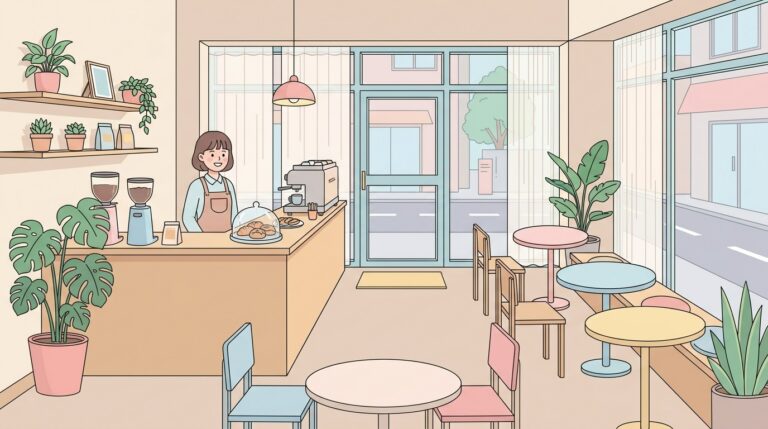
Setting: A warm, plant-filled cafe in Yeonnam-dong. Barista Minjun (민준) is at the counter, and customer Alex (알렉스) walks in looking at the chalkboard sign by the entrance.
Dialogue:
* 알렉스: 저기요, 입구에 적힌 ‘케어키즈존’이 무슨 뜻인가요? (Jeogiyo, ipgue jeokhin ‘ke-eo-ki-jeu-jon’-i museun tteusingayo?)
* 🎭 Politely stepping up to the counter, blinking with curiosity. — “Excuse me, what does ‘Care Kids Zone’ written at the entrance mean?”
* 민준: 아, 저희 카페는 아이 동반이 가능하지만, 부모님의 세심한 케어를 부탁드리고 있어요. (A, jeohui kapeneun ai dongban-i ganeunghajiman, bumonim-ui sesimhan keeoreul butakdeurigo isseoyo.)
* 🎭 Smiling warmly while wiping an espresso portafilter. — “Ah, children are welcome here, but we ask parents for attentive care and supervision.”
* 알렉스: 아하! 모든 어린이를 막는 노키즈존과는 다르네요. (Aha! Modeun eorin-ireul mangneun no-kijeu-jon-gwaneun dareuneyo.)
* 🎭 Nodding understandingly, taking off sunglasses. — “Aha! So it’s different from a No-Kids Zone that bans all children.”
* 민준: 네, 맞아요. 아이가 뛰거나 소리를 지르면 다른 손님들께 방해가 될 수 있거든요. (Ne, majayo. Aiga ttwigeona sorireul jireumyeon dareun sonnimdeulkke banghaega doel su itgeodeunyo.)
* 🎭 Speaking in a soft, calm tone with an open hand gesture. — “Yes, exactly. If a child runs or shouts, it could disturb other guests.”
* 알렉스: 그럼 매너를 지키지 않으면 어떻게 되나요? (Geureom maeneoreul jikiji aneumyeon eotteoke doenayo?)
* 🎭 Leaning in slightly with a genuine, intrigued look. — “Then what happens if someone doesn’t follow the etiquette?”
* 민준: 정중히 주의를 드리고, 계속 방해가 되면 퇴장을 요청드릴 수 있습니다. (Jeongjunghi juuireul deurigo, gyesok banghaega doemyeon toejang-eul yocheongdeuril su itseumnida.)
* 🎭 Explaining professionally without sounding harsh. — “We politely issue a reminder, and if disruptions continue, we may kindly ask them to leave.”
* 알렉스: 합리적이네요. 공간을 함께 배려하는 느낌이에요. (Hamnijeogineyone. Gonggan-eul hamkke baeryeohaneun neukkim-ieyo.)
* 🎭 Appreciative smile, pointing toward an open table. — “That sounds very reasonable. It feels like everyone is looking out for the shared space.”
* 민준: 그렇게 말씀해 주셔서 감사합니다! 편안한 시간 보내세요. (Geureoke malsseumhae jusyeoseo gamsahamnida! Pyeon-an-han sigan bonaeseyo.)
* 🎭 Handing over the receipt with both hands and bowing slightly. — “Thank you for saying that! Please have a wonderful time.”
🔀 Interactive Decision Point
Imagine you are at the cafe with a friend, and a nearby child keeps playing mobile phone games with the volume turned all the way up, while the parent is distracted. What do you do?
- Option A: Stand up and shout across the room: “아이 좀 조용히 시키세요!” (Ai jom joyonghi sikiseyo! — Make your child quiet!)
- Result: Bad. Creates an aggressive scene, violates Korean social harmony, and makes everyone in the cafe uncomfortable.
- Option B: Speak quietly to the staff: “저기 죄송한데, 소리가 조금 커서요. 확인 부탁드려도 될까요?” (Jeogi joesonghande, soriga jogeum keoseoyo. Hwagin butakdeuryeodo doelkkayo? — Excuse me, the volume is a bit loud. Could you kindly check on it?)
- Result: Best. Perfectly utilizes polite B1 Korean and respects nunchi. Staff can professionally mediate under their ‘No Bad Parents / Care Kids’ guidelines.
- Option C: Stare fiercely at the parent until they feel guilty without saying a word.
- Result: Risk. While eye contact is used in nunchi, silent glaring often causes passive-aggressive tension without solving the issue.
Phase 6: 10-Second Emotion Shadowing Drill
Practice these lines out loud! Pay attention to the pause markers (/) and emotional tone cues.
[😊 정중하고 친절하게 / Politely and warmly]- 매너를 / 지켜 주시면 / 감사하겠습니다. (Maeneoreul / jikyeo jusimyeon / gamsahagetseumnida.)
- “We would appreciate it / if you could observe / proper etiquette.”
[🤝 차분하고 사려 깊게 / Calmly and thoughtfully]- 다른 손님들을 위해 / 목소리를 조금만 / 낮춰 주시겠어요? (Dareun sonnimdeureul wihae / moksorireul jogeumman / natchwo jusigesseoyo?)
- “For the sake of other guests / could you lower / your voice just a bit?”
[🥺 조심스럽지만 단호하게 / Careful yet clear and firm]- 모두의 안전을 위해 / 아이의 손을 / 꼭 잡아 주세요. (Modu-ui anjeon-eul wihae / ai-ui soneul / kkok jaba juseyo.)
- “For everyone’s safety / please hold / your child’s hand securely.”
Phase 7: K-Culture Mini Dictionary
- 노배드페어런츠존 (No-bae-deu-pe-eon-tsu-jon) | “No Bad Parents Zone”
- Meaning: A progressive social campaign in restaurants and cafes that welcomes children, but enforces courteous behavior by holding inattentive caregivers accountable.
- 케어키즈존 (Ke-eo-ki-jeu-jon) | “Care Kids Zone”
- Meaning: An establishment where children are permitted under the explicit agreement that guardians actively manage their noise and physical safety.
- 민폐 (Min-pye) | “Inconvenience / Nuisance to others”
- Meaning: A fundamental concept in Korean social philosophy. Causing minpye means disrupting communal harmony, which Koreans strive deeply to avoid.
- 배려 (Bae-ryeo) | “Consideration / Thoughtfulness”
- Meaning: The core counter-virtue to minpye. Making small compromises (e.g., whispering, holding doors, controlling volume) to make shared spaces pleasant for everyone.
Phase 8: Traveler’s Survival Kit
Survival Expressions TOP 3
- 1. 혹시 여기 아이 동반 가능한가요? (Hoksi yeogi ai dongban ganeunghangayo?)
- Translation: Is it possible to bring children here?
- Pro Tip: Use this at the entrance of trendy cafes before ordering if you travel with family.
- 2. 아기 의자 있나요? (Agi uija innayo?)
- Translation: Do you have a high chair (baby seat)?
- Pro Tip: Many family-friendly Korean restaurants will happily bring an agi uija if requested.
- 3. 제가 조용히 하도록 신경 쓸게요. (Jega joyonghi hadorok singyeong sseulgeyo.)
- Translation: I will make sure we stay quiet and mindful.
- Pro Tip: Saying this reassuring sentence immediately builds instant goodwill with cafe owners.
Editor’s Travel Note
- Checking Cafe Policies: Use the Naver Map app store download search filter. By typing cafe names alongside keywords like “예스키즈존” (Yes Kids Zone) or looking through visitor reviews, you can confirm whether a spot welcomes kids before taking a long taxi ride.
- Subway & Transit: If taking the Seoul Metro, observe the designated “pink seats” for pregnant mothers and the end seats for seniors. While not legally enforced, occupying them without necessity can lead to awkward stares due to communal expectations.
Phase 9: “One Step Deeper” (Reflective Humanities Essay)
Korea’s rapid transition from a collective agrarian society to one of the world’s most hyper-connected, high-density urban environments has created unique growing pains. In a megacity like Seoul, where personal physical boundaries naturally shrink on packed subways and in tight cafes, the invisible boundary of etiquette becomes our only shield of privacy.
When parents feel overwhelmed and fellow cafe visitors feel overstimulated, friction occurs. The emergence of the ‘No Bad Parents Zone’ is inspiring because it moves away from blanket exclusion (banning age groups) and moves toward mutual civic maturity. It says: Our space belongs to everyone, provided we all bring our best consideration. Language reflects this shift as well—moving from cold prohibitions to respectful appeals for care and consideration.
💬 Your Turn: Does your home country have age-restricted spaces like cafes or restaurants? How do you feel about the transition from ‘No Kids’ to ‘No Bad Parents’? Share your perspective in the comments below!
Phase 10: FAQ & Common Mistakes
Q: Are ‘No-Kids Zones’ legal in South Korea?
A: Korea’s National Human Rights Commission ruled in 2017 that blanket No-Kids Zones can be considered discriminatory without reasonable justification. However, business owners have commercial freedom regarding who they serve, so private establishments can set operational guidelines. This legal tension is why many places now prefer ‘Care Kids Zones’.
Q: What is a ‘No Senior Zone’ (노시니어존)?
A: A controversial trend where a handful of cafes or bars restricted entry to individuals over 60 or 65, citing cultural discomfort among younger clientele or laptop-campers. This sparked significant public outcry and debate across Korean society regarding ageism, leading most businesses to reject such labels.
Q: If a cafe has no sign, is it safe to bring children?
A: Most standard cafes and franchise chains (like Twosome Place, Mega Coffee, Starbucks) are fully family-friendly. It is typically boutique roasteries, rooftop lounges, or cafes decorated with fragile antiques where kid policies are in place.
🚨 Common Mistakes TOP 3
- Mistake: Using informal banmal (반말) when addressing someone’s child in public (e.g., saying “야, 뛰지 마!” / Hey, don’t run!).
- Correct Action: Always speak through the parent or cafe staff using polite honorifics.
- Mistake: Confusing ‘노키즈존’ (No Kids) with ‘키즈카페’ (Kids Cafe).
- Correct Action: A ‘키즈카페’ is a play center paradise for children with trampolines and ball pits, the exact opposite of a No-Kids Zone!
- Mistake: Assuming “양해 부탁드립니다” means the establishment is doing something wrong.
- Correct Action: Recognize it as standard etiquette for requesting customer cooperation or announcing a policy.
Phase 11: Action Missions
- 🥉 Bronze Mission (Solo Practice): Record yourself reading the 3 Emotion Shadowing sentences in Phase 6 on your phone. Focus on softening your final syllables
-요and-니다. - 🥈 Silver Mission (Social Connection): Write a one-sentence Korean comment on your social media or language exchange app using the pattern: “[공간]에서는 매너를 지켜 주세요!” (e.g., 도서관에서는 매너를 지켜 주세요! — Please keep manners in the library!).
- 🥇 Gold Mission (Real-Life Application): The next time you visit a cafe or store, use the respectful phrasing “-해 주실 수 있나요?” instead of a simple noun + “주세요”.
- 🎮 K-Culture Media Mission: In your next K-drama binge, listen for whenever a character uses the word ‘배려’ (baeryeo) or ‘민폐’ (minpye). Notice the facial expressions and social dynamics surrounding that scene!
Phase 12: Interactive Quiz Challenge
Test your understanding of Korean public etiquette and vocabulary!
1. Situational Judgment
You enter an aesthetic ceramic cafe in Ikseon-dong and notice a sign saying ‘케어키즈존’. What does this imply?
(A) Children are banned entirely from entering.
(B) Children are welcome, but guardians are requested to supervise them carefully.
(C) Free daycare service is provided by the cafe staff.
2. Fill in the Blank
Fill in the missing respectful honorific particle:
“다른 손님들께 방해가 되지 않도록 매너를 지켜 ______.”
(A) 마라
(B) 주세요
(C) 보아라
3. True or False Culture Check
In modern Korean dining, asking someone “목소리 조금만 낮춰 주실 수 있나요?” is considered more natural and polite than “조용히 해 주십시오.”
(True / False)
👉 Click to reveal answers & explanations!
1. Answer: (B)
Explanation: ‘케어키즈존’ (Care Kids Zone) welcomes families under the understanding that guardians actively take responsibility for their children’s safety and quietness.
2. Answer: (B) 주세요
Explanation: ‘지켜 주세요’ (Please keep/observe) is the natural, polite request form appropriate for public guidance.
3. Answer: True
Explanation: Adding conversational buffers like ‘조금만’ (just a bit) and soft endings like ‘-실 수 있나요?’ softens requests and honors the other person’s face in social etiquette.







