

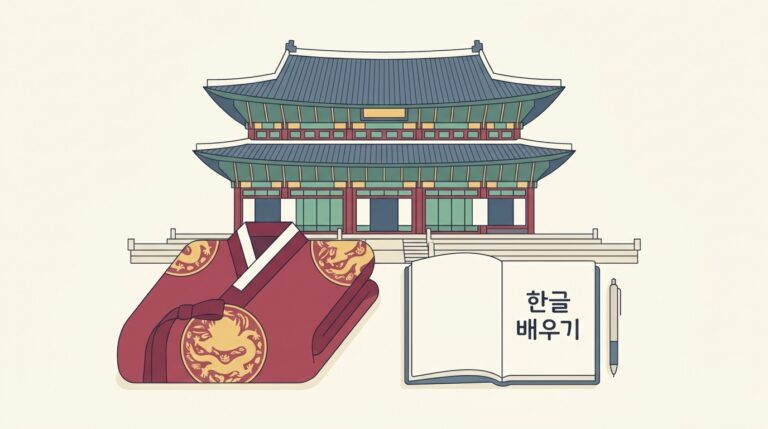
Master the Royal Tongue: The Dramatic Court Honorifics of Historical K-Dramas
Phase 1: Empathy (Story-Immersive Opening)
안녕하세요! 매일한글 에디터입니다. (Hello! This is your Daily Hangul editor.)
Picture this: It is 1:00 AM on a Friday, and you are completely glued to the screen watching a high-stakes historical drama (사극, Sageuk) like Under the Queen’s Umbrella or The Red Sleeve. The tension in the Grand Throne Hall is palpable. Dozens of red-robed royal ministers drop to their knees simultaneously, their forehead-touching prostrations echoing against the stone floor. In one thunderous, desperate unison, they cry out:
**”전하, 통촉하여 주시옵소서!” (Jeonha, tongchokhayeo jusiopsoseo! / Your Majesty, please grant your profound wisdom!)
The English subtitle flashes a brief “Please reconsider, Your Majesty.” But you can feel in your gut that something vital is missing in translation. The agonizing vibrato in their voices, the grand archaic rhythm, and the poetic weight of every syllable carry a cultural gravity that standard modern textbooks simply never cover. Many intermediate learners tell me: “I understand standard polite endings like -요 (-yo) and -습니다 (-seumnida), but when historical dramas start rolling, I feel completely lost in the court dialogue!”
Do not worry! Learning these iconic royal court honorifics is not just about understanding ancient kings; it gives you an authentic, insider grasp of Korean emotional nuance, hyper-politeness, and even modern workplace humor. By dissecting these signature lines, you will transition from merely reading subtitles to experiencing the raw drama just like native speakers do. Let us unlock the majestic speech of the Joseon court together!
Phase 2: In-Depth Analysis of 3 Core Expressions
1. 전하, 통촉하여 주시옵소서 (Jeonha, tongchokhayeo jusiopsoseo)
- Pronunciation: [Jeon-ha, tong-cho-kha-yeo ju-si-op-so-seo] (Sounds like “Jun-ha, tong-choke-ha-yeo joo-see-op-so-suh”)
- Meaning:
- Literal: “Your Majesty, please shine a torch deep into this dark matter and understand.”
- Nuanced: “Your Majesty, we beg you to look beneath the surface and reconsider with deep benevolence and discernment!”
- K-Culture Moment: Seen whenever court ministers stage a collective strike (지부상소, jibusangso) outside the royal quarters in historical dramas, protesting an unconventional decree or defending a falsely accused scholar.
- Editor’s Insight: The word 통촉 (洞燭, tongchok) literally pairs “cave/penetrate” (洞) with “candlelight/torch” (燭). It implies that the king’s wisdom must illuminate the darkest corners of an injustice. Adding the archaic extreme honorific ending “-옵소서” (-opsoseo) turns a plea into a solemn prayer.
- Situation Spectrum:
- Casual: 🚫 (Sounds ridiculously dramatic, unless done playfully among friends)
- Semi-formal / Modern Office: 🚫 (Do not use this with your manager unless joking!)
- Sageuk / Court Drama: ✅ (The ultimate signature royal phrase)
- 🤔 Think About It: In your native language, how would you respectfully tell an absolute monarch that their decision is misguided without getting yourself beheaded?
2. 성은이 망극하옵니다 (Seongeuni manggeukhaopnida)
- Pronunciation: [Seong-eun-i mang-geu-kha-om-ni-da] (Sounds like “Sung-eun-ee mang-geuk-ha-ohm-nee-da”)
- Meaning:
- Literal: “The sacred royal favor is without boundaries.”
- Nuanced: “Your royal grace is so boundless that I am utterly unworthy and overwhelmed with gratitude!”
- K-Culture Moment: Uttered when the King promotes a humble servant, spares someone from execution, or confers medicine upon a sick vassal.
- Editor’s Insight: 성은 (聖恩, seongeun) translates to “holy/sacred grace,” while 망극 (罔極, manggeuk) means “having no limits or ends.” It embodies extreme humility (낮춤), placing the speaker in a position of boundless debt toward the monarch’s benevolence.
- Situation Spectrum:
- Casual: ⚠️ (Koreans ironically shout this when a senior colleague or friend pays for a lavish dinner)
- Semi-formal: 🚫
- Historical Court: ✅
- 🤔 Think About It: Notice how Korean deep gratitude often combines thankfulness with expressing self-diminishment and awe rather than just saying “thank you.”
3. 어명 (Eomyeong) / 어명이오! (Eomyeong-io!)
- Pronunciation: [Eo-myeong] / [Eo-myeong-i-o] (Sounds like “Uh-myung” / “Uh-myung-ee-oh!”)
- Meaning:
- Literal: “Royal command!”
- Nuanced: “This is the sovereign decree of the King! Disobedience is treason!”
- K-Culture Moment: The royal messenger bursts into an estate brandishing a silk scroll or royal seal, declaring an arrest, a forced marriage, or the tragic sentence of drinking poison (사약, sayak).
- Editor’s Insight: 어 (御, eo) is a royal prefix designating items or actions belonging to the ruler (e.g., 어진 = royal portrait, 어의 = royal physician). When someone shouts “어명이오!”, all present must immediately kneel, regardless of rain, mud, or snow.
- Situation Spectrum:
- Casual: ⚠️ (Hilariously used when passing down an unavoidable group chore, like deciding who buys coffee)
- Semi-formal: 🚫
- Historical Drama: ✅
- 🤔 Think About It: How does giving a divine prefix to a state decree affect legal and psychological authority?
Phase 3: Textbook Korean vs. Real Korean
In standard Korean curricula, you study contemporary high-polite forms like Hasipsio-che (하십시오체). But in K-Dramas and cheeky modern banter, these royal tropes turn into witty social currency!
Situation 1: Begging someone to listen to your desperate reason
- 📖 교과서 한국어 (Textbook):
제 사정을 한 번만 깊이 헤아려 주시기 바랍니다. (Je sajeong-eul han beon-man gipi he-a-ryeo jusigi baramnida.)
“I hope you will deeply consider my situation just once.” - 🗣️ 진짜 한국어 (Dramatic Sageuk Style):
전하, 소인의 억울함을 부디 통촉하여 주시옵소서! (Jeonha, soin-ui eog-ul-ham-eul budi tongchokhayeo jusiopsoseo!)
“Your Majesty, I beseech thee, please see through my bitter grievance with your piercing wisdom!” - 💡 왜 다를까? (Why the difference?): Standard Korean sounds neutral and transactional. Sageuk phrasing elevates the stakes to cosmic proportions, highlighting total devotion and extreme injustice.
Situation 2: When your coworker unexpectedly buys an expensive meal
- 📖 교과서 한국어 (Textbook):
정말 감사합니다. 맛있게 잘 먹겠습니다. (Jeongmal gamsahamnida. Mas-itge jal meokgetseumnida.)
“Thank you so much. I will enjoy this meal.” - 🗣️ 진짜 한국어 (Modern K-Humor):
부장님, 성은이 망극하옵니다! (Bujangnim, seongeuni manggeukhaopnida!)
“Department Head, your royal grace is truly boundless!” - 💡 왜 다를까? (Why the difference?): Modern Koreans love using dramatic royal court honorifics playfully with close colleagues to flatter superiors and lighten the office mood.
Phase 4: K-Culture Deep Dive & Non-Verbal Manners
4-1. Nunchi & Court Body Language
When watching or imitating Sageuk dialogue, vocal delivery is only half the battle. Royal court speech dictates strict somatic choreography:
1. Gongsu (공수): The hands must be crossed at the solar plexus (left hand over right for men; right hand over left for women during ceremonies) and concealed within the expansive flowing sleeves of the Hanbok.
2. Gaze Aversion: Looking directly into the King’s eyes was traditionally an act of insolence tantamount to treason. The head remains angled at a 45-degree tilt toward the floor.
3. Prostration (Jeol – 절): When delivering lines like “성은이 망극하옵니다,” speakers do not stay upright. They drop to their knees, place both hands flat on the floor, and bow their head until it touches the back of their hands.
4-2. Cultural Code Analysis: The Neo-Confucian Pyramid
The unique grandeur of Sageuk court speech is anchored in Joseon’s state philosophy: Neo-Confucianism (성리학). In this worldview, the King was not merely an administrative bureaucrat; he was the moral fulcrum of the universe. To contradict him required immense moral courage. Therefore, court officials used the most elevated, linguistically intricate deference structures imaginable (극존칭, geukjonching) to critique policy without appearing rebellious.
Phase 5: Real-Life Roleplay Scenario
Setting: Late evening outside the King’s inner sanctum, Gangnyeongjeon. Snow falls gently on the courtyard. Royal Inspector Min (민 감찰관) seeks an urgent audience with the resolute King Yi Heon (이헌 왕).
- Turn 1 (Inspector Min):
전하! 밤이 깊었사오나 급히 아뢸 말씀이 있사옵니다.
(Jeonha! Bam-i gipeot-sa-ona geupi a-rwoel malsseum-i it-sa-opnida.)
🎭 Kneeling on the cold flagstones, hands clutching a scroll to his chest.
“Your Majesty! The night runs deep, yet I have an urgent matter that must be brought before you.” -
Turn 2 (King Yi Heon):
야심한 시각에 무슨 소란인가? 들어와 아뢰라.
(Yasimhan sigag-e museun soran-inga? Deul-eowa a-roe-ra.)
🎭 Speaking from behind the lattice screen with deep, resonant composure.
“What commotion is this in the dead of night? Enter and speak.” -
Turn 3 (Inspector Min):
어명을 받들어 조사한 뇌물 사건의 배후가 밝혀졌사옵니다.
(Eomyeong-eul batdeul-eo josahan noemul sageon-ui baehu-ga balkhyeojyeot-sa-opnida.)
🎭 Shuffling forward on knees, eyes fixed strictly on the floorboards.
“Carrying out the royal command, the mastermind behind the bribery scandal has finally been unmasked.” -
Turn 4 (King Yi Heon):
배후라니? 그자가 누구더냐?
(Baehu-rani? Geujaga nugudeonya?)
🎭 Putting down his brush, his brow furrowing.
“A mastermind? Who is this traitor?” -
Turn 5 (Inspector Min):
다름 아닌 영의정이옵니다. 부디 사정을 살펴 주시옵소서!
(Dareum anin yeong-uijeong-iopnida. Budi sajeong-eul salpyeo jusiopsoseo!)
🎭 Pressing forehead firmly to the floor in a solemn plea.
“It is none other than the Chief State Councilor. I beseech you to scrutinize this matter!” -
Turn 6 (King Yi Heon):
영의정이라니… 조정이 크게 흔들릴 것이야. 그러나 국법은 엄정한 법.
(Yeong-uijeong-irani… Jojeong-i keuge heundeullil geos-iya. Geureona gukbeob-eun eomjeonghan beop.)
🎭 Pausing gravely, then delivering a resolute nod.
“The Chief State Councilor… The court will tremble. Yet the law of the state remains inviolable.” -
Turn 7 (King Yi Heon):
추국청을 열어 철저히 문초하라. 과인의 뜻이다!
(Chugukcheong-eul yeol-eo cheoljeohi mun-chohara. Gwain-ui tteus-ida!)
🎭 Standing tall, throwing open his crimson dragon robe.
“Open the Special Court and interrogate thoroughly. This is my sovereign will!” -
Turn 8 (Inspector Min):
어명, 받들겠사옵니다! 성은이 망극하옵니다, 전하!
(Eomyeong, batdeul-get-sa-opnida! Seongeuni manggeukhaopnida, Jeonha!)
🎭 Bowing once more with absolute conviction and reverence.
“I shall execute your royal command! Your grace is boundless, Your Majesty!”
🔀 Interactive Decision Point
Suppose you are Inspector Min, and the King initially hesitated, showing reluctance to punish his mentor. What would you utter?
- Choice A: “전하, 법을 지키지 않으시면 안 됩니다!” (Jeonha, beobeul jikiji aneushimyeon an doemnida!)
- Choice B: “전하, 종묘사직을 위하여 통촉하여 주시옵소서!” (Jeonha, jongmyosajig-eul wihayeo tongchokhayeo jusiopsoseo!)
- Choice C: “전하, 왕으로서 제발 일 좀 하세요!” (Jeonha, wang-euroseo jebal il jom haseyo!)
Feedback:
* Choice A (Risk ⚠️): Grammatically modern and blunt. Speaking like this to a Joseon king would lead to instant banishment for insolence.
* Choice B (Best ✅): Flawless! Appealing to the “altars of the state” (종묘사직, jongmyosajik) while using “통촉하여 주시옵소서” combines patriotic duty with pinnacle deference.
* Choice C (Bad 🚫): “Your Majesty, please do your job as king!” You would be imprisoned for lèse-majesté before the sentence even finishes!
Phase 6: 10-Second Emotion Shadowing Drill
Practice these lines with theatrical voice projection! Deliver them right from your diaphragm.
- Sentence 1 [🙇♂️ Desperate & Earnest]:
전하! / 신들의 충정을 / 부디 / 통촉하여 주시옵소서!
(Jeonha! / Sindeul-ui chungjeong-eul / budi / tongchokhayeo jusiopsoseo!)
“Your Majesty! / Our loyal devotion / we beg you / please grant your profound discernment!” -
Sentence 2 [👑 Authoritative & Uncompromising]:
물러서지 마라! / 이것은 / 지엄한 / 어명이니라!
(Mulleoseoji mara! / Igeos-eun / jieomhan / eomyeong-inira!)
“Do not step back! / This is / an inviolable / royal command!” -
Sentence 3 [😭 Overcome with Sacred Gratitude]:
망극하옵니다! / 망극하옵니다! / 성은이 / 망극하옵니다!
(Manggeukhaopnida! / Manggeukhaopnida! / Seongeuni / manggeukhaopnida!)
“It is boundless! / It is boundless! / Your royal grace / is beyond all bounds!”
Phase 7: K-Culture Mini Dictionary (4 Key Terms)
-
과인 (Gwain)
- Meaning: “This lacking person” (The King’s self-deprecating first-person pronoun).
- Usage: Used exclusively by the reigning monarch to balance supreme authority with moral humility before the Heavens.
- 소인 (Soin)
- Meaning: “This small/insignificant person” (Humble first-person pronoun for subjects).
- Usage: Used by commoners or lower-ranking individuals when speaking to nobility or superiors in historical settings.
- 마마 (Mama)
- Meaning: Royal Title Suffix (e.g., 중전마마 Jungjeon-mama for Queen, 대비마마 Daebi-mama for Queen Dowager).
- Usage: An honorific marker attached to high royal women and princes to convey ultimate nobility.
- 납시오 (Napsio)
- Meaning: “Behold, royal arrival!”
- Usage: Proclaimed loudly by eunuchs and palace attendants when a monarch steps into a courtyard: “전하 납시오!” (Make way for the King!).
Phase 8: Traveler’s Survival Kit
Visiting Seoul’s Grand Palaces (Gyeongbokgung, Changdeokgung)? Put your Sageuk knowledge to work!
Top 3 Survival Expressions for Palace Enthusiasts
- 성은이 망극하옵니다! (Seongeuni manggeukhaopnida!)
- Pro Tip: Wear a rented Hanbok to Gyeongbokgung (admission is free when wearing Hanbok!). When staff hand you your ticket or open the royal gate, playfully bow and say this line. It brings delightful smiles every time!
- 전하, 함께 사진을 찍어 주시옵소서! (Jeonha, hamkke sajin-eul jjigeo jusiopsoseo!)
- Pro Tip: Use this formal request when asking the Royal Guard reenactors at Gwanghwamun Gate for a souvenir photo.
- 어명이오! (Eomyeong-io!)
- Pro Tip: Fun to declare to your travel buddies when deciding to halt for refreshments at a traditional tea house in Insadong.
Editor’s Travel Note
- Palace Navigation: Download the Official Korea Heritage Service Palace Information App for real-time guard change schedules and English audio tours.
- Smart Transit: Check out the Naver Map Subway and Bus Navigation Tool to find direct transit routes to the historical palaces without missing royal reenactment ceremonies.
Phase 9: “One Step Deeper” (Reflective Prompt)
Korean honorifics are not merely grammatical markers; they are cultural architecture. In the Joseon court, speech forms mirrored cosmic harmony, emphasizing that power and humility are two sides of the same coin. When a modern Korean jokingly uses “성은이 망극하옵니다” over barbecue pork, they are tapping into centuries of collective cultural memory, bridging ancient reverence with affectionate modern irony.
💬 Your Turn: Which period drama king or queen line gave you chills the first time you heard it? Drop your favorite Sageuk dialogue in the comments below!
Phase 10: FAQ & Common Mistakes
Q: Can I use “전하, 통촉하여 주시옵소서” to my Korean professor or boss?
A: Only as an intentional, lighthearted joke! If you use it with a deadpan face in an actual formal meeting, it will come across as confusing and theatrical. For serious requests, stick to modern high honorifics like: “너그러운 양해 부탁드립니다” (Please grant your generous understanding).
Q: Why do they say “전하” (Jeonha) for some kings and “폐하” (Pyeha) in other dramas?
A: Historical context is key! “폐하” (Pyeha – Your Imperial Majesty) is reserved for emperors (such as during the Goguryeo Empire or the late Korean Empire of 1897). “전하” (Jeonha – Your Royal Highness) was used during the Joseon Dynasty in diplomatic alignment with East Asian tributary traditions.
Q: What is the difference between “소신” (Sosin) and “소인” (Soin)?
A: “소신” (小臣) combines “small” and “minister”—it is exclusively used by court officials when addressing the King. “소인” (小人) is a broader humble term used by commoners, servants, or civilians.
🚨 Common Mistakes (흔한 실수)
- Calling a modern Korean friend “전하” in serious situations.
- Correction: Reserve royal honorifics strictly for reenactments, playful jokes, or Sageuk script reading.
- Confusing “어명” (Royal Command) with “명령” (Standard Order).
- Correction: Remember that “어명” carries the sacred royal prefix ‘어’ (御); never apply it to ordinary civilian instructions.
- Dropping honorific endings during court lines.
- Correction: Sageuk lines strictly require archaic suffixes like -시옵소서 (-siopsoseo) or -하옵니다 (-haopnida). Half-modernizing them ruins the cadence!
Phase 11: Action Missions & Engagement
- 🥉 Bronze Mission (Solo Shadowing):
Record a 10-second voice memo reciting: “전하, 부디 통촉하여 주시옵소서!” Focus on deep vocal resonance. - 🥈 Silver Mission (Social Share):
Post a still of your favorite Sageuk drama on Instagram or Threads and caption it with #성은이망극하옵니다. - 🥇 Gold Mission (Real-Life Hanbok Quest):
Visit a palace or Korean cultural center, put on a Hanbok, and bow to your friend shouting “어명이오!” without breaking character! - 🎮 K-Culture Mission:
Watch one episode of The Red Sleeve or Under the Queen’s Umbrella. Tally how many times you spot the phrase 전하 or 통촉 in 60 minutes!
Phase 12: Interactive Quiz Challenge
Test your royal court mastery!
- Which phrase would ministers chant when begging the King to reconsider a severe decision?
- A) 성은이 망극하옵니다
- B) 통촉하여 주시옵소서
- C) 어명이오
- Fill in the blank with the humble royal prefix:
The King’s sovereign command is known as [____]명 (___-myeong). -
True or False: Modern Koreans never use Sageuk expressions in contemporary daily life.
Click here to reveal the answers and explanations!
- Answer: B) 통촉하여 주시옵소서
- Explanation: 통촉 (洞燭) asks the King to illuminate dark matters and look with deep insight.
- Answer: 어 (어명 / Eomyeong)
- Explanation: The royal prefix ‘어’ (御) denotes matters belonging directly to the sovereign.
- Answer: False
- Explanation: Koreans frequently quote lines like “성은이 망극하옵니다” or “어명이오” for witty social banter among close friends and coworkers!
- Explanation: Koreans frequently quote lines like “성은이 망극하옵니다” or “어명이오” for witty social banter among close friends and coworkers!







