

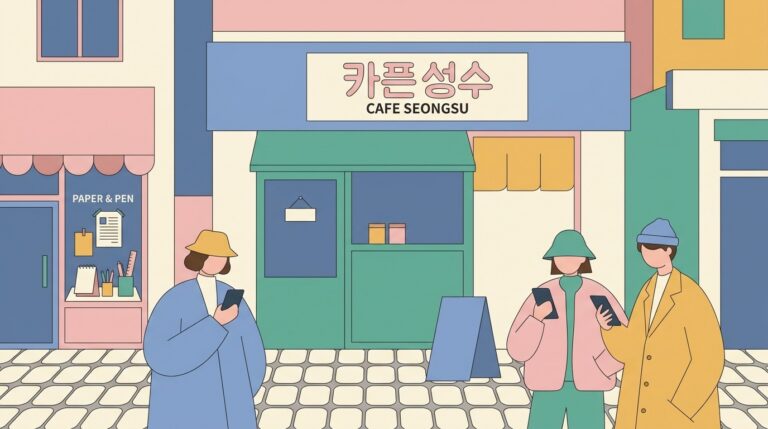
Phase 1: Empathy & Storytelling Opening
안녕하세요! 매일한글 에디터입니다.
Picture this: You are standing in the middle of Seongsu-dong (성수동) or Yeonnam-dong (연남동) on a breezy Saturday afternoon. You have finally found that viral bakery cafe or trendy tteokbokki restaurant you saved on Instagram weeks ago. But as you step up to the door, you are greeted by an iPad running Catch Table (캐치테이블). The screen boldly announces: “32 teams waiting ahead of you (~60 mins).”
Your stomach drops for a second, but then you look to your right. Just two doors down, there is a glowing, charming little sopum-shop (소품샵 – boutique gift and stationery shop) filled with handcrafted stickers, scented candles, and fluffy keyrings. You don’t want to stand awkwardly on the street curb for an hour, but you also panic: “What if they call my name while I’m looking at stickers? How do I tell the host or my friend that I’ll just check out the cute shop next door and come straight back?”
Don’t worry! This is the ultimate rite of passage in modern Seoul. Over 85% of our Daily Hangul beginner students confessed that waiting at Korean hot spots felt terrifying because of the fast-paced alert system. Today, we will turn that anxiety into pure confidence. With just a few simple, natural A2-level Korean phrases, you will handle waiting apps like a local hipster and enjoy your neighborhood stroll stress-free!
Phase 2: Core Expressions Deep Dive
1. 웨이팅 등록했어요 (Weiting deungrokhaesseoyo)
- Pronunciation: [We-i-ting deung-nokh-ae-ssyo-yo] (Sounds like “waiting” + “doong-nock-hae-sseo-yo”)
- Meaning: Literal: “I registered for waiting.” / Real Nuance: “I put our names on the waitlist!”
- K-Culture Moment: Seen frequently in Korean travel vlogs where friends high-five after entering their phone number into a tablet kiosk outside a Michelin-guide pork belly restaurant.
- Editor’s Insight: Notice that Koreans borrow the English word waiting and pronounce it as 웨이팅 (we-i-ting) rather than using the formal Sino-Korean word 대기 (daegi) in casual speech. Combining it with 등록하다 (to register) in the past tense creates an immediate, natural status update.
- Situation Spectrum: Casual: ✅ | Semi-formal: ✅ | Formal: ⚠️
- 🤔 Think About It: In English, we often say “We’re on the list.” Korean emphasizes the active verb “registered” (등록했어요). How does stating the completed action bring peace of mind to your companions?
2. 바로 옆 소품샵 보고 올게요 (Baro yeop sopum-syap bogo olgeyo)
- Pronunciation: [Ba-ro yeop so-pum-syap bo-go ol-ge-yo] (Think: “Bah-ro” like rapid, “yup”, “so-poom-shop”, “bo-go-ol-ge-yo”)
- Meaning: Literal: “I will see the prop shop right next door and come back.” / Real Nuance: “I’m just going to browse the cute shop right next door and be right back!”
- K-Culture Moment: Typical scene in K-Dramas like Our Beloved Summer where characters explore tiny aesthetic boutiques in alleyways while waiting for food.
- Editor’s Insight: The structure -고 오다 (-go oda) means “to do something and come back.” 보고 올게요 (bogo olgeyo) is friendlier and less intense than “I will go shopping.” It implies casual window-shopping.
- Situation Spectrum: Casual: ✅ | Semi-formal: ✅ | Formal: 🚫
- 🤔 Think About It: Korean separates small lifestyle/craft shops as 소품샵 (sopum-shop) rather than general “gift shops.” It highlights tiny, curated aesthetic items (소품).
3. 알림 오면 바로 올게요 (Allim omyeon baro olgeyo)
- Pronunciation: [Al-lim o-myeon ba-ro ol-ge-yo] (Flows like: “Ahl-leem oh-myun bah-ro ol-ge-yo”)
- Meaning: Literal: “If/when notification comes, immediately I will come.” / Real Nuance: “The second I get the text notification, I’ll run straight back!”
- K-Culture Moment: What you tell the cafe door manager when stepping away from the front line so they know you won’t abandon your spot.
- Editor’s Insight: 알림 (allim) refers to push notifications or KakaoTalk automated alerts. Pairing -(으)면 (~myeon, when/if) with 바로 (baro, right away) conveys clear reassurance and respect for the staff’s schedule.
- Situation Spectrum: Casual: ✅ | Semi-formal: ✅ | Formal: ✅
- 🤔 Think About It: Why is promptness emphasized in Korean restaurant culture? Tables turn over swiftly, so expressing prompt return shows strong community courtesy.
Phase 3: Textbook Korean vs. Real Korean
Situation 1: Telling the host you want to explore nearby
- 📖 교과서 한국어: 여기서 계속 기다려야 합니까? (Yeogiseo gyesok gidaryeoya hamnikka?) — “Must I continue to wait here?”
- 🗣️ 진짜 한국어: 카톡 알림 오면 들어오면 되죠? (Katok allim omyeon deureoomyeon doejo?) — “I can just come in once the KakaoTalk alert arrives, right?”
- 💡 왜 다를까? Textbook Korean sounds like an official interrogation. In reality, young Koreans mention 카톡 알림 (KakaoTalk alert) directly to confirm they are free to roam.
Situation 2: Telling your travel buddy where you are heading
- 📖 교과서 한국어: 저는 옆에 있는 가게에서 물건을 구경하겠습니다. (Jeoneun yeope inneun gageeseo mulgeoneul gugyeonghagesseumnida.) — “I shall observe goods in the establishment beside us.”
- 🗣️ 진짜 한국어: 옆에 잠깐 둘러보고 올게! (Yeope jamkkan dulleobogo olge!) — “I’ll take a quick look next door and be back!”
- 💡 왜 다를까? Real Korean speakers prefer verbs like 둘러보다 (dulleoboda, to look around / browse) rather than the formal 구경하다 in casual companionship contexts.
Phase 4: K-Culture Deep Dive & Non-Verbal Manners
4-1. Nunchi (눈치) & Gestures
When using waitlist machines outside popular restaurants:
1. The Screen Show: After entering your international or Korean mobile number, quickly show your screen confirmation to the staff with a gentle two-handed point if they are standing near the door.
2. The Polite Neck Bow (목례): As you say “바로 옆에 보고 올게요” (Baro yeope bogo olgeyo), give a brief 15-degree head nod. It signals that you are not leaving the queue, just stepping out of foot traffic.
3. Sound Check: Always switch your phone ringer or high-priority vibration ON. In busy districts like Seongsu or Hongdae, you won’t hear KakaoTalk chimes inside a bustling store!
4-2. The ‘Sopum-Shop’ (소품샵) Culture
In trendsetting neighborhoods across South Korea, restaurants rarely stand alone. Next door, you will almost always find a curated sopum-shop selling sticker packs, customized phone cases, quirky ceramics, and idol keychains. Koreans consider browsing these shops part of the dining experience itself! Instead of wasting 45 minutes staring at your shoes, browsing stationery is the quintessential Seoul street-culture ritual.
Phase 5: Real-World Roleplay Scenario
Location: In front of a hot brunch cafe in Seongsu-dong.
Characters:
* Alex: Eager food lover (A2 learner)
* Staff (Minji): Polite cafe host managing the tablet kiosk
Alex: 저기요, 여기에 번호 입력하면 돼요?
(Jeogiyo, yeogie beonho ipryeokhamyon dwaeyo?)
"Excuse me, do I just enter my number here?"
🎭 [Points politely at the Catch Table screen]

Minji: 네! 인원수랑 전화번호 찍어주시면 카톡으로 알림 가요.
(Ne! Inwonsurang jeonhwabeonho jjigeojusimyeon katogeuro allim gayo.)
"Yes! If you tap in the party size and phone number, you'll receive a KakaoTalk alert."
🎭 [Smiles and gestures toward the touch screen]

Alex: 네, 등록했어요! 지금 앞에 몇 팀 남았어요?
(Ne, deungrokhaesseoyo! Jigeum ape myeot tim namasseoyo?)
"Okay, I registered! How many teams are ahead of us right now?"
🎭 [Taps screen and looks at the queue counter]

Minji: 지금 열 팀 정도 있어서 25분 정도 걸리실 거예요.
(Jigeum yeol tim jeongdo isseoseo isib-o-bun jeongdo geollisil geoyeyo.)
"There are about 10 teams right now, so it will take around 25 minutes."
🎭 [Checks management tablet]

Alex: 아, 그래요? 그럼 바로 옆 소품샵 보고 올게요!
(A, geuraeyo? Geureom baro yeop sopum-syap bogo olgeyo!)
"Ah, really? Then I'll check out the gift shop right next door and come back!"
🎭 [Points thumb towards the pastel shop next door with a bright smile]

Minji: 네, 천천히 보고 오세요. 다만 1팀 남았을 때 매장 앞에 계셔야 해요!
(Ne, cheoncheonhi bogo oseyeo. Daman han tim namasseul ttae maejang ape gyesyeoya haeyo!)
"Sure, take your time browsing. Just please make sure to be in front of the shop when 1 team is left!"
🎭 [Nods gently]

Alex: 네! 알림 오면 바로 올게요. 감사합니다!
(Ne! Allim omyeon baro olgeyo. Gamsahamnida!)
"Got it! I will come right away once the alert arrives. Thank you!"
🎭 [Gives a crisp 15-degree bow]

Minji: 네, 이따 뵐게요!
(Ne, itta boelgeyo!)
"See you shortly!"
🔀 Interactive Choice Point
You just stepped into the stationery shop, but your phone buzzes with an urgent alert: “Your turn is 2nd! Please wait in front of the door.” What do you do?
- Option A: Pay for your chosen postcard right away, tell your companion “우리 지금 바로 가야 해!” (We must go right now!), and head to the cafe entrance.
👉 Feedback (Best!): Perfect! Catch Table usually gives you only 3 to 5 minutes once called before canceling your reservation automatically. - Option B: Ignore the alert and keep shopping since they said 25 minutes originally.
👉 Feedback (Bad): High risk of automatic cancellation (노쇼/No-show). Queues move fast if parties ahead cancel! - Option C: Send a text to the restaurant saying you need 10 more minutes.
👉 Feedback (Risk): Automated tablets rarely receive reply texts. You must use the Catch Table “Delay Turn” (순서 미루기) feature in the app instead.
Phase 6: 10-Second Emotion Shadowing Drill
Read these aloud while matching the emotional markers and rhythm breaks (/):
[😊 Relieved and energetic]
웨이팅 등록했어요! / 바로 옆 / 보고 올게요!
(Weiting deungrokhaesseoyo! / Baro yeop / bogo olgeyo!)-
[📱 Attentive & reassuring]
알림 오면 / 3분 안에 / 바로 뛰어올게요!
(Allim omyeon / sambun ane / baro ttwieoolgeyo!) -
[🛍️ Playful and excited]
우리 순서 전까지 / 귀여운 소품샵 / 구경하자!
(Uri sunseo jeonkkaji / gwiyeoun sopum-syap / gugyeonghaja!)
Phase 7: K-Culture Mini Dictionary
-
웨이팅 (Weiting)
Literal translation: Waiting
Real-life usage: Refers to both waiting in line and the digital queue list itself (e.g., “웨이팅 길어요?” = Is the waiting line long?). -
소품샵 (Sopum-syap)
Literal translation: Small-items / prop shop
Real-life usage: Curated boutique retail stores selling aesthetic lifestyle goods, design stickers, stationery, and home decor. -
캐치테이블 (Catch Table)
Literal translation: Catch Table
Real-life usage: The dominant dining reservation and on-site queue management platform used across South Korea’s trendiest districts. -
순서 미루기 (Sunseo mirugi)
Literal translation: Postponing one’s turn
Real-life usage: An in-app button feature on waiting apps that allows you to push your queue spot behind 2 or 3 other groups if you need more time.
Phase 8: Survival Kit for Travelers
Top 3 Survival Phrases
-
“카톡 없으면 이메일로 돼요?”
(Katok eopseumyeon imeillo dwaeyo?)
Pro Tip: For travelers without a Korean SIM card, some Catch Table kiosks support email notifications or global numbers. -
“지금 몇 팀 남았어요?”
(Jigeum myeot tim namasseoyo?)
Pro Tip: Ask the door host if your app battery dies or if the kiosk screen goes to sleep. -
“알림 받고 왔어요!”
(Allim batgo wasseoyo!)
Pro Tip: Say this triumphantly when you walk back to the door after your notification rings.
Editor’s Travel Note
Before hitting Seongsu, Euljiro, or Hongdae, ensure you complete the Catch Table Global App Setup Guide for Tourists. While some tablets require a Korean 010 mobile number for KakaoTalk, the global version supports foreign phone roaming and email verification. Also make sure you have the Naver Map App Navigation bookmarked to discover hidden sopum-shops within 100 meters of your food queue!
Phase 9: “One Step Deeper” (Cultural Reflection)
In many Western cultures, waiting for a popular restaurant involves crowding around a host stand or holding an analog buzzer that only works within a 30-meter radius. In South Korea, high-speed digital integration has transformed waiting from dead time into dynamic micro-tourism. By trusting patrons to return upon receiving a KakaoTalk notification, Korean street businesses create a mutually supportive ecosystem: restaurants relieve crowding, while neighborhood accessory boutiques thrive on waiting diners.
💬 Your Turn: What would you prefer to explore while waiting for delicious Korean barbecue: a stationery shop, a self-photo booth (인생네컷), or an indie bookstore? Share your thoughts in the comments below!
Phase 10: FAQ & Common Mistakes
Q: What if I don’t have a Korean local phone number (010)?
A: Look for a language toggle (English/Japanese/Chinese) on the Catch Table tablet kiosk screen. Many tourist-friendly spots allow you to enter an international number with your country code or sign in via email.
Q: How much time do I have to return after getting the “Enter Now” notification?
A: Typically, you are given 3 to 5 minutes to present yourself to the door host. If you fail to arrive within that window, the system automatically marks your status as cancelled (노쇼 처리).
Q: Can I leave the neighborhood entirely while waiting?
A: It is safer to stay within a 3-5 minute walking radius. Queue numbers can drop drastically if multiple parties ahead abandon their spots or choose takeout.
🚨 흔한 실수 (Common Mistakes) Warning Board
- Mistake: Assuming the initial time estimate is fixed (e.g., leaving for a 30-minute cafe run when the app estimated 35 minutes).
Correct Action: Monitor the live queue counter in real time while browsing adjacent shops. - Mistake: Entering an international phone number without selecting the correct country code (+1, +44, etc.).
Correct Action: Tap the flag/country selector icon first before keying in your digits. - Mistake: Forgetting to tap “Confirm Arrival” (입장 확인) or walking straight to an open table without showing the alert message to the staff.
Correct Action: Always show the alert screen to the host at the entrance before walking inside.
Phase 11: Action Mission & Engagement
- 🥉 Bronze Mission (Solo Practice): Stand in front of your mirror with your phone. Pretend you just registered on a tablet and practice saying: “웨이팅 등록했어요! 바로 옆에 보고 올게요!” three times with natural rhythm.
- 🥈 Silver Mission (Social Connection): Take a screenshot of a cute Korean gift shop or cafe on Instagram and write a story caption using the phrase: “알림 오면 바로 갈게요! 🛍️”
- 🥇 Gold Mission (Real Life Action): Visit any Korean restaurant or cafe that utilizes waiting kiosks. Register yourself, notify the host in polite Korean that you are stepping nearby, and check your notification smoothly!
- 🎮 K-Culture Mission: Watch an episode of a Korean street food travel show (like Street Food Fighter or a Seoul vlog). Spot how customers check their queue status and listen for the word 순서 (sunseo, turn).
Phase 12: Interactive Quiz Challenge
Test your real-world skills below! Click each dropdown to check the answers.
Quiz 1: Situational Judgment
You are registered on Catch Table. You want to tell the door staff that you will check out the cute accessory shop right beside the cafe and return upon receiving the text. Which sentence is the most natural?
* A) 여기서 계속 서 있겠습니다.
* B) 바로 옆 소품샵 보고 올게요. 알림 오면 바로 올게요!
* C) 물건을 살 테니 나중에 다시 부르십시오.
Click to view Answer & Explanation
Correct Answer: B
Explanation: Option B uses natural A2 level conversational Korean combining 보고 올게요 (I’ll browse and come back) and 알림 오면 바로 올게요 (I’ll come right away when the notification arrives). Option A means “I will keep standing here,” and Option C is excessively stiff and rude.
Quiz 2: Fill in the Blank
Complete the sentence using the correct verb ending for “I will do and return”:
“옆에 가게 잠깐 _________ 올게요!” (둘러보다 – to look around)
Click to view Answer & Explanation
Correct Answer: 둘러보고
Explanation: Combining the verb stem 둘러보- with the connector -고 creates 둘러보고 올게요 (“I will take a look around and come back”).
Quiz 3: True or False (K-Culture)
In Korea, once you enter your phone number into Catch Table, you have an unlimited amount of time to show up at the table after receiving the entrance alert.
Click to view Answer & Explanation
Correct Answer: False
Explanation: You generally have only 3 to 5 minutes to show up at the restaurant entrance after receiving your final admission message. Otherwise, your queue ticket will be automatically cancelled.







