

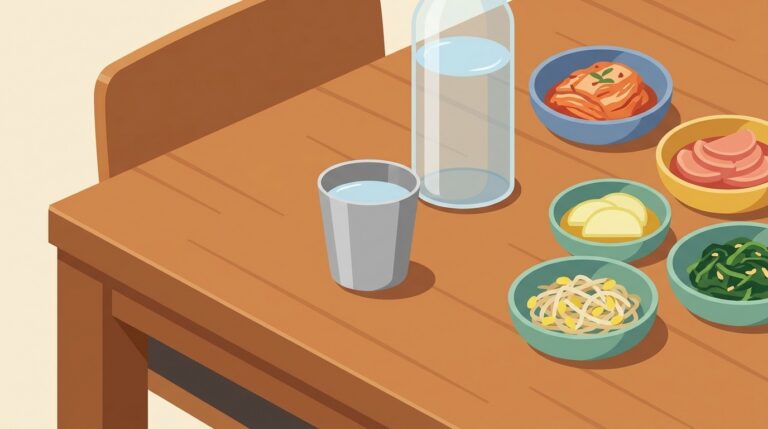
Master the Magic Word: How to Ask for Water in Korean with Juseyo
Phase 1: Empathy (Story-Driven Opening)
안녕하세요! (Annyeonghaseyo!) It is your Daily Hangul editor here, your 10-year local culture navigator and Korean language bestie!
Picture this: You are seated at a buzzing, vibrant restaurant in Hongdae, Seoul. The table in front of you is sizzling with hot, fiery tteokbokki or savory bulgogi. You take a brave bite, and suddenly—whoosh—your mouth is on fire! You urgently need a cool sip of water. You look around, catch the server’s eye, and your mind goes completely blank. You know the English word “water,” but how do you ask for it politely in Korean without sounding demanding or awkward? Should you whisper? Should you point?
Don’t worry, you are not alone! Over the past decade teaching beginner Korean learners, asking for water and basic items in a restaurant is hands down the #1 real-world panic point. Today, we are turning that panic into pure confidence. In this lesson, you will master the ultimate polite request tool: 주세요 (juseyo). Grounded in hundreds of real learner experiences, this guide will have you ordering water and extra banchan like a true Seoulite!
Phase 2: Deep Dive into 3 Core Expressions
Here are the three foundational expressions you need right now to conquer any Korean dining situation:
1. 물 좀 주세요 (Mul jom juseyo)
- Pronunciation: [Mul jom ju-se-yo] (Sound analogy: “Mool” like pool, “jom” rhymes with the first syllable of zombie, “joo-seh-yo” like juice + say + yo)
- Meaning: Literal: “Please give me a little water.” | Nuance: “Could I please have some water?”
- K-Culture Moment: In K-Dramas, whenever characters eat extra spicy ramyeon at a street cart (pojangmacha), they clutch their throats and gasp, “이모님, 물 좀 주세요!” (Imonim, mul jom juseyo!).
- Editor’s Insight: The tiny word 좀 (jom) literally means “a little,” but in Korean requests, it acts as a magical politeness cushion—just like saying “could you possibly” in English.
- Situation Spectrum: Casual: ⚠️ | Semi-formal: ✅ | Formal: ✅
- 🤔 Think About It: Why does asking for “a little” make an order sound friendlier? Think about how English speakers soften requests with “could I just get…”
2. 저기요 (Jeogiyo)
- Pronunciation: [Jeo-gi-yo] (Sound analogy: “Chaw-ghee-yo”)
- Meaning: Literal: “Over there!” | Nuance: “Excuse me (to get attention)!”
- K-Culture Moment: Seen in almost every modern K-Drama scene set in a BBQ shop—shouting this with a gentle hand raise to summon the server without leaving your seat.
- Editor’s Insight: Never use this to apologize if you bump into someone on the subway! This word is strictly an attention-getter for service staff.
- Situation Spectrum: Casual: ⚠️ | Semi-formal: ✅ | Formal: ⚠️
- 🤔 Think About It: Notice how Korean creates closeness by using spatial words (“over there”) instead of calling strangers by titles.
3. 이거 주세요 (Igeo juseyo)
- Pronunciation: [I-geo ju-se-yo] (Sound analogy: “Ee-guh joo-seh-yo”)
- Meaning: Literal: “Give me this.” | Nuance: “I would like this one, please.”
- K-Culture Moment: Walking through Myeongdong street stalls or pointing at picture menus when the Hangul alphabet still looks like abstract art!
- Editor’s Insight: Combine pointing with two fingers or an open palm (polite!) and say this sentence. It works for food, drinks, and souvenirs!
- Situation Spectrum: Casual: ⚠️ | Semi-formal: ✅ | Formal: ✅
- 🤔 Think About It: How empowering is it that learning just one pattern (Noun + 주세요) unlocks hundreds of daily transactions?
Phase 3: Textbook Korean vs. Real Korean
Let us bridge the gap between classroom theory and real Seoul streets.
Situation 1: Asking for water at a casual diner
- 📖 교과서 한국어 (Textbook): 저에게 물 한 잔을 주시겠습니까? (Jeoege mul han janeul jusigesseumnikka? – “Would you bestow a glass of water upon me?”)
- 🗣️ 진짜 한국어 (Real-Life): 사장님, 물 좀 주세요~ (Sajangnim, mul jom juseyo~ – “Boss, water please!”)
- 💡 왜 다를까? (Why the difference?): Real-life Korean prefers warmth and brevity over ultra-stiff archaic grammar in everyday eateries.
Situation 2: Asking for a refill on side dishes
- 📖 교과서 한국어 (Textbook): 반찬을 더 주실 수 있으십니까? (Banchaneul deo jusil su isseusimnikka? – “Do you possess the ability to grant more side dishes?”)
- 🗣️ 진짜 한국어 (Real-Life): 반찬 좀 더 주세요! (Banchan jom deo juseyo! – “A little more side dishes, please!”)
- 💡 왜 다를까? (Why the difference?): Simply adding 더 (deo – more) to your magic pattern 주세요 (juseyo) is how 99% of Koreans ask for delicious refills.
Phase 4: K-Culture Deep Dive & Non-Verbal Manners
4-1. 눈치 (Nunchi) & Gestures
When asking for anything in Korea, your posture matters just as much as your grammar:
* The Open Hand: Never point with a single finger at the staff. Wave gently with your palm facing down or outward at chest level.
* Two-Hand Rule: When the server brings your water bottle or cup, receive it with both hands (or touch your left hand to your right wrist/forearm) and give a slight head nod. This shows immense respect!
* Eye Contact: Avoid a piercing stare; make brief, friendly eye contact, then nod warmly.
4-2. The Mystery of “물은 셀프” (Mul-eun Sel-peu)
Ever walked into a Korean kimbap shop, said “물 좀 주세요” (Mul jom juseyo), and the server pointed to a corner fridge? Welcome to Korean food culture! Look around the walls: if you see a sign saying 물은 셀프 (Mul-eun sel-peu), it means “Water is self-service!” Grab a small stainless-steel cup from the UV sterilizer box and fill it yourself from the water purifier. Water in Korea is always complimentary and unlimited!
Phase 5: Real-Life Roleplay Scenario
- Setting: A bustling lunch spot in Sinchon, Seoul, smelling of garlic and sizzling pork.
- Characters: You (Hungry Traveler) & Auntie Owner (이모님 – Imonim, warm, fast-moving, wearing a floral apron).
-
Turn 1 (You): 저기요! (Jeogiyo!) [🎭 Raising hand gently at chest level]
- Turn 2 (Auntie): 네~ 뭐 드릴까요? (Ne~ mwo deurilkkayo? / “Yes~ what can I get you?”) [🎭 Approaching with a friendly notepad flick]
- Turn 3 (You): 비빔밥 하나 주세요. (Bibimbap hana juseyo. / “One bibimbap, please.”) [🎭 Pointing to the menu with an open hand]
- Turn 4 (Auntie): 매운 거 잘 먹어요? (Maeun geo jal meogeoyo? / “Can you handle spicy food?”) [🎭 Looking with caring, curious eyes]
- Turn 5 (You): 네, 좋아해요! (Ne, joahayeo! / “Yes, I like it!”) [🎭 Smiling enthusiastically]
- Turn 6 (Auntie): 자, 여기 비빔밥 나왔어요! (Ja, yeogi bibimbap nawasseoyo! / “Here comes your bibimbap!”) [🎭 Placing a sizzling stone bowl on the table]
- Turn 7 (You): 와, 감사합니다! 저, 물 좀 주세요! (Wa, gamsahamnida! Jeo, mul jom juseyo! / “Wow, thank you! Um, water please!”) [🎭 Looking parched and thirsty]
- Turn 8 (Auntie): 아이고, 물은 저기 냉장고에서 셀프예요~ (Aigo, muleun jeogi naengjanggo-eseo selpeuyeyo~ / “Oh dear, water is self-service over by the fridge!”) [🎭 Pointing warmly toward the silver water dispenser]
🔀 Interactive Choice Point: What do you do now?
- Choice A: Say “아, 네! 감사합니다!” (Ah, ne! Gamsahamnida!), walk to the fridge, and pour your own water.
- Choice B: Loudly shout “물 가져와!” (Mul gajyeowa! / “Bring the water!”).
-
Choice C: Stay seated, look disappointed, and eat the spicy meal without any water.
-
Feedback on Choices:
- Choice A (Best!): Perfect! You understood Korean diner etiquette, saved the busy auntie time, and showed great adaptation!
- Choice B (Bad!): Extreme danger! That is informal and rude speech (반말 – banmal). You might get a stern lecture from the auntie!
- Choice C (Risk!): Ouch! Your tongue will suffer the fiery gochujang heat all afternoon! Never be afraid to get your self-service water.
Phase 6: 10-Second Emotion Shadowing Drill
Read these aloud, pausing at / and mimicking the exact emotion indicated!
[😊 Polished & Friendly]
저기요! / 물 좀 / 주세요~
(Jeogiyo! / Mul jom / juseyo~)-
[🥵 Gasping for relief after hot kimchi]
매워요! / 물 좀 / 빨리 / 주세요!
(Maewoyo! / Mul jom / ppalli / juseyo!) -
[🥰 Super polite & appreciative]
감사합니다! / 물 / 잘 마실게요~
(Gamsahamnida! / Mul / jal masilgeyo~)
Phase 7: K-Culture Mini Dictionary
- 셀프 (Sel-peu) | Self-Service | Ubiquitous in casual eateries; means you fetch your own water, napkins, or side dishes.
- 이모님 (I-mo-nim) | Auntie (Respectful) | A warm, endearing title used to address female restaurant owners/servers instead of formal titles.
- 정 (Jeong) | Warm emotional connection/Affection | The cultural reason Korean restaurants give free banchan refills and hospitality generously.
- 서비스 (Seo-bi-su) | Service / On the house | When an owner gives you a free soda or extra side dish with a smile, they will shout “서비스!”
Phase 8: Survival Kit for Travelers
Top 3 Survival Phrases
- 이거 더 주세요 (Igeo deo juseyo) [Ee-geo deo joo-seh-yo]
Pro Tip: Point at any empty side dish plate to request a free refill! - 계산해 주세요 (Gyesanhae juseyo) [Gye-san-hae joo-seh-yo]
Pro Tip: Say this at the counter to mean “Please check me out / bill please.” - 메뉴판 주세요 (Menyupan juseyo) [Meh-nyoo-pan joo-seh-yo]
Pro Tip: Use this when there is no English menu on the table.
Editor’s Travel Note
Before stepping into a Korean restaurant, make sure your phone has essential tools installed! Check out our Naver Map app navigation guide to easily find hidden, authentic local restaurants instead of tourist traps. Also, be aware that most restaurants will expect you to pay at the front counter near the exit when you finish, rather than at your dining table!
Phase 9: One Step Deeper (Reflection)
In Western languages, asking for something often centers on the speaker’s permission: “Can I have water?” or “May I get the bill?” In Korean, however, requests center on the action of giving: 주세요 (juseyo) means “Please give.” Adding words like 좀 (jom – a little) reflects the core cultural value of consideration (배려 – baeryeo), ensuring that your request never feels like an imposition on the hard-working host.
💬 Your Turn: How does asking for things in your native language compare? Do you focus on permission or giving? Let us know in the comments below!
Phase 10: FAQ & Avoiding Misunderstandings
Q: Can I use “주세요 (juseyo)” with verbs?
A: Yes! When attached to verbs (in the 아/어 주세요 form), it translates to “please do (something) for me.” For example, 도와주세요 (Dowa-juseyo) means “Please help me!”
Q: Does “좀 (jom)” make it sound like I only want one tiny drop of water?
A: Not at all! In Korean cultural linguistics, “좀” is a softening particle. It simply means “Please be kind enough to grant this small favor.” You will get a full bottle or cup every time!
Q: How do I call a younger male waiter if I cannot call him “이모님 (Imonim)”?
A: The safest, most universally polite word for any server regardless of age or gender is simply 저기요 (Jeogiyo) or 사장님 (Sajangnim – boss/owner)!
🚨 Common Mistakes Warning Board
| Mistake | Why It Happens | Correct Action |
|---|---|---|
| Snapping fingers or waving both arms | Common in some countries to grab waiters’ attention | Gently raise one hand and say “저기요 (Jeogiyo)” once. |
| Saying “물 줘! (Mul jwo!)” | Dropping “-seyo” thinking it sounds friendly | Never drop “-seyo” to strangers; it sounds like an angry command! |
| Waiting 20 minutes for water at a self-service place | Not noticing the “물은 셀프” sign | Spot the silver water dispenser and UV cup cabinet! |
Phase 11: Action Mission & Engagement
- 🥉 Bronze Mission: Stand in front of your bathroom mirror, raise your right hand gently, and say “저기요, 물 좀 주세요!” 5 times with a bright smile.
- 🥈 Silver Mission: Write down 3 everyday items you want (e.g., 커피 – coffee, 사과 – apple, 빵 – bread) and combine them with 주세요 on your social media notes!
- 🥇 Gold Mission: Visit your local Korean grocery market, K-BBQ restaurant, or bakery, and order your next item using “[Item] 주세요!” in real life.
- 🎮 K-Culture Mission: Watch the latest episode of your favorite K-Drama. Keep your ears open and tally how many times you hear the characters shout “저기요!” or “주세요!”.
Phase 12: Interactive Quiz Challenge
Test your skills before your next trip to Korea!
- Situation Judgment: You are at a restaurant, your food is spicy, but the server is busy across the room. What should you say?
- A) 야! (Ya!)
- B) 저기요, 물 좀 주세요! (Jeogiyo, mul jom juseyo!)
- C) 물 줘! (Mul jwo!)
- Fill in the Blank: Pointing at a delicious menu item:
“이거 _____ 주세요!” (Please give me this!) -
True or False: If a sign reads “물은 셀프”, the waiter will bring cold water bottles to your table immediately.
👉 Click here to reveal the answers and explanations!
- Answer: B. 저기요, 물 좀 주세요! is the most natural and polite combination. ‘야’ is rude yelling, and ‘물 줘’ is informal!
- Answer: 좀 (jom) (or just leaving it as 이거 주세요). Saying “이거 좀 주세요” or “이거 주세요” is 100% correct!
- Answer: False. “셀프 (Self)” means you need to get up and pour the water into a metal cup yourself from the dispenser.







