

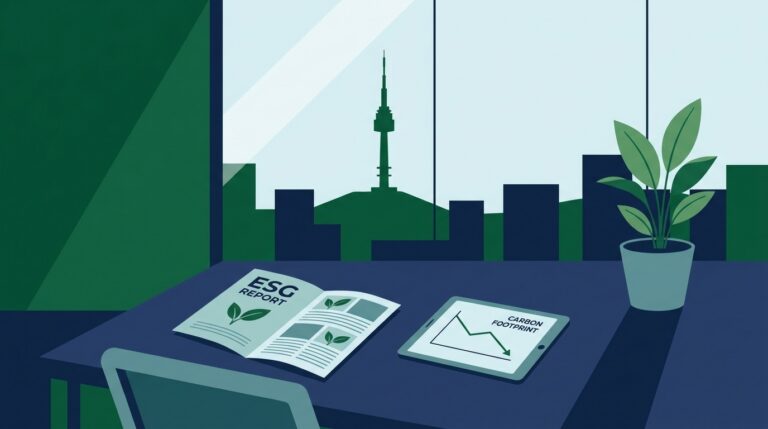
Master Boardroom ESG Korean: Disclosing Third-Party Assurance with Confidence
Phase 1: 공감 (Immersive Empathy & Opening)
안녕하세요! 매일한글 에디터입니다.
Imagine this scene: You are sitting in a sleek glass conference room overlooking the bustling skyline of Yeouido, Seoul’s premier financial hub. On the mahogany table lies a 120-page draft of your company’s latest Sustainability Report (지속가능경영보고서). Opposite you, the executive Managing Director (상무님) is nervously reviewing greenhouse gas emissions spreadsheets covering Scope 1, Scope 2, and the notorious Scope 3 supply chain metrics. International institutional investors have been raising concerns about potential greenwashing, and tensions are running high. Everyone is looking for absolute certainty before this public disclosure goes live on the regulatory filing system.
You calmly lean forward, maintain professional eye contact, and state: “지속가능경영보고서의 신뢰성을 위해 독립된 제3자 검증 기관의 검증 의견서를 받았어요.” (We obtained formal assurance from an independent third-party verification body to secure the reliability of our sustainability report.)
Instant sigh of relief across the table. In corporate South Korea, mastering this precise register of C1-level business language bridges the gap between being seen merely as a bilingual professional and stepping up as a trusted corporate strategist. This guide is crafted directly from corporate governance workshops and real expatriate executive coaching sessions, designed to turn high-stakes corporate reporting into your ultimate professional triumph.
Phase 2: 핵심 표현 3선 심층 분석 (Top 3 Key Expressions)
1. 독립된 제3자 검증 기관 (Doknipdoen jesamja geomjeung gigwan)
- Pronunciation: [Dok-nip-doen je-sam-ja geom-jeung gi-gwan] (Think of ‘dok-nip’ sounding like ‘dong-nip’, ‘geom’ rhyming with ‘gum’)
- Meaning: Literal: “Independent 3rd party verification institution” | Nuance: An autonomous, accredited auditing authority (such as BSI, DNV, or major accounting bodies) free from internal corporate bias.
- K-Culture Moment: In workplace dramas like Misaeng or Agency, characters avoid internal conflicts of interest by outsourcing high-stakes risk evaluation to an undisputed external body.
- Editor’s Insight: ‘독립된’ (doknipdoen) carries heavy weight in corporate governance. It emphasizes that no internal hierarchy could manipulate the ESG figures.
- Situation Spectrum: Casual 🚫 | Semi-formal ⚠️ | Formal ✅
- 🤔 Think About It: Why does Korean business emphasize the literal “third party” (제3자) rather than just saying “external partner” (외부 협력사)? How does this distinction establish legal and ethical accountability in your home country?
2. 검증 의견서를 수령하다/받다 (Geomjeung uigyeonseoreul suryeonghada/batda)
- Pronunciation: [Geom-jeung ui-gyeon-seo-reul su-ryeong-ha-da] (Pronounce ‘ui’ softly like ‘ee’ in fluid speech: ‘ee-gyeon-seo’)
- Meaning: Literal: “To receive a verification opinion paper” | Nuance: To secure formal, legally binding assurance of audit completion.
- K-Culture Moment: Used at the climax of financial and corporate disclosure briefings right before a press release goes out to news desks in Gwanghwamun.
- Editor’s Insight: In C1 business environments, swap the everyday verb 받다 (batda) with the high-register Sino-Korean verb 수령하다 (suryeonghada) when addressing board members or filing official disclosures.
- Situation Spectrum: Casual 🚫 | Semi-formal ⚠️ | Formal ✅
- 🤔 Think About It: In English, we often say “we got certified.” How does specifying “opinion letter” (의견서) highlight that audits are consultative assessments rather than absolute guarantees?
3. 공시 데이터의 신뢰성을 제고하다 (Gongsi deiteoui sinroeseongeul jegohada)
- Pronunciation: [Gong-si de-i-teo-ui sil-loe-seong-eul je-go-ha-da] (Note the liquid assimilation: ‘sin-roe’ becomes ‘sil-loe’)
- Meaning: Literal: “To elevate the trustworthiness of disclosure data” | Nuance: Actively mitigating compliance and greenwashing risks by fortifying data transparency.
- K-Culture Moment: The cornerstone line delivered in corporate social responsibility (CSR) investor relations presentations.
- Editor’s Insight: ‘제고하다’ (jegohada – to heighten/boost) is often confused by foreign professionals with ‘재고하다’ (jaegohada – to reconsider). Make sure your vowels are sharp!
- Situation Spectrum: Casual 🚫 | Semi-formal ⚠️ | Formal ✅
- 🤔 Think About It: What role does public trust (공신력) play in Korean corporate culture where public sentiment can directly influence consumer boycotts?
Phase 3: 교과서 한국어 vs 진짜 한국어 (Textbook vs. Real Korean)
Situation 1: Explaining Scope 3 Supply Chain Data Assessment
- 📖 교과서 한국어: 우리는 다른 협력 회사의 탄소 배출량도 다 확인해야 합니다. (Uri-neun dareun hyeomnyeok hoesa-ui tanso baechullyang-do da hwaginhaeya hamnida. / We must check all the carbon emissions of other partner companies.)
- 🗣️ 진짜 한국어: 협력사 공급망을 포함한 Scope 3 배출량 산정이 이번 공시의 핵심 쟁점입니다. (Hyeomnyeoksa gonggeummang-eul pohamhan Seukopeu sseuri baechullyang sanjeong-i ibeon gongsi-ui haeksim jaengjeom-imnida. / Quantifying Scope 3 emissions across our partner supply chain is the critical disclosure issue this cycle.)
- 💡 왜 다를까?: Executive conversations rely heavily on established ESG industry nomenclature (Scope 3, 산정, 쟁점) rather than descriptive colloquial verbs.
Situation 2: Stating Assurance Completion to the Managing Director
- 📖 교과서 한국어: 외부 회사에서 우리 보고서가 맞다고 확인해 주었습니다. (Oebu hoesa-eseo uri bogoseo-ga matdago hwaginhae jueossseumnida. / An external company confirmed our report is right.)
- 🗣️ 진짜 한국어: 제3자 검증 기관의 검증 의견서 확보로 대외 공신력을 완벽히 담보했습니다. (Jesamja geomjeung gigwan-ui geomjeung uigyeonseo hwakboro dae-oe gongsinryeog-eul wanbyeokhi dambohaessseumnida. / Securing the third-party assurance statement has fully underpinned our external credibility.)
- 💡 왜 다를까?: Phrases like ‘공신력을 담보하다’ (guarantee public credibility) reflect senior executive ownership and strategic clarity.
Phase 4: K-Culture 딥다이브 & 비언어적 매너 (Culture Deep Dive & Non-Verbal Protocol)
4-1. Boardroom Nunchi (눈치) & Physical Delivery
Presenting audit results requires refined non-verbal etiquette:
* Document Handling: Hand the verification summary across the table using both hands (두 손으로 서류 건네기), turning the document so the text faces the senior recipient.
* Affirmative Modulation: Avoid open-ended conjecture like “~인 것 같아요” (~it seems like). When dealing with compliance, finish your sentences with unyielding formal honorific endings: “수령을 완료하였습니다” (We have completed receipt) or “확보했습니다” (We have secured it).
* Eye Line & Nodding: When senior directors inspect the assurance annex, cast your gaze slightly downward toward the document, waiting for their verbal cue before launching into the methodological breakdown.
4-2. Cultural Dimension: The Chaebol ESG Transformation
In Korean corporate history, rapid industrialization was led by top-down execution. Today, under rigorous K-ESG standards driven by the Financial Services Commission (FSC), the stakes have shifted to transparency. K-dramas depicting business warfare often showcase the intense scrutiny behind annual shareholder meetings (주주총회). In this environment, third-party verification is not just paperwork; it is a corporate shield safeguarding company honor and public standing.
Phase 5: 실전 롤플레이 시나리오 (Interactive Strategic Roleplay)
- Setting: The 18th-floor ESG Strategy War Room at ‘Mirae Core’, Seoul.
- Characters:
- 팀장 박성현 (Team Leader Park Sung-hyun): Highly experienced, risk-averse ESG veteran.
- 알렉스 (Alex – You): Senior Global ESG Reporting Specialist.
Turn 1
박 팀장: 알렉스 님, 환경부와 글로벌 투자사들이 우리 Scope 3 공시 데이터를 집중 검토한다고 합니다. 대비는 끝났습니까?
(Alex-nim, hwan-gyeong-bu-wa geul-lo-beol tu-ja-sa-deul-i u-ri Seukopeu sseuri gong-si de-i-teo-reul jip-jung geom-to-han-da-go ham-ni-da. Dae-bi-neun kkeun-nat-seum-ni-kka?)
(Alex, the Ministry of Environment and global investors are scrutinizing our Scope 3 disclosures. Are our countermeasures set?)
🎭 Furrows brow, anxiously tapping his fountain pen against the agenda sheet.
Turn 2
알렉스: 네, 팀장님. 산정 근거와 온실가스 배출 계수의 정확성을 이미 재확인했습니다.
(Ne, tim-jang-nim. San-jeong geun-geo-wa on-sil-ga-seu bae-chul gye-su-ui jeong-hwak-seong-eul i-mi jae-hwag-in-haet-seum-ni-da.)
(Yes, Team Leader. We have already re-verified the calculation methodology and emission factors.)
🎭 Maintains an upright posture and opens the executive tablet file.
Turn 3
박 팀장: 투자자들이 제기할 수 있는 그린워싱 의혹을 원천 차단해야 합니다. 보고서의 신뢰성을 어떻게 증명할 겁니까?
(Tu-ja-ja-deul-i je-gi-hal su in-neun geu-rin-wo-sing ui-hog-eul won-cheon cha-dan-hae-ya ham-ni-da. Bo-go-seo-ui sil-loe-seong-eul eo-tteoh-ge jeung-myeong-hal geom-ni-kka?)
(We must proactively preempt any greenwashing doubts raised by investors. How will we prove the report’s credibility?)
🎭 Leans forward with a tense, probing gaze.
Turn 4
알렉스: 지속가능경영보고서의 신뢰성을 위해 독립된 제3자 검증 기관의 검증 의견서를 받았습니다.
(Ji-sok-ga-neung-gyeong-yeong-bo-go-seo-ui sil-loe-seong-eul wi-hae dok-nip-doen je-sam-ja geom-jeung gi-gwan-ui geom-jeung ui-gyeon-seo-reul bat-at-seum-ni-da.)
(We obtained formal assurance from an independent third-party verification body to secure the reliability of our sustainability report.)
🎭 Speaks firmly with a reassuring, grounded nod.
Turn 5
박 팀장: 다행이군요. 보증 수준은 한계 보증(Limited Assurance)인가요, 아니면 합리적 보증(Reasonable Assurance)인가요?
(Da-haeng-i-gun-yo. Bo-jeung su-jun-eun han-gye bo-jeung-in-ga-yo, a-ni-myeon hap-ri-jeok bo-jeung-in-ga-yo?)
(That is a relief. Is the assurance standard Limited Assurance or Reasonable Assurance?)
🎭 Relaxes his shoulders and pulls up the assurance checklist.
Turn 6
알렉스: 국제 검증 표준인 AA1000AS 기준의 Type 2 한계 보증을 채택하여 신뢰도를 극대화했습니다.
(Guk-je geom-jeung pyo-jun-in AA1000AS gi-jun-ui Type 2 han-gye bo-jeung-eul chae-taek-ha-yeo sil-loe-do-reul geuk-dae-hwa-haet-seum-ni-da.)
(We maximized reliability by applying Type 2 Limited Assurance in line with international AA1000AS standards.)
🎭 Points smoothly to section 4 of the summary dossier.
Turn 7
박 팀장: 좋습니다. 검증 의견서 원본을 최종 공시 본문에 부록으로 첨부하도록 합시다.
(Jot-seum-ni-da. Geom-jeung ui-gyeon-seo won-bo-neul choe-jong gong-si bon-mun-e bu-rog-eu-ro cheom-bu-ha-do-rok hap-si-da.)
(Excellent. Let us attach the original assurance statement as an appendix to the final disclosure.)
🎭 Nods approvingly, signing his initials onto the cover sheet.
Turn 8
알렉스: 네, 지체 없이 공시 시스템에 업로드 준비를 완료하겠습니다.
(Ne, ji-che eop-si gong-si si-seu-tem-e eop-ro-deu jun-bi-reul wan-ryo-ha-get-seum-ni-da.)
(Yes, I will prepare the upload to the disclosure portal without delay.)
🎭 Rises gracefully with a respectful bow.
🔀 인터랙티브 분기점 (Choose Your Response)
When the executive director asks: “What if civic watchdog groups question our Scope 3 supply chain estimates next week?”
- Option A: “그건 협력사 잘못이지 우리 책임이 아니라고 해명하겠습니다.” (We will explain that it is the suppliers’ fault, not our responsibility.)
- Option B: “독립된 제3자 검증 기관의 의견서와 산정 방법론을 공개하여 투명하게 대응하겠습니다.” (We will respond transparently by releasing the independent assurance statement and calculation methodology.)
- Option C: “나중에 문제 생기면 그때 다시 계산해 보면 되지 않을까요?” (If an issue arises later, couldn’t we just recalculate it then?)
Branch Feedback:
* Option A [Bad ❌]: Deflecting blame onto supply chain partners violates modern K-ESG corporate stewardship (공급망 동반성장) and will damage your professional standing.
* Option B [Best ✅]: Demonstrates unflinching executive composure, relying on institutional independence and methodological transparency.
* Option C [Risk ⚠️]: Shows a lack of compliance foresight that can trigger corporate greenwashing allegations and investor backlash.
Phase 6: 10초 감정 섀도잉 드릴 (10-Second Emotional Shadowing Drill)
Practice these variations focusing on rhythm pauses (/) and executive emotional tone:
- [💼 결연하고 신뢰감 넘치게 / Resolute & Trustworthy]
“지속가능경영보고서의 신뢰성을 위해 / 독립된 제3자 검증 기관의 / 검증 의견서를 수령했습니다.”
(Ji-sok-ga-neung-gyeong-yeong-bo-go-seo-ui sil-loe-seong-eul wi-hae / dok-nip-doen je-sam-ja geom-jeung gi-gwan-ui / geom-jeung ui-gyeon-seo-reul su-ryeong-haet-seum-ni-da.) -
[📊 차분하고 논리적으로 / Composed & Analytical]
“Scope 3 배출량 산정의 투명성을 입증하고자 / 공인 기관의 독립 검증 절차를 거쳤습니다.”
(Seukopeu sseuri bae-chul-ryang san-jeong-ui tu-myeong-seong-eul ip-jeung-ha-go-ja / gong-in gi-gwan-ui dok-nip geom-jeung jeol-cha-reul geo-chyeot-seum-ni-da.) -
[🤝 파트너를 안심시키며 / Reassuring a Stakeholder]
“외부 감사인의 검증 의견서를 확보했으므로 / 공시 리스크는 사전에 완전히 통제되었습니다.”
(Oe-bu gam-sa-in-ui geom-jeung ui-gyeon-seo-reul hwak-bo-haet-seu-meu-ro / gong-si ri-seu-keu-neun sa-jeon-e wan-jeon-hi tong-je-doe-eot-seum-ni-da.)
Phase 7: K-Culture 미니 사전 (Mini ESG Vocabulary)
- 탄소 회계 (Tanso hoegye) | Carbon Accounting
The comprehensive discipline of measuring, managing, and reporting corporate carbon footprints throughout Scope 1, 2, and 3 scopes. - 공급망 실사 (Gonggeummang silsa) | Supply Chain Due Diligence
Evaluating supplier human rights, environmental governance, and ethical compliance under emerging global supply chain laws. - 한계 보증 (Hangye bojeung) | Limited Assurance
A negative assurance framework indicating that no evidence was discovered to suggest the ESG report contains material misstatements. - 그린워싱 (Geurinwosing) | Greenwashing
Deceptively marketing or reporting ESG initiatives without verified actions or data integrity.
Phase 8: 여행자를 위한 생존 키트 (Business Traveler Survival Kit)
Corporate Meeting Survival Expressions TOP 3
- “회의 자료를 두 손으로 검토해 주시겠습니까?” (Hoe-ui ja-ryo-reul du son-eu-ro geom-to-hae ju-si-get-seum-ni-kka?)
Pro Tip: Perfect polite phrase when handing key ESG briefings to senior stakeholders. - “추가 검증 데이터가 필요하시면 즉각 송부하겠습니다.” (Chu-ga geom-jeung de-i-teo-ga pil-yo-ha-si-myeon jeuk-gak song-bu-ha-get-seum-ni-da.)
Pro Tip: Shows prompt agility when external auditors ask for supplementary disclosures. - “공시 마감 일정에 차질 없이 맞추겠습니다.” (Gong-si ma-gam il-jeong-e cha-jil eop-si mat-chu-get-seum-ni-da.)
Pro Tip: Calms management down during high-pressure quarterly audit dead-runs.
Editor’s Business Travel Note
Navigating Seoul’s financial corridors requires swift technological mobility. When traveling between corporate headquarters in Yeouido, Gangnam, and Gwanghwamun, avoid relying on international map utilities. Instead, check our guide on the 네이버 지도 앱 다운로드 to seamlessly track subway exit connections and locate underground enterprise document centers for last-minute executive printouts.
Phase 9: “한 발 더 깊이” (Cultural Insights & Critical Reflection)
In Korean corporate philosophy, accountability is not just a ledger balance; it is rooted in Gongsinryeok (공신력 – public trust). Korean institutions exist within an interconnected ecosystem where consumer communities, media, and state oversight operate in constant dialogue. Achieving formal third-party assurance is fundamentally an act of humility and respect toward the collective community. It signals: We do not judge our own work; we subject our actions to unbiased societal scrutiny.
💬 Your Turn: Does your organization treat sustainability assurance as a defensive legal check or as a genuine bridge of trust with the public? Share your thoughts below!
Phase 10: FAQ & 오해 방지 (FAQ & Common Mistakes)
Q: Can I say ‘독립적인 제3자’ instead of ‘독립된 제3자’?
A: Yes, both are understood. However, ‘독립된’ (past participle form meaning ‘established as independent’) sounds much more institutional and definitive in legal disclosure documents.
Q: What is the exact difference between ‘검사’ (geomsa) and ‘검증’ (geomjeung)?
A: ‘검사’ refers to an inspection or examination (like quality testing on a factory line), whereas ‘검증’ represents rigorous third-party verification, verification of theories, or auditing methodologies.
Q: Is it acceptable to use casual speech (반말) with younger ESG team members in the boardroom?
A: In strategic ESG meetings, always maintain formal haeyoche or hapsyoche (존댓말) regardless of age. Professional parity reinforces data integrity.
🚨 흔한 실수 (Common Mistakes) 경고판
- ❌ Mistake 1: Saying “우리가 리포트를 검증했어요” (We verified the report ourselves).
➡️ Correct Action: Use “제3자 기관을 통해 검증을 받았습니다” (We received verification through an independent body) to prevent accidental greenwashing claims. - ❌ Mistake 2: Mispronouncing ‘신뢰성’ as ‘sin-roe-seong’.
➡️ Correct Action: Ensure fluid phonological assimilation: pronounce it as [실뢰성 / sil-loe-seong]. - ❌ Mistake 3: Confusing ‘제고’ (enhancement) with ‘재고’ (inventory/reconsideration).
➡️ Correct Action: Contextualize clearly: “신뢰성을 제고하다” (Enhance credibility).
Phase 11: 액션 미션 & 참여 유도 (Action Missions)
- 🥉 Bronze Mission: Stand before a mirror and record yourself saying the core sentence from Phase 1 three times with solid executive posture.
- 🥈 Silver Mission: Open LinkedIn or your study journal, post a Korean business tip featuring ‘독립된 제3자 검증 기관’, and tag
@DailyHangul. - 🥇 Gold Mission: During your next multinational business briefing, introduce the concept of Gongsinryeok (공신력) when presenting audit reports.
- 🎮 K-Culture Mission: Watch an episode of a modern Korean corporate drama (e.g., Numbers or Search: WWW) and spot instances where external auditors or advisors deliver reports to upper management.
Phase 12: 인터랙티브 퀴즈 챌린지 (Interactive Quiz)
Test your boardroom fluency!
- Situational Context: Which phrase best reassures an investor worried about corporate bias in carbon disclosure?
- (A) 그냥 믿으시면 됩니다. (Geu-nyang mi-deu-si-myeon doem-ni-da.)
- (B) 독립된 제3자 검증 기관의 의견서를 받았습니다. (Dok-nip-doen je-sam-ja geom-jeung gi-gwan-ui ui-gyeon-seo-reul bat-at-seum-ni-da.)
- (C) 우리끼리 철저하게 계산했습니다. (U-ri-kki-ri cheol-jeo-ha-ge gye-san-haet-seum-ni-da.)
- Fill in the Blank: 공시 데이터의 ( )을(를) 제고하기 위해 외부 감사를 실시했습니다. (Hint: Trustworthiness)
-
True / False: In Korean financial reporting, ‘Scope 3’ emissions are translated only into pure Korean without using the English term. (T / F)
정답 및 해설 보기 (Click to reveal answers)
-
정답: (B)
해설: An independent third-party opinion statement is the institutional benchmark for disproving bias. -
정답: 신뢰성 (Sin-roe-seong / [실뢰성])
해설: ‘신뢰성’ (credibility/reliability) pairs naturally with the verb ‘제고하다’ (to elevate). -
정답: False
해설: ‘Scope 1·2·3’ is globally adopted terminology and is almost universally retained as ‘Scope 1, 2, 3’ in Korean corporate reporting.







