

Phase 1: 공감 (Story Immersion Opening)
안녕하세요! 매일한글 에디터입니다.
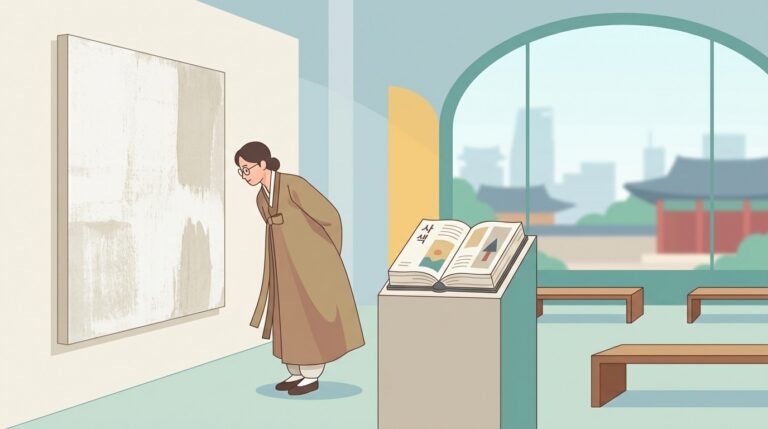
Imagine stepping into the hushed, velvet-draped preview hall of a prestigious auction house in Pyeongchang-dong or Gangnam. The tension is palpable. Bidders hold their breath as a monumental monochrome canvas by an acclaimed master like Kim Whanki or Lee Ufan is unveiled under precise gallery spotlights. In private salons, family-office portfolio managers and museum advisors aren’t just swooning over brushwork—they are scrutinizing an immaculate, cloth-bound tome resting on a display pedestal: the Catalogue Raisonné (전작 도록, jeonjak dorok).
At the C2 tier of the Korean art world, a single question dictates whether an acquisition worth billions of won is approved or discarded: “작가가 생전에 공인한 전작 도록에 정식 등재되어 있습니까?” (Is it officially catalogued in the artist’s lifetime-authorized catalogue raisonné?). For non-native connoisseurs, navigating this ultra-elite intersection of provenance (소장 이력), connoisseurship (안목), and legal authentication (진위 감정) in Korean can feel like deciphering an esoteric code. A misplaced honorific or imprecise term can instantly undermine your credibility among top-tier gallerists and institutional appraisers. Based on extensive masterclasses with Korean auctioneers and blue-chip art advisors, this guide provides the linguistic rigor, cultural nunchi, and forensic vocabulary needed to navigate high-stakes Korean art investment with supreme confidence.
Phase 2: 핵심 표현 3선 심층 분석 (Core Expressions In-Depth)
1. 카탈로그 레조네에 등재되어 있어 진위 여부는 의심의 여지가 없습니다
- Pronunciation: [Katallogeu rejone-e deungjaedoe-eo jin-wi yeobuneun uisim-ui yeojiga eopseumnida] (Analogy: Imagine saying ‘catalogue’ with crisp, even Korean vowels, followed by the firm, grounded cadence of ‘deung-jae-doe-eo’, finishing with an authoritative ‘eop-seum-ni-da’ like a gavel falling).
- Meaning:
- Literal: Because it is registered in the catalogue raisonné, whether it is authentic or fake has no room for doubt.
- Actual Nuance: “It boasts definitive catalogue raisonné pedigree, rendering its authenticity incontrovertible.”
- K-Culture Moment: Seen in boardroom showdowns in dramas like Queen of Tears or Mine, where a disputed masterpiece is brought before a chaebol appraisal committee, and the chief curator shuts down all contention with this precise, legalistic pronouncement.
- Editor’s Insight: The phrase 의심의 여지가 없다 (uisim-ui yeojiga eopda – “leaves no room for doubt”) is the gold standard for closing high-value due diligence discussions. In Korean contract negotiation, invoking this phrase signifies that further dispute is considered ungentlemanly or bad-faith.
- Situation Spectrum: Casual 🚫 | Semi-formal ⚠️ | Formal ✅
- 🤔 Think About It: Notice how Korean syntax places the foundational documentation (카탈로그 레조네에 등재되어 있어) before the declaration of certainty. Why does Korean institutional speech require empirical grounding before stating an absolute conclusion?
2. 프로비넌스(소장 이력)가 명확해야 2차 시장에서 온전한 프리미엄이 형성됩니다
- Pronunciation: [Peurobineonseu(sojang iryeok)ga myeonghwak-haeya icha sijang-eseo onjeonhan peurimieomi hyeongseongdoemnida] (Analogy: Emphasize the clear, staccato sound of ‘myeong-hwak’ [clarity], contrasting with the smooth flow of ‘hyeong-seong-doem-ni-da’ [takes shape]).
- Meaning:
- Literal: Only when provenance (collection history) is clear, a complete premium forms in the secondary market.
- Actual Nuance: “Secondary-market value appreciation strictly hinges on an unbroken, transparent chain of provenance.”
- K-Culture Moment: Frequently used by blue-chip private bankers during VIP asset management seminars at COEX or major art fairs like Kiaf/Frieze Seoul, counseling elite collectors on art funds.
- Editor’s Insight: While the English loanword 프로비넌스 is ubiquitous among modern dealers, pairing it with the traditional Sino-Korean 소장 이력 (所藏履歷) demonstrates exceptional dual-fluency. 온전한 프리미엄 (uncompromised premium) implies that missing a single ownership receipt or exhibition sticker can slash 30–40% off the hammer price.
- Situation Spectrum: Casual 🚫 | Semi-formal ⚠️ | Formal ✅
- 🤔 Think About It: How does the Korean emphasis on 소장 이력 reflect the broader cultural value placed on pedigree, lineage, and verifiable personal accountability in transaction networks?
3. 탁월한 안목(眼目) 없이는 도록의 권위에 맹목적으로 휘둘리기 십상이에요
- Pronunciation: [Tak-wolhan anmok eopsineun dorog-ui gwon-wie maengmokjeog-euro hwidulligi sipsang-ieyo] (Analogy: The word ‘anmok’ resonates softly in the throat [eye-discernment], while ‘hwidulligi sipsang’ dances with a rhythmic cautionary tilt).
- Meaning:
- Literal: Without outstanding eye-connoisseurship, it is very easy to be blindly swung around by the authority of the catalogue.
- Actual Nuance: “Without true connoisseurship, one is fatally vulnerable to relying blindly on institutional prestige.”
- K-Culture Moment: Heard during private after-hours viewing sessions in Insa-dong or Samcheong-dong, where veteran gallerists mentor the next generation of serious art collectors over traditional wild green tea.
- Editor’s Insight: 안목 (眼目) goes beyond mere knowledge; it translates to visual taste honed through decades of observation. Pairing it with ~기 십상이다 adds a refined, worldly cynicism—warning that even published catalogues can contain post-humous printing discrepancies or political omissions.
- Situation Spectrum: Casual ⚠️ | Semi-formal ✅ | Formal ✅
- 🤔 Think About It: How does the concept of 안목 elevate art collecting in Korea from mere financial speculative trading into a recognized discipline of spiritual and moral cultivation?
Phase 3: 교과서 한국어 vs 진짜 한국어 (Textbook vs. Real-World Art Fluency)
Situation 1: Confirming the Painting’s Entry in the Complete Works Catalogue
- 📖 교과서 한국어: 이 그림이 화가의 책에 나와 있는지 확인해 주세요. (I geurimi hwaga-ui chaeg-e nawa inneunji hwag-inhae juseyo.) — Please check if this painting appears in the artist’s book.
- 🗣️ 진짜 한국어: 해당 작품이 유족 및 감정위원회가 공인한 전작 도록(Catalogue Raisonné)에 누락 없이 수록되었는지 교차 검증을 부탁드립니다. (Haedang jakpumi yujok mit gamjeong-wiwonhoega gong-inhan jeonjak dorog-e nurak eopsi surokdoe-eonneunji gyocha geomjeung-eul butakdeurimnida.) — Please cross-reference whether the artwork in question is comprehensively included in the catalogue raisonné endorsed by the artist’s estate and the appraisal committee.
- 💡 왜 다를까? At the C2 institutional level, terms like 화가의 책 (artist’s book) sound uneducated. Native art professionals always specify the authority behind the publication (유족 및 감정위원회가 공인한) and the precise verification action (교차 검증, cross-verification).
Situation 2: Inquiring About Gaps in Ownership History
- 📖 교과서 한국어: 전 주인이 누구였는지 다 알 수 없어서 좀 걱정돼요. (Jeon ju-ini nugu-yeonneunji da al su eopseoseo jom geokjeongdwaeyo.) — I can’t know all the previous owners, so I’m a bit worried.
- 🗣️ 진짜 한국어: 1980년대 소장처 이력에 공백(gap)이 존재하는데, 이 부분에 대한 보증서나 전시 아카이브 증빙이 뒷받침되나요? (Cheon-gubaek-palsim-nyeondae sojangcheo iryeog-e gongbaeg-i jonjaehaneunde, i bubun-e daehan bojeongseona jeonsi aka-ibeu jeungbing-i dwitbatchimdoenayo?) — There appears to be a hiatus in the provenance records from the 1980s; are there corroborating appraisal certificates or exhibition archive documentations to substantiate it?
- 💡 왜 다를까? Using personal terms like 전 주인 (previous owner) reduces museum-grade provenance to an everyday flea market purchase. Real art fund specialists use 소장처 이력 (custodial history) and request 증빙이 뒷받침되는지 (whether archival evidence supports it).
Phase 4: K-Culture 딥다이브 & 비언어적 매너 (Cultural Nuances & Etiquette)
4-1. 눈치(Nunchi) & Non-Verbal Art Etiquette
- The Two-Finger Pointing Taboo: Never point directly at an oil canvas or Joseon porcelain with an outstretched index finger. Korean auction specialists tuck their thumb against their palm and use an open, tilted hand (손바닥을 비스듬히 펴서) when referencing specific brushstrokes or seal marks (낙관).
- The Silent Gaze (침묵의 관조): When an auction specialist presents a catalogue raisonné open to the artwork’s plate number, maintain silence for at least three to five seconds before speaking. Rushing to question the price immediately reveals an amateur mindset focused solely on monetary arbitrage rather than artistic reverence.
- Handling White Cotton Gloves (면장갑 매너): Even if the specialist invites you to inspect a work closely, never reach toward a canvas without asking, “제가 직접 장갑을 착용하고 살펴봐도 실례가 되지 않겠습니까?” (May I wear gloves and inspect it directly without causing offense?).
4-2. Cultural Code: Chaebol Art Collections & Korean Philanthropy
In Korea, art collection at the highest echelon has historically walked a fine line between civic cultural patronage and private asset preservation, as dramatized in hit series like Reborn Rich and Mine. The legendary collections of the Leeum Museum of Art (Samsung) and the Kansong Art Museum demonstrate how provenance in Korea is deeply tied to national heritage preservation (문화재 보국). When an elite buyer asks about provenance, they aren’t just assessing fraud risk; they are ensuring the work was not historically looted or tied to dubious illicit dealings during Korea’s rapid industrialization periods.
Phase 5: 실전 롤플레이 시나리오 (Interactive Auction VIP Saleroom Scenario)
Setting: A private viewing salon on the 3rd floor of a prestigious auction house in Pyeongchang-dong, Seoul. Outside, rain gently patters against floor-to-ceiling windows overlooking Mount Bukhan.
Characters:
* Min-woo Kang (강민우 수석 스페셜리스트): Senior Auction Specialist and Appraiser. Impeccable charcoal suit, calm demeanor, sharp eyes.
* Elena Vance (엘레나): Senior Art Fund Portfolio Advisor representing an international institutional collection.
Turn 1
강민우: 🎭 (흰 면장갑을 착용하며 부드러운 손짓으로 도록을 가리킨다)
이사님, 이 작품이 바로 이번 경매의 메인 하이라이트인 1974년 점화(Dot Painting) 원작입니다.
(Isanim, i jakpumi baro ibeon gyeongmae-ui mein hairaitteu-in cheon-gubaek-chilsipsa-nyeon jeomhwa wonjag-imnida.)
“Director Vance, this is the very original 1974 Dot Painting that anchors this season’s evening sale.”
Turn 2
엘레나: 🎭 (돋보기를 살짝 내려놓고 도록의 에디션 넘버와 캔버스 후면을 번갈아 살피며)
화면의 비례와 안료의 보존 상태는 대단히 훌륭하군요. 다만, 작가의 1990년 초판 전작 도록(Catalogue Raisonné) 2권에 실린 도판과 후면 서명의 필적이 미세하게 상이해 보입니다.
(Hwamyeon-ui birye-wa anlyo-ui bojeon sangtaeneun daedanhi hwullyunghagunyo. Daman, jakga-ui cheon-gubaek-gusim-nyeon chopan jeonjak dorok i-gwone sillin dopan-gwa humyeon seomyeong-ui piljeog-i misa-ehage sang-ihae boimnida.)
“The compositional proportions and pigment preservation are remarkable. However, the signature on the reverse seems subtly different from the plate published in Volume 2 of the artist’s 1990 first-edition catalogue raisonné.”
Turn 3
강민우: 🎭 (고개를 정중하게 끄덕이며 묵직한 가죽 바인더를 열어젖힌다)
역시 정확한 안목이십니다. 초판 도록 인쇄 당시 흑백 사진의 명암 왜곡으로 인해 해당 도판 서명이 일부 뭉개져 수록되었던 전례가 있습니다.
(Yeoksi jeonghwak-han anmog-isimnida. Chopan dorok insae dangsi heukbaek sajin-ui myeong-am waegog-euro inhae haedang dopan seomyeong-i ilbu mung-gaejeo surokdoeeotdeon jeonlyega itseumnida.)
“Your eye is as piercing as ever. When the first edition was printed, dark tonal distortions in the black-and-white plates resulted in that particular signature appearing partially crushed.”
Turn 4
엘레나: 🎭 (차분하지만 단호한 톤으로 의자를 앞으로 당겨 앉으며)
그렇다면 2012년 작가 유족 재단에서 발간한 개정 증보판 도록에는 이 오차가 정식으로 정정 수록되었습니까?
(Geureotdamyeon i-cheon-sibi-nyeon jakga yujok jaedan-eseo balganhan gaejeong jeungbopan dorog-eneun i ochaga jeongsig-euro jeongjeong surokdoeeotseumnikka?)
“In that case, was this discrepancy formally rectified in the 2012 revised and expanded catalogue raisonné published by the artist’s estate?”
Turn 5
강민우: 🎭 (스캔본 분석 문서와 감정서에 형광펜 표시된 페이지를 정중히 제시하며)
네, 바로 이 348페이지의 도판 412번을 확인해 주십시오. 고해상도 컬러 촬영을 통해 서명의 원형과 캔버스 직조 연대까지 완벽히 일치함이 전작 감정위원회에 의해 공인되었습니다.
(Ne, baro i sambaek-saspal-peiji-ui dopan sa-baek-sibi-beon-eul hwag-inhae jusipsio. Gohaesangdo keolleo chwal-yeong-eul tonghae seomyeong-ui wonhyeong-gwa kkaembeoseu jikjo yeondae-kkaji wanbyeokhi ilchihami jeonjak gamjeong-wiwonhoe-e uihae gong-indoeeotseumnida.)
“Indeed; please look at Plate No. 412 on page 348. Through high-resolution color imaging, both the original signature and the warp-and-weft weave date of the canvas were verified to match perfectly by the Raisonné Authentication Board.”
Turn 6
엘레나: 🎭 (도록의 캡션과 감정서 스탬프를 대조하며 미소를 띤다)
도판 등재 이력은 확실하군요. 그렇다면 작가 생전 개인전 이후 첫 번째 소장처였던 도쿄 화랑에서 국내 컬렉션으로 이관된 소장 이력(Provenance) 공증 서류도 완비되어 있나요?
(Dopan deungjae iryeog-eun hwaksilhagunyo. Geureotdamyeon jakga saengjeon gaeinjeon ihu cheot beonjjae sojangcheoyeotdeon Dokyo hwarang-eseo guknae keollekseon-euro igwandoen sojang iryeok gongjeung seoryudo wanbidoeeo innayo?)
“The publication credentials are indisputable. Are the notarized provenance records documenting the transfer from the Tokyo gallery—the first custodian post-exhibition—to the Korean domestic collection also fully in order?”
Turn 7
강민우: 🎭 (가죽 바인더에서 원본 선하증권과 영수증 아카이브를 한 장씩 조심스럽게 넘긴다)
물론입니다. 1975년 당시 수송 선하증권 사본부터 유족 서명 양도 증서까지 단 하나의 공백 없이 체계적으로 바인딩해 두었습니다.
(Mollon-imnida. Cheon-gubaek-chilsibo-nyeon dangsi susong seonhajung-gwon sabonbuteo yujok seomyeong yangdo jeungseokkaji dan hana-ui gongbaek eopsi chegyejeog-euro baindinghae dueotseumnida.)
“Certainly. Everything from the 1975 marine bill of lading copy to the estate-signed assignment deed has been systematically bound without a single custodial lapse.”
Turn 8
엘레나: 🎭 (만족스럽게 서류를 덮으며 시계를 확인한다)
훌륭합니다. 이 정도의 완벽한 전작 도록 수록과 소장 이력이라면 아트펀드 심의위원회에서도 만장일치로 응찰을 승인할 것입니다. 프리뷰 당일 컨디션 리포트 최종본을 제 메일로 송부해 주시지요.
(Hwullyunghamnida. I jeongdo-ui wanbyeokhan jeonjak dorok surok-gwa sojang iryeog-iramyeon ateupeondeu sim-ui-wiwonhoe-eseodo manjang-ilchiro eungchal-eul seung-inhal geosimnida. Peuribyu dang-il keondisyeon ripoteu choejongbon-eul je meil-ro songbuhae jusijiyo.)
“Exemplary. With this caliber of catalogue raisonné documentation and unbroken provenance, our Art Fund Investment Committee will unanimously approve bidding. Please transmit the finalized condition report to my email prior to preview day.”
🔀 인터랙티브 분기점 (Interactive Branching Challenge)
At Turn 4, if you suspected the signature was a later addition, how would you probe without insulting the house?
- Option A: “이 서명 좀 이상한데요? 가짜 아니에요? 감정위원들이 대충 본 것 같은데요.”
(This signature is weird. Isn’t it fake? It looks like the appraisers barely looked at it.)
Feedback: ❌ Bad. Blatantly accusatory. Destroys rapport and violates professional decorum; the auction house may restrict your access to future private salerooms. - Option B: “작가 서명의 운필(運筆)과 묵흔에서 후대 가필(加筆)의 가능성이 제기될 소지는 없습니까? 보존과학적 분석 데이터가 있다면 제시해 주십시오.”
(Is there any possibility that questions might arise regarding post-humous additions in the brushwork dynamics and ink traces? If conservation-science analysis data exists, please present it.)
Feedback: 🌟 Best! Flawless C2 connoisseurship terminology (운필, 후대 가필, 보존과학적 분석). Demonstrates immense technical knowledge while maintaining respectful skepticism. - Option C: “도록에 실렸으니까 진짜 맞겠죠? 그냥 믿고 사겠습니다.”
(Since it’s in the catalogue, it must be real, right? I’ll just trust you and buy it.)
Feedback: ⚠️ Risk. Abdicates due diligence. Art fund fiduciary responsibility demands active verification of potential plate errors.
Phase 6: 10초 감정 섀도잉 드릴 (10-Second Emotional Shadowing Drill)
Master the subtle rhythm and professional authority of these phrases by pausing at / and embodying the emotion marker:
[🧐 신중하고 권위 있게]
“카탈로그 레조네의 도판 번호와 / 캔버스 후면의 아카이브 라벨을 / 정밀하게 대조해 주시기 바랍니다.”
(Katallogeu rejone-ui dopan beonhowa / kkaembeoseu humyeon-ui aka-ibeu raebeleul / jeongmilhage daejohae jusigi baramnida.)
(“Please meticulously cross-check / the plate number in the catalogue raisonné / against the archive label on the canvas reverse.”)-
[💼 단호하고 흔들림 없이]
“소장 이력에 단 1년의 공백이라도 발생한다면 / 펀드 투자 심의위원회를 통과하기 / 어렵습니다.”
(Sojang iryeog-e dan il-nyeon-ui gongbaeg-irado balsaenghandamyeon / peondeu tuja sim-ui-wiwonhoereul tonggwahagi / eoryeopseumnida.)
(“If even a single year of unexplained hiatus occurs in the provenance, / passing our fund investment review committee / is virtually out of the question.”) -
[🤝 정중하지만 확신에 찬 어조로]
“감정위원회의 전원 합의로 / 진위가 재확인된 작품이므로 / 2차 시장에서의 유동성은 / 완벽히 보장됩니다.”
(Gamjeong-wiwonhoe-ui jeonwon hab-uiro / jin-wiga jaehwag-indoen jakpum-imeuro / icha sijang-eseo-ui yudongseong-eun / wanbyeokhi bojangdoemnida.)
(“As a masterpiece whose authenticity has been reaffirmed / by unanimous consensus of the appraisal board, / its liquidity in the secondary market / is completely guaranteed.”)
Phase 7: K-Culture 미니 사전 (Art Market Mini-Dictionary)
- 전작 도록 (Jeonjak Dorok) | Catalogue Raisonné
The comprehensive, annotated compendium of an artist’s entire known body of work. In the Korean secondary market, being indexed here (등재) is the non-negotiable benchmark that separates multi-million dollar blue chips from uninsurable inventory. - 안목 (Anmok) | Discerning Eye / Connoisseurship
Literally “eye and aperture.” Refers to the internalized aesthetic intuition capable of discerning subtle stylistic evolution, brush cadence, and subtle forgeries beyond mere paper certificates. - 소장 이력 (Sojang Iryeok) | Provenance
The chronological record of an artwork’s physical ownership. In Korea, elite collectors often favor works emerging from historic corporate collections (e.g., Samsung, Hanwha) or seminal institutional exhibitions. - 블루칩 거장 (Beulluchip Geojang) | Blue-Chip Master
Refers to seminal modern masters whose market liquidity and historical significance are institutionalized—most prominently masters of Dansaekhwa (Dansaekhwa monochrome movement) like Park Seo-bo, Ha Chong-hyun, and Chung Sang-hwa.
Phase 8: 컬렉터를 위한 생존 키트 (Collector’s Survival Kit)
서바이벌 표현 TOP 3
- “컨디션 리포트(상태 보고서) 원본과 액자 탈거 검수 결과를 요청합니다.”
(Keondisyeon ripoteu wonbon-gwa aekja talgeo geomsu gyeolgwaleul yocheonghamnida.)
Pro Tip: Use this to inspect the bare edges of a painting without the framing concealing restoration patches or water damage. - “낙찰 수수료와 부가가치세(VAT)를 포함한 바이어스 프리미엄 계산서를 발행해 주십시오.”
(Nakchal susuryowa bugagachisereul pohamhan baieoseu peurimieom gyesanseoreul balhaenghae jusipsio.)
Pro Tip: Korean auctions calculate buyer’s premiums on sliding tier scales (typically 15–18% plus VAT on the fee itself). Clarifying this upfront prevents closing discrepancies. - “해외 반출 시 문화유산 불법 유출 방지 심사 대상인지 사전 확인이 필요합니다.”
(Hae-oe banchul si munhwayusan bulbeop yuchul bangji simsa daesang-inji sajeon hwag-in-i piryohamnida.)
Pro Tip: Important for works created over 50 years ago! Korean law strictly monitors antique and modern cultural heritage from being exported without official Heritage Agency permits.
Editor’s Travel Note: Elite Art Trekking in Seoul
- Where to Go: Start in Pyeongchang-dong, home to the majestic headquarters of Seoul Auction and prestigious legacy galleries nestled against the granite cliffs. Next, visit Samcheong-dong & Sagan-dong, bordering Gyeongbokgung Palace, where Kukje Gallery and Hyundai Gallery curate international and Korean masters side by side.
- Digital Logistics: Download the 네이버 지도 앱 바로가기 (Naver Map app) for seamless transit around the winding hills of Pyeongchang-dong, where foreign ride-hailing services frequently lose signal.
Phase 9: “한 발 더 깊이” (Cultural Insight & Humanistic Reflection)
In the West, provenance is traditionally viewed as a paper trail—an objective legal chain of custody. In Korea, however, provenance is intertwined with 인연 (In-yeon), the Buddhist and philosophical concept of fated connection. When a masterpiece moves from an elder statesman’s study to a new guardian, the collector is considered not merely a temporary proprietor (소유자), but a designated custodian (수호자) maintaining cultural continuum. This explains why Korean appraisal committees look not only at receipts, but at personal correspondences, commemorative inscriptions (간기/제발), and historical exhibition catalogs. Authentication is a moral and collective pact of historical preservation.
💬 Your Turn: Have you ever encountered an art object whose authenticity felt emotionally palpable even before seeing the paperwork? Or do you believe institutional documentation (전작 도록) must always supersede visual intuition (안목)? Share your thoughts below!
Phase 10: FAQ & 오해 방지 (FAQ & Common Pitfalls)
Q: 작가가 작고한 후에 발견된 미발표작은 전작 도록에 어떻게 등재되나요?
A: 작가 사후(死後) 발족한 공식 유족 재단 또는 공인 학술감정위원회가 주관하여 엄격한 안목 감정과 과학적 안료/연대 측정을 거친 뒤, 주기적으로 발간되는 ‘증보판(Catalogue Raisonné Supplement)’에 추가 등재됩니다. 이 과정에서 만장일치 채택이 되지 않으면 2차 시장에서 가격 방어가 어렵습니다.
Q: 갤러리 보증서(Gallery Certificate)만 있으면 옥션 출품에 문제가 없나요?
A: 일반 갤러리의 자체 보증서는 단순 판매 확인서에 불과합니다. 서울옥션이나 케이옥션 등 메이저 경매사의 감정위원회나 (사)한국화랑협회 감정위원회의 공식 감정서, 혹은 전작 도록 수록 증빙이 수반되지 않으면 블루칩 경매 출품이 거부될 수 있습니다.
Q: 카탈로그 레조네에 수록되었더라도 위작으로 판명되는 경우가 있습니까?
A: 드물지만 존재합니다. 과거 작가 생전에 발간된 초기 도록의 경우 사진 기술의 한계, 작가의 기억 착오, 혹은 당시 유력 딜러의 사적인 입김으로 인해 오류가 발생하기도 합니다. 따라서 진정한 C2 컬렉터는 도록 수록 여부와 함께 실물의 보존과학적 분석 데이터를 반드시 교차 검증합니다.
🚨 흔한 실수 (Common Mistakes) 경고판
- Mistake: Referring to the catalogue raisonné as simply 도록 (Dorok).
Consequence: 도록 typically means a general 10-page exhibition brochure. Specialists may assume you are referring to a casual gallery leaflet.
Correct Action: Always specify 전작 도록 (Jeonjak Dorok) or use the full loanword 카탈로그 레조네. - Mistake: Asking “이거 가짜면 전액 환불되나요?” in a blunt, transactional tone.
Consequence: Sounds hostile and damages negotiations.
Correct Action: Ask with legal precision: “향후 진위 관련 중대한 하자 발생 시 보상 규약(Warranty Policy)의 유효 범위는 어떻게 설정되어 있습니까?” - Mistake: Overlooking the 도판 번호 (Plate Number) vs 작품 일련번호 (Catalogue Index Number) distinction.
Consequence: Bidding on the wrong lot during rapid phone auctions.
Correct Action: State both clearly: “전작 도록 3권 도판 120번, 카탈로그 번호 45번 롯(Lot)에 응찰합니다.”
Phase 11: 액션 미션 & 참여 유도 (Action Missions)
- 🥉 Bronze Mission (Solo Shadowing): Read Phase 6’s Shadowing Drill aloud three times. Record your voice, focusing on pausing sharply at the slashes (
/) to project executive authority. - 🥈 Silver Mission (Interactive Commentary): Leave a comment below answering the “Your Turn” prompt in Phase 9, using at least two core terms: 전작 도록 and 안목.
- 🥇 Gold Mission (Real-World Art Hunt): Visit the website of a major Korean auction house (such as 서울옥션 공식 웹사이트 바로가기) or a world-class institution like MMCA. Find a piece of Dansaekhwa, locate its provenance section, and identify whether a catalogue raisonné is cited in its literature list!
🎮 K-Culture Mission: Watch an episode of a drama featuring an art gallery setting (e.g., Her Private Life or Queen of Tears). Spot whether the curators wear white cotton gloves when handling canvases and listen for the terms 진품 (authentic work) or 위작 (forgery)!
Phase 12: 인터랙티브 퀴즈 챌린지 (Interactive Quiz Challenge)
1. 상황 판단 (Situational Judgment)
당신은 글로벌 아트펀드의 수석 실사 담당자입니다. 블루칩 김환기 화백의 뉴욕 시대 전면점화를 인수하려 할 때, 가장 우선적으로 취해야 할 행동은 무엇일까요?
* A) 화랑 대표의 구두 보증을 믿고 즉시 계약금을 송금한다.
* B) 해당 작품이 재단 공인 전작 도록(Catalogue Raisonné)에 수록되었는지 대조하고, 아카이브 선하증권 및 감정위원회의 감정서를 교차 검증한다.
* C) 인스타그램에 작품 사진을 올려 대중의 반응과 여론을 살핀다.
2. 빈칸 채우기 (Fill in the Blank)
미술품 2차 시장에서 작품의 가치와 가격을 결정짓는 핵심 요소는, 화가의 생애 전체 작품을 체계적으로 집대성한 [ ]에의 수록 여부와 단절 없는 [ ](소장 이력)의 투명성이다.
3. True / False 문화 퀴즈
- Q: 한국에서 제작된 지 50년 이상 된 역사적·예술적 가치를 지닌 근현대 미술품은 문화재청(현 국가유산청)의 허가 없이 해외로 자유롭게 영구 반출할 수 있다. (T / F)
정답 및 해설 확인하기 (Click to reveal answers & explanations)
1. 상황 판단 정답: B
해설: 수억에서 수십억 원을 호가하는 블루칩 미술품은 구두 보증(A)이나 대중적 인기(C)가 아닌, 공인된 전작 도록 등재 여부와 객관적인 소장 이력(Provenance) 증빙 서류를 통해서만 기관 투자가 정당화됩니다.
2. 빈칸 채우기 정답: 전작 도록 (또는 카탈로그 레조네) / 프로비넌스 (또는 소장 이력)
해설: 두 용어는 2차 시장에서 작품의 진위와 유동성을 보장하는 양대 축입니다.
3. True / False 퀴즈 정답: False
해설: 한국의 문화유산 보호 법령에 따라 제작 연대가 50년 이상 경과한 주요 미술품 중 국가적 가치가 인정되는 작품은 국외 반출 시 국가유산청 감정관실의 사전 심의와 수출 허가를 반드시 득해야 합니다.







