

Phase 1: 공감 (Story-Driven Opening)
안녕하세요! 매일한글 에디터입니다.
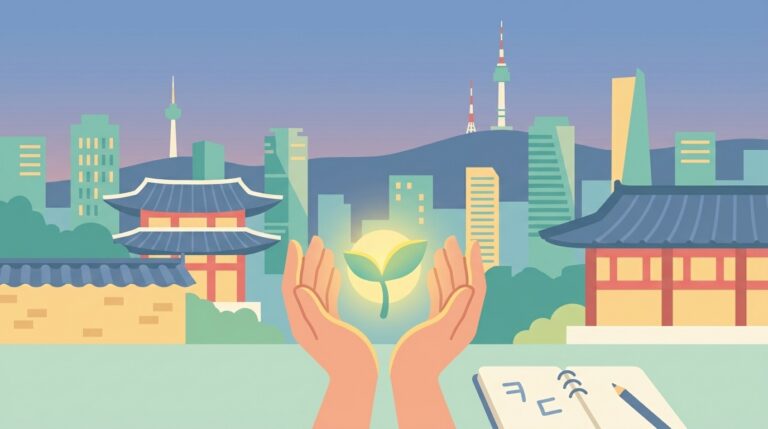
Have you ever stood in the middle of Gangnam at 7:00 PM, watching an endless river of people rushing toward the subway station, faces illuminated only by smartphone screens? Or perhaps you’ve watched dramas like My Mister (나의 아저씨) or Misaeng (미생) and felt a poignant ache behind the sparkling skyscrapers of Seoul. South Korea achieved what economists call “the Miracle on the Han River”—condensing two centuries of industrialization and democratization into just a few frantic decades. This phenomenon, academically known as Compressed Modernity (압축 성장), brought unprecedented material comfort, high-speed internet, and world-class public transport.
Yet, this hyper-efficiency often arrived with an invisible bill: relentless competition, the ethos of ppalli-ppalli (faster, faster), and a collective emotional exhaustion. Many of our advanced learners share this exact pain point: “I want to converse with my Korean friends beyond lighthearted banter about K-Pop. I want to articulate our mutual burnout, question our obsession with speed, and discuss social solidarity, but standard textbooks only teach dry economic jargon or shallow small talk!”
This guide is crafted directly from advanced tutoring sessions with learners who wanted to hold empathetic, deeply philosophical conversations with native speakers. By the end of this article, you will have the linguistic poise and cultural depth of a C1 speaker—capable of asking whether the direction of our journey matters more than its speed, and advocating for human dignity alongside relentless productivity.
Phase 2: 핵심 표현 3선 심층 분석 (Core Expressions)
1. 속도보다 방향이 중요해요 (Sok-do-bo-da bang-hyang-i jung-yo-hae-yo)
- Pronunciation: [Sok-do-bo-da bang-hyang-i jung-yo-hae-yo] (Think of ‘sok’ like ‘soak’ but shorter, and ‘bang-hyang’ like ‘bahng-hyahng’ with a soft nasal resonance).
- Meaning:
- Literal: Direction is more important than speed.
- Nuance: A philosophical reminder that running fast is meaningless if you are heading off a cliff; used to gently urge someone to pause and reconsider life goals or societal pressure.
- K-Culture Moment: Seen in reflective dramas when a seasoned mentor sits down with an exhausted junior worker on an office rooftop after a grueling project, handing them a warm canned coffee.
- Editor’s Insight: The particle -보다 (-boda) signifies comparison (“rather than”). This phrase is a powerful rhetorical antithesis in Korean intellectual culture, directly counterbalancing the national obsession with ppalli-ppalli (fast-paced progress).
- Situation Spectrum:
- Casual: ✅ (속도보다 방향이 중요하지)
- Semi-formal: ✅ (속도보다 방향이 중요해요)
- Formal: ✅ (속도보다 방향이 중요하다고 봅니다)
- 🤔 Think About It: Does your native culture glorify raw hustle and speed, or does it prioritize introspective purpose? How does the grammatical emphasis on “direction” (방향) shift the responsibility from sheer effort to mindful living?
2. 인간의 존엄성을 잃지 말아야 해요 (In-gan-ui jon-eom-seong-eul il-chi mar-a-ya hae-yo)
- Pronunciation: [In-gan-ui jon-eom-seong-eul il-chi ma-ra-ya hae-yo] (Pronounce ‘ui’ as a soft ‘ee’ [e], and blend ‘il-chi’ cleanly like ‘ill-chee’).
- Meaning:
- Literal: We must not lose human dignity.
- Nuance: An earnest plea that no degree of corporate success, national growth, or economic efficiency justifies treating people as mere disposable cogs.
- K-Culture Moment: Evoked in labor rights discourses, investigative journalism shows like Unanswered Questions (그것이 알고 싶다), or dialogue-heavy social dramas highlighting the struggles of delivery drivers or contract workers.
- Editor’s Insight: 존엄성 (尊嚴性, Jon-eom-seong) carries profound moral gravity. When combined with -지 말아야 하다 (-ji mar-a-ya ha-da, “must not”), it transforms the sentence from passive observation into an active moral imperative.
- Situation Spectrum:
- Casual: ⚠️ (Sounds overly dramatic among close friends unless discussing a serious documentary)
- Semi-formal: ✅ (인간의 존엄성을 잃지 말아야 해요)
- Formal: ✅ (인간의 존엄성을 잃지 말아야 합니다)
- 🤔 Think About It: How is the concept of “human dignity” expressed in your mother tongue? Is it viewed primarily as an individual legal right, or as an ethical standard upheld by the community?
3. 각자도생 대신 연대해야 할 때예요 (Gak-ja-do-saeng dae-sin yeon-dae-hae-ya hal ttae-ye-yo)
- Pronunciation: [Gak-ja-do-saeng dae-shin yeon-dae-hae-ya hal ttae-ye-yo] (Snap the ‘gak’ crisply, and say ‘yeon-dae’ smoothly like ‘yawn-day’).
- Meaning:
- Literal: It is time to stand in solidarity instead of each seeking their own survival.
- Nuance: A critical critique of hyper-individualism and survivalism, calling for mutual aid and collective empathy in an unforgiving society.
- K-Culture Moment: Frequently headlined in societal editorials, youth forums, and community meetings addressing housing crises, climate grief, or competitive education fever.
- Editor’s Insight: 각자도생 (Each person seeks their own survival) is a four-character idiom (사자성어) that resurfaced dramatically in modern Korea to depict the lonely struggle of the individual without a social safety net. Counterposing it with 연대 (solidarity) creates an incisive, socially conscious C1-level contrast.
- Situation Spectrum:
- Casual: ⚠️ (A bit bookish for casual gossip, though natural in student activism or book clubs)
- Semi-formal: ✅ (각자도생 대신 연대해야 할 때예요)
- Formal: ✅ (각자도생 대신 연대해야 할 때입니다)
- 🤔 Think About It: Why do societies in hyper-developed environments drift toward solitary survivalism? What does choosing 연대 (solidarity) demand from an individual?
Phase 3: 교과서 한국어 vs 진짜 한국어 (Textbook vs. Real Korean)
Situation 1: Talking about relentless company competition and burnout
- 📖 교과서 한국어: 회사가 너무 경쟁적이라서 저는 매우 피곤합니다. (Hoesaga neomu gyeongjaengjeogiraseo jeoneun maeu pigonhamnida.) – “Because the company is very competitive, I am very tired.”
- 🗣️ 진짜 한국어: 끝없는 효율성만 따지다 보니까 다들 번아웃 직전이에요. (Kkeut-eomneun hyoyulseongman ttajida bonikka dadeul beon-aut jikjeon-ieyo.) – “Because we focus strictly on endless efficiency, everyone is on the brink of burnout.”
- 💡 왜 다를까? Textbook Korean relies on rigid descriptors like “매우 피곤합니다”. Native C1 speakers use nuanced expressions such as ~만 따지다 보면 (fixating only on…) and vivid conversational loan words like 번아웃 직전 (on the verge of burnout) to reflect modern workplace reality.
Situation 2: Emphasizing the need to support each other
- 📖 교과서 한국어: 우리는 서로를 도와야 하는 사회적 존재입니다. (Urineun seororeul dowaya haneun sahoejeok jonjae-imnida.) – “We are social beings who must help one another.”
- 🗣️ 진짜 한국어: 무작정 앞만 보고 달릴 게 아니라, 서로의 손을 잡아주는 연대가 절실해요. (Mujakjeong amman bogo dallil ge anira, seoroui soneul jabajuneun yeondaega jeolsilhaeyo.) – “Rather than recklessly sprinting forward without looking, we desperately need the solidarity of holding each other’s hands.”
- 💡 왜 다를까? Instead of textbook sociology definitions, educated Koreans employ evocative metaphors like 앞만 보고 달리다 (sprinting blindly forward) and pairing it with 절실하다 (desperately necessary, acutely felt).
Phase 4: K-Culture 딥다이브 & 비언어적 매너 (Deep Dive & Non-verbal Manners)
4-1. 눈치 (Nunchi) & Non-verbal Gestures
When discussing heavy historical outcomes, modern burnout, or human solidarity in Korean:
* The Subdued Sincerity Nod: Avoid enthusiastic Western-style nodding or sharp hand chopping motions. Maintain a warm, composed gaze with slight, contemplative downward nods (고개를 천천히 끄덕임). This conveys that you are internalizing the gravity of their emotional struggle.
* Lowered Vocal Pitch & Posture: Lower your vocal resonance slightly. Keep your hands relaxed and open on the table rather than folding your arms defensively. In Korean social dynamics, open hands coupled with a contemplative tone indicate intellectual humility and mutual respect.
4-2. Cultural Code Analysis: The Legacy of “Compressed Modernity”
In classic Korean cinema and dramas—such as Bong Joon-ho’s Parasite (기생충) or the drama My Mister (나의 아저씨)—the central tension is seldom about pure material greed. It is about the loss of human dignity under systemic pressure.
After the Korean War, South Korea reconstructed its entire infrastructure in two generations. Slogans like “하면 된다” (If you try, it can be done) pushed citizens beyond their biological limits. This created world-renowned tech giants and sleek cities, but also institutionalized the fear of falling behind. Today, modern Koreans are actively re-evaluating this social contract. There is an intellectual and cultural renaissance asking: Are we happy? Where are we rushing to? When you engage in these discussions with Koreans using nuanced vocabulary, you transcend the realm of a foreigner speaking the language—you become a true confidant participating in their national soul-searching.
Phase 5: 실전 롤플레이 시나리오 (Real-Life Roleplay Scenario)
Setting: A quiet rooftop garden café overlooking the glittering high-rises of Yeouido financial district at 9:30 PM.
Characters:
* 민우 (Min-woo): Your senior colleague (선배), rubbing his temples, visibly drained after completing an urgent quarter-end presentation.
* 당신 (You): An observant junior colleague who wants to offer genuine reflection rather than empty platitudes.
Frequently Asked Questions (FAQ)
Q: What does "속도보다 방향이 중요해요 (Sok-do-bo-da bang-hyang-i jung-yo-hae-yo)" mean in Korean and how do you pronounce it?
A: In Korean, "속도보다 방향이 중요해요 (Sok-do-bo-da bang-hyang-i jung-yo-hae-yo)" is pronounced [Sok-do-bo-da bang-hyang-i jung-yo-hae-yo] and means: Literal: Direction is more important than speed.
Q: What does "인간의 존엄성을 잃지 말아야 해요 (In-gan-ui jon-eom-seong-eul il-chi mar-a-ya hae-yo)" mean in Korean and how do you pronounce it?
A: In Korean, "인간의 존엄성을 잃지 말아야 해요 (In-gan-ui jon-eom-seong-eul il-chi mar-a-ya hae-yo)" is pronounced [In-gan-ui jon-eom-seong-eul il-chi ma-ra-ya hae-yo] and means: Literal: We must not lose human dignity.
Q: What does "각자도생 대신 연대해야 할 때예요 (Gak-ja-do-saeng dae-sin yeon-dae-hae-ya hal ttae-ye-yo)" mean in Korean and how do you pronounce it?
A: In Korean, "각자도생 대신 연대해야 할 때예요 (Gak-ja-do-saeng dae-sin yeon-dae-hae-ya hal ttae-ye-yo)" is pronounced [Gak-ja-do-saeng dae-shin yeon-dae-hae-ya hal ttae-ye-yo] and means: Literal: It is time to stand in solidarity instead of each seeking their own survival.






