

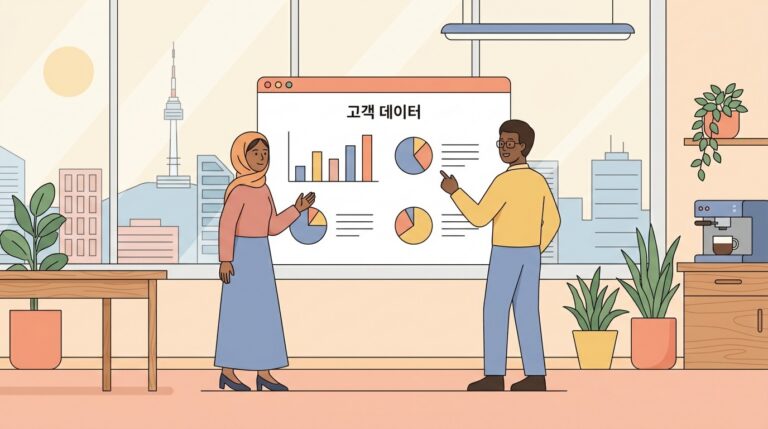
Phase 1: 공감 (Story-driven Opening)
안녕하세요! 매일한글 에디터입니다.
Imagine this scene straight out of a Korean startup drama like Start-Up or Search: WWW: You are sitting at a minimalist café in Gangnam or Pangyo Techno Valley, your laptop glowing in the evening dusk. You’ve just drafted what you believe is an unstoppable cold email to pitch a dream partnership with a rising Korean brand. You spent hours detailing your company’s prestigious history, listing your five international tech awards, and explaining how innovative your software is. You click send, feeling like an elite CEO.
Three days pass. Then a week. Absolute silence.
Why did this happen? Many intermediate Korean learners assume that business proposals require strong, assertive self-promotion. But in Korean corporate culture, a pitch that screams “내가 제일 잘나가 (Look how amazing we are!)” often triggers immediate fatigue. Korean decision-makers receive dozens of self-absorbed cold pitches daily. What actually gets their attention isn’t how impressive you are on paper—it is whether you understand their brand, where your customer bases cross paths, and whether working together produces a tangible “윈윈 (win-win)” synergy.
Our intermediate learners frequently share this exact hurdle: “I know polite honorifics, but my proposals sound arrogant or one-sided!” Today, we are upgrading your business Korean to a confident B2 level. You will master how to step back from unilateral bragging and present mutually beneficial, data-driven value that opens meeting doors.
Phase 2: 핵심 표현 3선 심층 분석 (Core Expressions)
1. 타깃 고객층이 겹치다 (Tagit gogaekcheungi gyeopchida)
- Pronunciation: [Tagit gogaekcheungi gyeopchida] (Think of tagit as the English loanword ‘target’, gogaek sounding like ‘go-geck’, and gyeopchida sounding like ‘gyup-chee-da’)
- Meaning: “The target audience/customer base overlaps” (Literal: Target customer group folds together).
- K-Culture Moment: In modern Korean office dramas, marketing leads use this when pitching collaborative pop-up stores in Seongsu-dong, proving both brands appeal to identical MZ demographics.
- Editor’s Insight: The verb 겹치다 (to overlap) sounds organic and natural in Korean strategy meetings. Instead of claiming you will give them new users, stating your user bases naturally overlap reassures them that conversion friction will be minimal.
- Situation Spectrum: Casual: 🚫 / Semi-formal: ⚠️ / Formal: ✅
- 🤔 Think About It: Why do you think Korean professionals prefer saying audiences “overlap” rather than “we will take over your customer base”? How does this reflect the cultural emphasis on natural alignment?
2. 시너지 효과를 창출하다 (Sineoji hyogwareul changchulhada)
- Pronunciation: [Sineoji hyogwareul changchulhada] (Sineoji like ‘synergy’, hyogwa like ‘hyo-gwa’, and changchulhada like ‘chahng-chool-ha-da’)
- Meaning: “To create a synergy effect” (Literal: To originate/generate synergy efficacy).
- K-Culture Moment: Frequently uttered in boardroom pitch scenes when two founders form an alliance against a larger industry competitor.
- Editor’s Insight: While 낳다 (to produce) or 만들다 (to make) are common verbs, in B2-level business emails and proposals, 창출하다 (to create/generate economic value or impact) conveys seasoned professionalism and analytical credibility.
- Situation Spectrum: Casual: 🚫 / Semi-formal: ⚠️ / Formal: ✅
- 🤔 Think About It: In English, “synergy” can sometimes feel like an overused corporate buzzword. In Korean business, combined with 효과 (effect) and 창출 (value generation), does it feel more actionable and grounded?
3. 데이터를 기반으로 제안드리다 (Deiteoreul gibaneuro jeeandeurida)
- Pronunciation: [Deiteoreul gibaneuro jeeandeurida] (Deiteo like ‘data’, gibaneuro like ‘ghee-bahn-oo-ro’, and jeeandeurida like ‘jeh-ahn-doo-ree-da’)
- Meaning: “To propose based on data” (Using the deferential form 드리다 instead of 주다).
- K-Culture Moment: When a sharp project manager gently pushes back against subjective opinions during an executive deck presentation.
- Editor’s Insight: Notice the honorific 제안드리다 instead of 제안하다. Coupling “hard data” (객관적 데이터) with humble, deferential phrasing (제안드립니다) strikes the golden balance between analytical confidence and relational respect in Korean corporate etiquette.
- Situation Spectrum: Casual: 🚫 / Semi-formal: ⚠️ / Formal: ✅
- 🤔 Think About It: Why does pairing objective data with humble verbal endings make a cold outreach far more persuasive in Korea than sheer confidence alone?
Phase 3: 교과서 한국어 vs 진짜 한국어 (Textbook vs. Real Native Business)
Situation 1: Introducing Why Your Brands Should Partner
- 📖 교과서 한국어: 우리 회사는 시장 1위이고 매우 우수합니다. (Uri hoesaneun sijang il-wi-igo maeu usuhapnida.) — “Our company is number one in the market and very superior.”
- 🗣️ 진짜 한국어: 양사의 타깃 접점이 높아 협업 시 유의미한 시너지가 기대됩니다. (Yangsa-ui tagit jeopjeomi nopa hyeobeop si yu-uimihan sineojiga gidaedoemnida.) — “Because the target intersection between our two companies is high, we anticipate meaningful synergy through collaboration.”
- 💡 왜 다를까?: Claiming your company is “number one” sounds boastful and leaves the recipient asking, “So what does that have to do with me?” Using terms like 양사 (both companies) and 타깃 접점 (target touchpoints) proves you did your homework on their market positioning.
Situation 2: Asking for an Initial Discovery Call
- 📖 교과서 한국어: 우리 제안서를 보고 미팅을 잡아주십시오. (Uri jeeanseoreul bogo miting-eul jabajusipsio.) — “Look at our proposal and set up a meeting.”
- 🗣️ 진짜 한국어: 관련 데이터 요약본을 첨부드리오니, 편하신 일정에 15분 티타임 가능하실지 여쭙니다. (Gwanryeon deiteo yoyakboneul cheombudeurioni, pyeonhasin iljeong-e sibo-bun titaim ganeunghasilji yeojjumnida.) — “I have attached a summary of the relevant data, and would like to ask if a brief 15-minute tea chat might be possible at your convenience.”
- 💡 왜 다를까?: An outright demand for a “meeting” feels burdensome. Reframing it as a “15-minute tea chat” (15분 티타임/커피챗) along with an attached data summary lowers commitment anxiety while remaining utterly polite.
Phase 4: K-Culture 딥다이브 & 비언어적 매너 (Culture Deep Dive)
4-1. 눈치(Nunchi) & 제스처 (The Art of Business Distance)
When sending a cold partnership email to a Korean company, timing and visual formatting demonstrate your situational awareness (눈치):
* Email Sending Window: Send partnership cold emails between Tuesday morning (9:30 AM – 10:30 AM KST) and Thursday afternoon. Monday mornings are overwhelmed by team meetings (주간회의), and Friday afternoons mean people are mentally clocking out.
* Visual Hierarchy: Korean business culture is intensely visual and efficiency-driven. Avoid writing endless blocks of text. Structure your cold proposal with bullet points (-, •), clear bold headings, and a 1-page PDF summary rather than a heavy PowerPoint attachment.
* Deferential Demeanor in Words: In written Korean, non-verbal deference is expressed through spacing and humble verbs: use 말씀 나누다 (to share words together) instead of 이야기하다, and 검토 부탁드립니다 (we kindly ask for your review) instead of 확인하세요.
4-2. 문화 코드 분석: The Rise of “상생 (Sangsaeng)” in Korean Business
In popular K-dramas like Start-Up or reality business variety shows, you will hear the term 상생 (co-prosperity / mutual growth) constantly. Modern Korean startups and conglomerates alike shy away from predatory, zero-sum alliances. A partnership pitch that succeeds in Seoul is rooted in mutual elevation: “If we combine your active community with our conversion engine, both of our user bases benefit without cannibalization.” Demonstrating that you care about their company’s risk profile and brand image as much as your own is the single highest mark of business maturity.
Phase 5: 실전 롤플레이 시나리오 (Pangyo Coffee Chat Simulation)
Background: You secured a short intro call with Team Leader Kang Min-seo (강민서 팀장), head of strategic partnerships at a premier Seoul lifestyle app. You are meeting over coffee at a sleek Pangyo lobby café to turn your cold email into a concrete trial project.
- 강민서 팀장: 제안 메일 잘 받아봤습니다. 솔직히 제휴 제안이 워낙 많이 들어와서 처음엔 그냥 넘길 뻔했어요. (Jeean meil jal badabwasseumnida. Soljikhi jehyu jeeani wonak mani deureowaseo cheoeumen geunyang neomgil ppeonhaesseoyo.)
🎭 Opens a tablet notebook with a thoughtful, analytical expression. — “I received your proposal email well. Honestly, we receive so many partnership pitches that I almost scrolled past it at first.” -
나 (Learner): 바쁘신 일정 중에도 시간 내어 주셔서 감사합니다. 단순 홍보보다는 양사의 타깃 접점을 먼저 보여드리고 싶었습니다. (Bappeusin iljeong jung-edo sigan naeeo jusyeoseo gamsahamnida. Dansun hongbobodaneun yangsa-ui tagit jeopjeomeul meonjeo boyeodeurigo sipeosseumnida.)
🎭 Smiles warmly, bowing slightly while maintaining confident eye contact. — “Thank you for taking the time out of your busy schedule. Rather than mere self-promotion, I wanted to first highlight where our target audiences intersect.” -
강민서 팀장: 메일에 첨부해주신 2030 세대 고객 데이터 그래프가 특히 인상 깊더라고요. (Meire cheombuhaejusin isamsip-dae sedae gogaek deiteo geuraepeuga teukhi insang gipeodeoragoyo.)
🎭 Nods with genuine curiosity, tapping the screen. — “The customer data graph regarding the 20s and 30s demographic that you attached was particularly impressive.” -
나 (Learner): 네, 조사 결과 양사 유저층의 라이프스타일 관심사가 약 65% 이상 겹치는 것으로 나타났습니다. (Ne, josa gyeolgwa yangsa yujeocheung-ui ripeuseutail gwansimsaga yak yuksio peosenteu isang gyeopchineun geoseuro natanasseumnida.)
🎭 Presents a clean, one-page printed executive brief with both hands. — “Yes, our findings revealed that lifestyle interests between our user bases overlap by over 65%.” -
강민서 팀장: 타깃층이 겹치면 양쪽 모두 이탈 없이 자연스럽게 유입될 수 있겠네요. (Tagitcheungi gyeopchimyeon yangjjok modu ital eopsi jayeonseureopge yuipdoel su itgenneyo.)
🎭 Leans in closer, her arms uncrossing as engagement builds. — “If our audiences overlap that cleanly, users can transition naturally without drop-off.” -
나 (Learner): 맞습니다. 저희의 결제 솔루션과 팀장님 플랫폼의 콘텐츠가 결합되면 확실한 시너지 효과를 창출할 수 있습니다. (Masseumnida. Jeohui-ui gyeolje sollusyeongwa timjangnim peullaetpom-ui kontencheuga gyeolhapdoemyeon hwaksilhan sineoji hyogwareul changchulhal su isseumnida.)
🎭 Speaks at a steady, reassuring pace with clear articulation. — “Precisely. When our payment solution combines with your platform’s content, we can create an unmistakable synergy effect.” -
강민서 팀장: 좋습니다. 내부 마케팅팀과 바로 공유해볼게요. 혹시 파일럿 테스트 기간은 어느 정도로 생각하시나요? (Joeusseumnida. Naebu maketingtim-gwa baro gong-yuhaebolgeyo. Hoksi pailleot teseuteu giganeun eoneu jeongdoro saenggakhasinayo?)
🎭 Jots down a star beside your company name on her tablet. — “Sounds good. I will share this with our internal marketing team right away. What timeframe do you envision for a pilot test?” -
나 (Learner): 데이터를 기반으로 2주간의 소규모 파일럿을 먼저 진행해보시는 것을 제안드립니다. (Deiteoreul gibaneuro ijugan-ui sogyumo pailleoteul meonjeo jinhaenghaebosineun geoseul jeeandeurimnida.)
🎭 Hands over your business card with both hands and a polite slight nod. — “Based on the data, I propose we first run a small-scale two-week pilot test.”
🔀 인터랙티브 분기점: How should you respond if Team Leader Kang says, “We already have a similar feature in-house”?
- Choice A: “저희 기술이 훨씬 뛰어나니 써보시면 바로 차이를 아실 겁니다! (Our tech is far superior, so once you try it you will see the difference right away!)”
- Feedback [Bad]: Triggers defensiveness. Criticizing their existing internal tech insults their engineers and sounds like arrogance.
- Choice B: “기존 기능과 직접 경쟁하기보다는, 저희 유저 데이터를 연동해 기존 기능의 활성화를 돕는 보완적 시너지를 제안드립니다. (Rather than competing directly with your existing feature, we propose complementary synergy to boost its activation using our user data.)”
- Feedback [Best]: Excellent! It eliminates threat, positions you as an ally, and respects their in-house infrastructure.
- Choice C: “그럼 이번 제휴는 어려울 것 같네요. 나중에 필요하시면 연락 주세요. (Then a partnership seems difficult this time. Contact us later if you need it.)”
- Feedback [Risk]: Abruptly closes the door. Partnership meetings in Korea often pivot into alternate arrangements if you remain flexible.
Phase 6: 10초 감정 섀도잉 드릴 (Shadowing Drill)
Practice reading these out loud, observing the breath stops marked with /.
[🤝 상생을 강조하며 진정성 있게]
단순한 기업 홍보가 아니라, / 양사의 타깃 접점을 기반으로 한 / 상생 방안을 고민했습니다.
(Dansunhan gieop hongboga anira, / yangsa-ui tagit jeopjeomeul gibaneuro han / sangsaeng banganeul gominhaesseumnida.)
“Rather than simple corporate promotion, / we pondered mutual growth solutions / founded upon the intersection of our target audiences.”-
[📊 객관적이고 신뢰감 넘치는 톤으로]
최근 분기 데이터를 분석한 결과, / 두 브랜드의 핵심 고객층이 / 60% 이상 겹치는 것을 확인했습니다.
(Choegeun bungi deiteoreul bunseokhan gyeolgwa, / du beuraendeu-ui haeksim gogaekcheungi / yuksip peosenteu isang gyeopchineun geoseul hwaginhaesseumnida.)
“As a result of analyzing recent quarterly data, / we confirmed that our two brands’ core customer bases / overlap by more than 60%.” -
[✨ 미래지향적이고 당당하게]
양사의 강점이 결합된다면, / 시장에서 독보적인 시너지 효과를 / 창출할 수 있을 것으로 확신합니다.
(Yangsa-ui gangjeomi gyeolhapdoendamyeon, / sijang-eseo dokbojeogin sineoji hyogwareul / changchulhal su isseul geoseuro hwaksinhapnida.)
“If both our strengths are combined, / we are confident we can create / unprecedented synergy in the market.”
Phase 7: K-Culture 미니 사전 (Key Vocabulary)
- 상생 (Sangsaeng) | Mutual prosperity / Co-existence
Usage: The foundational philosophy of modern Korean business alliances. If an agreement benefits only one party, it is considered poor business conduct. Always highlight how both sides grow. - 접점 (Jeopjeom) | Point of contact / Touchpoint
Usage: Used when discussing marketing, consumer behavior, or customer journeys. For example: “고객과의 접점을 넓히다” (To widen the customer touchpoints). - 윈윈 (Win-win) | Win-Win (Adopted English term)
Usage: Written as 윈윈, this is universally used in Korean corporate discussions. It sounds practical and punchy: “윈윈할 수 있는 모델을 제안합니다” (We propose a model where both can win). - 콜라보 / 협업 (Kollabo / Hyeobeop) | Collaboration / Cross-brand partnership
Usage: While 협업 is the formal Sino-Korean term used in formal contracts, 콜라보 (short for collaboration) is constantly spoken in meetings regarding marketing campaigns, limited editions, or joint content.
Phase 8: 비즈니스 여행자와 실무자를 위한 생존 키트 (Survival Kit)
TOP 3 Survival Phrases for Korean Business Meetings
- 명함 한 장 건네 드려도 되겠습니까? (Myeongham han jang geonne deuryeodo doegesseumnikka?)
Pro Tip: Always present your business card with both hands, fingers holding the edges without covering your company logo or name. - 편하신 시간으로 조율해 주시면 맞춰 찾아뵙겠습니다. (Pyeonhasin sigan-euro joyulhae jusimyeon matchwo chajaboepgetseumnida.)
Pro Tip: The ultimate polite phrasing for securing a cold meeting: “If you suggest a convenient time, I will adjust my schedule to visit you.” - 오늘 나눈 논의 사항은 이메일로 정리하여 금일 중 공유드리겠습니다. (Oneul nanun nonui sahang-eun imeillo jeongrihayeo geum-il jung gong-yudeurigesseumnida.)
Pro Tip: Sending a summary email within 4 hours after a coffee chat drastically raises partnership conversion rates in Korea’s fast-paced business sphere.
Editor’s Professional Travel & Toolkit Note
- Business Networking App: Download the 리멤버(Remember) 비즈니스 명함 관리 앱 다운로드 to instantly scan Korean business cards and track partner organizational changes.
- Meeting Locations: If meeting partners around Teheran-ro in Gangnam or Pangyo Techno Valley, avoid noisy general franchise cafes. Choose quiet hotel lobby lounges or specialized meeting spaces easily located via the 네이버 지도(Naver Map) 길찾기 앱 다운로드.
Phase 9: “한 발 더 깊이” (Cultural Reflection)
In Western business culture, pitching is frequently about demonstrating undeniable individual brilliance, disrupting incumbents, and asserting superiority. In contrast, Korean corporate language is anchored in the collective pronoun “우리 (Uri – We/Our)” and balanced ecosystem dynamics. When you email a Korean team stating only how incredible your product is, they feel a subtle distance—as if you view them merely as a customer to sell to, rather than an equal partner to build with. Shifting your pitch from “Look at what we did” to “Look at where our communities naturally intersect” signals that you respect their status and desire a genuine partnership.
💬 Your Turn: Have you ever received a cold pitch that was all about the sender? How would framing it around shared data and customer overlap change your response? Let’s discuss in the comments below!
Phase 10: FAQ & 오해 방지 (FAQ & Common Mistakes)
Q: Can I use English business buzzwords like ‘Synergy’ or ‘Target’ in my Korean emails?
A: Yes! Terms like 타깃 (target), 시너지 (synergy), 니즈 (needs), and 레퍼런스 (references) are standard loanwords in Seoul offices. However, always conjugate them cleanly using natural Korean verbal frames like ~를 창출하다 or ~가 겹치다 rather than awkward literal translations.
Q: Is it rude to attach data files in the very first cold outreach?
A: Not at all—in fact, it is preferred, provided it is concise. A 1-to-2 page PDF executive summary or data infographic shows you value the recipient’s time. Avoid attaching heavy ZIP files or editable spreadsheets in the first touchpoint, as corporate firewalls may flag them.
Q: How should I address the recipient if I don’t know their exact job title?
A: If you only know their department, use “[회사명] 제휴 담당자님께 (To the Partnership Lead at [Company Name])”. If you know their name but not exact rank, “[성함] 님 (Name + Nim)” is the modern standard across startups and tech firms.
🚨 흔한 실수 (Common Mistakes) 경고판
- Mistake: Writing “저희 회사는 업계 최고입니다 (Our company is the best in the industry).”
Correct Action: Use “양사 간의 시너지를 통해 더 큰 가치를 만들고자 합니다 (We seek to create greater value through synergy between both companies).” - Mistake: Using casual imperative forms like “제안서를 확인해 보세요 (Check out our proposal).”
Correct Action: Use deferential polite honorifics: “제안서를 유첨하오니, 편하신 때에 검토 부탁드립니다 (I attach our proposal and kindly request your review at your convenience).” - Mistake: Asking for a 1-hour formal meeting right away.
Correct Action: Ask for a low-friction 15-minute introductory tea chat: “15분 내외의 가벼운 티타임을 요청드립니다.”
Phase 11: 액션 미션 & 참여 유도 (Action Missions)
- 🥉 Bronze Mission (Solo): Read the Phase 6 Shadowing Drill aloud three times. Focus on pronouncing “시너지 효과를 창출하다” with smooth liaison and authoritative confidence.
- 🥈 Silver Mission (Interactive): Draft a 3-sentence Korean cold email hook comparing your own project/brand with a partner brand. Share it in our comment section for personal feedback!
- 🥇 Gold Mission (Real-world): Find a Korean brand or creator on LinkedIn or Instagram. Instead of a generic “I love your work,” send a short message highlighting a specific user overlap (
타깃 고객층이 겹치다) and see how warmly they respond! - 🎮 K-Culture Mission: Watch Episode 5 of the K-drama Start-Up or any startup pitch scene. Listen carefully for when characters transition from explaining product tech to presenting user market data.
Phase 12: 인터랙티브 퀴즈 챌린지 (Quiz Challenge)
Test your mastery of Korean business partnership expressions! Click the toggles below to verify your answers.
1. 상황 판단 (Situational Judgment)
You are drafting a cold email to a Korean beauty brand for a joint summer campaign. Which opening sentence demonstrates the best B2-level business etiquette?
* (A) 우리 회사가 제일 유명하니까 같이 일합시다. (Uri hoesaga jeil yumyeonghanikka gachi ilhapsida.)
* (B) 양사 타깃 고객층의 접점이 높아, 유의미한 시너지 효과를 창출할 수 있을 것으로 기대되어 제안드립니다. (Yangsa tagit gogaekcheung-ui jeopjeomi nopa, yu-uimihan sineoji hyogwareul changchulhal su isseul geoseuro gidaedoeeo jeeandeurimnida.)
* (C) 제안서를 첨부했으니 내일까지 읽어보세요. (Jeeanseoreul cheombuhaesseuni nae-ilkkaji ilgeoboseyo.)
👉 정답 및 해설 확인하기 (Click for Answer & Explanation)
정답: (B)
해설: (B) highlights mutual target overlap (타깃 고객층의 접점) and value creation (시너지 창출) with formal, respectful grammar. (A) is boastful and informal, while (C) is rude and pushy.
2. 빈칸 채우기 (Fill in the Blank)
Complete the sentence using the correct verb form for creating synergy:
“두 브랜드의 협업을 통해 독보적인 시너지 효과를 ________ 제안드립니다.”
* (A) 창출하고자 (changchulhagoja)
* (B) 놀리고자 (nolligoja)
* (C) 닫고자 (datgoja)
👉 정답 및 해설 확인하기 (Click for Answer & Explanation)
정답: (A) 창출하고자
해설: In professional Korean, “시너지 효과를 창출하다” is the standard collocation meaning to generate/create synergy.
3. True / False 문화 퀴즈 (Culture Quiz)
Statement: In Korean business cold emails, talking about your company’s prestige and awards is much more effective than presenting data on how customer demographics overlap.
👉 정답 및 해설 확인하기 (Click for Answer & Explanation)
정답: False
해설: One-sided boasting creates fatigue. Korean companies prioritize “상생 (mutual benefit)” and clear demographic synergy over unilateral corporate prestige.







