

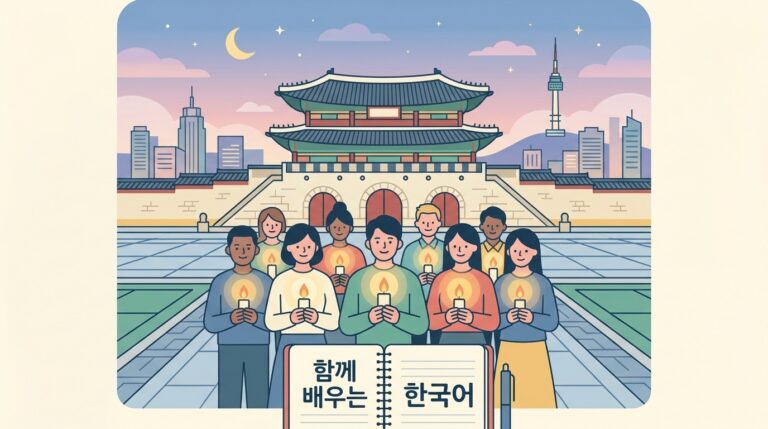
The Spirit of the Square: Unlocking Korea’s Modern History and Democratization
Phase 1: 공감 (Empathy & Narrative Opening)
안녕하세요! 매일한글 에디터입니다.
Have you ever watched the hard-hitting K-movie 1987: When the Day Comes or the tear-jerking drama Youth of May (오월의 청춘) and felt a heavy lump in your throat? You see students holding hands, ordinary taxi drivers risking their lives, and peaceful crowds illuminating dark city boulevards with warm candlelight. But when you try to discuss these profound moments with your Korean friends, you suddenly hit an invisible linguistic wall. You find yourself asking: “Is it rude to bring up Gwangju? How do I talk about protests without sounding political or naive? What words accurately capture the dignity of these historical sacrifices?”
Many intermediate learners face this exact barrier. You have mastered ordering your iced Americano and dissecting romance dramas, but when the conversation shifts to modern Korean identity, textbook terms feel too stiff or awkwardly clinical. Understanding the democratization movement (민주화 운동) is not just about memorizing historical dates; it is the master key to understanding modern Korean civic pride, the passion behind public rallies, and the collective soul of everyday Koreans. Based on real feedback from our community of global learners, this guide will walk you through the essential vocabulary, cultural nuances, and conversational etiquette to navigate one of Korea’s proudest and most touching chapters with genuine respect and fluency.
Phase 2: 핵심 표현 3선 심층 분석 (Top 3 Core Expressions)
1. 민주화 운동 (Minjuhwa undong)
- Pronunciation: [Min-ju-hwa un-dong] (Sounds like “Mean-zoo-hwa oon-dong” — note that undong here means a social movement, not physical gym exercise!)
- Meaning: Democratization Movement. Literally “democracy-becoming movement,” describing the historic series of citizen-led uprisings from the 1960s through the late 1980s.
- K-Culture Moment: In historical dramas set in the 1980s, university students exchange flyers and declare that their struggle is a vital 민주화 운동 (democratization movement).
- Editor’s Insight: In English, people often casually say “the protests,” but Koreans deliberately choose the term 민주화 운동 to honor the civic sacrifice and institutional progress achieved by ordinary people.
- Situation Spectrum:
- Casual: ⚠️ (Sounds quite serious for light banter, but fine when discussing history)
- Semi-formal: ✅ (Common in documentaries, podcasts, and university discussions)
- Formal: ✅ (The standard term used in news, museums, and historical texts)
- 🤔 Think About It: In your home country, do people distinguish between a routine “protest” and a sacred “constitutional movement”? How does language shape our respect for history?
2. 피와 땀으로 일군 (Piwa ttameuro ilgun)
- Pronunciation: [Pi-wa tta-meu-ro il-gun] (Sounds like “Pee-wah ttam-eu-ro eel-goon” with a crisp, double ‘tt’ sound like the ‘t’ in stop)
- Meaning: Built through blood and sweat. Refers to hard-won accomplishments achieved through immense labor and sacrifice.
- K-Culture Moment: Often heard in stirring speeches by community leaders or documentary narrators describing Korea’s journey from war-torn poverty to vibrant democracy.
- Editor’s Insight: 일구다 means to till uncultivated soil and harvest life from barren ground. Pairing it with 피와 땀 (blood and sweat) turns abstract freedom into something physical, earned, and deeply precious.
- Situation Spectrum:
- Casual: ⚠️ (Can sound poetic or melodramatic in daily chat)
- Semi-formal: ✅ (Great for reflective talks about heritage and work ethic)
- Formal: ✅ (Widely used in journalism, essays, and memorial addresses)
- 🤔 Think About It: Notice how Korean uses agricultural imagery (일구다) to describe civil liberties. What metaphors does your culture use for hard-won rights?
3. 촛불 집회 (Chotbul jiphoe)
- Pronunciation: [Chot-ppul jip-hwe] (Sounds like “Choke-pool jeen-pweh” with a tense ‘pp’ sound)
- Meaning: Candlelight rally / vigil. Literally “candlelight assembly.”
- K-Culture Moment: Featured in news broadcasts of Gwanghwamun Square filled with hundreds of thousands of people holding candles and paper cups.
- Editor’s Insight: Unlike aggressive riots, a 촛불 집회 symbolizes peaceful, resolute solidarity. Whole families, children, and elderly citizens attend together, making it an emblem of mature civic action.
- Situation Spectrum:
- Casual: ✅ (Easily used when reminiscing: “그때 촛불 집회 가봤어? / Did you go to the candlelight rally back then?”)
- Semi-formal: ✅ (Standard in conversations about social trends)
- Formal: ✅ (Used in academic papers and international reporting)
- 🤔 Think About It: Why do you think glowing candles became the universal Korean symbol of non-violent collective will rather than clenched fists or banners?
Phase 3: 교과서 한국어 vs 진짜 한국어 (Textbook vs. Real-Life Korean)
Situation 1: Explaining how citizens stood up to authoritarian rule
- 📖 교과서 한국어: 국민들이 독재 정부에 적극적으로 항의했습니다. (Gungmindeuri dokjae jeongbue jeokgeukjeogeuro hang-uihaessseumnida. / The citizens actively protested against the authoritarian government.)
- 🗣️ 진짜 한국어: 시민들이 다 같이 거리로 나와서 목소리를 냈어요. (Simindeuri da gachi georiro nawaseo moksorireul naesseoyo. / Everyday citizens all took to the streets together to make their voices heard.)
- 💡 왜 다를까?: Textbook expressions rely on heavy Sino-Korean academic nouns (독재 정부, 항의). Native speakers prefer poetic, human-centered phrases like 거리로 나오다 (to come out to the streets) and 목소리를 내다 (to voice one’s convictions).
Situation 2: Describing modern Korea’s democratic pride
- 📖 교과서 한국어: 대한민국은 민주주의 시스템을 확립하였습니다. (Daehanmingugeun minjujuui siseutemeul hwangniphayeossseumnida. / The Republic of Korea established a democratic system.)
- 🗣️ 진짜 한국어: 지금의 자유는 평범한 사람들의 희생으로 얻은 거예요. (Jigeumui jayuneun pyeongbeomhan saramdeurui huisaengeuro eodeun geoyeyo. / The freedom we enjoy today was won through the sacrifice of ordinary people.)
- 💡 왜 다를까?: Native speakers frame democracy not as a dry institutional blueprint, but as a living gift passed down from their parents’ and grandparents’ generations.
Phase 4: K-Culture 딥다이브 & 비언어적 매너 (Deep Dive & Non-Verbal Etiquette)
4-1. 눈치 (Nunchi) & Respectful Physicality
When discussing historical events like the May 18 Gwangju Democratization Movement (5·18 민주화운동) or the June Struggle of 1987 (6월 민주항쟁):
* Vocal Tone & Posture: Lower your voice pitch slightly and maintain a calm, attentive posture. Avoid treating the topic like cheap gossip or light entertainment.
* Eye Contact & Nodding: When a Korean friend shares stories of their parents taking part in demonstrations, listen with steady eye contact and slow, sincere nods (고개를 끄덕이다).
* Non-Verbal Humility: Keep both hands relaxed on the table or resting in your lap. Pointing or waving your hands dismissively during historical topics is seen as inconsiderate.
4-2. Cultural Code Analysis: The Power of Gwanghwamun and Cinema
Korean cinema has played an unmatched role in processing historical grief (한, Han). The award-winning movie A Taxi Driver (택시운전사) showed that the democratization movement was carried on the shoulders of ordinary people—taxi drivers, market vendors, and students—rather than abstract politicians. Similarly, the public square (광장, Gwangjang) in central Seoul holds immense cultural significance. It is not just asphalt; it is Korea’s communal living room where collective grief transforms into democratic power.
Phase 5: 실전 롤플레이 시나리오 (Interactive Roleplay Scenario)
Setting: A quiet café overlooking the National Museum of Korean Contemporary History near Gwanghwamun Square.
Character: Min-woo (민우), a 28-year-old Korean graduate student who loves sharing authentic history over roasted coffee.
- Turn 1 (Min-woo):
저기 광화문 광장 보이죠? 저곳이 한국 현대사에서 참 특별한 공간이에요.
(Jeogi Gwanghwamun gwangjang boijyo? Jeogosi hanguk hyeondaesa-eseo cham teukbyeolhan gong-gan-ieyo.)
“You see Gwanghwamun Square over there? That place is truly special in modern Korean history.”
🎭 Looking out the window toward the square with a thoughtful expression. -
Turn 2 (Learner):
네, 다큐멘터리에서 봤어요. 촛불 집회가 열렸던 곳 맞죠?
(Ne, dakyumenteori-eseo bwasseoyo. Chotbul jiphoega yeollyeotdeon got matjyo?)
“Yes, I saw it in a documentary. That’s where the candlelight rallies took place, right?”
🎭 Leaning forward with genuine curiosity. -
Turn 3 (Min-woo):
맞아요. 사실 우리 부모님도 1987년에 대학생 신분으로 시위에 참여하셨대요.
(Majayo. Sasil uri bumonimdo cheon-gubaek-palsip-chil-nyeone daehaksaeng sinbuneuro siwie cham-yeohasyeotdaeyo.)
“Exactly. Actually, my parents also took part in protests back in 1987 when they were university students.”
🎭 Smiling gently, sharing personal family history. -
Turn 4 (Learner):
정말 대단하시네요. 그 시절에는 정말 두려우셨을 텐데요.
(Jeongmal daedanhasineyo. Geu sijeoreneun jeongmal duryeousyeosseul tendeyo.)
“That is truly remarkable. They must have been very frightened back then.”
🎭 Speaking in an empathetic, warm tone. -
Turn 5 (Min-woo):
네, 맞아요. 그래도 민주화를 이뤄내겠다는 시민들의 뜻이 하나로 모인 거죠.
(Ne, majayo. Geuraedo minjuhwareul irwonaegetdaneun simindeurui tteusi hanaro moin geojyo.)
“Yes, that’s right. Still, the will of citizens determined to achieve democracy brought everyone together.”
🎭 Nodding slowly with quiet pride. -
Turn 6 (Learner):
한국의 민주주의는 시민들의 힘으로 일군 역사라는 생각이 들어요.
(Hangugui minjujuineun simindeurui himeuro ilgun yeoksaraneun saenggagi deureoyo.)
“It makes me think that Korea’s democracy is truly a history built by the strength of its citizens.”
🎭 Maintaining respectful eye contact. -
Turn 7 (Min-woo):
그렇게 깊이 이해해 주시니 한국인으로서 정말 고맙고 감동적이네요!
(Geureoke gipi ihaehae jusini hangugin-eoroseo jeongmal gomapgo gamdongjeogineyo!)
“Hearing you understand it so deeply touches my heart as a Korean!”
🎭 Putting hands together with a delighted, genuine smile. -
Turn 8 (Learner):
역사를 알고 나니 이 거리가 훨씬 더 다르게 느껴져요.
(Yeoksareul algo nani i georiga hwolssin deo dareuge neukkyeojyeoyo.)
“Now that I understand the history, this street feels completely different to me.”
🎭 Looking out at the square with fresh appreciation.
🔀 Interactive Decision Point: Min-woo asks, “Would you like to walk across the square and check out the historic photo exhibition?”
- Option A: “좋아요! 시민들이 만든 역사적인 공간을 직접 걸어보고 싶어요.” (I’d love to! I want to walk through the historic space built by the people.)
- Feedback (Best): Shows cultural reverence and enthusiasm. Min-woo will gladly act as your personal history docent.
- Option B: “귀찮은데 그냥 여기서 커피나 더 마셔요.” (Sounds bothersome, let’s just drink more coffee here.)
- Feedback (Bad): Dismisses a sincere cultural gesture and can make you seem indifferent.
- Option C: “그런데 요즘 시위는 너무 시끄럽지 않아요?” (By the way, aren’t today’s protests just too noisy?)
- Feedback (Risk): Shifting into controversial contemporary political complaints can instantly sour the mood.
Phase 6: 10초 감정 섀도잉 드릴 (Emotional Shadowing Drill)
Practice reading these lines aloud with the indicated pause markers (/) and emotional cues:
[🥺 숙연하고 진지하게 / Solemn & Respectful]
지금 우리가 누리는 자유는 / 수많은 사람들의 희생으로 / 얻은 소중한 결과예요.
(Jigeum uriga nurineun jayuneun / sumanheun saramdeurui huisaengeuro / eodeun sojunghan gyeol-gwayeyo.)
“The freedom we enjoy right now / is a precious outcome / won through the sacrifices of countless people.”-
[🔥 굳건하고 당당하게 / Resolute & Proud]
평범한 시민들이 / 다 함께 손을 잡고 / 역사의 물줄기를 / 바꿨어요.
(Pyeongbeomhan simindeuri / da hamkke soneul japgo / yeoksaui muljulgireul / bakkwosseoyo.)
“Ordinary citizens / joined hands together / and changed / the flow of history.” -
[💡 깨달음을 얻고 감탄하며 / Inspired & Thoughtful]
광화문 광장이 / 단순한 도로가 아니라 / 소통과 민주주의의 상징이었군요!
(Gwanghwamun gwangjang-i / dansunhan doroga anira / sotong-gwa minjujuuiui sangjing-ieotgunyo!)
“So Gwanghwamun Square / was not merely a roadway, / but a true symbol of dialogue and democracy!”
Phase 7: K-Culture 미니 사전 (Mini Dictionary: 4 Essential Terms)
-
5·18 민주화운동 (O-il-pal Minjuhwa Undong)
- Translation: May 18 Gwangju Democratization Movement (1980).
- Usage: A cornerstone of contemporary Korean democracy where citizens of Gwangju stood against military oppression. Referencing this with respect demonstrates a deep awareness of Korean society.
- 광장 문화 (Gwangjang Munhwa)
- Translation: Public Square Culture.
- Usage: The tradition of gathering in wide civic plazas to celebrate, mourn, or voice opinions peacefully (e.g., World Cup celebrations or candlelight vigils).
- 87년 체제 (Palsip-chil-nyeon Cheje)
- Translation: The 1987 Constitutional System.
- Usage: Commonly used in sociopolitical talks referring to direct presidential elections and modern democratic rights achieved in June 1987.
- 시민의식 (Simin Uisik)
- Translation: Civic Consciousness / Civic Mindset.
- Usage: Praising public actions—such as peaceful cleanups after massive protests or strict recycling—as reflections of mature 시민의식.
Phase 8: 여행자를 위한 생존 키트 (Traveler’s History Survival Kit)
Top 3 Survival Expressions for Historic Landmarks
- 이곳에 얽힌 역사적 배경을 알 수 있을까요?
(Igose eolkhin yeoksajeok baegyeong-eul al su isseulkkayo?)- Pro Tip: Use this at museum info desks to receive English pamphlets or audio guide options.
- 여기서 사진 촬영이 가능한가요?
(Yeogiseo sajin chwallyeong-i ganeunghangayo?)- Pro Tip: Memorial halls and tribute rooms often have designated photo-restricted zones to maintain dignity.
- 해설사 투어는 몇 시에 시작하나요?
(Haeseolsa tueoneun myeot sie sijakhannayo?)- Pro Tip: Many Korean museums provide free docent-led tours in English and Korean throughout the afternoon.
Editor’s Travel Note
When you are in Seoul, skip the generic shopping mall for an afternoon and visit the National Museum of Korean Contemporary History (대한민국역사박물관) right in front of Gyeongbokgung. Admission is completely free, and the 5th-floor rooftop lounge gives you an incredible panoramic view of Gwanghwamun. To navigate your way smoothly across Seoul’s historic alleys, make sure to check the 네이버 지도 앱 다운로드 page ahead of time, as foreign mapping tools often lack real-time pedestrian routes in Korea.
Phase 9: “한 발 더 깊이” (A Deeper Step: Thinking Reflection)
In Western political theory, freedom is frequently framed as individual liberty—the right of the single person to be left alone by the state. But when you examine Korean history, freedom is almost always conceptualized as an act of “우리 (Uri – We / Us).” During the financial crisis, citizens collected household gold rings; during authoritarian regimes, factory workers and university students shielded each other from tear gas. Democracy in Korea is not an abstract legal philosophy; it is a shared triumph forged through communal solidarity.
💬 Your Turn: Does your country celebrate historical milestones through individual heroes or through the collective power of everyday people? Share your thoughts below in Korean or English!
Phase 10: FAQ & 오해 방지 (FAQ & Common Mistakes)
Q: Is it considered rude to ask young Koreans about historical protests?
A: Not at all! Most Koreans are proud of their nation’s rapid transition into an open democracy. However, avoid asking confrontational questions like “Which political party does your family vote for?” Instead, frame your question around national pride: “한국의 민주화 과정에 대해 배우고 있는데, 정말 인상적이에요 (I am studying Korea’s democratization process, and it is truly impressive).”
Q: What is the difference between 시위 (siwi) and 집회 (jiphoe)?
A: While both describe public demonstrations, 시위 (protest) often brings to mind marching and vocal demands, whereas 집회 (assembly/rally) is broader, encompassing everything from solemn memorials to festive cultural gatherings.
Q: Why do people hold candles instead of signs or flags?
A: The candlelight symbolizes peace, transparency, and warmth. A single candle flicker seems fragile alone, but when hundreds of thousands gather, they create an ocean of light without setting a single fire.
🚨 Common Mistakes Warning Board
- Mistake 1: Confusing Independence Movement with Democratization Movement.
- Correction: The Independence Movement (독립운동) fought Japanese colonial rule (1910–1945). The Democratization Movement (민주화운동) fought domestic post-war authoritarian rule in the late 20th century.
- Mistake 2: Referring to 5·18 as a “riot” (폭동).
- Correction: Calling the May 18 Gwangju movement a 폭동 is deeply offensive and associated with fringe extremist rhetoric. Always use 5·18 민주화운동.
- Mistake 3: Overusing casual internet slang for historical matters.
- Correction: Keep terms like 대박 or 쩔어 away from tragic historical discussions. Use 대단하다 (remarkable) or 존경스럽다 (admirable).
Phase 11: 액션 미션 & 참여 유도 (Action Missions)
- 🥉 Bronze Mission (Solo Practice): Read the Phase 6 Shadowing Drill aloud three times, focusing on natural pauses at the
/marks. - 🥈 Silver Mission (Social Sharing): Write one Korean sentence using the word 시민의식 or 민주화 in the comments below or in your study journal.
- 🥇 Gold Mission (Real-Life Application): Next time you meet a Korean conversation partner, bring up a Korean movie like 1987 or A Taxi Driver and ask for their perspective!
- 🎮 K-Culture Mission: Watch the movie 1987: When the Day Comes or the first episode of Youth of May this weekend. Listen closely for the word 민주주의 (democracy) or 광장 (square).
Phase 12: 인터랙티브 퀴즈 챌린지 (Interactive Quiz Challenge)
Test your understanding of today’s lesson! Can you get a perfect score?
1. Situation Judgment
You are visiting a historical memorial hall dedicated to the June 1987 Struggle with your Korean colleague. Which comment is the most culturally mature?
* A) “시위 때문에 차가 많이 막혔겠네요.” (Traffic must have been so bad because of protests.)
* B) “평범한 시민들이 함께 이뤄낸 변화라는 점이 정말 감동적이에요.” (The fact that ordinary citizens achieved this change together is truly touching.)
* C) “우리나라 역사가 훨씬 더 복잡해요.” (My country’s history is way more complicated.)
2. Fill-in-the-Blank
광화문 광장은 평화로운 ________ 집회가 열리는 대표적인 공간입니다.
(Gwanghwamun gwangjang-eun pyeonghwaroun ________ jiphoega yeollineun daepyojeogin gong-gan-imnida.)
3. True or False
In Korean history, the term 일구다 is used in relation to democracy because civil rights are seen as something cultivated and harvested like fertile ground through hard labor. (True / False)
👉 Click to reveal answers & explanations!
- Answer: B
- Explanation: Option B highlights respect for civic achievement (시민들이 함께 이뤄낸 변화), whereas A is trivializing and C is dismissive.
- Answer: 촛불 (Chotbul – Candlelight)
- Explanation: 촛불 집회 represents Korea’s world-famous peaceful candlelight rallies.
- Answer: True
- Explanation: 일구다 reflects the profound cultural belief that liberty was earned through hard communal labor (피와 땀으로 일군), rather than given for free.
- Explanation: 일구다 reflects the profound cultural belief that liberty was earned through hard communal labor (피와 땀으로 일군), rather than given for free.







