

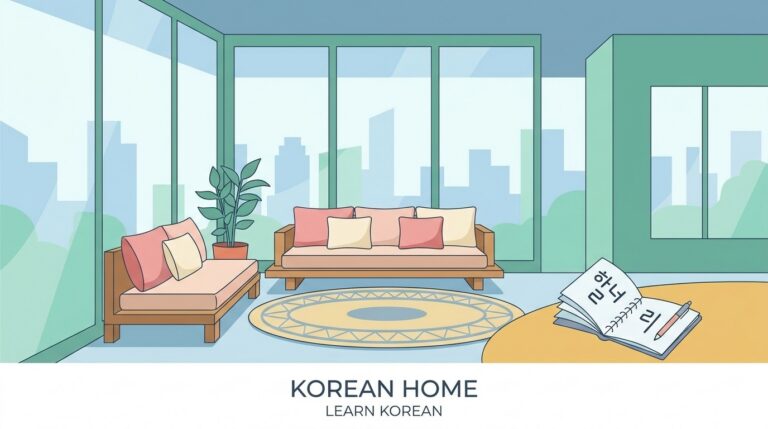
Phase 1: Empathy (Story Immersion Opening)
안녕하세요! 매일한글 에디터입니다. (Hello! I’m your Daily Hangul editor.)
Have you ever watched a slice-of-life K-drama like Because This Is My First Life or Crash Landing on You and noticed how central apartments are to modern Korean living? In Korea, high-rise apartment complexes aren’t just buildings—they are the beating heart of suburban dreams, community identity, and family investments.
Picture this: It’s Saturday afternoon in Pangyo. You walk up to a grand, glass-fronted building called a 모델 하우스 (Model House / Showroom). Outside, banners flutter with slogans like “프리미엄 힐링 라이프” (Premium Healing Life), and couples are eagerly clutching glossy floor plans. You take a step inside, ready to explore, but suddenly you are handed blue fabric shoe covers, a polite curator bows and asks you about “Pyeong” (평), and you’re confronted with technical terms like 발코니 확장 (balcony expansion) and 팬트리 (walk-in pantry). Your textbook taught you words like 방 (room) and 집 (house), but here, everyone is speaking a completely different dialect of architectural Korean!
Don’t panic! Touring a model house is actually one of the most exciting, eye-opening cultural experiences in modern Korea. Many local couples and families visit model houses simply as weekend hobby dates to check out interior trends. Today, based on real feedback from intermediate learners who felt lost during real estate tours, I’ve designed this step-by-step navigation kit. By the end of this guide, you will master the exact expressions real Koreans use to evaluate floor layouts, spot hidden storage, and sound like a seasoned homebuyer—even if you’re just there to admire the automated kitchen faucets!
Phase 2: Core Expressions (Deep Dive)
Let’s unpack the top three sentences you need to confidently tour any Korean showroom.
1. 몇 평형이에요? (Myeot pyeonghyeong-ieyo?)
- Pronunciation: [Myeot pyeong-hyeong-ee-yo?] (Think: ‘Myut’ like ‘mutt’, ‘pyeong’ rhymes with ‘young’, followed by ‘hyeong-ee-yo’)
- Meaning: Literal: “How many pyeong type is this?” / Real Nuance: “What size is this unit in pyeong?”
- K-Culture Moment: Seen whenever prospective buyers or newlyweds step across the threshold of a showroom and immediately ask the curator about the apartment’s square footage category.
- Editor’s Insight: While official government documents legally require square meters ($m^2$), 99% of Koreans still calculate home sizes in 평 (pyeong) (1 pyeong $\approx$ 3.3 square meters). When asking about standard apartment models, people attach 형 (type) to the number—such as 34평형 (approx. 84$m^2$).
- Situation Spectrum: Casual 🚫 | Semi-formal ✅ | Formal ✅
- 🤔 Think About It: Why does Korea cling to an ancient measurement unit like Pyeong (the area two tatami mats take up) in a hyper-modern, digital society? How does traditional spatial perception influence your own culture?
2. 발코니 확장 포함인가요? (Balkoni hwakjang poham-ingayo?)
- Pronunciation: [Bal-ko-nee hwak-jang po-ham-een-ga-yo?]
- Meaning: Literal: “Is balcony expansion included?” / Real Nuance: “Does this layout and price include the knocked-down balcony space?”
- K-Culture Moment: In real estate dramas, characters meticulously inspect the living room window to see whether the balcony wall has been removed to maximize the interior room area.
- Editor’s Insight: In almost every modern Korean apartment showroom, the stunningly huge living rooms you see are only possible because the balcony has been legally knocked out (확장). You must ask this question to verify whether the displayed room size includes this paid structural option.
- Situation Spectrum: Casual 🚫 | Semi-formal ✅ | Formal ✅
- 🤔 Think About It: In many Western homes, outdoor balconies or yards are prioritized. In Korean urban high-rises, why do you think enclosed indoor living space is considered vastly more valuable than an open balcony?
3. 수납공간이 잘 빠졌네요. (Sunapgonggani jal ppajyeonneyo.)
- Pronunciation: [Soo-nap-gong-gan-ee jal bba-jyut-neh-yo.] (The ‘pp’ is a sharp, tensed ‘p’ sound like the ‘p’ in ‘spot’.)
- Meaning: Literal: “The storage space has come out/drained well.” / Real Nuance: “The storage space is exceptionally well-designed and laid out!”
- K-Culture Moment: Home design reality shows like Where Is My Home (구해줘! 홈즈), where celebrity interior hunters slide open hidden kitchen cabinets and exclaim this phrase in awe.
- Editor’s Insight: Koreans use the verb 빠지다 (to drop, drain, come out) to describe floor plans, structural layouts, or even car body designs. Saying 잘 빠졌다 means the architects used the available footprint smartly without creating dead, awkward corners.
- Situation Spectrum: Casual ✅ | Semi-formal ✅ | Formal ⚠️
- 🤔 Think About It: Notice how the Korean language frames good design as something that naturally “comes out” (빠지다) rather than simply being “made” (만들어졌다). What does this reveal about spatial harmony?
Phase 3: Textbook Korean vs. Real-World Korean
Situation 1: Commenting that the room looks bigger than expected
- 📖 교과서 한국어 (Textbook): 이 방은 매우 넓습니까? (I bang-eun maeu neolpseumnikka? / “Is this room very spacious?”)
- 🗣️ 진짜 한국어 (Real-World): 방이 생각보다 되게 넓게 빠졌네요! (Bangi saenggakboda doege neolpge ppajyeonneyo! / “The room layout came out way more spacious than I thought!”)
- 💡 왜 다를까? (Why the difference?): Standard textbooks teach rigid questions with “매우” (very), which sounds like an interrogation. Real Koreans express observational admiration using “생각보다” (more than thought) paired with “넓게 빠지다”.
Situation 2: Asking when construction finishes and residents can move in
- 📖 교과서 한국어 (Textbook): 언제 여기에 살 수 있습니까? (Eonje yeogie sal su itseumnikka? / “When can one live here?”)
- 🗣️ 진짜 한국어 (Real-World): 입주 예정일이 언제쯤이에요? (Ipju yejeong-iri eonjejjeum-ieyo? / “Around when is the scheduled move-in date?”)
- 💡 왜 다를까? (Why the difference?): Korean apartments are typically presold years before the building is physically constructed (선분양 system). Therefore, native speakers always ask for the professional term 입주 예정일 (scheduled occupancy date) rather than asking vaguely when they can “live” there.
Phase 4: K-Culture Deep Dive & Non-Verbal Manners
4-1. 눈치 (Nunchi) & Gestures in a Showroom
When you step into a Korean model house, etiquette sets the tone immediately:
* The Footwear Ritual: You will almost always be asked to step onto an automatic shoe-cover machine or slip on white disposable slippers (덧신). Never step directly onto the polished wooden floors with outdoor shoes.
* The “Display Only” Glances: You will see luxurious Italian marble tables, designer espresso machines, and high-end beds labeled with tiny stickers that say 디스플레이용 (Display Only). Do not flop onto beds or yank decorative accessories. To inspect a built-in closet, gently tap the soft-close drawer with your fingertips rather than pulling forcefully.
* The Two-Handed Brochure Receive: When a curator or real estate agent hands you the comprehensive floor plan brochure (카탈로그), accept it using both hands while giving a slight nod. It shows mutual respect.
4-2. Cultural Code: The Apartment Republic (아파트 공화국)
Why are Koreans so passionate about visiting model houses? In Korea, an apartment unit is not just shelter; it is an all-in-one ecosystem. Modern complexes include private saunas, indoor golf ranges, children’s water parks, and breakfast-service lounges.
Furthermore, the orientation of the apartment is a matter of profound importance. Almost every visitor will immediately ask: 남향인가요? (Is it south-facing?). In Korea’s continental climate with freezing winters and humid summers, a south-facing home guarantees maximum natural sunlight in winter and cooler shade in summer, directly impacting property value!
Phase 5: Real-Life Roleplay Scenario
Setting: A bustling model house for “Han River Central Park Heights” in Mapo-gu. Sunlight floods through the mock floor-to-ceiling windows of unit type 84A.
Characters:
* 민우 (Min-woo / Alex): An intermediate Korean learner exploring modern housing design.
* 김수현 큐레이터 (Curator Kim Su-hyeon): A polished, professional showroom coordinator wearing a dark navy blazer.
- 김수현: 어서 오세요! 84A 타입 모델하우스입니다. 천천히 둘러보세요.
(Eoseo oseyo! Palsipsa-A taip moderhauseu-imnida. Cheoncheonhi dulleoboseyo.)
“Welcome! This is our 84A type showroom. Please take your time looking around.”
🎭 Hands Min-woo a sleek floorplan booklet with both hands and bows warmly. -
민우: 감사합니다. 혹시 이 타입은 몇 평형에 해당하나요?
(Gamsahamnida. Hoksi i taipeun myeot pyeonghyeong-e haedanghanayo?)
“Thank you. By any chance, how many pyeong does this type correspond to?”
🎭 Points respectfully to the living room overview map in the booklet. -
김수현: 네, 구 34평형이라고 보시면 됩니다. 전용면적은 84제곱미터입니다.
(Ne, gu samsipsapyeonghyeong-irago bosimyeon doemnida. Jeonyongmyeonjeog-eun palsipsa-jegommiteo-imnida.)
“Yes, you can consider it the traditional 34-pyeong size. The net exclusive area is 84 square meters.” -
민우: 아, 그렇군요! 거실이 생각보다 되게 넓게 빠졌네요.
(A, geureokgunyo! Geosiri saenggakboda doege neolpge ppajyeonneyo.)
“Ah, I see! The living room layout came out much more spacious than I thought.”
🎭 Steps into the living room and looks up at the recessed tray ceiling. -
김수현: 지금 보시는 구조는 발코니 확장이 기본 적용된 상태입니다.
(Jigeum bosineun gujoneun balkoni hwakjang-i gibon jeogyongdoen sangtae-imnida.)
“The layout you are seeing now has the balcony expansion applied by default.” -
민우: 아! 그러면 주방 옆 팬트리 수납장도 분양가 포함인가요?
(A! Geureomyeon jubang yeop penteuri sunapjangdo bunyangga poham-ingayo?)
“Ah! Then is the pantry storage cabinet next to the kitchen also included in the presale price?”
🎭 Tilts head slightly and gently opens the sliding frosted glass door. -
김수현: 주방 팬트리는 유상 옵션 품목이고, 시스템 에어컨도 선택 사항입니다.
(Jubang penteurineun yusang opsyeon pummog-igo, siseutem eeokeondo seontaek sahang-imnida.)
“The kitchen pantry is a paid option item, and the built-in system air conditioning is also an elective choice.” -
민우: 그렇군요. 꼼꼼히 확인해 봐야겠네요. 입주 예정일은 언제쯤이에요?
(Geureokgunyo. Kkomkkomhi hwaginhae bwayagenneyo. Ipju yejeong-ireun eonjejjeum-ieyo?)
“Understood. I will have to inspect the options thoroughly. Around when is the scheduled move-in date?”
🎭 Takes notes on the catalog margin with an appreciative nod.
🔀 Interactive Decision Point!
Curator Kim offers you a seat at the consultation desk to run through the financial paperwork and asks: “청약 통장 가지고 계신가요?” (Do you have a housing subscription bankbook?)
- Choice A: “네, 있어요! 청약 자격 조건이 어떻게 되나요?” (Ne, isseoyo! Cheong-yak jagyeok jogeoni eotteoke doenayo?)
👉 Best Choice: Shows you understand Korean apartment subscription mechanisms and opens a detailed real estate discussion. - Choice B: “집이 마음에 드니까 지금 바로 살게요! 카드 되나요?” (Jibi maeume deunikka jigeum baro salgeyo! Kadeu doenayo?)
👉 Bad Choice: Korean apartments in showrooms cannot be bought like a handbag on a credit card; they require lottery rankings, bank accounts, and down payments. The curator will be utterly bewildered! - Choice C: “저는 외국인이라 그냥 구경하러 왔어요. 인테리어 참고하려고요.” (Jeoneun oegugin-ira geunyang gugyeonghareo wasseoyo. Interieo chamgoharyeogoyo.)
👉 Safe & Honest (Risk-Free): Polite and clear. The curator will warmly let you freely browse without pressuring you with financial brochures.
Phase 6: 10-Second Emotional Shadowing Drill
Practice matching the cadence, natural pauses (/), and authentic emotional tones of native speakers!
[😊 감탄하며 / Impressed and delighted]
와, / 생각보다 / 거실이 되게 넓게 빠졌네요!
(Wa, / saenggakboda / geosiri doege neolpge ppajyeonneyo!)
“Wow, / the living room turned out / way more spacious than I thought!”-
[🤔 진지하고 꼼꼼하게 / Inquiring thoughtfully]
혹시 / 발코니 확장이랑 / 시스템 에어컨은 / 유상 옵션인가요?
(Hoksi / balkoni hwakjang-irang / siseutem eeokeoneun / yusang opsyeon-ingayo?)
“By any chance, / are the balcony expansion / and built-in AC / paid options?” -
[🤝 정중하게 감사하며 / Polite wrap-up]
설명 감사합니다! / 카탈로그 보면서 / 조금 더 둘러볼게요.
(Seolmyeong gamsahamnida! / Katallogeu bomyeonseo / jogeum deo dulleobolgeyo.)
“Thank you for the explanation! / While looking at the brochure, / I’ll look around a bit more.”
Phase 7: K-Culture Mini Dictionary
- 청약 (Cheong-yak / Housing Subscription Lottery): The national government-backed system where citizens hold special savings accounts to apply for the right to purchase brand-new apartments at controlled prices.
- 남향 (Nam-hyang / South-Facing Orientation): The most coveted building direction in Korea. Highly prized because it maximizes winter sunlight while deflecting blistering summer midday rays.
- 팬트리 (Paen-teu-ri / Walk-in Storage Pantry): Adopted from the English word ‘pantry’, in modern Korean apartments this refers to hidden, hyper-functional walk-in storage rooms adjacent to the kitchen or foyer.
- 옵션 (Op-syeon / Interior Options): Refers to optional add-on appliances or upgraded construction finishes (like engineered stone countertops or motorized laundry racks) not included in base presale pricing.
Phase 8: Traveler’s Survival Kit
TOP 3 Survival Phrases for Showroom Visitors
- 사진 촬영 가능한가요? (Sajin chwaryeong ganeunghangayo?)
Meaning: “Am I allowed to take photos?”
Pro Tip: Many Korean model houses strictly ban photography or video recording of unfinished floor designs to protect intellectual property. Always ask first! - 신발 커버는 어디에 버리나요? (Sinbal keobeoneun eodie beorinayo?)
Meaning: “Where do I discard the shoe covers?”
Pro Tip: When exiting, look for designated bins marked 폐기함 (disposal box) right near the front doorway. - 상담 번호표 뽑아야 하나요? (Sangdam beonhopyo ppobaya hanayo?)
Meaning: “Do I need to take a consultation ticket number?”
Pro Tip: If you wish to sit down with a loan or sales specialist on crowded launch weekends, you must pull a numbered ticket (번호표) at the reception desk.
Editor’s Travel Note
- Finding Showrooms: Open your Naver Map App and search for 모델하우스 or 견본주택 near newly developing districts like Songdo, Magok, or Dongtan.
- Reservation Requirement: Since the pandemic, many popular Tier-1 brand showrooms (like Raemian, Hillstate, or Xi) require online pre-booking via their official website before you can enter.
Phase 9: “One Step Deeper” (Critical Reflection)
In Western cities, high-density apartment blocks are historically associated with public housing or temporary urban dwellings before one “graduates” to a detached suburban home with a lawn. In South Korea, the narrative is completely inverted. The branded apartment complex (브랜드 아파트) is the undisputed gold standard of family life, security, and wealth accumulation.
Because rapid economic growth forced Seoul to build vertical cities in the 1970s and 80s, apartments evolved into high-tech communities complete with integrated schools, parks, and underground parking. When Koreans visit a model house, they are not merely judging wall paint; they are dreaming of a shared lifestyle where elevators connect directly to heated basement parking and grocery deliveries arrive noiselessly before dawn.
💬 Your Turn: How does your home country view high-rise apartment living compared to single-family homes? Does your language have unique words to describe layout efficiency? Share your thoughts in the comments below!
Phase 10: FAQ & Common Mistakes
Q: Can foreign residents buy apartments through a model house lottery?
A: Yes, foreign nationals holding valid long-term registration (외국인등록증) can legally purchase and own real estate in Korea. However, winning an initial 청약 (subscription lottery) generally requires long-standing local bank accounts and priority points that favor multi-member Korean households.
Q: What does “구 34평” mean when the sign says 84㎡?
A: The prefix 구 (舊) means “former” or “old”. Even though regulations require metric units ($84m^2$ net area), people instinctively understand traditional sizes, so salespeople refer to it as the “old 34-pyeong equivalent”.
Q: Is it rude to enter a model house if I have no intention of buying?
A: Not at all! Showrooms are built as marketing spectacles. Crowds create buzz (흥행), which attracts media attention. As long as you follow viewing etiquette and avoid interfering with serious buyers during consultations, everyone is welcome to admire the architecture.
🚨 Common Mistakes Warning Board
- Mistake 1: Calling the showroom an 아파트 전시관 (apartment exhibition hall).
Correct Action: Use the natural terms 모델하우스 (Model House) or the formal Sino-Korean term 견본주택 (Gyeonbon Jutaek). - Mistake 2: Assuming all appliances on display come with the apartment.
Correct Action: Always check the label. If it says 유상 옵션 (paid option) or 전시용 품목 (display-only item), it will cost thousands of dollars extra or won’t be included at all. - Mistake 3: Walking into the mock bathroom and turning on the water faucet.
Correct Action: Remember that model houses are temporary wood-and-plaster installations! Faucets and toilets are completely non-plumbed mockups.
Phase 11: Action Missions
- 🥉 Bronze Mission (Solo Practice): Stand in front of your own living room or kitchen. Say out loud in Korean: “수납공간이 생각보다 되게 잘 빠졌네요!” three times with natural inflection.
- 🥈 Silver Mission (Social Media Hunt): Search
#랜선집들이(Online Housewarming) or#모델하우스투어on Instagram or YouTube Shorts. Identify two built-in options (팬트리, 시스템에어컨) mentioned by Korean vloggers. - 🥇 Gold Mission (Real-world Execution): Visit a local furniture showroom (like IKEA Korea, Hanssem, or an actual model home). Ask the staff: “혹시 이 수납장은 유상 옵션인가요?” (By any chance, is this cabinet a paid option?).
- 🎮 K-Culture Mission: Watch an episode of the real estate variety show Where Is My Home (구해줘! 홈즈). Count how many times the hosts shout “남향” or praise the “수납공간”!
Phase 12: Interactive Quiz Challenge
1. Situation Judgment
You are standing in an apartment showroom, amazed at how cleverly the master bedroom closet fits into the wall without wasting space. Which phrase sounds most like a native speaker?
* (A) 이 방은 물건을 많이 넣을 수 있어서 좋습니다.
* (B) 와, 드레스룸 수납공간이 정말 잘 빠졌네요!
* (C) 옷장이 아주 비쌉니까?
2. Fill-in-the-Blank
“아파트 분양받을 때 햇빛이 잘 들어오는 ( ) 집이 인기가 가장 많아요.”
(When winning an apartment presale, [ ] homes that receive abundant sunlight are the most popular.)
3. Cultural True or False
True or False: In Korean model houses, the wide, spacious living room layouts shown to visitors always reflect the standard, base-level construction plan without any additional fees.
👉 Click to reveal answers & explanations!
- Answer: (B)
Explanation: Using 수납공간 (storage space) and 잘 빠졌다 (expertly laid out) is the exact natural idiom Koreans use to admire functional architectural design. -
Answer: 남향 (South-facing)
Explanation: South-facing homes (남향집) are the ultimate priority in Korean real estate for daylighting and seasonal climate moderation. -
Answer: False
Explanation: Almost all showrooms exhibit units with the 발코니 확장 (balcony expansion) already built-in, which is usually a paid structural option (유상 옵션) that costs extra.







