

Never Freeze Again When the Teacher Says ‘짝과 함께 하세요’ (Work with a Partner)
Phase 1: Empathy & Immersion
안녕하세요! 매일한글 에디터입니다.
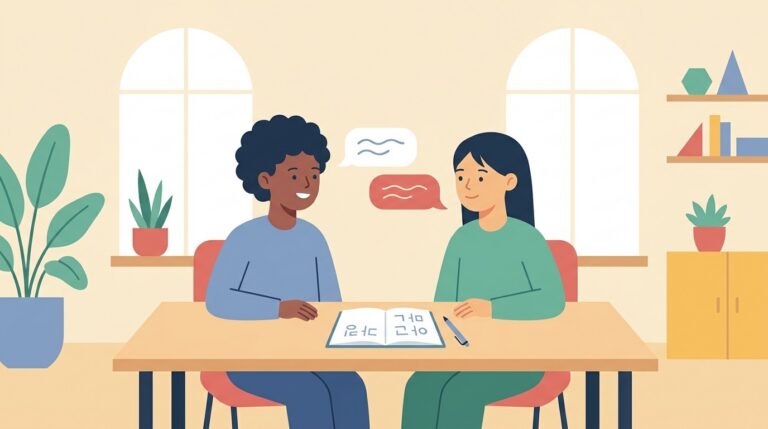
Imagine this: You are sitting in a sunlit classroom in Sinchon, Seoul, pencil in hand. The teacher writes a new dialogue on the whiteboard, smiles warmly at the room, and announces the words every beginner secretly dreads: “자, 짝과 함께 하세요 (Ja, jjak-gwa hamkke haseyo – Now, please practice with your partner)!”
Instantly, your stomach does a little flip. You glance at the student sitting beside you, lock eyes for a split second, and panic kicks in. Your mind goes completely blank. How do you casually say, “Let’s work together”? Who starts reading first? What if you mess up your pronunciation and freeze?
We have all been there! That sudden, awkward hesitation right after the teacher pairs you up is the most universal hurdle for Korean language learners worldwide. But pairing up doesn’t have to feel like a high-stakes test. Based on years of real classroom observation and learner feedback, this guide will give you three bulletproof phrases and cultural cues to break the ice instantly. By the time you finish reading, you will be looking forward to partner practice every single day.
Phase 2: Top 3 Core Expressions
1. 저랑 같이 해요! (Jeorang gachi haeyo!)
- Pronunciation: [Jeorang gachi haeyo] (Sounds like juh-rang gah-chee hae-yo — imagine saying “gah-chee” like the crunch of cheese snacks!)
- Meaning: “Let’s do it together!” (Literal: “With me, together do!”)
- K-Culture Moment: In high school K-Dramas like Extraordinary You, this is the bubbly line students use when choosing desk buddies or lab partners.
- Editor’s Insight: Adding “저랑 (with me)” softens the sentence immediately, transforming a boring school exercise into an enthusiastic team effort.
- Situation Spectrum: Casual ⚠️ | Semi-formal ✅ | Formal ⚠️
- 🤔 Think About It: In English, we often ask “Do you want to be my partner?” as a question. Why do you think Korean frequently phrases this as an enthusiastic shared invitation (해요) instead?
2. 먼저 하실래요? (Meonjeo hasillaeyo?)
- Pronunciation: [Meonjeo hasillaeyo] (Sounds like muhn-juh ha-sheel-lae-yo — “muhn” rhymes with “sun”!)
- Meaning: “Would you like to go first?” (Nuance: Gentle deference and consideration for your partner’s pace)
- K-Culture Moment: In Korean variety shows like Running Man, cast members politely pass tricky game turns to their partner using this exact phrase.
- Editor’s Insight: The infix “-시-” adds a layer of polite respect without feeling stiff or overly distant. It shows supreme classroom manners.
- Situation Spectrum: Casual 🚫 | Semi-formal ✅ | Formal ✅
- 🤔 Think About It: Why is offering the first turn considered polite in teamwork cultures across East Asia?
3. 제 차례예요! (Je charyeyeyo!)
- Pronunciation: [Je charyeyeyo] (Sounds like jeh cha-rye-ye-yo — pronounce “cha-rye” smoothly like “chair-yeah”)
- Meaning: “It’s my turn!”
- K-Culture Moment: Idols playing games during live streams shout this excitedly when claiming their spot in a quiz game.
- Editor’s Insight: If your partner finishes reading line A and looks confused about what comes next, jumping in with “제 차례예요!” keeps the practice flow smooth and energetic.
- Situation Spectrum: Casual ⚠️ | Semi-formal ✅ | Formal ✅
- 🤔 Think About It: How does taking clear ownership of your turn create psychological safety for your partner in class?
Phase 3: Textbook Korean vs. Real Korean
Situation 1: Asking someone to be your study partner
- 📖 교과서 한국어: 저와 함께 연습하시겠습니까? (Jeowa hamkke yeonseuphasigessseumnikka? / Would you care to practice with me?)
- 🗣️ 진짜 한국어: 우리 같이 할까요? (Uri gachi halkkayo? / Shall we do it together?)
- 💡 왜 다를까? Textbook forms use heavy formal honorific endings that make casual classmates sound like diplomats negotiating a treaty. In modern classrooms, warm inclusivity using “우리 (we/our)” builds friendship immediately.
Situation 2: Deciding who speaks first
- 📖 교과서 한국어: 당신이 먼저 시작하십시오. (Dangsini meonjeo sijakhasipsio. / Please begin first.)
- 🗣️ 진짜 한국어: 가위바위보 해요! (Gawibawibo haeyo! / Let’s play Rock-Paper-Scissors!)
- 💡 왜 다를까? In Korea, “당신 (you)” can sound confrontational if used with strangers. Real students instantly solve turn-taking with a playful round of Gawi-bawi-bo.
Phase 4: K-Culture Deep Dive & Non-verbal Manners
4-1. Nunchi & Classroom Gestures
When your teacher says “짝과 함께 하세요”, never point at someone with a single index finger—it can appear aggressive. Instead, make gentle eye contact, give a tiny seated bow (목례, mok-rye), and motion toward yourself with an open palm when saying “같이 해요!”. If you need a second to check your notes, put your index finger softly to your chin while saying “잠시만요 (Just a moment)”; your partner will intuitively wait.
4-2. The Cultural Meaning of ‘짝꿍’ (Jjakkkung)
In Korea, your assigned partner isn’t merely an academic peer—they are your 짝꿍 (jjakkkung). From primary school desk-mates who share snacks to variety show duos who win prizes together, having a jjakkkung implies shared destiny and mutual support. Approaching pair practice with this mindset transforms an intimidating assignment into a friendship builder.
Phase 5: Real Roleplay Scenario
Setting: A bustling Level 1 Korean classroom at a university language institute in Seoul. You are sitting next to Minji (민지), a friendly local teaching assistant paired with you for speaking practice.
- 선생님 (Teacher): 여러분, 옆 사람과 짝과 함께 하세요! (Yeoreobun, yeop saramgwa jjak-gwa hamkke haseyo! / Everyone, please work with your partner next to you!)
🎭 Claps hands twice and gestures toward the pairs. - You: 저기… 민지 씨, 저랑 같이 해요! (Jeogi… Minji ssi, jeorang gachi haeyo! / Um… Minji, let’s work together!)
🎭 Smiling shyly with an open-palm gesture. - 민지 (Minji): 네, 좋아요! 같이 해요. (Ne, joayo! Gachi haeyo. / Sure, sounds great! Let’s do it together.)
🎭 Opens her textbook and leans closer warmly. - You: 먼저 하실래요? (Meonjeo hasillaeyo? / Would you like to go first?)
🎭 Points politely toward Minji’s book with two hands. - 민지 (Minji): 제가 먼저 할게요. 안녕하세요, 이름이 뭐예요? (Jega meonjeo halgeyo. Annyeonghaseyo, ireumi mwoyeyo? / I’ll go first. Hello, what is your name?)
🎭 Speaks clearly at a comfortable beginner pace. - You: 제 차례예요! 저는 알렉스예요. (Je charyeyeyo! Jeoneun Alex-yeyo. / It’s my turn! I am Alex.)
🎭 Speaks with cheerful confidence. - 민지 (Minji): 와, 발음 정말 좋아요! (Wa, baleum jeongmal joayo! / Wow, your pronunciation is really good!)
🎭 Gives two enthusiastic thumbs up. - You: 감사합니다! 다음 대화도 해요. (Gamsahamnida! Daeum daehwado haeyo. / Thank you! Let’s do the next dialogue too.)
🎭 Laughs together and turns the page.
🔀 Interactive Choice Point: How will you decide who reads part A?
- Option A: Smile and say “가위바위보 할까요? (Shall we play rock-paper-scissors?)”
Feedback: Best! It breaks the tension instantly, sparks laughter, and is 100% culturally authentic. - Option B: Stay completely silent and wait for Minji to start talking.
Feedback: Bad. Creates awkward silence (정적) and puts all the pressure on your partner. - Option C: Say “너 먼저 해 (You go first)” in informal 반말 (banmal).
Feedback: Risk! Dropping honorifics without permission can make you sound impolite or overly blunt to a new classmate.
Phase 6: 10-Second Emotion Shadowing Drill
Repeat these aloud, matching the pause markers (/) and emotional cues:
[😊 밝고 친절하게 / Bright & Inviting]
저랑 / 같이 / 해요! (Jeorang / gachi / haeyo!)[🤝 배려 넘치고 정중하게 / Thoughtful & Polite]
민지 씨, / 먼저 / 하실래요? (Minji ssi, / meonjeo / hasillaeyo?)[🎉 씩씩하고 신나게 / Cheerful & Enthusiastic]
이제 / 제 차례예요! (Ije / je / charyeyeyo!)
Phase 7: K-Culture Mini Dictionary
- 짝꿍 (Jjakkkung): A desk buddy or designated pair partner. Derived from 짝 (pair), it carries a sweet sense of camaraderie.
- 가위바위보 (Gawi-bawi-bo): Scissors-rock-paper. The undisputed universal decision-maker in Korean classrooms, offices, and dinner tables.
- 차례 (Charye): One’s turn or order in a sequence. Essential for board games, partner drills, and waiting queues.
- 화이팅 / 파이팅 (Hwaiting / Paiting): The ultimate Korean cheer meaning “You got this!” or “Let’s do our best!”
Phase 8: Survival Kit for Travelers & Language Students
Top 3 Survival Expressions
- 같이 사진 찍을래요? (Gachi sajin jjigeullaeyo? / Want to take a photo together?)
Pro Tip: Perfect at photo booths like Life Four Cuts (인생네컷) during language exchange meetups! - 다시 한번 말해 주세요. (Dasi hanbeon malhae juseyo. / Please say it one more time.)
Pro Tip: Use this whenever your partner speaks too quickly instead of just nodding blankly. - 천천히 부탁해요. (Cheoncheonhi butakhaeyo. / Slowly, please.)
Pro Tip: Short, sweet, and rescues beginners from conversational overwhelm.
Editor’s Travel Note
When attending language meetups or cultural classes in Seoul, finding quiet study spots with group tables is key. You can discover spacious study cafes near Hongdae or Gangnam by downloading the Naver Map app on official stores. It provides accurate real-time transit routes and quiet study spot reviews in English.
Phase 9: “One Step Deeper” (Cultural Reflection)
In Korean society, language rarely centers solely around the autonomous individual. Notice how native speakers naturally say “우리 학교 (our school)” or “우리 반 (our class)” rather than “my school.” Pair work is not merely a pedagogical technique for grammar mastery; it is a ritual of building 정 (jeong)—interpersonal warmth and shared connection. When you lean over to practice Korean with your desk-mate, you step into this rich tradition of shared experience.
💬 Your Turn: Have you ever felt nervous during a foreign language class? What is your favorite way to break the ice with a new partner? Let us know in the comments below!
Phase 10: FAQ & Mistake Prevention
Q: What should I say if my partner’s Korean is much more advanced than mine?
A: Be honest and appreciative! Say: “제가 초보예요. 잘 부탁드려요! (Jega choboyeyo. Jal butakdeuryeoyo! / I’m a beginner. Please guide me well!)” Korean speakers love humility and will eagerly help you.
Q: Can I use 반말 (informal speech) if my classmate is the exact same age as me?
A: Not right away! Always start with polite 존댓말 (jondaetmal) like “-해요”. Once you become comfortable friends, you can ask: “우리 말 편하게 할까요? (Shall we speak comfortably?)”
Q: What if I didn’t catch the teacher’s instructions for the activity?
A: Simply turn to your partner and whisper: “지금 뭐 해야 돼요? (Jigeum mwo haeya dwaeyo? / What are we supposed to do right now?)”
🚨 Common Mistakes Alert
- ❌ Mistake 1: Calling your partner “당신 (dangsin)”.
👉 Correct Action: Use their name with “씨” (e.g., “민지 씨”), or simply speak directly without a second-person pronoun. - ❌ Mistake 2: Nodding along silently without understanding.
👉 Correct Action: Politely raise one hand slightly and say: “이해 못 했어요 (I didn’t understand).” - ❌ Mistake 3: Starting to read without agreeing on who is speaker A and B.
👉 Correct Action: Always clarify first with “누가 A 할까요? (Who will do part A?)”.
Phase 11: Action Missions
- 🥉 Bronze Mission (Solo Practice): Stand in front of your mirror and practice saying “저랑 같이 해요!” with a warm, genuine smile 3 times.
- 🥈 Silver Mission (Social Engagement): Leave a comment below introducing yourself using “저는 [Your Name]예요. 같이 한국어 공부해요! (Let’s study Korean together!)”.
- 🥇 Gold Mission (Real Life Action): In your next Korean class, offline meetup, or online language exchange, be the very first person to say “먼저 하실래요?” to your study partner.
- 🎮 K-Culture Mission: Watch an episode of an idol variety show (such as Going Seventeen or Run BTS) and spot the exact moment the members shout “가위바위보!” to decide pairs or game turns.
Phase 12: Interactive Quiz Challenge
Question 1: Situational Judgment
Your teacher pairs you up with a classmate named Sarah. What is the most polite and natural way to suggest starting the drill?
* A) 너 해 (Neo hae)
* B) 사라 씨, 저랑 같이 해요! (Sarah ssi, jeorang gachi haeyo!)
* C) 당신이 하십시오 (Dangsini hasipsio)
Question 2: Fill in the Blank
When it is finally your turn to read the dialogue, you say:
“제 _________예요! (It’s my turn!)”
Question 3: Cultural True or False
In Korea, playing Rock-Paper-Scissors (가위바위보) to decide who speaks first in an informal pair exercise is considered rude.
* True
* False
👉 Click to reveal answers & explanations!
- Question 1 Answer: B. Using their name with “씨” followed by “저랑 같이 해요!” strikes the ideal balance of warmth and classroom politeness. (A is too blunt; C is unnaturally stiff and awkward).
- Question 2 Answer: 차례 (charye). The full sentence is “제 차례예요!” meaning “It’s my turn!”
- Question 3 Answer: False. 가위바위보 is universally used in Korean classrooms and variety games as a fun, fair, and friendly way to break the ice and assign speaking roles!






