

Phase 1: 공감 (Story-driven Opening)
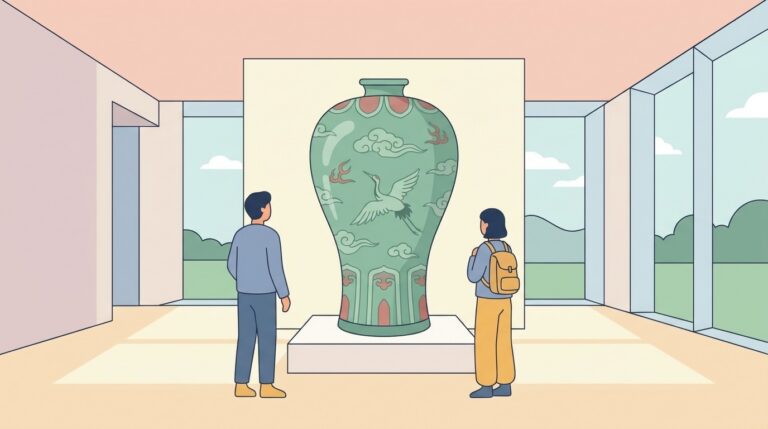
안녕하세요! 매일한글 에디터입니다. Have you ever stepped into the soaring grand hall of the National Museum of Korea, surrounded by centuries of quiet elegance, only to freeze when approaching the information desk? You spot magnificent Joseon Dynasty porcelain and golden Silla crowns just ahead. You want an audio guide, and you want to know if you can snap a photo of the 10-story marble pagoda without breaking any rules. But the silence feels intimidating, your tongue twists, and you end up nodding awkwardly in silence! Do not worry. Based on feedback from hundreds of beginner travelers, this practical guide gives you the exact phrases you need to explore Korean historical treasures with total ease and confidence.
Phase 2: 핵심 표현 3선 심층 분석 (Top 3 Key Expressions)
1. 오디오 가이드 대여할 수 있나요? (Audio gaideu daeyeohal su innayo?)
- Pronunciation: oh-dee-oh gah-ee-deu dae-yeo-hal soo een-nah-yo? (Think of “dae-yeo” sounding like “dare-yo” said quickly, smooth like asking a soft favor).
- Meaning: Literal: “Can [I] rent an audio guide?” | Real Nuance: “Could I please borrow an audio guide?”
- K-Culture Moment: In K-Dramas like Encounter, characters often wander through cultural exhibitions with headphones on, silently bonding over artifacts.
- Editor’s Insight: The verb
대여하다(to rent/borrow temporarily) sounds much more natural at public institutions than simply saying빌리다. - Situation Spectrum: Casual 🚫 | Semi-formal ✅ | Formal ✅
- 🤔 Think About It: In Korean, polite requests end in
~ㄹ 수 있나요?to leave room for the listener to answer comfortably. How does your language soften direct inquiries?
2. 사진 찍어도 돼요? (Sajin jjigeodo dwaeyo?)
- Pronunciation: sah-jeen jee-gaw-doh dway-yo? (The double jj in
찍sounds like the sharp “j/ch” sound in “cheese”). - Meaning: Literal: “Is it okay even if I take photos?” | Real Nuance: “Am I allowed to take photos here?”
- K-Culture Moment: You will often see Korean vloggers politely asking museum staff this exact sentence before filming aesthetic B-roll for their travel logs.
- Editor’s Insight: The pattern
~어도 돼요?is your master key for asking permission anywhere in Korea, from museums to vintage cafes. - Situation Spectrum: Casual ⚠️ (use
돼?only with close friends) | Semi-formal ✅ | Formal ✅ - 🤔 Think About It: Instead of asking “Can I?”, Koreans ask “Is it okay/permissible?”. Notice how the focus shifts to group harmony and rules.
3. 이거 한국어로 뭐라고 해요? (Igeo hangugeoro mworago haeyo?)
- Pronunciation: ee-gaw hahn-goo-gaw-roh mwoh-rah-goh hae-yo? (Flow through “mwo-ra-go” smoothly like “water-go”).
- Meaning: Literal: “This, in Korean, what do [people] call it?” | Real Nuance: “What is the Korean word for this artifact?”
- K-Culture Moment: Seen on variety shows like Welcome, First Time in Korea?, where curious foreign travelers point at cultural relics to learn authentic local names.
- Editor’s Insight: Museum curators love hearing this! It immediately transforms you from a passive tourist into an active cultural explorer.
- Situation Spectrum: Casual ⚠️ | Semi-formal ✅ | Formal ✅
- 🤔 Think About It: Why do Koreans prefer saying
이거(this thing) with a slight nod rather than pointing an index finger? (Keep reading Phase 4 to find out!)
Phase 3: 교과서 한국어 vs 진짜 한국어 (Textbook vs. Real Korean)
Situation 1: Getting an admission ticket at the counter
- 📖 교과서 한국어: 입장권을 구입하고 싶습니다. (Ipjanggwoneul guiphago sipseumnida. / “I desire to purchase an entrance ticket.”)
- 🗣️ 진짜 한국어: 성인 한 명 주세요. (Seong-in han myeong juseyo. / “One adult ticket, please.”)
- 💡 왜 다를까? In real life, Korean speakers drop heavy book words like
구입하다(to purchase) and simply state the ticket type plus주세요(please give me).
Situation 2: Asking for directions to a specific exhibition hall
- 📖 교과서 한국어: 조선실은 어디에 위치해 있습니까? (Joseonsireun eodie wichihae isseumnikka? / “Where is the Joseon Dynasty room situated?”)
- 🗣️ 진짜 한국어: 조선실 어디로 가요? (Joseonsil eodiro gayo? / “Which way to the Joseon Room?”)
- 💡 왜 다를까? Asking “Where does it go?” (
어디로 가요?) sounds much more conversational and dynamic than stiff geographical inquiry verbs.
Phase 4: K-Culture 딥다이브 & 비언어적 매너 (Culture Deep-Dive)
4-1. 눈치 (Nunchi) & Body Language at the Museum
- The Open-Palm Gesture: When pointing toward an ancient Buddhist statue or royal seal, never point with a single index finger! In Korea, pointing an index finger at sacred objects or respected figures is considered slightly aggressive. Instead, gesture toward the artifact gently with an open palm facing upward.
- Whisper Tone (속닥속닥): Koreans are very mindful of communal peace in public spots. Keep your voice at a gentle whisper, and place both hands in front of your body when speaking to museum docents.
4-2. Culture Code: Connecting Historical Relics to Modern K-Media
- When you walk through the Joseon Dynasty galleries, you are stepping straight into the world of popular historical dramas (사극 – Sageuk) like Under the Queen’s Umbrella and The King’s Affection. Spotting the
곤룡포(Gonryongpo – the King’s red dragon robe) in person helps you realize that every visual element in Korean cinema is rooted in meticulous historical preservation.
Phase 5: 실전 롤플레이 시나리오 (Interactive Roleplay Scenario)
- Setting: The grand central information rotunda of the National Museum of Korea.
- Characters: You (an excited culture lover) & Minji (a warm museum docent wearing an official badge).
-
Minji: 안녕하세요! 무엇을 도와드릴까요? (Annyeonghaseyo! Mueoseul dowadeurilkkayo? / “Hello! How may I help you?”)
- You: 🎭 (Smiling and bowing slightly) 안녕하세요. 오디오 가이드 대여할 수 있나요? (Annyeonghaseyo. Audio gaideu daeyeohal su innayo? / “Hello. Can I rent an audio guide?”)
- Minji: 🎭 (Typing on the computer) 네, 가능합니다. 영어 버전으로 드릴까요? (Ne, ganeunghamnida. Yeong-eo beojeoneuro deurilkkayo? / “Yes, you can. Would you like the English version?”)
- You: 🎭 (Nodding politely) 네, 영어로 부탁드려요. 그리고 사진 찍어도 돼요? (Ne, yeong-eoro butakdeuryeoyo. Geurigo sajin jjigeodo dwaeyo? / “Yes, in English please. And may I take photos?”)
- Minji: 🎭 (Handing over the audio device with two hands) 플래시 없이 일반 사진은 가능해요. (Peullaesi eopsi ilban sajineun ganeunghaeyo. / “General photos are okay without flash.”)
- You: 🎭 (Receiving the device with both hands) 감사합니다! 조선실은 어디로 가요? (Gamsahamnida! Joseonsireun eodiro gayo? / “Thank you! Which way is the Joseon room?”)
- Minji: 🎭 (Guiding with an open palm) 2층 오른쪽으로 올라가시면 됩니다. (I-cheung oreunjjogeuro ollagasi-myeon doemnida. / “Go right up to the second floor.”)
- You: 🎭 (Bowing gratefully) 친절하게 알려주셔서 감사합니다! (Chinjeolhage allyeojusyeoseo gamsahamnida! / “Thank you for explaining so kindly!”)
🔀 Your Interactive Decision Point
You reach the Joseon gallery and see an intricate wooden sundial from the 15th century. You want to ask the staff member standing nearby what it is called. What do you say?
- Option A: 저기요, 이거 이름이 뭐예요? (Jeogiyo, igeo ireumi mwoyeyo?)
- Feedback: ⚠️ [Risk] It is understandable, but
이름이 뭐예요?is usually reserved for people or pets, sounding a bit childish for historical treasures.
- Feedback: ⚠️ [Risk] It is understandable, but
- Option B: 실례지만, 이거 한국어로 뭐라고 해요? (Sillyejiman, igeo hangugeoro mworago haeyo?)
- Feedback: 🌟 [Best Choice!] Extremely polite, culturally natural, and shows genuine respect for the language!
- Option C: 야, 저거 뭐야? (Ya, jeogeo mwoya?)
- Feedback: 🚫 [Bad!] Extremely casual slang (“Hey, what is that over there?”). Never use this with strangers or in respectful spaces!
Phase 6: 10초 감정 섀도잉 드릴 (Emotion Shadowing Drill)
Practice these with natural rhythm! Pauses are marked with /.
[😊 조심스럽고 정중하게 - Polite & gentle inquiry]- 저기요, / 사진 찍어도 / 돼요? (Jeogiyo, / sajin jjigeodo / dwaeyo?)
[🤩 호기심 가득한 목소리 - Curious & impressed]- 와, / 이거 한국어로 / 뭐라고 해요? (Wa, / igeo hangugeoro / mworago haeyo?)
[🙏 따뜻하게 감사를 표하며 - Warm gratitude]- 도와주셔서 / 정말 / 감사합니다! (Dowajusyeoseo / jeongmal / gamsahamnida!)
Phase 7: K-Culture 미니 사전 (Mini Dictionary)
- 유물 (Yu-mul) | Relic / Historical Artifact
- Usage: Used when discussing treasured historical items inside museums or archaeological sites.
- 도슨트 (Do-seun-teu) | Docent / Museum Guide
- Usage: Widely used in Korean art galleries and museums: “도슨트 투어 몇 시에 시작해요?” (What time does the docent tour start?).
- 상설전시 (Sang-seol-jeon-si) | Permanent Exhibition
- Usage: Most major national museums offer free admission to the permanent collection (
상설전시).
- Usage: Most major national museums offer free admission to the permanent collection (
- 기념품점 (Gi-nyeom-pum-jeom) | Gift Shop
- Usage: Also popularly known as the “Museum Goods Shop” (
뮷즈 - MU:DS), famous for viral aesthetic souvenirs like King Sejong stationery and mother-of-pearl tumbler cups.
- Usage: Also popularly known as the “Museum Goods Shop” (
Phase 8: 여행자를 위한 생존 키트 (Traveler’s Survival Kit)
Survival Expressions TOP 3
- 무료입장인가요? (Muryo-ipjang-in-gayo? / “Is admission free?”)
- Pro Tip: Permanent galleries in state museums across Korea are usually free of charge!
- 물품 보관함 어디에 있어요? (Mulpum bogwanham eodie isseoyo? / “Where are the luggage lockers?”)
- Pro Tip: Keep your hands free. Museum lockers are almost always free or require a refundable 100-won coin.
- 한국어 팜플렛 있어요? (Hangugeo pampeullet isseoyo? / “Do you have a Korean pamphlet?”)
- Pro Tip: Grab both an English and a Korean pamphlet side-by-side to compare vocabulary!
Editor’s Travel Note
- App Recommendation: Make sure to check the 국립중앙박물관 공식 오디오가이드 앱 다운로드 page before arriving, so you can stream commentary directly from your smartphone without renting hardware.
- Navigation Tip: Find transit routes via the 네이버 지도 대중교통 길찾기 바로가기 search engine to find the quickest subway exit (Ichon Station has a direct underground path straight into the museum courtyard!).
Phase 9: 한 발 더 깊이 (Thoughtful Reflection)
In many cultures, history is displayed as a spectacle of foreign conquerors and kingdoms past. In Korea, however, historical relics (유물) are viewed as a living bridge of communal perseverance (한 and 흥) through endless challenges. When you visit a Korean museum, speaking soft, respectful words is not simply following institutional rules; it is participating in a communal act of honor toward ancestors who preserved these cultural memories for future generations.
💬 Your Turn: Which historical item from your own home country would you most love to describe to a Korean friend in Hangul? Share your thoughts in the comments below!
Phase 10: FAQ & 흔한 실수 (FAQ & Common Mistakes)
Q: Do I need to book museum tickets weeks in advance in Seoul?
A: For standard permanent exhibitions (상설전시), you can walk in without booking at major state museums. However, special interactive halls or popular limited-time exhibitions require an online reservation via their website.
Q: Can I use credit cards to pay for audio guides and locker storage?
A: Most automated audio guide rental desks accept local and international credit cards (Visa/Mastercard). Lockers are free, but some older coin models require a 100-won coin that is returned when you retrieve your bag.
Q: Is talking allowed while viewing exhibitions?
A: Yes, but keep it in a soft whisper (귓속말). Loud conversations or talking on phone calls inside gallery rooms will draw polite yet stern reminder glances from hall attendants.
🚨 흔한 실수 (Common Mistakes Top 3)
- Taking flash photography:
- Mistake: Leaving flash on auto when snapping relics.
- Correct Action: Turn off your phone flash before entering, as ancient lacquered wood and silk fade easily under strong light.
- Using informal speech (
반말) with young museum staff:- Mistake: Assuming young attendants prefer casual talk: “이거 얼마야?”
- Correct Action: Always maintain polite endings (
~요/~세요): “이거 얼마예요?”
- Handing tickets or IDs with one hand:
- Mistake: Giving your passport or deposit card casually with your left hand.
- Correct Action: Offer items using two hands, or support your right elbow lightly with your left hand.
Phase 11: 액션 미션 & 참여 유도 (Action Missions)
- 🥉 Bronze Mission (Solo Practice): Stand in front of your mirror and practice saying:
사진 찍어도 돼요?(Sajin jjigeodo dwaeyo?) 5 times with a gentle smile. - 🥈 Silver Mission (Social Media): Post a picture of your favorite antique item or souvenir on Instagram stories, captioning it:
이거 한국어로 뭐라고 해요?and tag @DailyHangul. - 🥇 Gold Mission (Real-world Challenge): Visit a museum or historical palace in Korea, approach the staff, and successfully ask:
오디오 가이드 대여할 수 있나요?using two hands! - 🎮 K-Culture Mission: Watch an episode of a Korean historical drama (사극) this weekend and try to spot at least one royal dragon robe (
곤룡포) or celadon jar (청자)!
Phase 12: 인터랙티브 퀴즈 챌린지 (Interactive Quiz Challenge)
Test your museum skills before your trip!
Q1. Situation Challenge: You want to ask the ticket desk clerk for two adult tickets. What is the most natural, real-life phrase?
* A) 입장권을 두 개 사고 싶습니다.
* B) 성인 두 명 주세요.
* C) 저기 표 두 개 내놔.
Q2. Fill-in-the-Blank: You want to make sure your camera is allowed:
* “실례지만, 사진 _________ 돼요?” (May I take photos?)
Q3. True or False: In Korean museums, pointing at ancient artifacts with a single index finger is considered courteous and precise.
* [ True / False ]
👉 Click here to reveal the answers and explanations!
- A1: B) 성인 두 명 주세요. (Natural and simple conversational Korean! Option A is too stiff like an old textbook, and Option C is rude).
- A2: 찍어도 (Full sentence:
실례지만, 사진 찍어도 돼요?– Sillyejiman, sajin jjigeodo dwaeyo?) - A3: False! You should gesture softly using an open palm facing upward rather than pointing a finger.







