

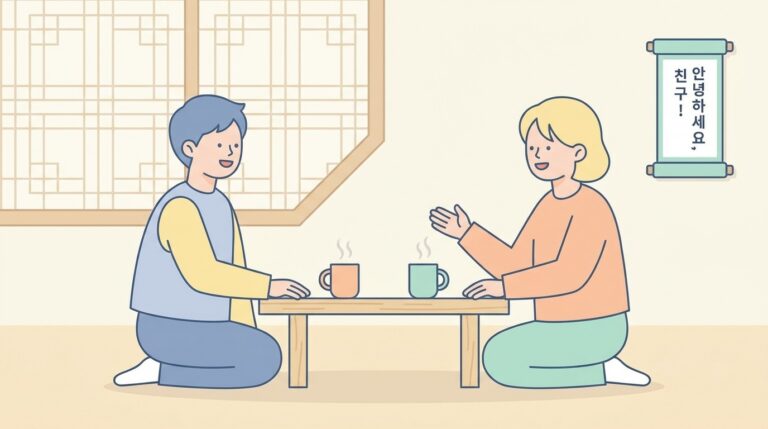
Master the Art of the Gentle No: 미안하지만 이번엔 도와주기 힘들어
Phase 1: 공감 (스토리 몰입형 오프닝)
안녕하세요! 매일한글 에디터입니다. Have you ever found yourself in that classic K-drama standoff? Your charming coworker asks you to take over their shift or proofread a massive presentation deck right as you’re packing your bag for a Friday night Chimaek run. In your native language, you might casually say, ‘Sorry, can’t make it today!’ But in Korean, if you blurt out ‘아니요 (Aniyo)’ or ‘싫어요 (Sireoyo),’ the entire room freezes into awkward silence. You don’t want to burn bridges, yet taking on the extra work will completely ruin your weekend! Over the past ten years of coaching intermediate learners, this exact dilemma comes up every single week. Learning how to deliver a polite, empathetic decline—saying ‘미안하지만 이번엔 도와주기 힘들어 (I’m sorry, but it’s hard for me to help this time)’—is the ultimate superpower to protect your boundaries while preserving precious interpersonal warmth (정, jeong). Let’s unlock the art of saying no like a true Seoul local!
Phase 2: 핵심 표현 3선 심층 분석
1. 이번엔 좀 힘들 것 같아요 (Ibeonen jom himdeul geot gatayo)
- Pronunciation: [I-beon-en jom him-deul geot ga-ta-yo] (Think of ‘him’ as the English pronoun + ‘deul’ like dull: ee-bun-en johm him-dull gut gah-tah-yo)
- Meaning: Literal: “This time it seems a bit difficult” vs. Actual Nuance: “I’d genuinely love to help, but circumstances just won’t allow it right now.”
- K-Culture Moment: A classic office scene in Misaeng (Incomplete Life) where a colleague politely steps aside from an impossible deadline without causing friction with seniors.
- Editor’s Insight: The secret weapon here is 좀 (jom – a little) combined with ~것 같아요 (~it seems like). In Korean culture, stating your refusal as an objective condition rather than a firm personal choice softens the blow completely.
- Situation Spectrum: Casual (이번엔 좀 힘들 것 같아) ✅ | Semi-formal (이번엔 좀 힘들 것 같아요) ✅ | Formal (이번에는 조금 어려울 것 같습니다) ✅
- 🤔 Think About It: Why does Korean culture frame personal decisions as descriptive situations rather than direct assertions?
2. 어쩌지? 선약이 있어서 어려울 것 같아(요) (Eojjeoji? Seonyagi isseoseo eoryeoul geot gata(yo))
- Pronunciation: [Eot-jeo-ji? Seon-ya-gi is-seo-seo eo-ryeoul geot ga-ta-yo] (Sound analogy: ‘Uh-jjuh-jee? Sun-yah-gee ees-suh-suh…’)
- Meaning: Literal: “What should I do? Because I have a prior appointment, it will be difficult.” vs. Actual Nuance: “Oh no, what bad timing! I already have plans, so I won’t be able to make it.”
- K-Culture Moment: When your favorite sunbae (senior) invites everyone for surprise samgyeopsal dinner, but you already promised your flatmate you’d cook together.
- Editor’s Insight: Starting with 어쩌지 (Eojjeoji – What should I do?) signals immediate emotional empathy. It proves your heart wanted to say yes before your calendar forced you to say no.
- Situation Spectrum: Casual ✅ | Semi-formal ✅ | Formal ⚠️ (For formal business contexts, use ‘선약이 있어서 참석이 어렵습니다’)
- 🤔 Think About It: How does showing personal distress (어쩌지) before saying no change the listener’s reaction?
3. 마음은 굴뚝같은데 이번엔 패스할게요 (Maeumeun gulttukgateunde ibeonen paeseuhalgeyo)
- Pronunciation: [Ma-eum-eun gul-ttuk-gat-eun-de i-beon-en pae-seu-hal-ge-yo] (Gul-ttuk sounds like ‘gool-took’, evoking smoke billowing up a chimney)
- Meaning: Literal: “My heart is like a chimney, but I’ll pass this time.” vs. Actual Nuance: “I want to do this so badly, but I have to take a rain check!”
- K-Culture Moment: Variety shows like Running Man, when cast members playfully decline an exhausting penalty challenge while keeping the banter cheerful.
- Editor’s Insight: 굴뚝같다 (gulttukgatda) is an expressive idiom meaning your desire is burning fiercely. It reassures your friend that you value their company immensely.
- Situation Spectrum: Casual ✅ | Semi-formal ✅ | Formal 🚫 (Keep this for peers and friendly acquaintances only)
- 🤔 Think About It: What idioms exist in your native language to express strong intent despite inability?
Phase 3: 교과서 한국어 vs 진짜 한국어
Situation 1: Declining an impromptu favor at school or work
- 📖 교과서 한국어: 도와줄 수 없습니다. (Dowajul su eopseumnida. / “I cannot help you.”)
- 🗣️ 진짜 한국어: 아, 제가 지금 손이 모자라서 이번엔 돕기 힘들 것 같아요. (A, jega jigeum son-i mojarraseo ibeonen dopgi himdeul geot gatayo. / “Ah, my hands are full right now, so it’s a bit tough to help this time.”)
- 💡 왜 다를까?: The textbook phrase sounds like an aggressive termination of goodwill. Real Koreans use the somatic idiom 손이 모자라다 (to lack hands/be short-handed) to point out a physical constraint rather than a lack of affection.
Situation 2: Skipping an after-work get-together
- 📖 교과서 한국어: 저는 회식에 가지 않겠습니다. (Jeoneun hoesige gaji anketseumnida. / “I will not go to the company dinner.”)
- 🗣️ 진짜 한국어: 오늘 진짜 가고 싶은데, 컨디션이 안 좋아서 이번엔 빠질게요! (Oneul jinjja gago sipeunde, keondisyeon-i an joaseo ibeonen ppajilgeyo! / “I really want to go, but I’m feeling under the weather, so I’ll sit this one out!”)
- 💡 왜 다를까?: Saying 안 가겠습니다 sounds rebellious. Native speakers always emphasize desire (진짜 가고 싶은데) before dropping the soft refusal (빠질게요).
Phase 4: K-Culture 딥다이브 & 비언어적 매너
4-1. 눈치 (Nunchi) & Body Language
Never deliver a refusal with cold, unblinking eye contact. Instead:
1. The Subtle Head Tilt: Tilt your head about 10-15 degrees with a rueful smile.
2. The Neck Tap: Lightly touch the nape of your neck or hold your hands together in front of your chest in a light prayer stance.
3. The Pre-Refusal Intake (쓰읍, Sseup): Native speakers often suck air softly through their teeth right before delivering a soft no. This auditory cue alerts the other person’s nunchi so the decline lands gently.
4-2. Cultural Code: Preserving 체면 (Che-myeon / Face)
In Korean social dynamics, preserving the other person’s 체면 (face) is paramount. A blunt ‘No’ implies the requester made an inappropriate demand. By inserting 이번엔 (this time), you promise implicitly that your relationship remains solid and future collaboration is still welcome.
Phase 5: 실전 롤플레이 시나리오
- Setting: A trendy café in Gangnam after a long group study session.
- Character: Min-woo (민우), your upbeat study partner who tends to over-delegate tasks.
- 민우: 지우 씨, 혹시 오늘 저녁에 발표 자료 번역하는 것 좀 도와줄 수 있어요?
(Jiwoo ssi, hoksi oneul jeonyeoge balpyo jaryo beonyeokaneun geot jom dowajul su isseoyo?)
“Jiwoo, could you by chance help me translate the presentation slides this evening?”
🎭 두 손을 모으고 간절한 눈빛으로 바라보며 -
지우: 아, 민우 씨… 오늘 저녁에 발표 자료요?
(A, Minu ssi… oneul jeonyeoge balpyo jaryoyo?)
“Ah, Min-woo… the presentation slides tonight?”
🎭 살짝 턱을 만지며 곤란한 미소를 짓는다 -
민우: 네! 양이 조금 많은데 지우 씨가 워낙 꼼꼼하니까 금방 끝날 것 같아서요.
(Ne! Yang-i jogeum maneunde Jiwoo ssiga wonak kkomkkomhanikka geumbang kkeunnal geot gataseoyo.)
“Yes! There’s quite a bit, but you’re so meticulous, I figured it would be quick with you.”
🎭 머리를 긁적이며 멋쩍게 웃는다 -
지우: 칭찬해 줘서 고마워요. 그런데 어쩌죠?
(Chingchanhae jwoseo gomawoyo. Geureonde eojjeojyo?)
“Thanks for the compliment. But oh dear, what should I do?”
🎭 찻잔을 만지작거리며 미안한 기색을 보인다 -
민우: 오늘 많이 바빠요? 1시간만 딱 도와주면 안 될까요?
(Oneul mani bappayo? Han siganman ttak dowajumyeon an doelkkayo?)
“Are you super busy today? Couldn’t you spare just one single hour?”
🎭 시계를 힐끔 보며 조심스레 재촉한다 -
지우: 미안하지만 이번엔 도와주기 힘들 것 같아요. 밀린 과제 마감이 오늘 자정이거든요.
(Mianhajiman ibeonen dowajugi himdeul geot gatayo. Millin gwaje magam-i oneul jajeong-igeodeunyo.)
“I’m really sorry, but it’s hard for me to help this time. I have a project deadline at midnight tonight.”
🎭 손을 가볍게 가슴에 얹으며 진심으로 사과한다 -
민우: 아, 자정 마감이면 진짜 바쁘겠네요! 제가 눈치 없이 무리한 부탁을 했네요.
(A, jajeong magam-imyeon jinjja bappeukenneyo! Jega nunchi eopsi murihan butak-eul haenneyo.)
“Ah, if it’s midnight, you must be swamped! I asked without reading the room.”
🎭 고개를 끄덕이며 바로 물러선다 -
지우: 아니에요! 다음 주 과제 끝나고 나면 맛있는 커피 한잔해요. 화이팅!
(Anieyo! Daeum ju gwaje kkeutnago namyeon masinneun keopi hanjanhaeyo. Hwaiting!)
“Not at all! Let’s grab coffee together once next week’s assignments are done. Fighting!”
🎭 환하게 웃으며 주먹을 가볍게 쥐어 보인다
🔀 인터랙티브 분기점 (Interactive Choice)
If Min-woo had pushed once more: “Can’t you just glance over page 1?”, what should you say?
* Choice A: 싫어요. 제 과제 하기도 바빠요. (Sireoyo. Je gwaje hagido bappayo.)
* Choice B: 진짜 돕고 싶은데, 지금 제 발등에 불이 떨어져서 이번엔 정말 무리예요! (Jinjja dopgo sipeunde, jigeum je baldeung-e buri tteoreojyeoseo ibeonen jeongmal muriyeo!)
* Choice C: 음… 그럼 제가 밤새워서 해볼게요. (Eum… geureom jega bamsaewoseo haebolgeyo.)
Feedback:
* Choice B is Best!: Acknowledges enthusiasm (돕고 싶은데), employs a vivid idiom (발등에 불이 떨어지다 – fire on my foot/urgent emergency), and holds the boundary firmly without hostility.
* Choice A is Bad: Extremely blunt and damages the relationship immediately.
* Choice C is High Risk: People-pleasing at the expense of your own mental health and sleep!
Phase 6: 10초 감정 섀도잉 드릴
Practice matching the exact rhythm and breathing points marked with /:
[🥺 아쉽고 곤란하게 - Empathetic & Hesitant]
아… / 어쩌죠? / 제가 오늘 / 선약이 있어서요.
(A… / eojjeojyo? / jega oneul / seonyag-i isseoseoyo.)-
[🙏 정중하고 배려 깊게 - Polite & Considerate]
미안하지만 / 이번엔 / 도와주기 / 좀 힘들 것 같아요.
(Mianhajiman / ibeonen / dowajugi / jom himdeul geot gatayo.) -
[😊 따뜻하고 희망차게 - Cheerful & Promising]
다음번에는 / 제가 꼭 / 먼저 / 챙겨드릴게요!
(Daeumbeon-eneun / jega kkok / meonjeo / chaenggyeodeurilgeyo!)
Phase 7: K-Culture 미니 사전
- 거절 (Geojeol): Refusal / Rejection.
Usage: Used frequently in professional environments (e.g., ‘정중한 거절’ – polite refusal). - 선약 (Seonyak): Prior engagement / Previous appointment.
Usage: The most socially foolproof and respectable justification to decline invitations gracefully. - 눈치 (Nunchi): Situational awareness / Tact.
Usage: ‘눈치껏 빠지다’ means knowing when to excuse yourself before overstaying your welcome. - 부담 (Budam): Burden / Emotional pressure.
Usage: Saying ‘부담 갖지 마세요 (Don’t feel pressured)’ makes requests and responses comfortable.
Phase 8: 여행자를 위한 생존 키트
TOP 3 Survival Phrases
- 죄송하지만 지금은 좀 어려워요. (Joesonghajiman jigeumeun jom eoryeowoyo.)
Pro Tip: Perfect for warding off aggressive street promoters in Myeongdong or Hongdae without tension. - 다음에 올게요, 감사합니다! (Daeume olgeyo, gamsahamnida!)
Pro Tip: The best way to step out of a boutique clothing store when you don’t wish to purchase anything. - 괜찮습니다, 혼자 둘러볼게요! (Gwaenchansseumnida, honja dulleobolgeyo!)
Pro Tip: Friendly shield phrase when retail staff hover too close while you are browsing.
Editor’s Travel Note
When navigating dynamic city streets or looking up station exits, always plan your transit ahead using the 네이버 지도 앱 다운로드 page. If someone stops you to ask for directions while you’re hurrying to your train, a polite bow accompanied by “죄송합니다, 바빠서요! (Joesonghamnida, bappaseoyo!)” allows you to keep moving without friction.
Phase 9: “한 발 더 깊이” (생각 질문)
In Western cultures, direct honesty is often praised as the highest form of respect: “No, I cannot attend because I need rest.” In Korea, however, preserving the warmth of the collective space takes precedence. A direct refusal can feel like a severed thread in the social fabric. By saying “이번엔 좀 힘들 것 같아요 (It seems difficult this time),” you aren’t being deceitful; you are honoring the invisible bridge between both people. You leave space for future reconciliation.
💬 Your Turn: How does your mother tongue communicate a soft refusal without burning bridges? Do you prefer direct honesty or softened harmony? Share your thoughts below!
Phase 10: FAQ & 오해 방지 (FAQ Schema)
Q: Can I just say ‘아니요, 못해요’ (Aniyo, mothaeyo) if I’m really busy?
A: While grammatically correct, native speakers rarely use it for interpersonal requests. 못해요 sounds like either a harsh rejection of effort or total incompetence. Always prefer 힘들 것 같아요 (it seems difficult).
Q: What if the requester is much older or higher rank than me?
A: Elevate your vocabulary! Replace 이번엔 힘들어요 with formal honorifics: “죄송하지만 이번에는 도움을 드리기 어려울 것 같습니다.” (Joesonghajiman ibeoneneun doum-eul deurigi eoryeoul geot gatseumnida.)
Q: Does saying ‘이번엔 (this time)’ mean I am legally obliged to help next time?
A: Not at all! It functions as a conversational cushion. It simply signals that you hold no malice toward the requester.
🚨 흔한 실수 (Common Mistakes) 경고판
- ❌ Mistake 1: Saying “싫어요! (Sireoyo!)”
Correct Action: 싫어요 means ‘I dislike/hate this.’ Use 어려울 것 같아요 (It will be difficult) instead. - ❌ Mistake 2: Over-explaining personal emergencies with excessive drama.
Correct Action: Keep justifications concise: 선약 (prior plans) or 일정 (schedule) is plenty. - ❌ Mistake 3: Freezing and staying completely silent.
Correct Action: Even a soft “어쩌죠… 죄송해요” is 100 times better than leaving dead air.
Phase 11: 액션 미션 & 참여 유도
- 🥉 Bronze Mission: Say “이번엔 좀 힘들 것 같아요” 5 times into your voice memo app, incorporating the subtle head-tilt gesture.
- 🥈 Silver Mission: Leave a comment below introducing an excuse you frequently use, translated into Korean using today’s grammar.
- 🥇 Gold Mission: Use “선약이 있어서 어려워요” the next time a friend or study buddy makes a sudden request!
- 🎮 K-Culture Mission: Watch an episode of your favorite office K-Drama and spot when a character draws in air (쓰읍) before declining an assignment.
Phase 12: 인터랙티브 퀴즈 챌린지
Q1. [Situation Judgment] A close sunbae asks you to help move furniture this Saturday, but you have your sister’s birthday dinner. What is the most natural B1 response?
* (1) 싫습니다. 저는 갈 수 없습니다.
* (2) 어쩌죠? 그날 가족 선약이 있어서 이번엔 도와주기 힘들 것 같아요!
* (3) 도와주지 않겠습니다.
Q2. [Fill-in-the-Blank] Complete the polite softening phrase:
“마음은 [ ________ ]같은데, 이번엔 패스할게요!”
Q3. [True or False] Saying ‘아니요’ bluntly to a Korean coworker is considered standard and polite because it saves time.
👉 Click to reveal answers & explanations!
- Q1 Answer: (2) – It blends emotional regret (어쩌죠), valid reason (가족 선약), and soft refusal (힘들 것 같아요).
- Q2 Answer: 굴뚝 (Gulttuk) – 마음은 굴뚝같다 expresses burning eagerness!
- Q3 Answer: False – Direct negation without softening buffers (좀, 것 같아요) causes discomfort in Korean social interactions.







