

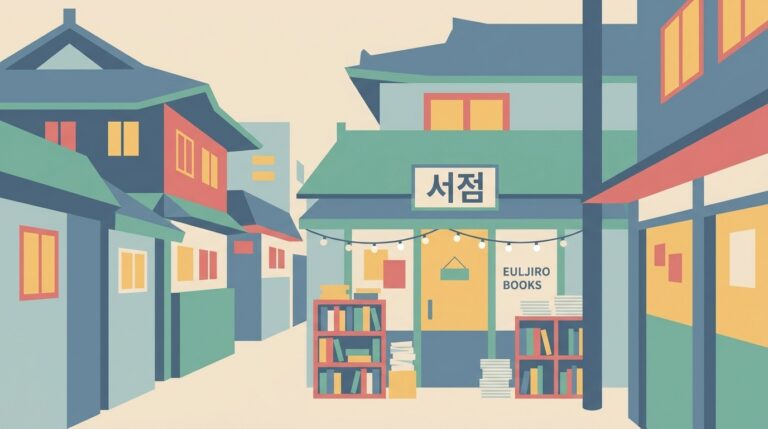
Phase 1: 공감 (Story-Immersive Opening)
안녕하세요! 매일한글 에디터입니다.
Picture this: You are standing in the middle of Euljiro’s printing alley in Seoul, surrounded by the mechanical rhythm of high-speed offset presses, the pungent aroma of fresh ink, and stacks of paper towering like papercraft skyscrapers. You have spent months pouring your heart into a manuscript, designing the layout, and prepping your digital EPUB files. Now, you want to bring your self-published essay or zine to life in Korea’s bustling literary scene—or perhaps list it on platforms like Kyobo or Ridibooks.
Suddenly, the print master (기사님) wipes his brow with a towel, turns around, and shouts over the roar of the machinery: “이거 별색 들어가요? 도련 몇 밀리 줬어요? 감리는 직접 볼 거예요?”
Your mind freezes. Even with advanced Korean proficiency, the technical jargon of Korean printing and publishing can feel like a totally separate language. Many advanced learners who aspire to publish in Korea find themselves trapped between textbook grammar and the hyper-specific, fast-moving vocabulary of indie creators and printing technicians.
Do not worry! Whether you are preparing to run a Tumblbug crowdfunding campaign for your bilingual poetry collection, launching an e-book, or navigating independent bookshops in Mangwon-dong, this guide is crafted specifically for you. Built from real-world consultations with foreign creators living in Seoul, this masterclass will elevate your Korean to a true C1 publishing-house level.
Phase 2: 핵심 표현 3선 심층 분석
1. 감리를 보다 (Gam-ni-reul bo-da)
- Pronunciation: [Gam-ni-reul bo-da] (Think of ‘Gam’ as in gummy, ‘ni’ like knee, ‘reul’ like a soft reel, and ‘bo-da’ like bow-down)
- Meaning: Literal: To supervise or inspect / Actual Nuance: To conduct a press check (inspecting sample print runs on-site to verify ink density, color balance, and paper finish).
- K-Culture Moment: Seen frequently in K-Dramas featuring publishers or editors (such as Romance Is a Bonus Book), where perfectionist editors race to Paju Book City at dawn to inspect first-run book jackets.
- Editor’s Insight: 감리 (監理) originates from Hanja, meaning oversight. In indie publishing, saying “제가 직접 감리 보겠습니다” immediately establishes you not as an amateur customer, but as a meticulous creator who cares deeply about color fidelity.
- Situation Spectrum: Casual: ⚠️ | Semi-formal: ✅ | Formal: ✅
- 🤔 Think About It: In Western indie publishing, print-on-demand often eliminates face-to-face press checks. Why do Korean boutique publishers place such immense cultural weight on physical presence during print verification?
2. 퇴고를 거치다 (Toe-go-reul geo-chi-da)
- Pronunciation: [Toe-go-reul geo-chi-da] (Pronounce ‘Toe’ like ‘tweh’ in twenty, ‘go’ as in golf, ‘geo-chi-da’ like gyuh-chee-dah)
- Meaning: Literal: To go through pushing and knocking / Actual Nuance: To rigorously polish, revise, and refine a manuscript through multiple editing passes.
- K-Culture Moment: Writers discussing their debut novels in YouTube literary salons (like Munhakdongne talk shows), explaining how a ragged draft became a masterpiece through relentless revision.
- Editor’s Insight: The term stems from an ancient Chinese anecdote about a poet deciding whether to “push” (推, toe) or “knock” (敲, go) on a gate in his poem. It conveys far more dedication and craftsmanship than the pedestrian 수정하다 (to edit).
- Situation Spectrum: Casual: ⚠️ | Semi-formal: ✅ | Formal: ✅
- 🤔 Think About It: How does choosing a classical metaphor like 퇴고 reflect Korea’s traditional reverence for written composition and scholarly deliberation?
3. 자가출판에 뛰어들다 (Ja-ga-chul-pan-e ttwieo-deul-da)
- Pronunciation: [Ja-ga-chul-pan-e ttwieo-deul-da] (Sounds like ‘jah-gah-chool-pahn-eh’ followed by ‘twee-uh-deul-dah’)
- Meaning: Literal: To jump into self-publishing / Actual Nuance: To courageously take the plunge into indie authoring or self-directed publishing.
- K-Culture Moment: Independent creators pitching their zines at indie book festivals such as Unlimited Edition (언리미티드 에디션), sharing their origins as DIY authors.
- Editor’s Insight: The verb 뛰어들다 (to dive/plunge into) transforms a routine business statement into a passionate, risk-embracing creative endeavor.
- Situation Spectrum: Casual: ✅ | Semi-formal: ✅ | Formal: ✅
- 🤔 Think About It: What does the phrase’s adventurous nuance tell us about how modern Korean youth view creative independence over corporate employment?
Phase 3: 교과서 한국어 vs 진짜 한국어
Situation 1: Explaining that you are proofreading for typos and errors
- 📖 교과서 한국어: 제 책의 오류를 수정하고 있습니다. (Je chaeg-ui o-ryu-reul su-jeong-ha-go it-seumnida. / “I am correcting errors in my book.”)
- 🗣️ 진짜 한국어: 지금 막바지 오탈자 잡느라 눈이 빠질 지경이에요. (Ji-geum mak-ba-ji o-tal-ja jam-neu-ra nun-i ppa-jil ji-gyeong-i-e-yo. / “I’m catching final typos right now, and my eyes are practically falling out.”)
- 💡 왜 다를까?: In professional publishing circles, 오탈자 (typos and omissions) is the standard technical term, while the hyperbolic idiom 눈이 빠지다 captures the grueling labor of exhaustive proofreading.
Situation 2: Finalizing the copyright and legal information page
- 📖 교과서 한국어: 책 뒷부분의 정보를 작성해야 합니다. (Chaek dwit-bu-bun-ui jeong-bo-reul jak-seong-hae-ya hamnida. / “I need to write the information for the back part of the book.”)
- 🗣️ 진짜 한국어: 판권지에 들어갈 서지정보랑 발행일자 확정해 주세요. (Pan-gwon-ji-e deul-eo-gal seo-ji-jeong-bo-rang bal-haeng-il-ja hwak-jeong-hae ju-se-yo. / “Please confirm the bibliographic metadata and date of issue for the colophon.”)
- 💡 왜 다를까?: Native editors refer directly to the colophon page as 판권지 and ISBN cataloging data as 서지정보. Using generic words sounds uninitiated.
Phase 4: K-Culture 딥다이브 & 비언어적 매너
4-1. 눈치(Nunchi) & 제스처 in Euljiro Print Alleys
When dealing with printing house technicians (기사님 or 반장님), direct confrontation regarding printing defects will quickly stall collaboration. If a test print looks slightly off-register or overly saturated, refrain from saying “색이 틀렸어요” (The color is wrong).
Instead, utilize tactile non-verbal cues. Hold the sample at eye level toward natural light, run your fingers gently along the trim edge, and gently ask with tilted body language: “기사님, 마젠타(붉은 기) 톤을 살짝만 덜어내는 게 가능할까요?” (Sir, would it be possible to pull back the magenta tone just a touch?). Handing them a warm canned coffee or energy drink with two hands before the run begins is the ultimate Nunchi ritual that guarantees meticulous craftsmanship.
4-2. 문화 코드 분석: The Tumblbug Phenomenon & Independent Bookstores
In South Korea, independent publishing is intimately tethered to platform culture. Many creators fund their physical production via Tumblbug (텀블벅), Korea’s premier crowdfunding platform for creatives. Having a successful Tumblbug campaign validates your project before independent bookshops (독립서점) in neighborhoods like Yeonnam-dong, Seochon, or Haebangchon agree to stock it on consignment (위탁판매). Understanding terms like 리워드 구성 (reward tiers) and 얼리버드 혜택 (early-bird perks) is vital for any indie creator targeting the Korean market.
Phase 5: 실전 롤플레이 시나리오
Setting: A bustling, ink-scented print shop in Euljiro 3-ga, Seoul.
Characters:
* Alex (알렉스): An independent creator publishing a bilingual photo essay.
* Master Park (박 기사님): A 30-year veteran press master with grease-stained spectacles and unmatched pride in his work.
- 박 기사님: 🎭 (인쇄용 CTP 판을 점검하며 돋보기를 치켜올린다) 청년, 표지랑 내지 데이터 웹하드에 올린 거 확인했는데, 도련 3밀리 사방으로 다 준 거 맞아요?
(Cheong-nyeon, pyo-ji-rang nae-ji de-i-teo wep-ha-deu-e ol-lin geo hwak-in-haet-neun-de, do-ryeon sam-mil-li sa-bang-eu-ro da jun geo maj-a-yo?)
“Young man, I checked the cover and text files you uploaded to Webhard. Did you add the 3mm bleed margin on all four sides?” -
알렉스: 🎭 (두 손을 모으고 서류철을 확인하며 공손하게) 네, 기사님! 재단선 밖으로 3밀리씩 여유 두고 작업해서 PDF 내보냈습니다.
(Ne, gi-sa-nim! Jae-dan-seon bakk-eu-ro sam-mil-li-ssik yeo-yu du-go jak-eop-hae-seo PDF nae-bo-naet-seumnida.)
“Yes, Master Park! I exported the PDF leaving a 3mm margin outside the cutting trim lines.” -
박 기사님: 🎭 (고개를 끄덕이며 종이 샘플북을 툭 건넨다) 종이는 아르떼 105그램으로 간다고 했지? 중철로 매길 건가, 아니면 무선제본인가?
(Jong-i-neun a-reu-tte baek-o-geu-raem-eu-ro gan-da-go haet-ji? Jung-cheol-lo mae-gil geon-ga, a-ni-myeon mu-seon-je-bon-in-ga?)
“You said you’re going with 105g Arte paper, right? Are we saddle-stitching this, or perfect binding?” -
알렉스: 🎭 (손으로 책 넘기는 시늉을 하며) 페이지 수가 120쪽이라 무선제본으로 가려 합니다. 책등 두께는 세네카 계산기로 맞췄습니다.
(Pe-i-ji su-ga baek-i-sip-jjog-i-ra mu-seon-je-bon-eu-ro ga-ryeo hamnida. Chaek-deung du-kke-neun se-ne-ka gye-san-gi-ro mat-chwot-seumnida.)
“It’s 120 pages, so we’re going with perfect binding. I calculated the spine thickness using a spine calculator.” -
박 기사님: 🎭 (안경을 고쳐 쓰며 옅은 미소를 짓는다) 제법 꼼꼼하네. 그럼 오늘 오후 2시에 초쇄 돌아가니까 감리 보러 올 건가?
(Je-beop kkom-kkom-ha-ne. Geu-reom o-neul o-hu du-si-e cho-swae dol-a-ga-ni-kka gam-ni bo-reo ol geon-ga?)
“Quite meticulous, aren’t you? First print run rolls at 2 PM today. Coming to do the press check?” -
알렉스: 🎭 (비타민 음료수를 공손히 건네며) 네, 직접 감리 보면서 흑백 사진 계조를 꼭 확인하고 싶습니다. 잘 부탁드립니다!
(Ne, jik-jeop gam-ni bo-myeon-seo heuk-baek sa-jin gye-jo-reul kkok hwak-in-ha-go sip-seumnida. Jal bu-tak-deu-rim-nida!)
“Yes, I’d like to do the press check in person to inspect the grayscale tonal gradients of the photos. Thank you for your guidance!” -
박 기사님: 🎭 (음료수를 받으며 껄껄 웃는다) 좋아! 데이터에 별색 팬톤 지정한 거 딱 맞춰놓을 테니 시간 맞춰 내려와요.
(Jo-a! De-i-teo-e byeol-saek paen-ton ji-jeong-han geo ttak mat-chwo-no-eul te-ni si-gan mat-chwo nae-ryeo-wa-yo.)
“Great! I will calibrate the spot Pantone color you specified in the file, so be here on the dot.” -
알렉스: 🎭 (고개 숙여 정중하게 인사한다) 감사합니다, 기사님! 2시에 뵙겠습니다!
(Gam-sa-ham-nida, gi-sa-nim! Du-si-e boep-get-seumnida!)
“Thank you so much, Master Park! See you at 2!”
🔀 Interactive Branching Moment
When Master Park asks if you want to inspect the press check at 2 PM, how do you respond?
- Choice A: “바쁘니까 그냥 기사님이 알아서 잘 찍어주세요.” (I am busy, so just print it nicely on your own.)
- Choice B: “네, 직접 감리 보면서 흑백 사진 계조를 꼭 확인하고 싶습니다.” (Yes, I want to oversee the press check to inspect the photo gradations.)
- Choice C: “기사님 인쇄 실력 못 믿겠으니까 제가 직접 다 감시할게요.” (I cannot trust your printing skills, so I will supervise everything personally.)
Detailed Feedback:
* Choice A (Risk): Technicians will proceed according to standard factory defaults. If your delicate photo tones come out crushed or muddy, you cannot request a reprint without paying full costs.
* Choice B (Best!): Professional, courteous, and shows craft literacy. Respects the printer’s time while safeguarding your book’s aesthetic quality.
* Choice C (Bad): Extremely offensive. Accusing an experienced technician of untrustworthiness will permanently ruin your working relationship in Euljiro.
Phase 6: 10초 감정 섀도잉 드릴
Practice these high-frequency sentences matching the emotional marker and pauses (/).
- [😤 비장하고 꼼꼼하게 – Determined & Meticulous]
“오탈자 하나로 / 책 전체의 완성도가 무너지니까 / 마지막까지 / 퇴고에 집중해야 해요.”
(O-tal-ja ha-na-ro / chaek jeon-che-ui wan-seong-do-ga mu-neo-ji-ni-kka / ma-ji-mak-kka-ji / toe-go-e jip-jung-hae-ya hae-yo.)
“Because a single typo can ruin the entire book’s perfection, we must concentrate on polishing until the very end.” -
[🙏 겸손하면서도 당차게 – Humble yet Confident]
“기사님, / 바쁘시겠지만 / 표지 감리 볼 때 / 팬톤 별색 톤만 / 한 번 더 확인 부탁드립니다.”
(Gi-sa-nim, / ba-ppeu-si-get-ji-man / pyo-ji gam-ni bol ttae / paen-ton byeol-saek ton-man / han beon deo hwak-in bu-tak-deu-rim-nida.)
“Master Park, I know you’re busy, but during the cover press check, please let me double-check the Pantone spot color tone once more.” -
[😊 성취감과 뿌듯함을 담아 – Proud & Accomplished]
“드디어 인쇄가 끝나서 / 다음 주부터 / 전국의 독립서점에 / 입고 문의를 넣으려고 합니다!”
(Deu-di-eo in-swae-ga kkeun-na-seo / da-eum ju-bu-teo / jeon-guk-ui dong-nip-seo-jeom-e / ip-go mun-ui-reul neo-eu-ryeo-go hamnida!)
“The printing is finally done, so starting next week, I’m reaching out to indie bookstores nationwide for stock distribution!”
Phase 7: K-Culture 미니 사전 (핵심 키워드 4개)
-
독립서점 (Dong-nip-seo-jeom) | Independent / Boutique Bookstore
Usage: Unlike franchise chains (Kyobo, Youngpoong), these curated shops specialize in independently published books, art zines, and small-batch essays. Visiting them to pitch your consignment stock (입고 제안서) is a core milestone for indie authors. -
판권지 (Pan-gwon-ji) | Colophon Page
Usage: The final page containing mandatory publication data: author, publisher, registration date, ISBN, copyright notices, and contact info. Critical when registering with the National Library of Korea. -
세네카 (Se-ne-ka) | Book Spine (Spine Width)
Usage: A printing industry loanword derived from Japanese typesetting (senaka, back). Designers calculate 세네카 두께 based on paper weight and page count before exporting final cover templates. -
EPUB 리플로우 (EPUB Ri-peul-lo-u) | Reflowable EPUB
Usage: The industry standard format for Korean e-book retailers (Ridi, Yes24). Unlike fixed-layout PDFs, text flows dynamically based on device font size and screen dimensions.
Phase 8: 여행자를 위한 생존 키트
Survival Expressions TOP 3
-
“입고 제안서 메일로 보내드렸는데, 검토 가능하실까요?”
(Ip-go je-an-seo me-il-lo bo-nae-deu-ryeot-neun-de, geom-to ga-neung-ha-sil-kka-yo?)
Pro Tip: Used when visiting or calling an indie bookstore after sending your PDF consignment proposal. -
“이 책, 무선제본 시 세네카가 몇 밀리 나오나요?”
(I chaek, mu-seon-je-bon si se-ne-ka-ga myeot mil-li na-o-na-yo?)
Pro Tip: Ask this to the printing house to ensure your spine text doesn’t spill over onto front or back covers. -
“전자책 ISBN 발급 절차가 얼마나 걸릴까요?”
(Jeon-ja-chaek ISBN bal-geup jeol-cha-ga eol-ma-na geol-ril-kka-yo?)
Pro Tip: Use this when communicating with the Korea Library Association or publishing agencies.
Editor’s Travel Note: Indie Creator’s Walking Route
If you want to experience Korea’s independent publishing firsthand, head to Euljiro 3-ga Station (Lines 2 & 3). Walk through the printing alleys behind exit 6 to witness paper cutters and binding shops in action. Afterward, hop over to the Hongdae/Yeonnam area using 네이버 지도 앱 다운로드 to tour indie bookstores like Gaga77page or Storage Book and Film. Always carry cash or a physical credit card—small print supply shops frequently do not support foreign mobile pay solutions.
Phase 9: “한 발 더 깊이” (생각 질문)
In Korean society, physical books have historically represented more than just containers of information; they symbolize 기록 문화 (the culture of documentation), dating back to the meticulous preservation of the Annals of the Joseon Dynasty. In our hyper-digitized era, the explosion of indie zines (독립출판물) among Korean twenty- and thirty-somethings represents an emotional rebellion against homogenized corporate narratives. By taking complete ownership of writing, editing, cover layout, and distribution, indie authors reclaim their unique voices.
💬 Your Turn: If you were to publish a personal book in Korea, what unspoken story or cross-cultural journey would you document? Share your book concept in the comments below!
Phase 10: FAQ & 오해 방지 (FAQ Schema)
Q: Can a foreigner publish an independent book or e-book legally in Korea?
A: Yes! Foreign nationals on valid resident visas (such as F-series, or with proper business registration) can register an independent publishing imprint (출판사 등록) at their local district office (구청). If you do not have business registration, you can either distribute through platforms that support individual self-publishing (like UPaper or Bookk) or sell directly to indie bookstores on a consignment contract basis.
Q: What is the difference between 무선제본 (Mulseon-jebon) and 중철제본 (Jungcheol-jebon)?
A: 무선제본 is perfect binding (pages glued together with a flat spine), ideal for books thicker than 40–50 pages. 중철제본 is saddle stitching (folded pages stapled along the spine), commonly used for thin zines, poetry chapbooks, or event pamphlets under 32 pages.
Q: Do I need an ISBN for books sold only in independent bookstores?
A: Not necessarily! Many indie books sold in boutique shops operate without an official ISBN. However, if you plan to distribute through major retail bookstores (Kyobo, Aladdin) or online e-book platforms, obtaining an ISBN through the Korean Seoji Center is legally mandatory.
🚨 흔한 실수 (Common Mistakes) 경고판
- Mistake: Exporting print files in RGB color mode.
Correct Action: Always convert all image assets to CMYK before generating print PDFs. Printing an RGB file results in dull, muddy color shifts. - Mistake: Forgetting the bleed margin (도련).
Correct Action: Set your artboard with an extra 3mm bleed around all edges. Otherwise, mechanical trimming leaves awkward white slivers along the paper borders. - Mistake: Addressing the master technician as “아저씨” (Ajeossi).
Correct Action: Never call technical masters 아저씨. Always address them respectfully as 기사님 (Gi-sa-nim) or 반장님 (Ban-jang-nim).
Phase 11: 액션 미션 & 참여 유도
- Bronze Mission (Solo): Draft a mock colophon page (판권지) in Korean containing your title, author name, publication date (발행일), and a copyright disclaimer.
- Silver Mission (Social): Post an Instagram story featuring your favorite Korean book or notebook with the caption: “퇴고를 거쳐 나만의 독립출판물 만들기 도전! #매일한글 #독립출판”
- Gold Mission (Real-world): Visit an indie bookstore or search an online Korean indie repository (such as Indiepub), locate a self-published work, and read its preface (머리말) to analyze its formatting style.
🎮 K-Culture Mission: Watch episode 1 or 2 of the K-Drama Romance Is a Bonus Book (로맨스는 별책부록). Spot the scenes where characters debate book covers and printing details, and listen for terms like 인쇄 (printing) and 교정 (proofreading)!
Phase 12: 인터랙티브 퀴즈 챌린지
Test your knowledge with these three practical questions!
- Situational Judgment: You are ordering 300 copies of an 80-page travel essay at an Euljiro printing shop. Which binding method should you request?
- A) 중철제본 (Saddle-stitch)
- B) 무선제본 (Perfect binding)
- C) 스프링제본 (Spiral coil binding)
- Fill in the Blank:
“글을 다 쓰고 나서 어색한 문장을 다듬고 오탈자를 수정하는 깊이 있는 교정 과정을 ‘_______를 거치다’라고 부릅니다.” -
True / False Culture Quiz:
In Korean indie publishing, calling the printing press master 기사님 is considered impolite, and you should use 사장님 instead. (True / False)
👉 Click here to reveal answers & explanations!
-
Answer: B) 무선제본 (Perfect binding)
Explanation: At 80 pages, the book is too thick for saddle stitching (중철제본), which would bulge and pop staples. Perfect binding provides a clean spine suitable for book title display. -
Answer: 퇴고 (Toe-go)
Explanation: 퇴고를 거치다 is the sophisticated, C1-level idiom for refining, editing, and polishing a written manuscript. -
Answer: False
Explanation: 기사님 (technician/engineer) is the standard, highly respectful form of address for experienced print masters in Euljiro. While 사장님 is acceptable, 기사님 acknowledges their technical mastery directly.







