

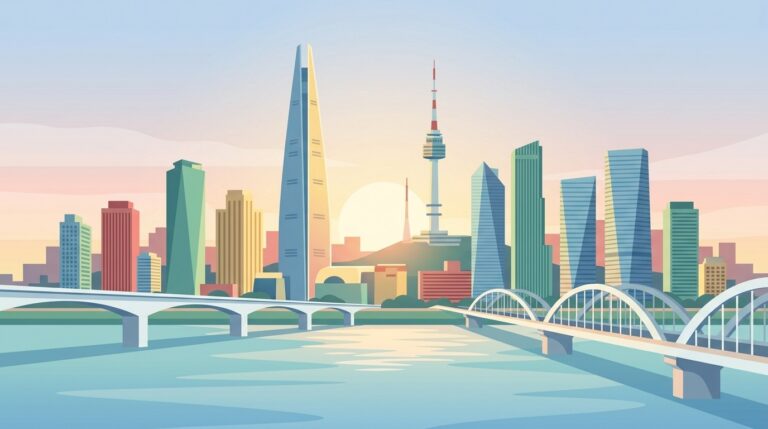
The Miracle on the Han River: How Korea Rebuilt from Ashes and What to Say About It
Phase 1: Empathy (Story-Driven Opening)
안녕하세요! 매일한글 에디터입니다. (Hello! This is your Daily Hangul editor.)
Picture this: You are standing on the balcony of an ultra-modern cafe in Mapo, Seoul, watching the subway glide smoothly across the bridge over the majestic Han River. Futuristic glass towers kiss the evening clouds, bullet trains hum quietly in the distance, and fast fiber-optic Wi-Fi powers everything around you. To an outsider, Seoul seems like it was born futuristic—a sci-fi utopia perfected over centuries.
Yet, if you ever sit down with an older Korean taxi driver, a homestay halmeoni (grandmother), or even chat with colleagues over dinner, you will notice a poignant nostalgia. They might glance at those gleaming bridges and whisper, “Back in my youth, there was nothing here but sand and rubble.” Many intermediate Korean learners tell us: “I know words like ‘economy’ and ‘development’, but when Koreans discuss their history, I feel lost. I don’t know how to speak respectfully about their past without sounding like a dry Wikipedia page!”
Understanding the “Miracle on the Han River” (한강의 기적) isn’t just a history lesson; it is the ultimate emotional key to decoding the Korean mindset. In this guide, designed from real feedback from intermediate (B2) learners, you will discover the exact idioms and cultural nuances needed to engage in profound, heart-to-heart conversations about Korea’s remarkable journey.
Phase 2: Core Expressions Deep Dive
1. 한강의 기적 (Hangang-ui gijeok)
- Pronunciation: [Han-gang-ui gi-jeok] (Sounds like Hahn-gahng-wee gee-juck)
- Meaning: The Miracle on the Han River (Literal: Han River’s Miracle | Nuance: Korea’s rapid post-war economic transformation against impossible odds)
- K-Culture Moment: You will hear this phrase constantly in Korean documentaries, political discourses, and period dramas like Giant or Ode to My Father (국제시장) whenever characters reflect on overcoming poverty.
- Editor’s Insight: Modeled after Germany’s “Miracle on the Rhine,” this phrase carries deep national pride. When you use this term with Koreans, it shows you respect the blood, sweat, and tears shed by the older generation.
- Situation Spectrum: Casual ⚠️ | Semi-formal ✅ | Formal ✅
- 🤔 Think About It: Does your native culture link major historical triumphs to a specific geographic landmark? Why do you think the Han River became the symbol of national rebirth?
2. 맨땅에 헤딩하다 (Maen-ttang-e he-ding-ha-da)
- Pronunciation: [Maen-ttang-e he-ding-ha-da] (Sounds like Men-tahng-eh heh-ding-hah-dah)
- Meaning: To start with nothing / To dive into an impossible task with pure grit (Literal: “To head-butt the bare ground like a soccer ball”)
- K-Culture Moment: In modern series like Itaewon Class or Start-Up, founders describe their gritty beginnings as 맨땅에 헤딩. It reflects how early Korean industrial pioneers built shipyards and car plants without capital or technology.
- Editor’s Insight: This is an indispensable B2-level idiom. It captures the relentless, stubborn determination (불굴의 의지) that drove Korea’s modernization.
- Situation Spectrum: Casual ✅ | Semi-formal ✅ | Formal ⚠️
- 🤔 Think About It: Is taking reckless risks praised or discouraged in your home culture? How does language reflect a society’s appetite for risk?
3. 격세지감 (Gyeok-se-ji-gam)
- Pronunciation: [Gyeok-se-ji-gam] (Sounds like Gyuk-seh-jee-gahm)
- Meaning: Astounded by how much times have changed (Literal: “Feeling as if an entire generation has elapsed”)
- K-Culture Moment: Think of Reply 1988 (응답하라 1988), where the characters visit rural Gangnam in the 1980s. Today, Gangnam is the epitome of wealth—a senior stepping into modern Gangnam feels pure 격세지감.
- Editor’s Insight: This four-character idiom (사자성어) instantly elevates your Korean. Using it when comparing historical Seoul with modern Seoul will instantly impress native speakers.
- Situation Spectrum: Casual ⚠️ | Semi-formal ✅ | Formal ✅
- 🤔 Think About It: What rapid technological or social change in your own lifetime evokes this feeling of “gyeok-se-ji-gam” for you?
Phase 3: Textbook Korean vs. Real Korean
Situation 1: Describing the pace of national growth
- 📖 Textbook Korean: 한국은 지난 반세기 동안 급격한 경제 발전을 이루었습니다. (Hanguk-eun jinan bansegi dongan geupgyeokan gyeongje baljeon-eul irueosseumnida. / Korea achieved rapid economic development over the past half-century.)
- 🗣️ Real Korean: 한국 발전 속도는 진짜 말도 안 되게 빨라요. (Hanguk baljeon sokdoneun jinjja maldo an doege ppallayo. / The speed of Korea’s development is honestly unreal.)
- 💡 Why is it different? The textbook phrasing sounds like an economics textbook citation. In daily conversation, native Koreans express their awe using emotional boosters like “말도 안 되게” (unbelievably / insanely).
Situation 2: Talking about the sacrifices of the older generation
- 📖 Textbook Korean: 이전 세대의 헌신적인 노력이 있었습니다. (Ijeon sede-ui heonsinjeogin noryeog-i isseosseumnida. / There was sacrificial effort from previous generations.)
- 🗣️ Real Korean: 우리 할머니, 할아버지 세대가 뼈 빠지게 일하셨죠. (Uri halmeoni, harabeoji sedega ppyeo ppajige ilhasyeotjyo. / Our grandparents’ generation worked their bones off to build this country.)
- 💡 Why is it different? While “헌신” (devotion) is proper, “뼈 빠지게 일하다” (to work so hard one’s bones give out) expresses visceral, human empathy for the physical hardship workers endured in factories and construction sites.
Phase 4: K-Culture Deep Dive & Non-Verbal Manners
4-1. Nunchi & Respectful Posture
When historical topics arise—especially the Korean War or the poverty of the 1960s—tone of voice matters. Koreans don’t view this as distant history; for anyone over 60, it was their childhood.
* Attentive Listening (경청): Rest your hands gently on your lap or keep them clasped lightly on the table. Avoid leaning back or crossing your arms, which signals arrogance or disinterest.
* The Empathetic Nod: Slowly nod while murmuring respectful acknowledgments like “정말 고생 많으셨겠어요” (Jeongmal gosaeng maneusyeotgesseoyo / They must have endured so much).
4-2. Cultural Code Analysis: The Gangnam Transformation
Did you know that until the 1970s, the world-famous Gangnam district was mostly cabbage fields and pear orchards? In films like Gangnam 1970 (강남 1970), you see how development policies transformed the south of the river into a hub of prestige almost overnight. This lightning growth created a unique societal psychology: a relentless drive for efficiency, educational obsession, and the famous “ppalli-ppalli” (hurry-hurry) culture.
Phase 5: Real-Life Roleplay Scenario
Setting: Alex is riding in a taxi crossing the Mapo Bridge at dusk. The driver, Mr. Park (72), glances at the towering financial buildings of Yeouido.
- Mr. Park: 허허, 여기 올 때마다 참 신기해요. 나 어릴 땐 여의도에 모래펄밖에 없었거든. (Heoheo, yeogi ol ttaemada cham singihaeyo. Na eoril ttaen Yeouido-e morapeulbakke eopseotgeodeun.)
🎭 Gazes fondly out the window at the skyline.
(Haha, every time I come here, it feels surreal. When I was a kid, Yeouido was nothing but sandflats.) -
Alex: 정말요? 여기가 전부 모래밭이었다고요? (Jeongmalyo? Yeogiga jeonbu moraebatieottagoyo?)
🎭 Leans forward slightly with genuine curiosity.
(Really? This whole area used to be just sand?) -
Mr. Park: 그럼요. 60년대에는 다들 먹고살기 바빠서 다리 하나 놓는 것도 큰일이었지. (Geureomyo. Yuksipnyeondaeeneun dadeul meokgosalgi bappaseo dari hana nonneun geotdo keunilieotji.)
🎭 Taps the steering wheel thoughtfully.
(Of course. In the 60s, everyone was struggling just to put food on the table, so building even one bridge was a monumental event.) -
Alex: 이 많은 빌딩을 다 지었다니, 정말 격세지감이네요. (I maneun bilding-eul da jieottani, jeongmal gyeokseji-gamineyo.)
🎭 Nods respectfully with an impressed expression.
(Building all these skyscrapers… it truly feels like stepping into a different epoch.) -
Mr. Park: 오, ‘격세지감’이란 말도 알아요? 한국말 아주 잘하네! (O, ‘gyeokseji-gam’-iran maldo arayo? Hangukmal aju jalhane!)
🎭 Smiles through the rearview mirror with delight.
(Oh, you know the word ‘gyeokseji-gam’? Your Korean is remarkably good!) -
Alex: 어르신들 세대가 맨땅에 헤딩하듯 일하셔서 지금의 한국이 있는 거잖아요. (Eoreusindeul sedega maenttange hedinghadeut ilhasyeoseo jigeum-ui hanguk-i inneun geojanhayo.)
🎭 Speaks warmly and sincerely.
(It’s because your generation built everything from scratch with pure grit that Korea thrives today.) -
Mr. Park: 그렇게 알아주니 고맙구만. 참 힘들었지만 보람은 있어. (Geureoke arajuni gomapguman. Cham himdeureotjiman boram-eun isseo.)
🎭 Chuckles warmly, feeling acknowledged.
(Thank you for recognizing that. It was tough as nails, but truly rewarding.) -
Alex: 덕분에 저희 같은 외국인도 편하게 여행하고 있습니다! (Deokbune jeohui gateun oeguk-indo pyeonhage yeohaenghago itseumnida!)
🎭 Smiles brightly as they pull up to the destination.
(Thanks to all that effort, even foreigners like us can travel here so comfortably!)
🔀 Interactive Branching Point
How would you respond if an elder tells you about Korea’s tough post-war days?
* Option A: “그래도 지금은 부자 나라니까 괜찮지 않아요?” (Geuraedo jigeumeun buja naranikka gwaenchanji anayo? / Well, isn’t it fine now since Korea is rich?)
* Feedback (Risk): Minimizes their painful lived experience. Sounds dismissive.
* Option B: “진짜 고생 많으셨네요. 어르신들의 노력 덕분인 것 같아요.” (Jinjja gosaeng maneusyeotneyo. Eoreusindeul-ui noryeok deokbun-in geot gatayo. / You must have gone through so much hardship. It is truly thanks to your generation’s efforts.)
* Feedback (Best!): Highly empathetic, respectful, and culturally validating.
* Option C: “옛날이야기는 너무 지루해요.” (Yennal-iyagineun neomu jiruhaeyo. / Old stories are so boring.)
* Feedback (Bad): Extremely rude; breaks social decorum completely.
Phase 6: 10-Second Emotion Shadowing Drill
Practice these pauses (/) and emotional cues to master natural, intermediate intonation:
[😲 Genuine admiration with a respectful tone]
“아무것도 없던 시절부터 / 이렇게 발전했다니 / 정말 대단해요.”
(Amugeotdo eopdeon sijeolbuteo / ireoke baljeonhaettani / jeongmal daedanhaeyo.)
(From a time when there was nothing / to develop like this / is truly astonishing.)-
[🤔 Thoughtful and deeply impressed]
“옛날 사진을 보니까 / 진짜 격세지감이 / 느껴지네요.”
(Yennal sajin-eul bonikka / jinjja gyeokseji-gami / neukkyeojineyo.)
(Looking at historical photos / I truly feel / how astonishingly the era has changed.) -
[💪 Resolute and inspired]
“그 시절에는 다들 / 맨땅에 헤딩하는 마음으로 / 도전하셨군요.”
(Geu sijeol-eneun dadeul / maenttange hedinghaneun ma-eum-euro / dojeonhasyeotgunyo.)
(In those days / everyone must have tackled challenges / with sheer raw grit.)
Phase 7: K-Culture Mini Dictionary
- 압축 성장 (Apchuk seongjang) | Compressed Growth
- What took Western nations 200 years during the Industrial Revolution, Korea pulled off in less than 40 years. You will encounter this term in news articles, business reports, and podcasts analyzing Korea’s development.
- 보릿고개 (Boritgogae) | The Barley Hump (Spring Hunger Gap)
- Historically, the difficult spring period when stored rice had run out but winter barley had not yet ripened. Elders often use this metaphor to represent severe poverty: “보릿고개를 넘다” (to survive destitution).
- 새마을 운동 (Saemaeul undong) | The New Village Movement
- The nationwide community-driven modernization initiative launched in 1970 to modernize rural infrastructure. Its iconic green cap and motto “근면, 자조, 협동” (Diligence, Self-Help, Cooperation) remain historic symbols.
- 빨리빨리 문화 (Ppallippalli munhwa) | ‘Hurry-Hurry’ Culture
- While often critiqued today as a source of modern stress, this relentless speed culture originally emerged as an urgent survival mechanism to rebuild national infrastructure and boost export manufacturing overnight.
Phase 8: Traveler’s Survival Kit
Survival Phrases TOP 3
- 여기가 예전에는 어떤 곳이었어요?
- Yeogiga yejeoneneun eotteon gosieosseoyo?
- Pro Tip: Ask this at historical tourist sites or traditional markets to spark delightful historical anecdotes from local shop owners.
- 서울 야경이 한눈에 내려다보이네요.
- Seoul yagyeong-i hannune naeryeodaboineyo.
- Pro Tip: Use this at N Seoul Tower or Lotte World Tower to transition gracefully into discussing Seoul’s architectural journey.
- 대한민국 역사박물관이 어디예요?
- Daehanminguk yeoksabangmulgwani eodiyeyo?
- Pro Tip: Ask this in Gwanghwamun to locate Korea’s premier contemporary history museum.
Editor’s Travel Note
- Must-Visit Gem: Make time for the rooftop garden at the National Museum of Korean Contemporary History right in front of Gyeongbokgung. The museum exhibits trace Korea from post-war black-and-white poverty to the semiconductor powerhouse of today.
- Local Navigation Tip: Google Maps has limited walking functionality in Korea. Use the Naver Map app download guide to save subway lines and locate riverside historical markers without getting lost.
Phase 9: “One Step Deeper” (Reflective Essay)
Korea’s economic miracle was not merely a miracle of corporate ledgers and steel mills; it was forged within the hearts of ordinary citizens who endured overwhelming sacrifice. Yet, this high-octane transformation also created the modern hyper-competitive landscape (경쟁 사회) and deep demographic pressures we observe in Korea today. When we study the phrase “한강의 기적,” we are looking at both the brilliance of human endurance and the profound sociological price paid for lightning speed.
💬 Your Turn: Has your home country experienced a period of dramatic modernization, and how do younger and older generations view those changes differently? Share your thoughts in the comments below!
Phase 10: FAQ & Avoiding Misunderstandings
Q: Is it polite to bring up Korea’s past poverty with seniors?
A: Yes, provided your perspective is rooted in admiration and respect rather than pity. Elders are deeply proud that Korea elevated itself from receiving foreign aid to becoming a major international donor.
Q: Can I use “맨땅에 헤딩하다” in a job interview or formal speech?
A: In very formal speeches, opt for “무에서 유를 창조하다” (Mu-eseo yu-reul changjohada / creating something from nothing). However, in a job interview describing your grit and problem-solving resilience, using “맨땅에 헤딩하듯 열정적으로 도전했습니다” can sound proactive and endearing.
Q: Why do Koreans refer to this period specifically as the “Han River” miracle?
A: The Han River flows straight through the heart of the capital city, Seoul. As bridges, highways, and export factories sprouted along its banks, the river stood as the living witness to the nation’s resurgence.
🚨 Common Mistakes Alert
- Mistake: Assuming modern Korea was always wealthy.
- Correct Action: Acknowledge that as recently as the 1960s, Korea’s GDP was on par with the poorest nations. Emphasize their remarkable hard work.
- Mistake: Calling the post-war era “Joseon era” (조선시대).
- Correct Action: Joseon ended in 1910. Refer to post-war history as “근현대사” (modern and contemporary history) or “전후 복구 시기” (post-war reconstruction era).
- Mistake: Dropping honorifics when asking seniors about their past.
- Correct Action: Always employ the honorific infix
-시-, saying “일하셨어요?” rather than “일했어요?”.
- Correct Action: Always employ the honorific infix
Phase 11: Action Missions
- 🥉 Bronze Mission (Solo Practice): Shadow the 3 drill sentences in Phase 6 three times each in front of your mirror, adjusting your facial expressions to match the emotion tags.
- 🥈 Silver Mission (Social Media): Post a photo of your favorite Seoul landmark or a historical Korean photo with the hashtag
#한강의기적and write one Korean sentence using 격세지감. - 🥇 Gold Mission (Real-World Chat): During your next ride with a Korean taxi driver or conversation with a language partner, ask: “여기가 예전이랑 많이 달라졌죠?” (Has this place changed a lot compared to before?) and listen carefully to their response.
- 🎮 K-Culture Mission: Watch the opening 20 minutes of the celebrated movie Ode to My Father (국제시장) and spot how families survived post-war challenges.
Phase 12: Interactive Quiz Challenge
1. Situational Judgment:
You are talking to an older Korean mentor who recounts how they worked 14-hour days in the 1970s to put their younger siblings through school. What is the most culturally empathetic reply?
* A) 요즘도 다들 그렇게 일해요. (Nowadays everyone works like that too.)
* B) 어르신 세대의 헌신 덕분에 지금의 대한민국이 있네요. (Thanks to the dedication of your generation, Korea is where it is today.)
* C) 너무 비효율적으로 일하셨네요. (You worked so inefficiently back then.)
2. Fill-in-the-Blank:
자본도 기술도 없이 스타트업을 시작해서 정말 [ __________ ] 기분이었어요.
(Starting a startup with neither capital nor technology, it really felt like head-butting the bare ground.)
3. True or False:
Gangnam was always the wealthiest and most developed center of Seoul since the Joseon Dynasty. (True / False)
👉 Click to reveal answers and explanations
- Answer: B — Validating the elder’s sacrifice with genuine honor and appreciation creates an immediate, heartfelt connection.
- Answer: 맨땅에 헤딩하는 — The idiom 맨땅에 헤딩하다 denotes taking on enormous challenges from absolute zero through pure grit.
- Answer: False — Gangnam was largely agricultural land until major government development projects transformed it starting in the 1970s.







