

Phase 1: 공감 (스토리 몰입형 오프닝)
안녕하세요! 매일한글 에디터입니다.
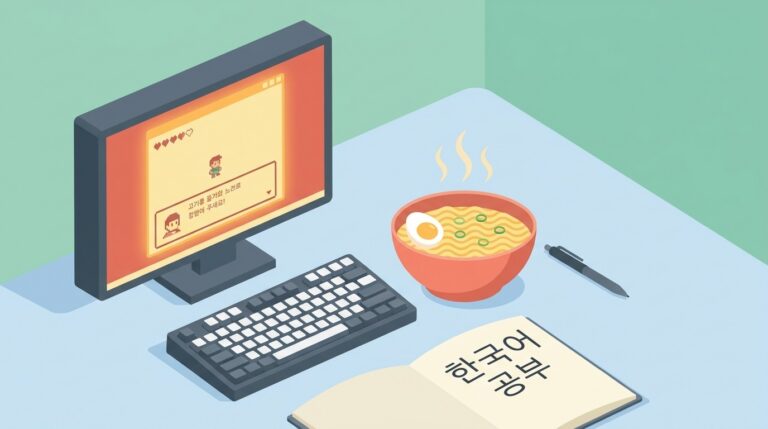
Picture this: You step into a neon-lit PC Bang in the bustling streets of Hongdae. Rows of high-end curved monitors glow softly in the dimmed room while mechanical keyboards click and clatter at lightning speed. You came in just to print a train ticket or kill an hour playing a quick game. But the moment you take your seat, your senses are ambushed not by stale dust or cold tech, but by an intoxicating aroma—sizzling scallions, savory broth, and rich, melted cheese.
Wait, is this a gaming den or a gourmet noodle restaurant?
In modern Korea, we affectionately call it a “PC-taurant” (PC방 + 레스토랑). PC bangs boast elaborate kitchen setups serving customized gourmet ramyeon that rivals traditional snack bars. Yet, when sitting in front of that sleek desktop screen, many international friends freeze up. The on-screen food delivery menu pops up completely in Korean, packed with custom topping options, shorthand slang, and payment steps. You want that steaming bowl of spicy noodles with an egg and melted cheese, but you end up nervously sipping canned iced tea because you didn’t know which button to click or what to say to the staff.
Don’t let ordering anxiety keep you hungry! Over the past decade as a cultural navigator, I have guided hundreds of Korean learners through this exact cultural landscape. By learning just a handful of authentic intermediate phrases, you will transform an intimidating digital interface into your personal midnight feast. Let’s level up your Korean together!
Phase 2: 핵심 표현 3선 심층 분석
1. 라면에 계란 추가해 주세요 (Ramyeon-e gyeran chugahae juseyo)
- Pronunciation: Rah-myeon-eh gyeh-ran choo-gah-hae joo-seh-yo (Think of “chew-gah” like chewing gum with an ‘ah’ at the end).
- Meaning: Direct: “Please add an egg to the ramyeon.” | Nuance: “Could you customize my ramyeon with an egg, please?”
- K-Culture Moment: In Korean variety shows and gaming streams, you will always hear streamers say this right before kicking off a late-night tournament.
- Editor’s Insight: The noun 추가 (chuga – addition/add-on) combined with -해 주세요 is a magic formula across Korea. You can use it at barbecue restaurants for extra lettuce or at trendy cafes for extra espresso shots.
- Situation Spectrum: Casual: ⚠️ (라면에 계란 추가해 줘) | Semi-formal: ✅ | Formal: ✅ (라면에 계란 추가해 주시겠습니까?)
- 🤔 Think About It: In many Western diners, custom orders come with endless questions about cooking style. Why do you think Korean food ordering prioritizes quick, pre-set add-ons like ‘계란 추가’?
2. 자리에서 주문할게요 (Jari-eseo jumunhalgeyo)
- Pronunciation: Jah-ree-eh-suh joo-moon-hal-geh-yo (Rhymes with the Italian word “allegro” on the tail sound ‘-geyo’).
- Meaning: Direct: “I will order from the seat.” | Nuance: “I’ll place my order through the desktop interface rather than at the front counter.”
- K-Culture Moment: When checking in at a PC bang front desk, the attendant might ask if you need food. Saying this shows you are a savvy, tech-literate regular.
- Editor’s Insight: The grammar ending -(으)ㄹ게요 conveys your gentle, immediate intention to the listener without sounding blunt or demanding.
- Situation Spectrum: Casual: ⚠️ (자리에서 주문할게) | Semi-formal: ✅ | Formal: ✅ (자리에서 주문하겠습니다)
- 🤔 Think About It: How does ordering from your private screen reflect Korea’s unique cultural value of friction-free service and personal space?
3. 여기 완전 라면 맛집인데요? (Yeogi wanjeon ramyeon matjib-inde-yo?)
- Pronunciation: Yeo-gee wahn-jeon rah-myeon maht-jeeb-een-deh-yo?
- Meaning: Direct: “Is this place completely a ramyeon restaurant?” | Nuance: “Wow, this place makes ramyeon better than actual specialty restaurants!”
- K-Culture Moment: Often said with genuine shock in food vlogs when a gamer takes their first bite of PC bang noodles topped with scallions and sesame oil.
- Editor’s Insight: 맛집 (matjib – famous/delicious eatery) was once reserved for legendary culinary institutions, but modern Koreans use it playfully for anywhere serving unexpectedly delicious food.
- Situation Spectrum: Casual: ✅ | Semi-formal: ✅ | Formal: 🚫 (Too conversational for strict business etiquette)
- 🤔 Think About It: What does turning unexpected venues into “맛집” tell us about Korean food appreciation in daily life?
Phase 3: 교과서 한국어 vs 진짜 한국어
Situation 1: Asking if desktop ordering is supported
- 📖 교과서 한국어: “컴퓨터로 음식을 주문할 수 있습니까?” (Keompyuteo-ro eumsig-eul jumunhal su itseumnikka?)
- 🗣️ 진짜 한국어: “자리에서 음식 주문 되나요?” (Jari-eseo eumsik jumun doenayo?)
- 💡 왜 다를까? Textbooks teach rigid passive constructions like ‘-ㄹ 수 있습니까?’. Real Koreans ask “되나요?” (Does it work? / Is it possible?) to sound friendly, modern, and concise.
Situation 2: Asking how long your food order will take
- 📖 교과서 한국어: “음식이 언제 완성됩니까?” (Eumsig-i eonje wanseongdoemnikka?)
- 🗣️ 진짜 한국어: “라면 나오는 데 얼마나 걸려요?” (Ramyeon naoneun de eolmana geollyeoyo?)
- 💡 왜 다를까? Words like 완성되다 (to be completed) sound like a construction project. Using “나오는 데” (in coming out) reflects how food physically arrives at your table.
Phase 4: K-Culture 딥다이브 & 비언어적 매너
4-1. 눈치(Nunchi) & Gaming Etiquette
- Discreet Delivery: When the part-time worker (알바생) brings your steaming noodle tray, they will slide it carefully next to your mousepad so they don’t block your screen during combat.
- The Head-Nod Acknowledgment: Never yell out your thanks. Give a polite 15-degree bow of the head with a soft “감사합니다” (Gamsahamnida) while keeping your eyes near your screen.
- Tray Return Culture: Always scan the environment. Look for the sign that says ‘퇴식구’ (toesikgu – tray return shelf). If the sign says ‘자리에 두고 가세요’ (Please leave it at your seat), leave it neatly stacked for the staff.
4-2. Cultural Code: The Rise of the ‘PC-taurant’
In the early 2000s, PC bangs offered pre-packaged cup ramyeon with hot water dispensers. But fierce market competition transformed them into full culinary operations equipped with industrial fryers, induction burners, and custom sauce recipes. Famous chains now hire recipe developers to engineer dishes like 짜계치 (Chapagetti + Egg + Cheese) specifically tuned to enhance the dopamine rush of winning a match.
Phase 5: 실전 롤플레이 시나리오
- Setting: A cozy, modern PC Bang in Sinchon.
- Characters: You (B1 Korean Learner) & Min-woo (Friendly PC bang staff).
- 민우: 어서 오세요! 몇 번 자리 앉으실 건가요? (Eoseo oseyo! Myeot beon jari anjeusil geon-gayo? / Welcome! Which seat will you take? / 🎭 Wiping down the counter and smiling warmly)
- You: 저기 24번 자리 앉을게요. 혹시 자리에서 주문 되나요? (Jeogi isip-sabeon jari anjeulgeyo. Hoksi jari-eseo jumun doenayo? / I will take seat 24 over there. Can I order food directly from the seat? / 🎭 Pointing toward an empty corner monitor)
- 민우: 네! 로그인하시고 화면 오른쪽 위 ‘먹거리 주문’ 누르시면 돼요. (Ne! Rogeu-in-hasigo hwamyeon oreunjjok wi ‘meokgeori jumun’ nureusimyeon dwaeyo. / Yes! Just log in and click ‘Order Food’ on the top right of your screen. / 🎭 Miming a double-click gesture with his hand)
- You: 감사합니다! 라면에 계란 추가도 가능한가요? (Gamsahamnida! Ramyeon-e gyeran chugado ganeunghangayo? / Thank you! Is it also possible to add an egg to the ramyeon? / 🎭 Looking interested while holding a payment card)
- 민우: 당연하죠! 옵션에서 치즈나 계란 반숙 다 고르실 수 있어요. (Dangyeonhajyo! Opsyeon-eseo chijeu-na gyeran bansuk da goreusil su isseoyo. / Of course! You can choose toppings like cheese or soft-boiled egg in the option menu. / 🎭 Giving an enthusiastic nod)
- You: 우와, 여기 완전 라면 맛집인데요? 바로 주문할게요! (Uwa, yeogi wanjeon ramyeon matjib-inde-yo? Baro jumunhalgeyo! / Wow, this place is totally a gourmet ramyeon spot! I will order right away! / 🎭 Eyes lighting up in anticipation)
- 민우: 하하, 저희 짜계치도 인기 많으니까 한번 드셔보세요! (Haha, jeohi jjagyechi-do ingi maneunikka hanbeon deusyeoboseyo! / Haha, our Jjagyechi is also super popular, so give it a try sometime! / 🎭 Chuckling warmly as he prints a computer pass)
- You: 네, 추천 감사해요! 맛있게 만들어 주세요. (Ne, chucheon gamsahaeyo! Mas-itge mandeureo juseyo. / Thank you for the recommendation! Please make it delicious. / 🎭 Giving a friendly bow and walking toward the PC station)
🔀 인터랙티브 분기점: The Food Has Arrived!
Min-woo brings your steaming tray while you are in the middle of a tense digital match. What do you do?
- Option A: Gently slide your keyboard back, nod respectfully, and whisper: “감사합니다! 잘 먹겠습니다.” (Gamsahamnida! Jal meokgetseumnida.)
- Feedback: [Best! ⭐⭐⭐] Perfect balance of gaming focus and traditional Korean courtesy. Staff love this!
- Option B: Loudly wave your hand and say: “거기 그냥 대충 두고 가요!” (Geogi geunyang daechung dugo gayo! / Just leave it roughly over there!)
- Feedback: [Bad! ❌] Extremely rude. It ruins the quiet atmosphere and discredits your Korean manners.
- Option C: Say nothing, ignore the staff completely, and snatch the chopsticks immediately.
- Feedback: [Risk! ⚠️] While gamers are often busy, total silence comes off as dismissive and cold.
Phase 6: 10초 감정 섀도잉 드릴
- [😋 기대감과 배고픔을 담아] 라면에 / 계란 추가해 주세요! (Ramyeon-e / gyeran chugahae juseyo!)
- [💡 공손하고 차분하게] 자리에서 / 음식 주문 / 되나요? (Jari-eseo / eumsik jumun / doenayo?)
- [🤩 깜짝 놀라며 유쾌하게] 와, / 여기 완전 / 라면 맛집인데요? (Wa, / yeogi wanjeon / ramyeon matjib-inde-yo?)
Phase 7: K-Culture 미니 사전 (핵심 키워드 4개)
- PC토랑 (PC-taurant) | [Noun] A blend of “PC방” and “레스토랑”. Refers to modern internet cafes known more for gourmet food menus than gaming.
- 꿀조합 (Ggul-johap) | [Noun] Literally “honey combination”. Refers to the ultimate food topping pairing, such as instant noodles with aged kimchi and American cheese.
- 짜계치 (Jjagyechi) | [Noun] The holy trinity of PC bang comfort meals: Chapagetti (black bean noodles) + Gyeran (fried egg) + Chijeu (cheddar cheese).
- 선불 / 후불 (Seonbul / Hubul) | [Noun] Prepaid / Postpaid. Crucial terminology when buying PC computer hours and food orders at the digital kiosk.
Phase 8: 여행자를 위한 생존 키트
서바이벌 표현 TOP 3
- 물은 셀프인가요? (Mul-eun selpeu-in-gayo? / Is water self-service?)
- Pro Tip: Most PC bangs have a filtered water cooler (정수기) in the corner. Bring your own cup or use paper cone cups.
- 계산은 나갈 때 하나요? (Gyesan-eun nagal ttae hanayo? / Do I pay when I leave?)
- Pro Tip: Clarifies whether your food order was added to your computer tab (후불) or charged upfront.
- 빈 그릇은 어디에 둬요? (Bin geureus-eun eodie dwoyo? / Where do I place the empty tray?)
- Pro Tip: Ask this if you cannot spot the tray drop-off rack.
Editor’s Travel Note
- Finding the Best PC-taurants: Look up neighborhood spots using the [네이버 지도 앱 다운로드 (Naver Map App Download)]. Search for “PC방 맛집” to find locations with verified food review ratings.
- Payment Systems: While ordering interfaces accept Korean domestic pay apps, international credit cards occasionally fail on older desktop software. Keep 10,000 KRW in paper cash to load into the kiosk machine upon entry.
Phase 9: “한 발 더 깊이” (생각 질문)
In Western cultures, public spaces are often divided sharply into functional zones: a library for quiet study, a diner for eating, and an arcade for gaming. The Korean PC bang, however, evolved into an all-in-one sanctuary—a modern “third space” where convenience (빨리빨리), communal comfort, and culinary cravings intersect harmoniously. It shows how Korean society continuously redefines spaces to maximize speed, hospitality, and comfort.
💬 Your Turn: Have you ever eaten a full meal while gaming or studying? What is your dream comfort food combination to try at a Korean PC bang? Leave a comment below and practice your Korean with us!
Phase 10: FAQ & 오해 방지 (FAQ Schema)
Q: Can non-Korean tourists use a PC bang without a Korean resident registration number (주민등록번호)?
A: Yes! Most modern kiosks offer a “비회원” (Guest / Non-member) login option. Simply select English on the kiosk screen, choose your desired hours, and pay with cash or a credit card to receive a printed login slip.
Q: Is tipping required when the PC bang staff brings food directly to my desk?
A: No. Tipping does not exist in Korean culture. A polite, gentle verbal greeting (“감사합니다”) or a brief nod is the standard and most respectful expression of gratitude.
Q: Can I bring outside takeout food into a Korean PC bang?
A: In general, no. Because modern PC bangs operate as registered food service establishments, bringing outside fast food or drinks is strictly discouraged or prohibited.
🚨 흔한 실수 (Common Mistakes) 경고판
- Yelling across the room to place an order.
- Correct Action: Never shout. Always click the on-screen “먹거리 주문” button to submit your order digitally.
- Leaving trash on the floor.
- Correct Action: Place all wrappers and beverage cans neatly on your tray before leaving.
- Using informal Korean (반말) with younger part-time workers.
- Correct Action: Even if the staff appears young, always use polite 존댓말 (-요 / -습니다).
Phase 11: 액션 미션 & 참여 유도
- 🥉 Bronze Mission: Read aloud the 3 core phrases from Phase 2 three times each, matching the speed of the shadowing drill.
- 🥈 Silver Mission: Share a photo of your favorite ramyeon or desk snack on social media using the sentence: “여기도 라면 맛집이에요!”
- 🥇 Gold Mission: Visit a Korean snack bar or PC bang, walk up with confidence, and customize your noodles with “라면에 계란 추가해 주세요!”
- 🎮 K-Culture Mission: Watch an episode of a Korean variety show (like Hangout with Yoo or I Live Alone) and spot how celebrities order food at PC bangs!
Phase 12: 인터랙티브 퀴즈 챌린지
- [Situational Judgment] You sit at a computer and want to order ramyeon through the desktop program. What do you say to the staff if asking for help?
- A) 라면 지금 당장 만들어 와.
- B) 자리에서 음식 주문 어떻게 하나요?
- C) 저기요, 밥 먹으러 왔는데요?
- [Fill-in-the-Blank] Complete the sentence to ask for extra cheese:
- 라면에 치즈 ________해 주세요. (힌트: addition)
- [True or False] In Korea, the phrase ‘맛집’ can only be used for Michelin-star restaurants or historical diners.
Click to reveal answers & explanations!
- 정답: B) 자리에서 음식 주문 어떻게 하나요?
- Explanation: Option B is natural and polite intermediate Korean. Option A is rude informal speech, and Option C sounds overly confrontational.
- 정답: 추가 (chuga)
- Explanation: 추가 means ‘addition’, making the full sentence “라면에 치즈 추가해 주세요” (Please add cheese to the ramyeon).
- 정답: False!
- Explanation: ‘맛집’ is widely used as a playful compliment for any place that serves top-tier food, including PC bangs and convenience stores!
- Explanation: ‘맛집’ is widely used as a playful compliment for any place that serves top-tier food, including PC bangs and convenience stores!







