Phase 1: Empathy (Immersive Story Opening)
안녕하세요! 매일한글 에디터입니다. (Hello! It’s your Daily Hangul editor.)
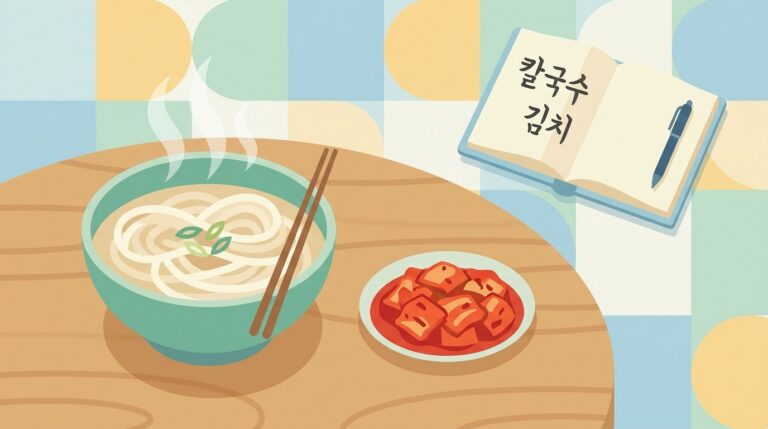
Picture this: It is a chilly, drizzly afternoon in Seoul. You step through sliding glass doors into an unassuming neighborhood restaurant tucked inside an alley in Jongno. The glass is completely steamed up, and the air smells intoxicatingly rich with deep anchovy and kelp broth. You order a piping hot bowl of Kalguksu (칼국수, knife-cut noodles). Moments later, a steaming porcelain bowl arrives next to a small, glistening dish of fiery red Geotjeori (겉절이, freshly tossed unfermented kimchi).
You take a bite of the noodles, followed by a crunch of that fresh kimchi, and your mind is blown. It’s crunchy, spicy, garlicky, and naturally sweet—nothing like the aged, sour kimchi you bought back home. But here comes the dilemma: you’ve devoured your tiny dish of geotjeori before finishing even half of your noodles! You look around nervously. Should you walk up to the kitchen? Do you yell out to the busy restaurant auntie (Imo)? How do you ask for more of this specific fresh kimchi without sounding rude or like you’re demanding extra free food?
If you’ve ever felt frozen in a bustling Korean noodle joint, wondering whether slurping is allowed or how to ask for refills like an insider, you are not alone! Based on feedback from hundreds of intermediate learners in our Daily Hangul community, navigating authentic dining etiquette is one of the biggest hurdles when trying to break out of the tourist bubble. Today, we are breaking down everything you need to know about the holy grail of Korean noodle combinations: Kalguksu and Geotjeori.
Phase 2: Core Expressions Deep Dive
1. 면이 쫄깃쫄깃해요 (Myeoni jjolgit-jjolgit-haeyo)
- Pronunciation: [Myeon-i jjol-git-jjol-git-hae-yo] (Think of the snappy ‘jj’ sound like the tight ‘ck’ click in “quick clip”, followed by a bouncy bounce rhythm!)
- Meaning: Literal: “The noodles are chewy-chewy.” / Actual Nuance: “These noodles have the perfect artisanal bite and springy texture!”
- K-Culture Moment: In food reality shows like Baek Jong-won’s Alley Restaurant, this is the exact compliment masters beam over when evaluating handmade knife-cut dough.
- Editor’s Insight: Korean has rich onomatopoeia and mimetic words (uiseong-eo and uitae-eo). While jjolgit-jjolgit denotes delicious chewiness, using jilgida (질기다) means tough or rubbery like leather. Don’t mix them up!
- Situation Spectrum: Casual: ✅ | Semi-formal: ✅ | Formal: ⚠️
- 🤔 Think About It: In Western dining, pasta aims for al dente (firm to the bite). How does jjolgit—which values elasticity and bounce—reflect Korean culinary appreciation for tactile mouthfeel?
2. 겉절이 좀 더 주실 수 있나요? (Geotjeori jom deo jusil su innayo?)
- Pronunciation: [Geot-jeo-ri jom deo ju-sil su in-na-yo] (Pronounce ‘Geot’ like “gut” with a soft ‘t’, and flow ‘ri’ into ‘jom’ smoothly.)
- Meaning: Literal: “Can you give a little more geotjeori?” / Actual Nuance: “Excuse me, could we please get a refill on this delicious fresh kimchi?”
- K-Culture Moment: Often heard in family-style dramas where characters flock to local comfort food spots after a hard day’s work and bond over shared banchan.
- Editor’s Insight: Inserting “좀” (jom – a little) is the linguistic magic wand of Korean politeness. It acts as a verbal cushion so your request never feels demanding.
- Situation Spectrum: Casual: ⚠️ | Semi-formal: ✅ | Formal: ✅
- 🤔 Think About It: In many Western countries, extra condiments or salads carry a surcharge. What does the Korean habit of asking comfortably for refills reveal about hospitality and Jeong (정)?
3. 국물이 시원하고 칼칼해요 (Gungmuri siwonhago kalkalhaeyo)
- Pronunciation: [Gung-mu-ri si-won-ha-go kal-kal-hae-yo] (Remember: ‘kuk-mul’ assimilates phonetically into ‘gung-mul’!)
- Meaning: Literal: “The broth is cool and spicy-throated.” / Actual Nuance: “The soup is deeply revitalizing, crisp, and has a pleasant peppery kick!”
- K-Culture Moment: Classic variety show trope: a foreigner takes a sip of boiling red soup, hears Koreans say “Ah, so cool (시원하다)!”, and checks if the stove was turned off in confusion.
- Editor’s Insight: Siwonhada here does not mean low temperature; it describes the sensation of warmth clearing your chest and digestive system. Pair it with kalkalhada (clean, sharp chili heat that hits the back of the throat without heaviness), and you sound like a true connoisseur.
- Situation Spectrum: Casual: ✅ | Semi-formal: ✅ | Formal: ✅
- 🤔 Think About It: Why does Korean vocabulary differentiate between heavy spicy (maepda), burning spicy (eol-eolhada), and crisp throat spicy (kalkalhada)?
Phase 3: Textbook Korean vs Real Korean
Situation 1: Calling for a Kimchi Refill
- 📖 교과서 한국어: “김치를 더 주실 수 있습니까?” (Gimchireul deo jusil su itsseumnikka?)
- 🗣️ 진짜 한국어: “사장님, 여기 겉절이 리필 좀 부탁드려요!” (Sajangnim, yeogi geotjeori ripil jom butakdeuryeoyo!)
- 💡 왜 다를까?: Textbook formulas rely heavily on stiff hasipnikka interrogatives. Real diners politely grab attention with “사장님” (boss/proprietor) and naturally slip in loanwords like “리필” (refill) combined with soft honorific requests.
Situation 2: Praising the Hand-Cut Dough
- 📖 교과서 한국어: “이 국수는 탄력이 있고 대단히 맛있습니다.” (I guksuneun tanryeogi itgo daedanhi masitseumnida.)
- 🗣️ 진짜 한국어: “와, 면발이 완전 살아있네요!” (Wa, myeonbari wanjeon sara-itneyo!)
- 💡 왜 다를까?: Saying “탄력이 있다” (possesses elasticity) sounds like a laboratory food-science report! Native speakers use dynamic, figurative phrases like “면발이 살아있다” (the noodles are truly alive) to praise fresh dough.
Phase 4: K-Culture Deep Dive & Non-verbal Manners
4-1. 눈치 (Nunchi) & Dining Table Gestures
- The ‘Self-Bar’ Radar: When your kimchi plate is empty, do not shout right away! Scan the restaurant for a sign saying 셀프 코너 (Self Corner) or 추가 반찬은 셀프 (Extra side dishes are self-serve). If you spot metal containers with tongs, take your empty dish and help yourself.
- The Polite Two-Hand Hold: When the staff brings a fresh bowl of geotjeori to your table, gently touch the rim or support the dish with both hands as they place it down, giving a slight nod. It signals respect and attentiveness.
- The Scissors Courtesy: If the staff serves whole leaves of geotjeori with metal kitchen shears, cut them into bite-sized segments for everyone at the table before digging in yourself.
4-2. Cultural Code: The Chemistry of Kalguksu & Geotjeori
Why do Koreans rarely serve mature, fermented sour kimchi (mugeunji) with kalguksu? Kalguksu broth—often made by boiling whole clams (bajirak), chicken, or dried anchovies with flour-dusted thick noodles—has a soothing, starchy, rich profile. Fermented kimchi would overpower this delicate starch with acidity. In contrast, Geotjeori is made by lightly salting fresh cabbage for just 20–30 minutes, then tossing it immediately with coarse red pepper powder, fragrant garlic, fish sauce, and a dash of plum syrup or starch paste. The sweet, juicy crunch cuts straight through the warm, doughy noodles. It is an intentional balance of temperature, crunch, and umami.
Phase 5: Real-World Roleplay Scenario
Setting: An old, bustling Kalguksu shop near Euljiro 3-ga. Steam billows from large stainless steel vats. You are sitting at a communal wooden table.
Characters:
* Min (You): An intermediate Korean learner on a solo food excursion.
* Imo (Restaurant Owner / Auntie): Energetic, affectionate, wearing a flowery apron.
- 이모: 어서 와요! 칼국수 하나 주면 돼요? (Eoseo wayo! Kalguksu hana jumyeon dwaeyo?)
- 🎭 Wiping down the tabletop briskly and setting down a metal cup with ice water.
- “Welcome! One bowl of kalguksu for you?”
- 민: 네, 이모님! 바지락 칼국수로 한 그릇 부탁드려요. (Ne, imonim! Bajirak kalguksuro han geureut butakdeuryeoyo.)
- 🎭 Smiling politely with palms resting on lap.
- “Yes, auntie! One bowl of clam kalguksu, please.”
- 이모: 그래요, 금방 삶아 줄 테니까 김치 먼저 맛보고 있어! (Geuraeyo, geumbang salma jul tenikka kimchi meonjeo matbogo isseo!)
- 🎭 Slides a small ceramic dish of glistening, bright red geotjeori onto the table.
- “Alright, I’ll boil it up in no time, go ahead and taste the kimchi first!”
- 민: 와, 배추가 아삭아삭하고 양념이 정말 맛있네요. (Wa, baechuga asak-asak-hago yangnyeomi jeongmal masitneyo.)
- 🎭 Taking a bite with chopsticks, eyes widening with genuine delight.
- “Wow, the cabbage is so crisp and the seasoning is delicious.”
- 이모: 매일 아침 내가 직접 버무리는 거야! 자, 뜨거우니까 조심해요. (Maeil achim naega jikjeop beomurineun geoya! Ja, tteugeounikka josimhaeyo.)
- 🎭 Carefully places a massive steaming bowl filled with clams, zucchini ribbons, and thick noodles.
- “I toss it by hand every morning! Here, watch out, it’s very hot.”
- 민: 잘 먹겠습니다! 국물이 진짜 시원해요. 면발도 엄청 쫄깃하고요. (Jal meokgetseumnida! Gungmuri jinjja siwonhaeyo. Myeonbaldo eomcheong jjolgit-hagoyo.)
- 🎭 Taking a spoonful of broth first, then slurping up a generous chopstick-full of noodles.
- “Thank you for the meal! The broth is so refreshing. And the noodles are so chewy.”
- 민: 저, 이모님! 김치를 다 먹었는데 혹시 리필 되나요? (Jeo, imonim! Gimchireul da meogeonneunde hoksi ripil doenayo?)
- 🎭 Holding up the clean kimchi plate slightly with both hands while making polite eye contact.
- “Excuse me, auntie! I finished the kimchi, can I possibly get a refill?”
- 이모: 당연하지! 맛있게 잘 먹으니까 한 접시 듬뿍 더 줄게. (Dang-yeonhaji! Masitge jal meogeunikka han jeopsi deumpuk deo julge.)
- 🎭 Beams proudly, scooping up a generous pile of fresh geotjeori with tongs.
- “Of course! Seeing you eat with such joy makes me want to give you a whole mountain of it.”
🔀 Interactive Decision Branch
What would you say if the restaurant is packed and you aren’t sure whether you should go get the kimchi yourself?
* Choice A: “이모, 김치 더 가져다 줘요!” (Imo, kimchi deo gajyeoda jwoyo! – Bring me more kimchi!)
* ❌ Feedback (Bad): Too blunt and commanding. Dropping polite honorific particles can sound abrasive and rude to older owners.
* Choice B: (Saying nothing, walking into the private kitchen area to find kimchi containers).
* ⚠️ Feedback (Risk): Never step inside the preparation kitchen! Kitchen floors are slick with boiling water and hot pans. Always check the customer dining area first.
* Choice C: “이모님, 반찬 셀프인가요, 아니면 더 주시나요?” (Imonim, banchan selpeuingayo, animyeon deo jusinayo?)
* 🏆 Feedback (Best): Shows impeccable Nunchi! It clarifies whether it’s self-serve without inconveniencing a busy owner.
Phase 6: 10-Second Emotional Shadowing Drill
Train your intonation and rhythm like a native speaker! Pay attention to pauses (/) and emotional tone cues.
[😋 감탄하며 입맛 다시듯이 - Savoring and admiring]- 국물이 / 진짜 시원하고 / 칼칼하네요! (Gungmuri / jinjja siwonhago / kalkalhaneyo!)
[🙏 상냥하고 싹싹하게 - Friendly and polite inquiry]- 사장님, / 겉절이가 너무 맛있어서 그런데 / 조금만 더 주실 수 있을까요? (Sajangnim, / geotjeoriga neomu masisseoseo geureonde / jogeumman deo jusil su isseulkkayo?)
[😍 신나고 활기차게 - Energetic praise to the chef]- 면발이 / 불지 않고 / 완전 쫄깃쫄깃해요! (Myeonbari / bulji anko / wanjeon jjolgit-jjolgit-haeyo!)
Phase 7: K-Culture Mini Dictionary
- 겉절이 (Geotjeori): Freshly tossed, unfermented cabbage kimchi dressed in raw spices and seasoned right before serving. Crisp, sweet, and garlicky.
- 칼국수 (Kalguksu): Literally “knife noodles.” Wheat flour dough rolled thin and cut by hand using a kitchen blade, boiled directly in rich stock.
- 셀프바 / 셀프 코너 (Selpeu-ba / Selpeu Koneo): The self-service condiment bar in Korean casual restaurants where customers refill side dishes.
- 면치기 (Myeonchigi): The cultural art of slurping long noodle strands without biting or breaking them halfway through, popularized heavily on Korean food broadcasts.
Phase 8: Traveler’s Survival Kit
Survival Expressions TOP 3
- “앞치마 하나만 주실 수 있나요?” (Apchima hanaman jusil su innayo?)
- Pro Tip: Red geotjeori chili paste and splashing noodle broth are white shirts’ worst enemies! Ask for an apron before taking your first slurp.
- “청양고추나 다대기 있나요?” (Cheong-yang-gochu-na dadaegi innayo?)
- Pro Tip: If you prefer extra heat, ask for minced spicy peppers (cheong-yang-gochu) or spicy seasoned paste (dadaegi) to mix into the soup.
- “면 조금만 덜 익혀주세요.” (Myeon jogeumman deol ikhyeojuseyo.)
- Pro Tip: If you love extra firm noodles that don’t get soggy (bulda), this requests the cook to boil them slightly less.
Editor’s Travel Note
When looking for authentic kalguksu hotspots rather than tourist traps, skip foreign search engines and open your Naver Map app for restaurant search. Search for 칼국수 맛집 and look for places where local reviews talk about the kimchi: “김치가 맛있어서 면이 술술 들어감” (The kimchi is so good the noodles slide down effortlessly). Most classic shops accept all major foreign credit cards at the counter near the exit. Remember: you pay after finishing your meal!
Phase 9: “One Step Deeper” (Reflective Essay)
In many global culinary cultures, a side dish is an itemized commodity—extra bread, a side salad, or dipping sauce all add up line by line on your final bill. But in a Korean noodle restaurant, the bowl of Geotjeori represents the ancient ethos of Jeong (정) and unconditional hospitality. Historically, sharing freshly made kimchi signaled welcome and care; cutting corners on side dishes was considered shameful for a restaurant owner. In fact, many Koreans will judge a noodle house not by its noodles, but solely by the dedication reflected in their daily batch of geotjeori. Dining here isn’t just a transaction; it’s an unspoken exchange of mutual respect between host and guest.
💬 Your Turn: Have you ever visited a restaurant where a free side dish completely stole the spotlight from the main entree? What feelings did that level of hospitality give you?
Phase 10: FAQ & Avoiding Misunderstandings
Q: Is slurping noodles considered rude in Korea like it is in some Western countries?
A: No! While exaggerated theatrics aren’t required, natural slurping (myeonchigi) is considered an acoustic compliment showing you are enjoying the noodles while they are piping hot. Just be careful not to splatter broth onto your tablemates!
Q: Why does the geotjeori taste so sweet compared to regular kimchi?
A: Unlike aged sour kimchi (shin-kimchi) which develops lactic acid over weeks, geotjeori is made for immediate consumption. Cooks often add ground pears, apples, plum extract (maesil-cheong), or a touch of sugar to enhance the natural sweetness of fresh autumn or winter Korean cabbage.
Q: Can I cut the noodles with scissors if they are too long?
A: Absolutely. While cold buckwheat noodles (naengmyeon) are more famous for scissors, many diners snip long knife-cut noodles once across the center to make them easier to manage.
🚨 Common Mistakes (흔한 실수) TOP 3
- Calling aged kimchi instead of geotjeori: Don’t say “익은 김치 주세요” (Give me ripe kimchi) at a kalguksu place; they often only prepare fresh geotjeori. Embrace the fresh crunch!
- Leaving whole giant kimchi leaves unbitten: Geotjeori leaves are often served whole. Wrap the long cabbage leaf around a clump of noodles like a savory blanket, or snip them beforehand.
- Putting kimchi directly into the main soup bowl right away: Savor the clear, pure broth first! Adding kimchi too early muddies the chef’s carefully balanced seafood or meat stock.
Phase 11: Action Missions
- 🥉 Bronze Mission: Stand in front of your mirror and practice the shadowing phrase: “사장님, 겉절이 리필 좀 부탁드려요!” three times with a bright, friendly smile.
- 🥈 Silver Mission: Snap a photo of your next bowl of noodles (or home-cooked pasta!) and post it on Instagram or Threads using the caption “면발이 완전 쫄깃쫄깃해요!” and tag #DailyHangul.
- 🥇 Gold Mission: Walk into a local Korean noodle joint, locate the side-dish station or ask the staff for extra kimchi in fluent Korean using the sentence you learned today.
- 🎮 K-Culture Mission: Watch an episode of a Korean food travel show (like Street Food Fighter or Delicious Guys) and spot how many times the hosts praise the side kimchi while eating noodles!
Phase 12: Interactive Quiz Challenge
1. Situation Quiz: You are eating Kalguksu and want to compliment the owner on the chewy texture of the handmade dough. What is the most natural sentence?
* (A) 면이 아주 딱딱하고 질겨요.
* (B) 면발이 정말 쫄깃쫄깃하고 살아있네요!
* (C) 이 국수는 탄력이 많아서 신기합니다.
2. Fill-in-the-Blank: Complete the polite sentence to request a refill on fresh kimchi:
* “사장님, 여기 겉절이 [ ] 더 주실 수 있나요?”
3. True or False: Geotjeori is heavily fermented over several months in an earthenware pot (onggi).
* (True / False)
👉 Click to view answers and explanations!
- Answer: (B)
- Explanation: “쫄깃쫄깃하다” (pleasantly chewy) and “면발이 살아있다” (the noodles have lively texture) are the natural native praise. (A) uses “질기다” (tough/leathery), which is an insult!
- Answer: 좀 (jom)
- Explanation: Adding “좀” softens the request, making your Korean sound polite, natural, and friendly.
- Answer: False
- Explanation: Geotjeori is unfermented, freshly seasoned salad-style kimchi mixed right before serving!
- Explanation: Geotjeori is unfermented, freshly seasoned salad-style kimchi mixed right before serving!