Why Does the Jeju Wind Blow So Hard? Essential Korean Expressions for Island Travel
Phase 1: Empathy (Story-Immersive Opening)
안녕하세요! 매일한글 에디터입니다.
Picture this: You step out of Jeju International Airport, inspired by dreamy K-dramas like Welcome to Samdal-ri and Our Blues. You are wearing a breezy linen outfit, a stylish sun hat, and holding an iced Americano in one hand, ready for your postcard-perfect island getaway. But the moment you walk toward the coastal bus stop, an unforgiving gust of oceanic wind violently snatches your hat right off your head, flinging your hair into your mouth and sending your iced coffee splashing across your shirt! You look around in mild shock, only to find the local hallmeoni (grandmothers) chuckling knowingly as their windbreakers barely flutter.
Welcome to Jeju Island—Korea’s legendary kingdom of wind! Many intermediate learners know how to say simple weather words like 날씨가 좋아요 (The weather is nice), but when confronted with the raw, dynamic elements of Korea’s distinctive geographic regions, textbook phrases quickly fall flat. If you only say “It’s cold,” you miss out on the rich cultural reality behind why Jeju is historically called 삼다도 (The Island of Three Abundances). Based on hundreds of real feedback sessions from our learners at Daily Hangul, mastering regional environmental expressions isn’t just about small talk; it’s about connecting with locals, preparing safely for your travels, and appreciating Korea’s unique geography like a true insider.
Phase 2: Key Expressions In-Depth Analysis
1. 제주도는 바람이 많이 불어요 (Jejudoneun barami mani bureoyo)
- Pronunciation: [Je-ju-do-neun ba-ra-mi ma-ni bu-reo-yo] (Sounds like: che-joo-doe-nun bah-rah-mee mah-nee boo-ruh-yo)
- Meaning: Literal: “As for Jeju Island, wind blows a lot.” | Actual Nuance: “Jeju Island is famously windy.”
- K-Culture Moment: In travel variety shows like Hyori’s Homestay, guests arrive at the house marveling at how trees and wind chimes bend continuously in the coastal breeze.
- Editor’s Insight: Notice the contrastive topic marker -는 (Jeju-do-neun). Using -는 subtly implies: “Unlike mainland Seoul or inland cities, Jeju specifically is known for immense wind.”
- Situation Spectrum: Casual ✅ / Semi-formal ✅ / Formal ✅
- 🤔 Think About It: In English, weather is often an adjective (It is windy), but Korean conceptualizes wind as an active agent performing a verb: 바람이 불다 (The wind blows). How does treating nature as an active force change your perspective?
2. 바람 때문에 날아갈 것 같아요 (Baram ttaemune naragal geot gatayo)
- Pronunciation: [Ba-ram ttae-mu-ne na-ra-gal geot ga-ta-yo] (Sounds like: bah-rahm ttae-moo-neh nah-rah-gahl guht gah-tah-yo)
- Meaning: Literal: “Because of the wind, it feels like I will fly away.” | Actual Nuance: “The wind is so strong I feel like I’m going to be blown away!”
- K-Culture Moment: Used frequently by K-Pop idols during outdoor music shoots or Jeju reality vlogs whenever their styling gets completely wrecked by seaside gusts.
- Editor’s Insight: The grammar point -ㄹ 것 같다 softens statements into subjective impressions or exaggerations. It turns a boring factual statement into a vivid, relatable reaction.
- Situation Spectrum: Casual ✅ / Semi-formal ✅ / Formal ⚠️
- 🤔 Think About It: Koreans love humorous, expressive exaggerations when reacting to weather extremes. What playful idioms does your native language use for intense wind?
3. 날씨가 변덕스러워요 (Nalssiga byeondeokseureowoyo)
- Pronunciation: [Nal-ssi-ga byeon-deok-seu-reo-wo-yo] (Sounds like: nahl-shee-gah byun-duhk-soo-ruh-woh-yo)
- Meaning: Literal: “The weather is capricious / fickle.” | Actual Nuance: “The weather keeps changing abruptly without warning.”
- K-Culture Moment: Weather forecasters on morning news channels describing sudden showers transitioning instantly back to blinding sunlight along Mount Hallasan.
- Editor’s Insight: 변덕 means a fickle temperament. Attaching -스럽다 personifies the climate, giving the weather an unpredictable personality.
- Situation Spectrum: Casual ✅ / Semi-formal ✅ / Formal ✅
- 🤔 Think About It: Attributing human personality traits to nature reflects a deep-seated linguistic animism embedded in traditional Korean culture.
Phase 3: Textbook Korean vs. Real Korean
Situation 1: Reacting to an intense gale on the coast
* 📖 교과서 한국어 (Textbook): 바람이 매우 강하게 붑니다. (Barami maeu ganghage bumnida. – “The wind is blowing very strongly.”)
* 🗣️ 진짜 한국어 (Real-life): 와, 바람 진짜 장난 아니네요! (Wa, baram jinjja jangnan anineyop! – “Wow, this wind is seriously no joke!”)
* 💡 왜 다를까?: Native speakers rarely use the formal adverb 매우 (very) in casual speech. Instead, they reach for 진짜 (real/really) and the idiom 장난 아니다 (to be no joke / unbelievable) to convey vivid emotion.
Situation 2: Warning a friend before heading to a scenic cliff
* 📖 교과서 한국어 (Textbook): 따뜻한 외투를 입으십시오. (Ttatteuthan oetureul ibeusipsio. – “Please put on a warm coat.”)
* 🗣️ 진짜 한국어 (Real-life): 바람막이 꼭 챙겨 입으세요! (Barammagi kkok chaenggyeo ibeuseyo! – “Make sure you bundle up in a windbreaker!”)
* 💡 왜 다를까?: In Jeju, thick wool coats are useless against wind penetrating the knit. Locals explicitly recommend a 바람막이 (windbreaker) using the vital conversational adverb 꼭 (definitely / make sure to).
Phase 4: K-Culture Deep Dive & Non-Verbal Manners
4-1. Nunchi & Gestures: Surviving the Jeju Gale with Courtesy
When visiting coastal lookouts like Seongsan Ilchulbong or Songaksan, the wind can make normal conversation challenging. If someone’s belongings blow towards you, secure them with your foot first before bending down, as bending over head-first in high wind can throw off your balance. When your umbrella inevitably flips inside out (a common Jeju rite of passage), Koreans avoid loud frustration; instead, they offer a self-deprecating smile, tuck their hair behind both ears, and laugh with others enduring the same plight.
4-2. Culture Code: The Wisdom of Samdado (삼다도)
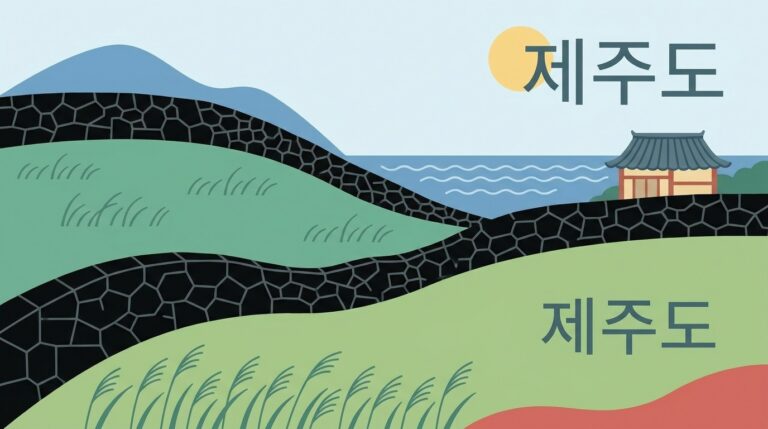
Jeju is historically known as 삼다도 (The Island of Three Abundances): 돌 (Stones), 바람 (Wind), and 여자 (Women). Because Mount Hallasan erupted millennia ago, the island is covered in porous black volcanic rock called basalt. When the ferocious wind whips across the plains, ordinary solid brick walls collapse from the pressure. Instead, Jeju ancestors built 돌담 (doldam)—stone walls stacked loosely without mortar. The wind naturally passes through the holes between the rocks, neutralizing the wind pressure while protecting fields and thatched roofs! What seems fragile is actually the highest form of ecological architecture.
Phase 5: Real-World Roleplay Scenario
Setting: A cozy glass cafe overlooking the rocky coastline of Woljeong-ri, Jeju. You are holding the door open while the wind howls behind you.
Characters:
* You (A curious B1 traveler)
* Minji (Friendly local barista in an oversized knit sweater)
- You: 안녕하세요! 밖이 생각보다 너무 추워요. (Annyeonghaseyo! Bakki saenggakboda neomu chuwoyo. / Hello! It’s much colder outside than I thought.)
🎭 [Shivers, rubbing arms while wiping wind-tears from eyes] -
Minji: 어서 오세요! 오늘 바람이 진짜 장난 아니죠? (Eoseo oseyo! Oneul barami jinjja jangnan anijyo? / Welcome! The wind is seriously no joke today, right?)
🎭 [Hands you a warm hand-towel with a sympathetic smile] -
You: 네, 맞아요. 제주도는 원래 이렇게 바람이 많이 불어요? (Ne, majayo. Jejudoneun wonrae ireoke barami mani bureoyo? / Yes, indeed. Is Jeju always this windy?)
🎭 [Glances out the rattling glass window at the foaming ocean waves] -
Minji: 하하, 네. 제주도는 바람으로 유명한 삼다도잖아요! (Haha, ne. Jejudoneun barameuro yumyeonghan samdadojanayo! / Haha, yes. Jeju is known as Samdado, famous for wind!)
🎭 [Chuckles warmly while grinding espresso beans] -
You: 아, 삼다도 들어봤어요! 바람 때문에 날아갈 것 같았어요. (A, samdado deureobwasseoyo! Baram ttaemune naragal geot gatasseoyo. / Ah, I’ve heard of Samdado! I felt like I was going to be blown away by the wind.)
🎭 [Laughs sheepishly while readjusting tangled windblown hair] -
Minji: 저런, 오늘은 모자 쓰시면 바로 날아가요. 바람막이 입으셨어요? (Jeoreon, oneureun moja sseusimyeon baro naragayo. Barammagi ibeusyeosseoyo? / Oh dear, if you wear a hat today it will fly right off. Did you bring a windbreaker?)
🎭 [Looks with caring curiosity at your light jacket] -
You: 아니요, 안 챙겨왔어요. 날씨가 생각보다 변덕스럽네요. (Aniyo, an chaenggyeowasseoyo. Nalssiga saenggakboda byeondeokseureopneyo. / No, I didn’t bring one. The weather is much more capricious than I expected.)
🎭 [Sighs playfully, looking at the suddenly passing rain clouds] -
Minji: 제주 날씨는 하루에도 열두 번 바뀌어요. 따뜻한 한라봉차 드셔보세요! (Jeju nalssineun haruedo yeoldu beon bakkwieoyo. Ttatteuthan hanrabongcha deusyeoboseyo! / Jeju weather changes twelve times a day. Try our hot Hallabong citrus tea!)
🎭 [Recommends the warm local specialty beverage with a welcoming gesture]
🔀 Interactive Decision Point
How will you answer Minji’s suggestion?
- Option A: “좋아요! 따뜻한 한라봉차 한 잔 주세요. 바람 부는 바다 보면서 마실게요.” (Johayo! Ttatteuthan hanrabongcha han jan juseyo. Baram buneun bada bomyeonseo masilgeyo.)
- Outcome: Best! Natural, respectful, and culturally responsive. You accepted the local specialty and acknowledged the dramatic weather scenic value.
- Option B: “바람이 너무 싫어요. 왜 날씨가 이래요?” (Barami neomu sireoyo. Wae nalssiga iraeyo?)
- Outcome: Bad. Complaining directly to a local resident about their island’s iconic geographic nature sounds rude and dismissive.
- Option C: “아이스 아메리카노 주세요. 얼죽아거든요!” (Aiseu amerika-no juseyo. Eoljuk-ageodeunyo!)
- Outcome: Risk. Funny cultural slang (Eoljuka = frozen to death but still drinking iced Americano), but you will freeze outside once you leave the cafe!
Phase 6: 10-Second Emotion Shadowing Drill
Practice matching natural cadence, tone, and expressive emotion. Pauses are indicated by /.
[💨 당황하며 깜짝 놀란 목소리로]- “와, / 바람 때문에 / 진짜 날아갈 것 같아요!”
- (Wa, / baram ttaemune / jinjja naragal geot gatayo!)
[🤔 호기심 가득하고 다정하게]- “제주도는 / 원래 이렇게 / 바람이 많이 불어요?”
- (Jejudoneun / wonrae ireoke / barami mani bureoyo?)
[😊 포근하고 따뜻한 위로의 어조로]- “날씨가 쌀쌀하니까 / 따뜻한 차 / 한 잔 마셔요.”
- (Nalssiga ssalssalhanikka / ttatteuthan cha / han jan masyeoyo.)
Phase 7: K-Culture Mini Dictionary
- 삼다도 (Samdado) | Noun: The traditional moniker for Jeju Island, literally translating to “Island of Three Abundances” (Stones, Wind, Women).
- 돌담 (Doldam) | Noun: Volcanic stone walls assembled with natural gaps to withstand fierce maritime typhoons and daily gales.
- 바람막이 (Barammagi) | Noun: A windbreaker jacket; an absolute mandatory gear item for any traveler exploring Jeju’s coastline or climbing Hallasan.
- 똥바람 (Ttongbaram) | Noun (Slang): A colorful regional slang term referring to sudden, icy, and penetrating crosswinds that strike out of nowhere.
Phase 8: Survival Kit for Travelers
Top 3 Survival Phrases
- 바람이 너무 세요. (Barami neomu seyo. / “The wind is too strong.”)
- Pro Tip: Use this when asking a taxi driver or tour guide if an outdoor coastal trail is currently safe to walk.
- 모자 조심하세요! (Moja josimhaseyo! / “Watch out for your hat!”)
- Pro Tip: Shout this kindly to fellow travelers when approaching high-altitude ocean cliffs.
- 실내 관광지 추천해 주실 수 있나요? (Silnae gwangwangji chucheonhae jusil su innayo? / “Could you recommend indoor attractions?”)
- Pro Tip: Perfect phrase for hotel receptionists when Jeju’s wind turns into a heavy squall.
Editor’s Travel Note
- App Essentials: Do not rely on generic global weather apps for Jeju; their localized readings are notoriously imprecise due to Mount Hallasan dividing north and south weather systems. Before heading out, refer to real-time public transit routes via the 네이버 지도 앱 다운로드 to track buses with climate control, and check wind-speed warning banners directly through the Korea Meteorological Administration app.
- Wardrobe Rule: Leave fragile umbrellas at home; Jeju winds bend steel ribs instantly. Always carry a hooded waterproof windbreaker and hair ties!
Phase 9: A Step Deeper (Reflection)
In many urban Western cultures, extreme weather is viewed as an inconvenience that disrupts human schedules. However, in Korean regional geography—and particularly in Jeju—wind is treated not as an enemy, but as an intimate co-inhabitant of the island. Jeju’s songs, unique thatched houses bound with thick straw ropes (초가지붕), and culinary traditions of warm broths developed in direct conversation with the gale.
💬 Your Turn: What is the most memorable weather surprise you have experienced while traveling? Have you ever had nature completely ruin your outfit like a Jeju gust of wind? Share your story in the comments below!
Phase 10: FAQ & Common Mistakes
Q: Can I use “바람이 많이 와요” to say it is very windy?
A: No! In English we say “The rain comes” and “The snow comes,” and Korean uses 비가 와요 (Rain comes) and 눈이 와요 (Snow comes). However, wind does not “come” (오다); it blows (불다). You must say: 바람이 많이 불어요 (Barami mani bureoyo).
Q: Why do locals say Jeju has different weather in the North and South?
A: Mount Hallasan sits directly in the center of Jeju Island at nearly 1,950 meters high. It physically blocks cold northern winds. Therefore, it can be cloudy and fiercely windy in Jeju City (North), while simultaneously sunny and calm in Seogwipo (South) just an hour away!
Q: What is the difference between “바람이 세다” and “바람이 불다”?
A: 불다 is the action verb meaning “to blow” (바람이 불어요 = The wind is blowing). 세다 is an adjective meaning “strong/fierce” (바람이 세요 = The wind is powerful). You can combine them: 바람이 세게 불어요 (The wind is blowing strongly).
🚨 Common Mistakes Warning Board
- Saying 바람이 커요 (The wind is big) ❌
- Correct Action: Wind cannot be 크다 (big). Always use 세다 (strong) or 강하다 (intense) -> 바람이 세요 ✅.
- Using fragile paper umbrellas on the coast ❌
- Correct Action: Wear a hooded jacket (바람막이) or rain poncho instead.
- Assuming Jeju is tropical and warm all year round ❌
- Correct Action: Because of open ocean winds, winter and spring in Jeju have a severe wind-chill factor (체감온도). Layer up!
Phase 11: Action Missions
- 🥉 Bronze Mission (Solo Shadowing): Record yourself saying: 제주도는 바람이 진짜 많이 불어요! (Jejudoneun barami jinjja mani bureoyo!) focusing on the rising emphasis on 진짜.
- 🥈 Silver Mission (Social Share): Post a photo of windy weather in your city on Instagram or Threads and caption it in Korean: 오늘 바람 때문에 날아갈 것 같아요! 💨
- 🥇 Gold Mission (Real Application): Next time you visit a Korean cafe or chat with a Korean conversation partner, ask them about their hometown’s geography: [City]는 날씨가 어때요? 바람 많이 불어요?
- 🎮 K-Culture Mission: Watch an episode of Welcome to Samdal-ri or Our Blues and count how many times you hear the rustle of coastal wind or see characters adjusting their hair against the breeze!
Phase 12: Interactive Quiz Challenge
1. Situational Judgment: You are walking along the coastline in Jeju, and your umbrella suddenly snaps backward from a sudden gust. What is the most natural sentence to say to your friend?
a) 비가 많이 와요. (Biga mani wayo.)
b) 바람 장난 아니에요! (Baram jangnan anieyo!)
c) 날씨가 너무 더워요. (Nalssiga neomu deowoyo.)
2. Fill in the Blank: 제주도는 돌, ( ), 여자가 많아서 삼다도라고 불려요.
a) 눈 (Nun – Snow)
b) 구름 (Gureum – Cloud)
c) 바람 (Baram – Wind)
3. True or False: In Korean, you can say 바람이 와요 to mean “The wind is blowing.”
(True / False)
👉 Click to view answers and explanations!
-
Answer: b) 바람 장난 아니에요!
Explanation: Option b captures the informal, natural reaction to wild wind. Option a is about rain, and option c means the weather is too hot. -
Answer: c) 바람 (Baram)
Explanation: The three abundances (삼다) of Jeju are 돌 (stones), 바람 (wind), and 여자 (women). -
Answer: False
Explanation: You must use the verb 불다 (to blow), making it 바람이 불어요. 오다 (to come) is only used for precipitation like rain (비) and snow (눈).