

Master Korean Project Management: How to Structure a Flawless WBS in a Korean Office
Phase 1: Empathy — Welcome to the Project War Room
안녕하세요! 매일한글 에디터입니다. (Hello! This is your Daily Hangul editor.)
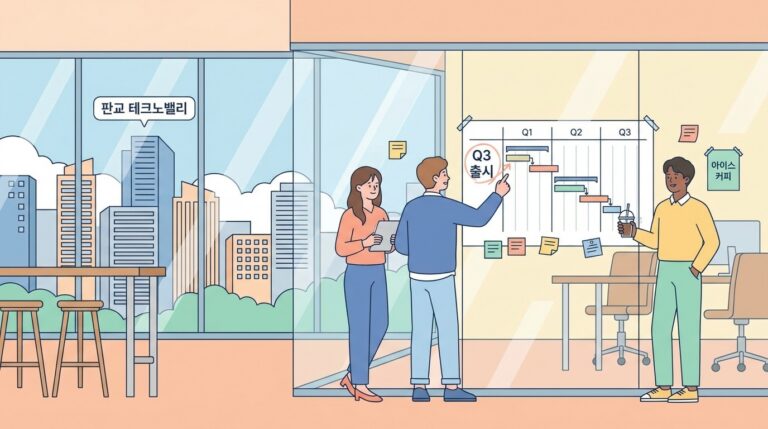
Picture this: You are seated in a glass-walled conference room overlooking the bustling skyline of Pangyo Techno Valley—the Silicon Valley of South Korea. Your team lead, Min-woo, slides a pristine yet intimidating Gantt chart across the screen. You’ve been tasked with designing the Work Breakdown Structure (WBS) for the upcoming Q3 product release. Everyone is typing furiously on mechanical keyboards, drinking iced Americanos regardless of the freezing autumn air, and throwing around terms like 공수 산정 (effort estimation) and 태스크 쪼개기 (breaking down tasks).
You know what a WBS is in theory, but when you attempt to map out task ownership and granular work packages in Korean, you hit a linguistic brick wall. How do you set boundaries without sounding confrontational? How do you demand clarity on deliverables without challenging your senior manager’s authority? If you’ve ever felt that pit in your stomach watching Korean business dramas like Misaeng (Incomplete Life) or Start-Up, wondering how professionals negotiate high-stakes accountability without breaking cultural harmony, you are not alone.
This guide was engineered directly from the battlefield of Korean corporate life, built on real feedback from bilingual PMs and senior consultants working in Seoul’s top tech firms. By mastering these C1-level nuances, you won’t just survive project planning—you will command the room with natural authority, precision, and tact.
Phase 2: Core 3 Expressions In-Depth
1. 업무를 잘게 쪼개다 (Eom-mureul jal-ge jjo-gae-da)
- Pronunciation: Eom-mu-reul jal-ge jjo-gae-da (Sounds like “um-moo-reul jahl-geh jjoh-gae-dah”; “jjo” starts with a crisp, tense ‘jj’ sound similar to the ‘zz’ in ‘pizza’ when whispered tensely).
- Meaning: Literal: To split/break work into small pieces. / Nuance: To deconstruct broad deliverables into granular, actionable work packages (WBS task breakdown).
- K-Culture Moment: Think of Misaeng when Manager Oh orders Jang Geu-rae to take a vague high-level strategic initiative and dissect it step-by-step into operational units so that external partners cannot exploit ambiguities.
- Editor’s Insight: In casual speech, 쪼개다 (to split) can sound colloquial, but when paired with 업무 (work) or 태스크 (task) in modern tech and consulting environments, it has become standard corporate jargon. It emphasizes dissecting complex scope into digestible, trackable units.
- Situation Spectrum:
- Casual (Peer to Peer): ✅ “이 태스크 너무 큰데 좀 더 쪼갤까?” (This task is too big; shall we break it down more?)
- Semi-formal (Sprint/Scrum Meeting): ✅ “WBS 작성할 때 업무 단위를 일단 일단계로 쪼개고 공유해 주십시오.”
- Formal (Board Presentation): ⚠️ (Prefer: 업무 단위를 세부화하다 / 세분화하다)
- 🤔 Think About It: In English, we say “decompose work.” Koreans intuitively say “쪼개다” (break/crack apart). Does breaking things into pieces feel more hands-on and physical in Korean work culture?
2. R&R을 명확히 하다 (Al-en-al-eul myeong-hwak-hi ha-da)
- Pronunciation: Al-en-al-eul myeong-hwak-hi ha-da (The English letters “R&R” are pronounced naturally as “Ah-ren-ahl”, while myeong-hwak-hi has a crisp aspiration on the “hi”).
- Meaning: Literal: To make Roles & Responsibilities clear. / Nuance: To eliminate ambiguity in task ownership and prevent cross-team finger-pointing.
- K-Culture Moment: In the drama Search: WWW, portal management directors frequently debate which department owns a technical bug versus a policy issue. “R&R” is the weapon used to protect one’s team from being saddled with orphaned tasks.
- Editor’s Insight: Korean organizations often suffer from the “collective responsibility trap,” where tasks without a dedicated single owner vanish into the void. Saying “R&R을 명확히 짚고 넘어갑시다” (Let’s clearly define R&R before moving on) signals elite PM competence.
- Situation Spectrum:
- Casual: ✅ “우리 R&R 정리부터 하자.” (Let’s organize our R&R first.)
- Semi-formal: ✅ “이 업무는 기획과 개발 간 R&R을 명확히 할 필요가 있습니다.”
- Formal: ✅ “프로젝트 성공을 위해 각 모듈별 R&R을 명확히 수립하였습니다.”
- 🤔 Think About It: Why do Koreans borrow the English acronym “R&R” instead of a native term? Often, foreign business jargon acts as a polite linguistic buffer, allowing people to delineate boundaries without sounding personally territorial.
3. 마일스톤을 박아두다 (Ma-il-seu-to-neul bag-a-du-da)
- Pronunciation: Ma-il-seu-to-neul bah-gah-doo-dah (Rhymes loosely with “smile stone”; bag-a-du-da has a grounded, punchy cadence).
- Meaning: Literal: To drive/embed a milestone like a stake into the ground. / Nuance: To set immovable milestone deadlines that serve as hard baseline checkpoints.
- K-Culture Moment: Seen in startup accelerators and enterprise war rooms alike: when leadership sets a hard launch date for an investor demo or Chuseok campaign, that date is “박혀 있다” (driven into stone).
- Editor’s Insight: The verb 박다 (to drive in, nail, stake) conveys unyielding commitment. Pairing it with 마일스톤 transforms a passive deadline into an active stake in the ground.
- Situation Spectrum:
- Casual: ✅ “일단 8월 말로 마일스톤 박아놓고 역산하자.” (Let’s plant the milestone at late August and back-calculate.)
- Semi-formal: ✅ “주요 마일스톤을 확정해 두고 세부 일정을 조율하시죠.”
- Formal: 🚫 (In formal corporate reports, write: 주요 마일스톤을 확정/설정하다)
- 🤔 Think About It: How does the physical metaphor of “driving a stake” reflect the speed-oriented, deliverable-driven urgency of the Korean Pali-pali work engine?
Phase 3: Textbook Korean vs. Real Corporate Korean
Situation 1: Asking team members to break down tasks further
- 📖 Textbook Korean: 작업 단위를 세부적으로 분할하여 기록해 주시기 바랍니다. (Jak-eop dan-wi-reul se-bu-jeok-eu-ro bun-hal-ha-yeo gi-rok-hae ju-si-gi ba-ram-ni-da.)
- 🗣️ Real Korean: 뎁스(Depth)를 한 단계 더 파서 태스크 단위로 잘게 쪼개 주실 수 있을까요? (Dep-seu-reul han dan-gye deo pa-seo tae-seu-keu dan-wi-ro jal-ge jjo-gae ju-sil su iss-eul-kka-yo?)
- 💡 Why the difference? Textbook language feels like an instruction manual from 1995. Contemporary Korean PMs use agile terminology mixed with intuitive physical verbs like 파다 (to dig) and 쪼개다 (to break down) to communicate technical depth.
Situation 2: Establishing task ownership to prevent delays
- 📖 Textbook Korean: 각 업무의 담당자를 지정하여 혼선을 방지합시다. (Gak eom-mu-ui dam-dang-ja-reul ji-jeong-ha-yeo hon-seon-eul bang-ji-hap-si-da.)
- 🗣️ Real Korean: 나중에 핑퐁 치지 않게 R&R 담당자 확실히 박고 가시죠. (Na-jung-e ping-pong chi-ji an-ge Al-en-al dam-dang-ja hwak-sil-hi bak-go ga-si-jyo.)
- 💡 Why the difference? The vivid phrase 핑퐁 치다 (playing ping-pong / passing the buck) encapsulates cross-departmental friction. Addressing it openly using 박고 가시죠 (let’s lock it in and proceed) demonstrates proactive leadership.
Phase 4: K-Culture Deep Dive & Non-Verbal Etiquette
4-1. 눈치 (Nunchi) & Non-Verbal Mechanics in WBS Alignment
When negotiating a WBS with Korean stakeholders, your verbal phrasing is only half the battle. Watch for these non-verbal cues:
1. The Double-Hand Laser Point: When referencing the WBS projected on the screen, never point with a single index finger at an empty cell assigned to a senior colleague. Instead, motion toward the cell with an open palm or use both hands together slightly tilted. Pointing directly can feel like an accusation of inefficiency.
2. The Softened Intake of Breath: If a Korean lead engineer looks at your suggested milestone, squints slightly, and inhales through their teeth (쓰읍…), do not take their silence as agreement. That sound translates directly to: “The engineering effort required here is completely underestimated.” Respond immediately by saying: “공수 산정에 조율이 좀 필요할까요?” (Does the effort estimation need adjustment?).
3. Post-Meeting Alignment (복도 미팅): The real agreement often happens in the 3-minute walk from the conference room back to the desks. Keep your antenna up for subtle comments whispered on the way out.
4-2. Cultural Code: The Pangyo Sprint Culture vs. Conglomerate Hierarchy
Modern South Korea operates on a dual business paradigm. In traditional conglomerates (Chaebols), the WBS must follow strict top-down milestones decreed by executives, requiring careful respect for rank (직급). However, in tech hubs like Pangyo, Yeouido fintech, and Seongsu creative agencies, agility rules. WBS models are fluid, sprint-driven, and built collaboratively over Notion and Jira. Mastering Korean WBS terminology means knowing when to sound hierarchical (보고 드리겠습니다) and when to sound like an agile facilitator (조율해 나가시죠).
Phase 5: Real-World Roleplay Scenario
Setting: A sunlit meeting room at an IT service firm in Gangnam. A WBS spreadsheet is projected on the display. Steam rises from a fresh cup of Maxim mocha gold.
Characters:
* You: Senior Project Manager coordinating a major API integration.
* Team Leader Min (민 팀장): Experienced, pragmatic engineering lead with high standards.
Dialogue
- You: 팀장님, 이번 스프린트 WBS 초안인데 한번 검토해 주시겠어요? (Tim-jang-nim, i-beon seu-peu-rin-teu WBS cho-an-in-de han-beon geom-to-hae ju-si-gess-eo-yo?)
🎭 Leaning slightly forward, displaying the spreadsheet with an open gesture.
“Team Leader Min, this is the draft WBS for this sprint; could you review it with me?” -
Team Leader Min: 음… 전반적으로 괜찮은데, 3번 데이터 마이그레이션 항목이 너무 뭉뚱그려져 있네요. (Eum… jeon-ban-jeok-eu-ro gwaen-chan-eun-de, sam-beon de-i-teo ma-i-geu-re-i-syeon hang-mok-i neo-mu mung-ttung-geu-ryeo-jyeo iss-ne-yo.)
🎭 Adjusting his glasses, tapping the table rhythmically.
“Hmm… It looks okay overall, but task #3, Data Migration, is lumped together too broadly.” -
You: 맞습니다. 아직 세부 태스크 뎁스가 안 파져서 업무를 더 잘게 쪼갤 생각입니다. (Mat-seum-ni-da. A-jik se-bu tae-seu-keu dep-seu-ga an pa-jyeo-seo eom-mu-reul deo jal-ge jjo-gael saeng-gak-im-ni-da.)
🎭 Nodding in validation before zooming in on row 3.
“You’re right. We haven’t dug into the sub-task depth yet, so I plan to break the work down much smaller.” -
Team Leader Min: 그래요. 그리고 인프라팀이랑 백엔드팀 사이에 R&R이 모호해서 병목이 생길 것 같은데요? (Geu-rae-yo. Geu-ri-go in-peu-ra-tim-i-rang baek-en-deu-tim sa-i-e Al-en-al-i mo-ho-hae-seo byeong-mok-i saeng-gil geot gat-eun-de-yo?)
🎭 Pointing his pen at the dependency column.
“Agreed. Also, the R&R between Infra and Backend seems ambiguous, which might cause a bottleneck.” -
You: 네, 그 부분은 오늘 오후에 양 팀 리드 모아서 R&R 확실히 정리하고 담당자 박아두겠습니다. (Ne, geu bu-bun-eun o-neul o-hu-e yang tim ri-deu mo-a-seo Al-en-al hwak-sil-hi jeong-ni-ha-go dam-dang-ja bag-a-du-gess-seum-ni-da.)
🎭 Making a firm annotation in the action item column.
“Understood. I will bring both team leads together this afternoon to settle R&R and lock in responsible owners.” -
Team Leader Min: 좋습니다. QA 일정 역산하면 배포 마일스톤은 다음 주 목요일로 고정해야 합니다. (Jot-seum-ni-da. QA il-jeong yeok-san-ha-myeon bae-po ma-il-seu-to-neun da-eum ju mok-yo-il-ro go-jeong-hae-ya ham-ni-da.)
🎭 Leaning back, checking his calendar.
“Good. Back-calculating from QA testing, the deployment milestone must be fixed for next Thursday.” -
You: 알겠습니다. 그 마일스톤 기준으로 크리티컬 패스 다시 계산해서 업데이트하겠습니다. (Al-gess-seum-ni-da. Geu ma-il-seu-to-neun gi-jun-eu-ro keu-ri-ti-keol pa-seu da-si gye-san-hae-seo eop-de-i-teu-ha-gess-seum-ni-da.)
🎭 Confidently noting down the hard deadline.
“Understood. I will recalculate the critical path based on that milestone and update the sheet.” -
Team Leader Min: 완벽하네요. 이대로 픽스하고 킥오프 미팅 소집합시다. (Wan-byeok-ha-ne-yo. I-dae-ro pik-seu-ha-go kik-o-peu mi-ting so-jip-hap-si-da.)
🎭 Smiling slightly with a nod of approval.
“Perfect. Let’s fix it as is and call the kickoff meeting.”
🔀 Interactive Decision Point
Team Leader Min suddenly adds: “그런데 클라이언트 쪽에서 갑자기 추가 요구사항 던지면 어쩌죠?” (What if the client suddenly drops additional requirements on us?)
- Option A: “클라이언트가 원하면 WBS 다 갈아엎어야죠.” (If the client wants it, we must overhaul the whole WBS.)
- Option B: “추가 인입 건은 스코프 크립 방지를 위해 변경 관리 프로세스로 쳐내고 마일스톤을 지키겠습니다.” (We will funnel incoming requests through the change control process to prevent scope creep and protect the milestone.)
- Option C: “그건 그때 가서 야근하면서 맞춰보겠습니다.” (We’ll handle that when it happens by working overtime.)
Feedback:
- Option A (Bad): Demonstrates zero project governance. Overhauling an approved WBS instantly undermines team morale.
- Option B (Best): Pure executive caliber! Using precise terms like 스코프 크립 (scope creep), 변경 관리 (change management), and 쳐내다 (to deflect/screen out) shows elite C1 competency.
- Option C (High Risk): Relying on 야근 (overtime) shows lack of structural planning and burns out key engineers.
Phase 6: 10-Second Emotion Shadowing Drill
Read these out loud, observing the intonation cuts (/) and feeling the distinct emotional state of each corporate scenario:
[💼 단호하지만 협조적으로 - Firm yet collaborative]
우선순위가 밀린 작업들은 / 이번 스프린트 WBS에서 과감히 덜어내겠습니다. (U-seon-sun-wi-ga mil-rin jak-eop-deul-eun / i-beon seu-peu-rin-teu WBS-e-seo gwa-gam-hi deol-eo-nae-gess-seum-ni-da.)
“Tasks with lower priority / will be boldly trimmed from this sprint’s WBS.”-
[🤝 차분하게 조율하며 - Calmly aligning expectations]
각 모듈별 공수가 확정되어야 / 마일스톤 일정을 신뢰성 있게 픽스할 수 있습니다. (Gak mo-dyul-byeol gong-su-ga hwak-jeong-dwoe-eo-ya / ma-il-seu-to-neun il-jeong-eul sin-roe-seong iss-ge pik-seu-hal su iss-seum-ni-da.)
“Only when the effort estimation for each module is locked in / can we reliably fix the milestone schedule.” -
[⚠️ 위기 속에서 명확성을 요구하며 - Assertive under pressure]
일정 딜레이를 막으려면 / 지금 시점에서 R&R 핑퐁을 멈추고 결정을 내려야 합니다. (Il-jeong dil-le-i-reul mag-eu-ryeo-myeon / ji-geum si-jeom-e-seo Al-en-al ping-pong-eul meom-chu-go gyeol-jeong-eul nae-ryeo-ya ham-ni-da.)
“To prevent schedule slippage / we must stop the R&R ping-pong right now and make a decision.”
Phase 7: K-Culture Mini Dictionary
-
공수 (Gong-su / Effort estimation / Man-days):
- Meaning: The calculated human labor time required to finish a task (often counted in Man-Months or Man-Days).
- Practical Use: In Korean tech, nobody says “시간이 얼마나 걸려요?” (How much time does it take?). They ask: “이 기능 개발하는 데 공수가 얼마나 나와요?” (How much effort/man-days will this feature require?).
- 병목 현상 (Byeong-mok hyeon-sang / Bottleneck):
- Meaning: A constriction point where the entire project workflow stalls waiting on one deliverable.
- Practical Use: “디자인 시안 검수가 늦어져서 프론트엔드 작업에 병목 현상이 생겼습니다.” (Design review delays have created a bottleneck for front-end development.)
- 핑퐁 (Ping-pong / Buck-passing):
- Meaning: The frustrating dynamic where two teams volley an orphaned responsibility back and forth.
- Practical Use: “기획팀이랑 개발팀이 에러 처리를 두고 핑퐁 치고 있어요.” (Planning and Dev are playing ping-pong over handling error exceptions.)
- 역산하다 (Yeok-san-ha-da / Back-calculation):
- Meaning: Setting the immutable final launch date first and scheduling backwards to determine interim deadlines.
- Practical Use: “오픈 일자가 12월 1일이니, WBS 일정은 D-day 기준으로 역산해서 짭시다.” (Since the launch is December 1st, let’s build the WBS schedule backwards from D-day.)
Phase 8: Expat Professional’s Survival Kit
Top 3 Meeting Survival Phrases
- “일정 산출 근거를 공유해 주실 수 있나요?”
- Il-jeong san-chul geun-geo-reul gong-yu-hae ju-sil su iss-na-yo?
- Pro Tip: When an engineer claims a 3-day task takes 3 weeks, never say “Why so long?”. Instead, ask for the “calculation basis” (산출 근거). It demands professional proof without sounding aggressive.
- “이 부분은 크리티컬 패스(Critical Path)라 집중 관리가 필요합니다.”
- I bu-bun-eun keu-ri-ti-keol pa-seu-ra jip-jung gwan-ri-ga pil-yo-ham-ni-da.
- Pro Tip: Use this to defend resources for core dependencies during sprint retrospectives.
- “선행 작업이 끝나야 후행 작업 착수가 가능합니다.”
- Seon-haeng jak-eop-i kkeut-na-ya hu-haeng jak-eop chak-su-ga ga-neung-ham-ni-da.
- Pro Tip: Perfect sentence to explain task dependencies to non-technical stakeholders requesting early delivery.
Editor’s Workplace Survival Note
If you work with Korean development teams, make sure you install KakaoWork and Naver Works. Even when teams use Slack or Jira, high-urgency notifications often fly through enterprise Kakao channels. Keep your desk stocked with Bacchus-F (energy tonic) or iced Americanos when negotiating tough deadlines—handing a cold coffee to an overworked tech lead before asking to adjust the WBS is worth ten polite emails!
Phase 9: Going One Step Deeper — The Cultural Architecture
In Western project management frameworks like PMBOK, a WBS is viewed primarily as a mathematical artifact—an objective breakdown of deliverables and logic trees. But in South Korea, a WBS is inherently a relational contract.
Because Korean society values 공동체 의식 (collective responsibility) and respect for interpersonal hierarchies (체면 and 눈치), putting an individual’s name next to an aggressive deadline on a public spreadsheet carries intense psychological weight. If an engineer misses a milestone, it is not merely a tracking variance; it is viewed as a personal loss of face that burdens their colleagues. Understanding this explains why Korean teams sometimes resist overly granular task tracking until trust is cemented. When you construct a WBS with empathy, actively identifying bottlenecks and removing roadblocks rather than merely policing deadlines, you transform from an external overseer into a respected 든든한 파트너 (dependable partner).
💬 Your Turn: In your home country’s workplace, is a project breakdown seen as a flexible guideline or an immutable contract? Share your experiences in the comments below!
Phase 10: FAQ & Avoiding Misunderstandings
Q: Can I use the English word “Deadline” instead of “마감일” in project meetings?
A: Absolutely! In fact, loanwords like 데드라인 (deadline) and 마일스톤 (milestone) are almost universally used in modern Korean tech, design, and marketing environments. However, when writing official status reports for upper management or clients, stick to formal Sino-Korean terms: 납기일 (delivery date) or 마감 시한 (deadline).
Q: How do I tell a Korean manager that their requested milestone is impossible?
A: Never say “불가능합니다” (That is impossible). That sounds blunt and insubordinate. Instead, frame the limitation around resource constraints and trade-offs: “현재 확보된 공수로는 해당 마일스톤 준수가 다소 어려울 것으로 사료됩니다. 일정 연장이나 스코프 조정 중 어느 쪽을 선호하시나요?” (Given our currently allocated effort, meeting that milestone may be difficult. Would you prefer a timeline extension or scope adjustment?).
Q: What is the difference between “업무” and “태스크” when drafting a WBS?
A: 업무 (eom-mu) is broader, referring to overarching job duties or work streams. 태스크 (tae-seu-keu) specifically designates an isolated, executable ticket or low-level work package in agile boards.
🚨 Common Mistakes Alert
- Mistake: Saying “이 일은 제 책임이 아닙니다” (This is not my responsibility) when rejecting an out-of-scope task.
- Correct Action: Say “해당 업무는 현재 합의된 R&R 범위 밖에 있어 리소스 배정이 어렵습니다.” (This task lies outside our agreed R&R scope, making resource allocation difficult).
- Mistake: Using “빨리 해주세요” (Please do it quickly) to follow up on overdue deliverables.
- Correct Action: Say “선행 작업 딜레이로 후행 일정에 영향이 가고 있어 현황 확인 부탁드립니다.” (Delays in preceding tasks are impacting subsequent schedules; please share the status).
- Mistake: Over-using informal imperatives like “쪼개라” or “박아라” to senior colleagues.
- Correct Action: Keep action verbs in polite proposal forms: “~로 확정 짓고 가시지요” or “~로 조율하면 어떨까 합니다.”
Phase 11: Action Mission
- 🥉 Bronze Mission (Solo Shadowing): Open your voice recorder. Record yourself reading the 3 emotional shadowing sentences from Phase 6, focusing on smooth pronunciation of 공수, 병목 현상, and 크리티컬 패스.
- 🥈 Silver Mission (Interactive Share): Take a look at your current personal or work to-do list. Translate your top 3 tasks into Korean using the pattern:
[모듈명] - [세부 태스크] (담당자 / 마일스톤)and share one in the comments! - 🥇 Gold Mission (Real-world Application): In your next stand-up or email with a Korean speaker, use the phrase “R&R을 명확히 정리하다” or “공수를 산정하다” in natural context.
- 🎮 K-Culture Mission: Watch Episode 3 of the office drama Misaeng. Pay attention to how interns and managers negotiate workload delegations—listen for how many times they say 보고 (reporting), 일정 (schedule), or 처리 (handling)!
Phase 12: Interactive Quiz Challenge
Test your C1 Korean project leadership instincts!
1. Situational Judgment
During a cross-functional alignment meeting, the marketing lead and backend lead are arguing over who should write transactional email copy. Which response demonstrates the most proficient PM leadership in Korean?
* A) “싸우지 마시고 알아서 결정하세요.”
* B) “이 건은 핑퐁 치지 말고, 기획 단계에서 텍스트를 확정해 주시는 걸로 R&R 정리하겠습니다.”
* C) “일정이 늦어지면 두 팀 모두 보고서에 쓰겠습니다.”
2. Fill in the Blank
기존 일정의 지연을 방지하기 위해 마감일을 D-day로부터 _______해서 중간 점검 일정을 수립했습니다.
* A) 가산 (Addition)
* B) 역산 (Back-calculation)
* C) 결산 (Settlement of accounts)
3. True / False Cultural Check
In a formal Korean project kick-off report presented to an executive director, writing “마일스톤을 세게 박아두었습니다” is considered elegant, professional business Korean.
* True or False?
👉 Click here to reveal answers and explanations!
Answers:
1. B is correct! It constructively eliminates the buck-passing (핑퐁 치지 말고) and establishes clear role boundaries (R&R 정리하겠습니다) without personal attack.
2. B is correct! 역산하다 means to calculate backwards from the final delivery target.
3. False! While 박아두다 is vibrant spoken corporate jargon in meetings, executive written reports require formal Sino-Korean diction like “주요 마일스톤을 확정/설정하였습니다.”
Happy planning, and remember: A well-structured WBS brings peace to your team and clarity to your Korean work life! 화이팅!







