

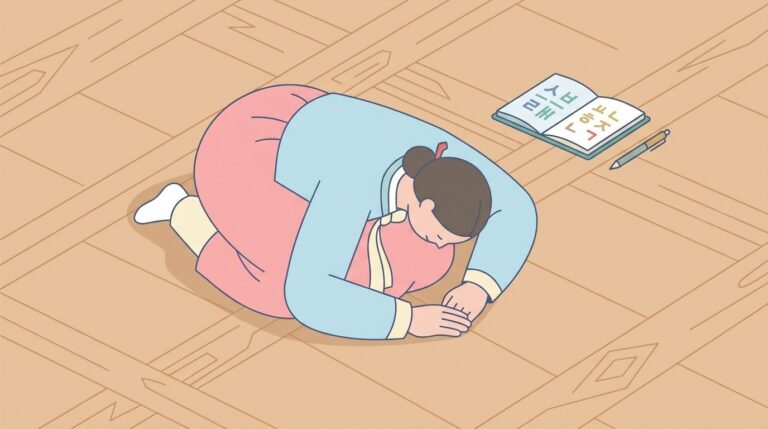
Master the Korean Deep Bow: How to Do Jeol Without Feeling Awkward
Phase 1: Empathy (Story Opening)
안녕하세요! 매일한글 에디터입니다. (Annyeonghaseyo! I am your Daily Hangul editor.)
Picture this: You are invited to your Korean friend’s home for Seollal (Lunar New Year). The living room smells of rich beef broth and sizzling savory pancakes. Everyone gathers on the floor, and suddenly, people start dropping to their knees for jeol (절 – traditional deep bow). Your heart begins to race. Wait, which hand goes on top again? Do men and women fold their hands differently? Am I supposed to touch my forehead to the floor? What if I trip over my Hanbok pants?
Don’t worry at all! Every single learner of Korean culture has frozen in place at least once during their first holiday gathering. Performing a deep bow can feel intimidating because in many cultures, getting down on all fours is reserved for solemn religious rites or historical dramas. But in Korea, jeol is an everyday gesture of warm affection, wishing long life and good fortune to those you cherish. Based on real feedback from dozens of our students who survived their first Chuseok and Seollal visits, this guide will walk you through every step, gesture, and phrase so you feel right at home.
Phase 2: Top 3 Core Expressions
1. 새해 복 많이 받으세요 (Saehae bok mani badeuseyo)
- Pronunciation: [Sae-hae bok mah-nee bah-deu-seh-yo] (Rhymes closely with say-hey, bok like book with an open ‘o’, and mani like money!)
- Meaning: Literal: “Please receive lots of New Year’s good fortune” | Real Nuance: “Wishing you abundant health, happiness, and prosperity this year!”
- K-Culture Moment: Seen in nearly every Lunar New Year broadcast, from your favorite K-pop idols bowing in colorful Hanbok on YouTube to heartwarming family scenes in K-dramas like Reply 1988.
- Editor’s Insight: This is the undisputed queen of holiday greetings. You say this after or as you finish your bow to elders, friends, and coworkers.
- Situation Spectrum: Casual (⚠️ with friends: 새해 복 많이 받아 / Saehae bok mani bada) | Semi-formal (✅) | Formal (✅)
- 🤔 Think About It: In English, we simply state “Happy New Year,” but Korean focuses on “receiving fortune” (복을 받다). How does wishing someone active blessings change the warmth of the greeting?
2. 절 받으세요 (Jeol badeuseyo)
- Pronunciation: [Jeol bah-deu-seh-yo] (Jeol rhymes with dull, followed by bah-deu-seh-yo)
- Meaning: Literal: “Please receive [my] bow” | Real Nuance: “Grandma/Grandpa, I am ready to give you my formal bow!”
- K-Culture Moment: In family variety shows like The Return of Superman, adorable toddlers announce this right before clumsily rolling over on the floor to make their grandparents laugh.
- Editor’s Insight: You do not just drop to the floor silently. Announcing 절 받으세요 lets the elders sit properly and prepare to receive your respect.
- Situation Spectrum: Casual (🚫) | Semi-formal (✅) | Formal (✅)
- 🤔 Think About It: Why does Korean describe a physical gesture as something the other person “receives” (받다)?
3. 건강하세요 (Geonganghaseyo)
- Pronunciation: [Geon-gang-hah-seh-yo] (Geon-gang sounds like gun-gahng)
- Meaning: Literal: “Please be healthy” | Real Nuance: “Wishing you vibrant health and longevity!”
- K-Culture Moment: The touching moment in historical dramas where children bow to their parents before leaving for the capital or entering military service.
- Editor’s Insight: Grammatically, 건강하다 is an adjective, but in spoken Korean, using it as an imperative blessing is beloved and accepted nationwide as the highest compliment to elders.
- Situation Spectrum: Casual (⚠️ only to equals) | Semi-formal (✅) | Formal (✅)
- 🤔 Think About It: Why do Koreans prioritize health over wealth when blessing their elders during family rituals?
Phase 3: Textbook Korean vs. Real Korean
Situation 1: Letting elders know you are about to bow
- 📖 교과서 한국어 (Textbook): 제가 지금 절을 해도 됩니까? (Jega jigeum jeoreul haedo doemnikka? – May I perform a bow now?)
- 🗣️ 진짜 한국어 (Real-life): 어르신, 절 올리겠습니다! (Eoreusin, jeol olligesseumnida! – Elders, I shall offer my bow!) or 할머니, 절 받으세요~ (Halmeoni, jeol badeuseyo~ – Grandma, please receive my bow!)
- 💡 왜 다를까? Asking dry, grammatical permission makes you sound like a business inspector. Real families announce the bow with warmth and humility using the honorific verb 올리다 (to raise/offer up).
Situation 2: Receiving holiday pocket money (세뱃돈 – Sebaedon)
- 📖 교과서 한국어 (Textbook): 주신 용돈을 감사히 받겠습니다. (Jusin yongdoneul gamsahi batgetseumnida. – I will gratefully receive the allowance you gave me.)
- 🗣️ 진짜 한국어 (Real-life): 와, 감사합니다! 잘 쓸게요! (Wa, gamsahamnida! Jal sseulgeyo! – Wow, thank you so much! I will use it well!)
- 💡 왜 다를까? Elders give money to see young people smile. Stiff, formal textbook recitation kills the joyous family vibe.
Phase 4: K-Culture Deep Dive & Nonverbal Manners
4-1. Nunchi & Gestures: The Art of Gongsu (공수)
The secret to a perfect Korean bow is hand positioning, known as Gongsu (공수). Before you bow, rest one hand comfortably over the other at belly-button level.
* For Men: Left hand goes over the right hand during happy occasions (New Year/holidays).
* For Women: Right hand goes over the left hand.
* Eye Contact & Movement: Never make sharp eye contact while going down! Look down softly toward your mat. Lower your knees smoothly (left knee first for men), bend forward at roughly 45 to 60 degrees, hold for 1 to 2 seconds, and rise slowly. Do not rush back up like you are doing burpees at the gym!
4-2. Culture Code: The Magic of Deokdam (덕담)
After the bow, sit comfortably on your knees and wait. The elders will give you Deokdam (덕담)—spoken wishes of wisdom, such as finding a good job, passing exams, or staying healthy. Only after they speak will they pull out crisp envelopes containing Sebaedon (세뱃돈). Receive the envelope with both hands!
Phase 5: Real-Life Roleplay Scenario
Setting: Minho’s grandparents’ warm living room in Seoul during Seollal morning. Grandmother (Halmeoni) sits on a silk cushion.
- Mark: 할머니, 새해 복 많이 받으세요! (Halmeoni, saehae bok mani badeuseyo! – Grandma, Happy New Year!)
- Halmeoni: 🎭 Smiling warmly, patting the floor mat 아이고, 마크 왔구나! 어서 와라. (Aigo, Makeu watguna! Eoseo wara. – Oh my, Mark is here! Welcome, come in.)
- Mark: 🎭 Placing hands together in front of belly 할머니, 절 받으세요. (Halmeoni, jeol badeuseyo. – Grandma, please receive my bow.)
- Halmeoni: 그래, 그래, 고맙다. (Geurae, geurae, gomapda. – Yes, yes, thank you.)
- Mark: 🎭 Slowly bowing down, touching floor, holding for 2 seconds, and standing back up smoothly 올 한 해도 건강하세요! (Ol han haedo geonganghaseyo! – Please stay healthy this whole year too!)
- Halmeoni: 🎭 Handing a white envelope with both hands 착하기도 하지. 우리 마크 올해 시험 다 붙어라! (Chakhagido haji. Uri Makeu olhae siheom da buteora! – What a good boy. May you pass all your exams this year!)
- Mark: 🎭 Bowing head slightly while receiving the envelope with two hands 감사합니다! 잘 쓰겠습니다! (Gamsahamnida! Jal sseugesseumnida! – Thank you so much! I will use it well!)
- Halmeoni: 떡국 식기 전에 많이 먹어라! (Tteokguk sikgi jeone mani meogeora! – Eat lots of rice cake soup before it gets cold!)
🔀 Interactive Decision Point
Halmeoni hands you the gift envelope. What do you do?
* Option A: Open the envelope instantly on the spot, count the cash, and shout “Jackpot!”
* Option B: Receive it with both hands, bow your head politely, say thank you, and place it beside you or in your pocket without peeking.
* Option C: Wave your hands aggressively saying “No no no, I cannot take your money!” and push it back.
- Feedback:
- Option A (Risk): Big taboo! Opening money envelopes immediately in front of elders looks greedy and childish.
- Option B (Best): Perfect 100 points! Showing respect with two hands while delaying curiosity shows mature Korean etiquette (Yewi).
- Option C (Bad): While modest in some Western cultures, pushing holiday money back repeatedly can offend Korean grandparents who prepared it with love.
Phase 6: 10-Second Emotion Shadowing Drill
Read aloud matching the rhythm slashes (/) and emotional tone tags:
[😊 밝고 공손하게 - Bright & Polite]
새해 복 / 많이 / 받으세요! (Saehae bok / mani / badeuseyo!)-
[🙇♂️ 차분하고 정중하게 - Calm & Respectful]
할머니, / 절 받으세요. (Halmeoni, / jeol badeuseyo.) -
[✨ 따뜻하고 진심을 담아 - Warm & Sincere]
올 한 해도 / 항상 / 건강하세요! (Ol han haedo / hangsang / geonganghaseyo!)
Phase 7: K-Culture Mini Dictionary
- 세배 (Sebae): The traditional formal deep bow performed specifically on New Year’s Day to pay respects to family elders.
- 세뱃돈 (Sebaedon): Pocket money gifted by grandparents and parents to children and young adults following a polite Sebae.
- 덕담 (Deokdam): Words of blessing, encouragement, and good fortune shared by elders after receiving a bow.
- 공수 (Gongsu): The formal hand-folding posture where one palm rests over the other at the waistline before and after bowing.
Phase 8: Traveler’s Survival Kit
Top 3 Survival Phrases
- 새해 복 많이 받으세요 (Saehae bok mani badeuseyo) – Happy New Year! (Pro Tip: Use this with hotel staff, taxi drivers, and shopkeepers during late January / early February).
- 어떻게 절해요? (Eotteoke jeolhaeyo?) – How do I bow? (Pro Tip: Ask your host friend before walking in—they will gladly demonstrate!).
- 새해 복 많이 받으시고 건강하세요 (Saehae bok mani badeusigo geonganghaseyo) – Happy New Year and please stay healthy! (Pro Tip: The ultimate all-in-one polite combination).
Editor’s Travel Note
If you visit Seoul during Chuseok or Seollal, royal palaces like Gyeongbokgung and Changdeokgung offer free admission if you wear Hanbok! Check holiday schedules directly on the Visit Korea official travel portal before heading out. Keep in mind that many small local restaurants close on the exact day of the holiday, so check open hours via the Naver Map application beforehand.
Phase 9: One Step Deeper (Reflection)
In Western traditions, bowing deeply to the floor often connotes surrender, subservience, or purely religious piety. But in Korea, lowering your entire body to touch the floor is an act of communal harmony—you temporarily place yourself lower than the other person to elevate their wisdom, age, and unconditional sacrifices for the family. It is an exchange of mutual grace: you offer humility, and they return it with blessings and protection.
💬 Your Turn: Does your culture have a special physical gesture or greeting reserved exclusively for elders or holidays? Share your story in the comments below!
Phase 10: FAQ & Mistake Prevention
Q: Which hand goes on top when doing a festive holiday bow?
A: For happy occasions like Seollal, men place their left hand over their right hand, while women place their right hand over their left hand. Remember: left-over-right for men, right-over-left for women!
Q: Is the bow for ancestral rites (Charye) or funerals different from holiday Sebae?
A: Yes! At funerals (Jangnye-sik), the hand placement reverses (right hand over left for men), and mourners bow twice to the deceased, whereas for living elders during Seollal, you only bow once.
Q: Can I wear socks or do I have to be barefoot when bowing?
A: Always wear clean socks! Being completely barefoot in front of Korean elders is considered impolite, especially in formal family settings.
🚨 Common Mistakes TOP 3
- The Double Bow (두 번 절하기): Bowing twice to living grandparents! Two full bows are reserved exclusively for the deceased. Always bow once for living people.
- Opening Sebaedon Immediately: Tearing open the money envelope right in the living room is a major faux pas. Pocket it respectfully with thanks first.
- Stepping on the Threshold (문턱 밟기): Stepping directly on the wooden raised door frame (Munteok) when entering traditional rooms is believed to bring bad luck. Step over it smoothly.
Phase 11: Action Missions
- 🥉 Bronze Mission: Practice the Gongsu hand position in front of a mirror (Men: Left on top / Women: Right on top) and say 새해 복 많이 받으세요 (Saehae bok mani badeuseyo) smoothly.
- 🥈 Silver Mission: Record a 5-second voice note practicing 할머니, 절 받으세요 (Halmeoni, jeol badeuseyo) and post it to your study group or language exchange app.
- 🥇 Gold Mission: Use 새해 복 많이 받으세요 with a Korean restaurant owner or cashier during the upcoming Lunar New Year period.
- 🎮 K-Culture Mission: Watch an episode of a Korean variety show (like 2 Days & 1 Night or Running Man) holiday special and spot how the cast members position their hands when doing Sebae!
Phase 12: Interactive Quiz Challenge
- Situational Judgment: You are at your Korean host family’s house on Seollal morning. Grandmother sits before you. What is the most natural sentence to say right before you lower your knees?
- A) 밥 주세요! (Bap juseyo!)
- B) 할머니, 절 받으세요. (Halmeoni, jeol badeuseyo.)
- C) 돈 많이 주세요. (Don mani juseyo.)
- Fill-in-the-Blank: Complete the famous Korean holiday greeting:
새해 ___ 많이 받으세요! (Hint: It means good luck or blessings). -
True or False: You should bow twice to your living grandparents during Seollal morning.
👉 Click here to check answers & explanations!
- Answer: B – 절 받으세요 is the courteous way to invite elders to receive your bow. (A means “Give me rice!” and C means “Give me lots of money!”).
- Answer: 복 (Bok) – The full expression is 새해 복 많이 받으세요 (Saehae bok mani badeuseyo).
- Answer: False – You only bow ONCE to living elders. Bowing twice is strictly reserved for memorial services and funerals!






