

Phase 1: Empathy (A Steamy Sunday Morning)
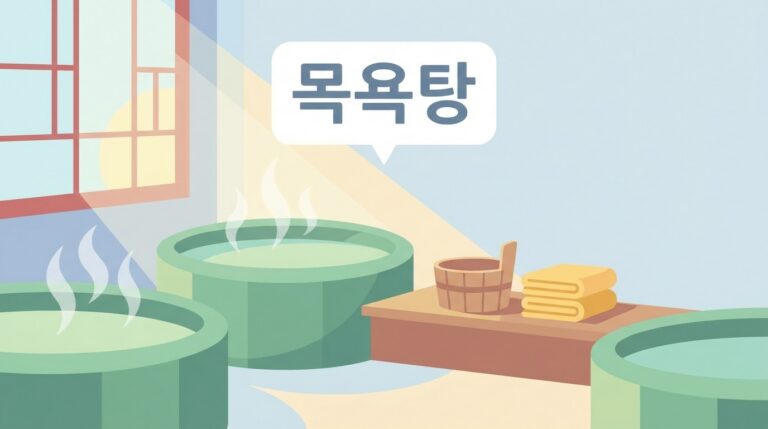
안녕하세요! 매일한글 (Daily Hangul) editor here! Picture this: It is 7:30 AM on a crisp Sunday in Seoul. You slide open the frosted glass door of a neighborhood mokyoktang (목욕탕, public bathhouse). The air envelops you instantly with the earthy fragrance of mugwort, cedarwood, and gentle soap. Steam drifts through the morning light pouring in from the high windows. Around you, grandfather-son duos laugh together, neighborhood regulars trade local gossip, and water trickles rhythmically into wide jade-tiled tubs.
Suddenly, your heart skips a beat. You are holding your tiny hand towel like a shield, realizing you have no idea where to sit, what to say, or why everyone looks so completely at ease in the buff. If the thought of a Korean public bathhouse makes you sweat before you even touch the hot water, you are not alone! Many B1 intermediate learners can smoothly order iced Americanos or discuss K-dramas, but completely freeze when navigating this intimate slice of authentic Korean daily life.
Do not worry! Based on the real experiences and embarrassing first-time blunders shared by our global learners, this survival guide will give you the cultural confidence, unspoken etiquette, and natural phrases you need to conquer your first Sunday morning bathhouse visit. By the end of this guide, you will be soaking like a local and sipping icy banana milk without an ounce of hesitation!
Phase 2: Key Expressions Breakdown
Here are three essential expressions you will hear and use inside a Korean bathhouse:
1. 어우, 시원하다! (Eou, siwonhada!)
- Pronunciation: Uh-oo, see-won-ha-da! (Exhale softly like sinking into a cozy bed after a 10-mile hike).
- Meaning: Literal: “Oh, it’s cold!” vs. Real: “Ah, this deep heat feels so relieving and cathartic!”
- K-Culture Moment: You will see this in almost every family K-drama. An elderly grandfather slides into a steaming 42°C (108°F) tub and sighs with pure joy, while a confused young child touches the water and yelps because it is boiling hot.
- Editor’s Insight: In Korean philosophy, siwonhada does not just mean low temperature; it describes the sensation of physical tension, stuffiness, or heavy stress leaving your chest and muscles.
- Situation Spectrum: Casual: ✅ | Semi-formal (with -yo): ✅ | Formal: ⚠️
- 🤔 Think About It: English speakers connect “refreshing” to cool breezes or chilled drinks. Why do you think Korean culture associates scorching hot water with physical liberation?
2. 혹시 여기 자리 있나요? (Hoksi yeogi jari innayo?)
- Pronunciation: Hohk-shee yuh-gee jah-ree een-nah-yoh? (Soft and inquiring, like politely checking if a cafe seat is free).
- Meaning: Literal: “By any chance, is there a seat here?” vs. Real: “Excuse me, is anyone currently using this wash stall?”
- K-Culture Moment: On busy weekend mornings, regulars leave their shampoo caddies at their favorite wash stations while soaking in the tub, leaving newcomers puzzled about whether a shower booth is free.
- Editor’s Insight: The magic buffer word here is hoksi (혹시, by any chance). Dropping hoksi before your question prevents you from sounding confrontational and shows respect for the shared communal space.
- Situation Spectrum: Casual: ⚠️ | Semi-formal: ✅ | Formal: ✅
- 🤔 Think About It: When space is shared intimately without private partitions, indirect speech serves as a social shield to preserve peace and harmony.
3. 피로가 싹 풀려요 (Piroga ssak pullyeoyo)
- Pronunciation: Pee-roh-gah ssahk pool-lyuh-yoh (Emphasize the brisk ssak sound like a broom sweeping dust away).
- Meaning: Literal: “Fatigue untangles cleanly” vs. Real: “All my built-up exhaustion is melting away!”
- K-Culture Moment: Stepping out of the herbal steam room and dipping into the cold plunge pool with a bath buddy, exhaling all your workweek tension.
- Editor’s Insight: The word ssak (싹) is a dynamic Korean mimetic adverb expressing complete and sweeping removal. Pairing it with puldah (to untie/unravel) shows that stress is viewed as knots in your body.
- Situation Spectrum: Casual: ✅ | Semi-formal: ✅ | Formal: ✅
- 🤔 Think About It: We often say “I am recharging my batteries” in English. What does the Korean image of “unraveling knots” say about how rest is perceived?
Phase 3: Textbook Korean vs. Real-World Korean
Let’s swap out robotic dictionary lines for real-world bathhouse vernacular.
Situation 1: Commenting on the bath temperature
- 📖 Textbook Korean: 수온이 매우 적당합니다. (Suoni maeu jeokdanghamnida. – The water temperature is very moderate.)
- 🗣️ Real-World Korean: 물이 딱 좋아요! (Muri ttak joayo! – The water is just perfect!)
- 💡 Why the Difference: Textbook phrasing relies on stiff Hanja words (suon = water temperature). Native speakers use the punchy conversational adverb ttak (딱, spot-on / exact) to sound lively and natural.
Situation 2: Asking someone nearby to scrub your hard-to-reach back
- 📖 Textbook Korean: 등을 씻어주시겠습니까? (Deungeul ssiseojusigesseumnikka? – Will you wash my back?)
- 🗣️ Real-World Korean: 저기, 죄송한데 등 한 번만 밀어주실 수 있어요? (Jeogi, joesonghande deung han beonman mireojusil su isseoyo? – Excuse me, sorry to bother you, but could you scrub my back just once?)
- 💡 Why the Difference: Mutual back-scrubbing (deung milgi) is a warm, reciprocal custom in traditional baths. Cushioning your request with jeogi (excuse me) and han beonman (just once) turns an imposing request into a polite, friendly gesture.
Phase 4: K-Culture Deep Dive & Non-Verbal Manners
4-1. Nunchi & Silent Gestures
- The Stool Rinse Ritual: Before sitting down at a sit-down wash station, fill your small plastic basin with warm water and rinse the stool and floor. When you finish, rinse both thoroughly again and place the basin upside down over the stool. Leaving soap suds behind shows a lack of nunchi (눈치, situational awareness).
- The Eye Horizon Rule: In a communal nude setting, eye contact should always stay at facial eye level or drift casually toward the ceiling tiles and steam vents. Looking downward is considered rude and invasive.
- Towel Etiquette: Never drop your small hand towel into the communal soaking tubs! Men usually fold the dry towel into a small rectangle and balance it on top of their head. Women generally wrap their hair up tightly to avoid stray strands floating in the water.
4-2. Cultural Code: The Sunday Reset & Banana Milk
In Korea, visiting the neighborhood bathhouse on Sunday morning is not just about hygiene; it is a profound community ritual of renewal. Multigenerational families scrub away the dead skin (ttae, 때) of the past week, symbolically leaving behind their emotional baggage. And the sacred finale? Grabbing an ice-cold, diamond-shaped bottle of sweet Binggrae Banana-Flavored Milk (Banana-mat Uyu) or chilled sweet rice punch (Sikhye) from the counter on your way out. That sweet sip on warm skin is pure nostalgia for every Korean.
Phase 5: Real-Life Roleplay Scenario
Setting: A warm, steamy neighborhood bathhouse in Mangwon-dong, Seoul. 8:00 AM on Sunday.
Characters: You (a relaxed B1 learner) and Minsu’s Mom (a friendly bathhouse veteran seated at the adjacent wash station).
- You: 🎭 (Rinsing the plastic wash stool with warm water before sitting down)
안녕하세요! 오늘 아침에 손님이 꽤 많네요.
(Annyeonghaseyo! Oneul achime sonnimei kkwae mannayo.)
“Hello! It is quite busy this morning.”) -
Minsu’s Mom: 🎭 (Wringing out her yellow washcloth with a warm smile)
일요일 아침이라 그래요. 학생, 한국 목욕탕 처음 와봐요?
(Ilyoil achim-ira geuraeyo. Haksaeng, Hanguk mokyoktang cheoeum wabwayo?)
“It’s because it’s Sunday morning. Are you new to Korean bathhouses?” -
You: 🎭 (Smiling sheepishly while pouring water over your shoulders)
혼자 온 건 처음이라 조금 긴장했어요. 그래도 물이 딱 좋아요!
(Honja on geon cheoeum-ira jogeum ginjanghaesseoyo. Geuraedo muri ttak joayo!)
“It’s my first time coming alone, so I was a bit nervous. But the water is just perfect!” -
Minsu’s Mom: 🎭 (Nodding approvingly)
온탕에 한 10분 푹 담그고 나와요. 그래야 피로가 싹 풀리지!
(Ontang-e han sip-bun puk damgeugo nawayo. Geuraeya piroga ssak pulliji!)
“Soak in the hot tub for about 10 minutes. That’s how all your fatigue melts away!” -
You: 🎭 (Getting out of the tub feeling refreshed, looking at your back)
어우, 정말 시원하네요! 저기… 죄송한데 등 한 번만 밀어주실 수 있어요?
(Eou, jeongmal siwonhaneyo! Jeogi… joesonghande deung han beonman mireojusil su isseoyo?)
“Ah, that was truly refreshing! Excuse me… sorry to ask, but could you scrub my back just once?” -
Minsu’s Mom: 🎭 (Chuckling warmly and slipping on an exfoliating glove)
아유, 당연하지! 이리 와요. 내가 시원하게 밀어줄게.
(Ayu, dang-yeonhaji! Iri wayo. Naega siwonhage mireojulge.)
“Oh, of course! Come over here. I’ll scrub it clean for you.” -
You: 🎭 (Bowing head slightly in gratitude)
감사합니다! 끝나고 제가 어머님 등도 밀어드릴게요.
(Gamsahamnida! Kkeutnago jega eomeonim deungdo mireodeurilgeyo.)
“Thank you so much! Once finished, let me scrub your back too.” -
Minsu’s Mom: 🎭 (Patting your shoulder cheerfully)
어머, 한국 예절을 아주 잘 아네! 착하다, 착해.
(Eomeo, Hanguk yejeoreul aju jal ane! Chakhada, chakhae.)
“My goodness, you know Korean etiquette so well! How polite and sweet.”
🔀 Interactive Choice Point
After Minsu’s Mom finishes helping you, she offers you some homemade chilled barley tea from her thermos. What do you do?
- Choice A: Say “아니요, 괜찮습니다” (No, I’m okay) stiffly and walk away to dry off immediately.
- Feedback (Bad): Declining blunt and retreating creates unnecessary awkwardness in a space rooted in sharing.
- Choice B: Receive the cup with both hands and say, “와, 정말 시원해요! 잘 마시겠습니다!”
- Feedback (Best): Perfect! Using two hands shows respect (ye-ui), and accepting hospitality cements warm neighborly bonding (jeong).
- Choice C: Take the entire thermos bottle to drink directly from the lid.
- Feedback (Risk): Sharing personal drink lids directly can trigger hygiene concerns among older bathers.
Phase 6: 10-Second Emotion Shadowing Drill
Practice saying these lines with the indicated rhythm pauses (/) and emotional tone:
[😌 Deeply relaxed & relieved]
어우, / 따뜻한 물에 들어가니까 / 피로가 싹 풀리네요.
(Eou, / ttatteut-han mure deureoganikka / piroga ssak pullineyo.)
“Ah, / stepping into the warm water / all my fatigue melts away.”-
[🤗 Polite & friendly]
저기, 실례지만 / 여기 자리 있나요? / 비어 있으면 앉아도 될까요?
(Jeogi, sillyejiman / yeogi jari innayo? / Bieo isseumyeon anjadow doelkkayo?)
“Excuse me, / is this spot taken? / May I sit if it is empty?” -
[😋 Cheerful & anticipatory]
목욕 끝나고 마시는 / 바나나 우유가 / 세상에서 제일 맛있어요!
(Mokyok kkeutnago masineun / banana uyuga / sesang-eseo jeil masisseoyo!)
“The banana milk / you drink after a bath / is the most delicious thing in the world!”
Phase 7: K-Culture Mini Dictionary
- 세신사 (Sesinsa / Professional Body Scrubber): Licensed bathhouse scrub masters who use specialized green Italy towels to exfoliate your entire body on vinyl-lined treatment tables.
- 때수건 (Ttaesugeon / Korea Italy Towel): The iconic rough-textured viscose towel (usually green with black stripes) engineered in Korea in the 1960s to gently remove dead skin cells.
- 온탕 / 냉탕 (Ontang / Naengtang): The core yin-yang hydrotherapy of Korean saunas: alternating between the hot tub (ontang, 39°C–42°C) and the brisk cold plunge pool (naengtang, 16°C–20°C).
- 바나나맛 우유 (Banana-mat Uyu): The chubby, barrel-shaped sweet banana milk launched by Binggrae in 1974 that remains the undisputed post-bathhouse comfort drink of Korea.
Phase 8: Traveler’s Survival Kit
Top 3 Survival Phrases
- 수건 한 장 더 주실 수 있나요? (Sugeon han jang deo jusil su innayo?)
- Pro Tip: Men are usually provided unlimited towels in the locker room, while women receive two small towels at the front desk due to historical loss prevention.
- 때밀이 얼마예요? (Ttaemiri eolmayeyo? – How much is a scrub?)
- Pro Tip: Sign up on the scrub chalkboard near the tubs early; weekend waiting lists fill up fast!
- 시원한 식혜 하나 주세요! (Siwonhan sikhye hana juseyo!)
- Pro Tip: Say this at the locker room counter to get a frozen, sweet rice punch with a straw.
Editor’s Travel Note
- Finding Great Spots: Download the Naver Map app download to search for “목욕탕” (traditional neighborhood bath) or “찜질방” (full-scale sauna complex with sleeping zones).
- Locker Key Sync: Your electronic wristband locker key serves as your credit card inside the facility. Tap it to pay for drinks, snacks, and scrubs, then settle your bill at the front desk when exiting.
Phase 9: One Step Deeper (Cultural Reflection)
In modern society, we rarely let our guards down. We wear stylish outfits, practice curated expressions, and maintain polite physical distance. But inside a Korean bathhouse, every single social armor drops away. Doctors, university students, corporate executives, and grandfathers sit side by side, completely unclad on matching plastic stools, washing away the grit of daily life. In Korean culture, this naked vulnerability is celebrated as a manifestation of Jeong (정, deep communal affection). When everyone is stripped bare under the steam, social hierarchies dissolve, leaving only shared human warmth and mutual respect.
💬 Your Turn: Have you ever experienced a public bathhouse or hot spring outside your home country? What was your initial emotional reaction, and would you be willing to try back-scrubbing with a local?
Phase 10: FAQ & Common Mistakes
Q: Can people with tattoos enter Korean bathhouses?
A: Neighborhood mokyoktang have become increasingly relaxed toward international visitors with modest tattoos. However, large full-body or gang-associated irezumi tattoos may still receive polite refusals at traditional establishments. Cover small tattoos with waterproof patches if you want to avoid prolonged stares.
Q: Do I have to get completely naked?
A: Yes, inside the wet bathing tub area (mokyoktang), swimwear is strictly forbidden for sanitation reasons. However, in the co-ed dry rest areas (jjimjilbang), you will wear the provided matching t-shirt and shorts uniform.
Q: Should I shower before entering the tubs?
A: Absolutely! You must thoroughly wash and rinse your entire body at the wash stations before stepping a single toe into any communal soaking pool.
🚨 Common Mistakes Warning Board
- Mistake: Stepping into the hot soaking tubs without showering first.
- Correct Action: Always do a full head-to-toe soap and rinse at the shower stations first.
- Mistake: Rinsing your exfoliating towel inside the communal soaking tub.
- Correct Action: Only soak your clean body; all soap, lather, and towel washing belongs strictly at the sit-down wash stalls.
- Mistake: Leaving personal toiletries to hog a wash booth indefinitely.
- Correct Action: Take your caddy with you or tuck it beneath the counter if you plan to soak in the tubs for an extended period.
Phase 11: Action Missions
- 🥉 Bronze Level: Practice saying “어우, 시원하다!” in front of your mirror with an exaggerated sigh of relief next time you step into a hot shower at home.
- 🥈 Silver Level: Post a photo of Binggrae banana milk or a Korean snack on your social media and caption it using the phrase “피로가 싹 풀려요!”
- 🥇 Gold Level: Visit a local Korean sauna or neighborhood bathhouse during your next weekend trip, greet the counter staff politely, and order a cup of sweet sikhye after soaking!
- 🎮 K-Culture Mission: Watch an episode of a slice-of-life K-drama (like Reply 1988) and listen for the moment characters sigh “시원하다!” while eating hot noodle soup or bathing.
Phase 12: Interactive Quiz Challenge
Question 1 (Situational Judgement): You sit down at a wash station on a busy Sunday morning. What is the very first thing you should do with the plastic stool and water basin?
* A) Put your towel over the mirror
* B) Rinse the stool and basin with warm water
* C) Turn on the cold shower full blast
Question 2 (Fill-in-the-Blank): Complete the sentence meaning “All my fatigue is swept away completely”:
* “따뜻한 물에 들어가니 피로가 (_____) 풀려요!”
Question 3 (True or False): You can dip your small hand towel into the communal herbal tub as long as it has no soap on it.
* A) True
* B) False
👉 Click to reveal answers and explanations!
- Answer 1: B. Rinsing the wash station before and after use is the golden rule of bathhouse nunchi!
- Answer 2: 싹 (ssak). The adverb ssak captures the refreshing feeling of stress being cleanly wiped out.
- Answer 3: B (False). Towels must never touch communal soaking water. Keep your towel folded on your head or place it on the tub ledge!
”







