

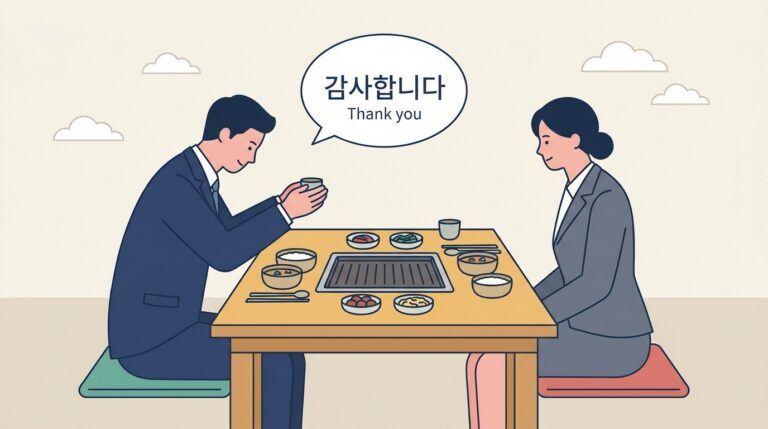
Mastering Korean Business Dining: How to Guide Foreign Guests Like a Pro
Phase 1: Empathy & Immersion
안녕하세요! It is your Daily Hangul editor here! Have you ever found yourself sitting at a bustling Korean barbecue restaurant or a serene Hanjeongsik (traditional course meal) room with an overseas business partner, feeling an invisible tension in the air? If you have watched K-Dramas like Misaeng or Agency, you already know that in Korea, a meal is never just about filling your stomach. It is a subtle, high-stakes choreography of respect, hierarchy, and bonding.
Imagine this scenario: the premium Hanwoo beef is sizzling over charcoal, the banchan dishes are arriving in waves, and your foreign executive or client freezes. Their hand hovers over their chopsticks, eyes darting between the boss and the grill, visibly terrified of committing a cultural faux pas. Do I eat first? Should I pour my own water? Why is everyone holding glasses with two hands?
This is where you step in as the ultimate cultural navigator. Knowing how to explain Korean dining etiquette in natural, warm, and sophisticated Korean (CEFR B2 level) transforms you from a bystander into an indispensable host. Based on real feedback from international managers working in Seoul, mastering these hospitality expressions builds tremendous trust and dissolves awkward dining tension in seconds. Let’s make sure you and your dining partners handle your next Korean business dinner with flawless grace!
Phase 2: Top 3 Core Expressions for Dining Etiquette
1. 어르신이나 손님이 먼저 수저를 드신 후에 드시면 돼요.
- Pronunciation: Eoreusin-ina sonnimm-i meonjeo sujeoreul deusin hue deusimyeon dwaeyo. (Think: Uh-reu-shin-ee-nah son-nim-ee mun-juh soo-juh-reul deu-shin hoo-eh deu-shi-myun dweh-yo — imagine saying “who eh” softly for 후에).
- Meaning: Literal: “You can eat after the elder or guest lifts their spoon/chopsticks first.” / Nuance: “In our dining culture, we show respect by waiting for the guest of honor or eldest person to take the first bite.”
- K-Culture Moment: Seen in almost every family or corporate K-Drama scene: younger professionals or juniors rest their hands politely on their laps until the chairman or managing director lifts his spoon and says, “자, 식사합시다!” (Alright, let’s eat!).
- Editor’s Insight: The phrase “수저를 들다” (to lift the spoon and chopsticks) is a quintessential Korean idiom meaning to begin eating. Using the polite honorific “드신 후에” (after taking) rather than “먹은 후에” elevates your speech to a polished, professional register.
- Situation Spectrum: Casual: ⚠️ (Sounds too formal for peers) | Semi-formal: ✅ | Formal/Business: ✅
- 🤔 Think About It: In many Western corporate dinners, guests wait until everyone is served before eating, but anyone can start once all plates are on the table. In Korea, timing is dictated by personhood (age/status) rather than plate delivery. How does this shift your perception of collective respect?
2. 술이나 음료를 따르거나 받으실 땐 두 손을 쓰시는 게 예의예요.
- Pronunciation: Sul-ina eumryoreul ttareugeona badeusil ttaen du soneul sseusineun ge yeuiyeyo. (Think: Sool-ee-na oom-ryo-reul tah-reu-guh-nah bah-deu-shil ddaen doo son-eul sseu-shi-noon geh yeh-ee-yeh-yo).
- Meaning: Literal: “Using two hands when pouring or receiving alcohol or drinks is courtesy.” / Nuance: “It is polite table etiquette in Korea to always pour and receive drinks with both hands.”
- K-Culture Moment: In Business Proposal, during the company dinners, employees always place their left hand under their right forearm or wrist while pouring soju for the CEO to express non-verbal deference.
- Editor’s Insight: Notice that you do not have to literally hold the bottle with two hands like a heavy jug! Touching your right forearm, elbow, or heart with your left hand counts as “두 손” (two hands). It derives from traditional hanbok clothing etiquette, holding wide sleeves back to avoid touching food.
- Situation Spectrum: Casual: ⚠️ (With close friends, one hand is standard) | Semi-formal: ✅ | Formal/Business: ✅
- 🤔 Think About It: Why do you think physical contact (supporting one’s own arm) symbolizes undivided attention and service in East Asian cultures?
3. 윗사람 앞에서는 술잔을 살짝 돌려서 가리고 마셔요.
- Pronunciation: Witsaram ap-eseoneun juljaneul saljjak dollyeoseo garigo masyeoyo. (Think: Weet-sah-rahm ahp-eh-suh-noon sool-jahn-eul sahl-jjak dohl-ryuh-suh gah-ree-goh mah-shyu-yo).
- Meaning: Literal: “In front of an elder/superior, you turn your glass slightly and cover it while drinking.” / Nuance: “When drinking with seniors or VIPs, we turn our bodies slightly away and cover the glass as a polite gesture.”
- K-Culture Moment: Whenever a junior detective in a crime K-drama drinks soju with their chief, their entire torso swivels 45 degrees away from the table while taking the shot.
- Editor’s Insight: The word “살짝” (slightly/gently) softens instructions. Telling a foreign guest “돌려서 마셔요” can sound demanding, but inserting “살짝” makes it sound like an insider pro-tip that helps them fit in.
- Situation Spectrum: Casual: 🚫 | Semi-formal: ✅ | Formal/Business: ✅
- 🤔 Think About It: In Western networking, maintaining direct eye contact while toasting (“Cheers!”) and taking a sip signals honesty and confidence. Why does Korean culture invert this into turning away?
Phase 3: Textbook Korean vs. Real-World Korean
Situation 1: Inviting the guest to start eating
- 📖 교과서 한국어 (Textbook): “이제 식사를 시작하십시오.” (Ije siksareul sijakhasipsio. — “Please commence the meal now.”)
- 🗣️ 진짜 한국어 (Real-World): “따뜻할 때 먼저 편하게 드세요.” (Ttatteuthal ttae meonjeo pyeonhage deuseyo. — “Please go ahead and enjoy it while it’s nice and hot!”)
- 💡 왜 다를까? (Why the difference?): The textbook phrasing sounds like an automated announcement at an official banquet. Real native hosts focus on the temperature and tastiness of the food, giving the guest emotional permission (“편하게”) to relax without worrying about rigid protocol.
Situation 2: Offering to pour a drink for a partner
- 📖 교과서 한국어 (Textbook): “제가 술을 한 잔 따라 드리겠습니다.” (Jega sureul han jan ttara deurigessseumnida. — “I will pour you one glass of alcoholic beverage.”)
- 🗣️ 진짜 한국어 (Real-World): “잔 비우셨네요, 한 잔 채워 드릴게요!” (Jan biusyeotneyo, han jan chaeweo deurilgeyo! — “Your glass is empty, let me top that up for you!”)
- 💡 왜 다를까? (Why the difference?): In Korea, pouring drinks is reactive to the other person’s glass status. A good host catches an empty glass immediately with keen Nunchi (quick cultural intuition), making the offer conversational rather than declarative.
Phase 4: K-Culture Deep Dive & Non-Verbal Manners
4-1. 눈치 (Nunchi) & Table Gestures
At a Korean dining table, body language speaks louder than speech. When introducing dining etiquette to a foreign visitor:
1. The Chopstick Rest Rule (수저 세팅): Never stick chopsticks vertically into a bowl of steamed rice. This mimics the incense burned at ancestral memorial services (Jesa) and brings immediate discomfort to Korean hosts. Teach your guest to lay them neatly across the rim of the bowl or on the ceramic chopstick rest (sujeo-batchim).
2. Hand Support Posture: When someone older or higher-ranking pours you water or alcohol, hold your glass with both hands (right hand grasping the glass, left hand cradling the bottom or side). A slight nod of the head accompanies this.
3. Grill Etiquette (고기 굽기): If you are at a K-BBQ establishment that does not have dedicated servers, the junior host manages the tongs (jipge) and scissors (gawi). Tell your guest: “제가 구워 드릴 테니 편하게 드세요” (I will grill it for you, please just enjoy).
4-2. Cultural Code: The Psychology of “정” (Jeong) at the Table
In Korean business culture, sharing food from communal pots (like jjigae or jeongol) used to be universal, but modern business dining often provides individual ladles (gukja) and small bowls (apjeopsi). Explaining this shows cultural sophistication: “한국에서는 찌개를 나눠 먹으며 정을 쌓지만, 비즈니스 자리에서는 보통 개인 접시에 덜어 먹어요” (In Korea, sharing stew builds emotional bonding, but in business settings, we usually scoop portions onto individual plates). This reassures sanitary-conscious international guests while honoring tradition.
Phase 5: Real-World Business Roleplay Scenario
- Setting: A private dining room (room-ssik) at a Korean beef restaurant in Yeouido, Seoul.
- Characters:
- 민우 (Min-woo): Korean Senior Associate, guiding the international visitor.
- David: An American marketing director visiting Seoul for a partnership deal.
- 박 전무 (Executive Director Park): The senior executive hosting the dinner.
- Turn 1 (David): 🎭 Looking nervously at the four pairs of spoons and chopsticks set on napkins. 민우 씨, who starts eating first? Everything looks amazing, but I don’t want to be rude. (Minwoo-ssi, who starts eating first?)
- Turn 2 (민우): 🎭 Speaking in a calm, friendly tone, gesturing discreetly toward Director Park. 박 전무님이 먼저 수저를 드실 때까지 잠시만 기다리시면 돼요. 한국에서는 윗사람이 먼저 식사를 시작하시거든요. (Bak jeonmunim-i meonjeo sujeoreul deushil ttaekkaji jamsiman gidarisimyeon dwaeyo. Hanguk-eseoneun witsaram-i meonjeo siksareul sijakhasigeodeunyo. / “You just wait a moment until Executive Director Park picks up his utensils. In Korea, the senior person starts the meal first.”)
- Turn 3 (박 전무): 🎭 Lifting his spoon and smiling warmly at David. 데이비드 이사님, 서울 오시느라 고생 많으셨습니다. 따뜻할 때 어서 드세요! (Deibideu isanim, Seoul osineura gosaeng maneusyeotsseumnida. Ttatteuthal ttae eoseo deuseyo! / “Director David, you worked hard traveling to Seoul. Please go ahead and eat while it is hot!”)
- Turn 4 (David): 🎭 Reaching for his water glass with one hand. Thank you! I will enjoy this. 잘 먹겠습니다! (Jal meokgetseumnida!)
- Turn 5 (박 전무): 🎭 Picks up the bottle of premium traditional liquor. 자, 한국 방문 기념으로 한잔 받으시죠. (Ja, Hanguk bangmun ginyeomeuro hanjan badeusijyo. / “Here, please receive a welcoming drink to celebrate your visit to Korea.”)
- Turn 6 (민우): 🎭 Leaning slightly toward David, whispering quickly and gently. 데이비드 님, 잔은 두 손으로 받으시는 게 좋아요. (Deibideu nim, janeun du soneuro badeusineun ge joayo. / “David, it is good to receive the glass with both hands.”)
- Turn 7 (David): 🎭 Quickly placing his left hand under his right wrist while holding the glass. 아, 감사합니다! 영광입니다. (A, gamsahamnida! Yeong-gwang-imnida. / “Ah, thank you! It’s an honor.”)
- Turn 8 (민우): 🎭 Subtly demonstrating the gesture. 마실 때는 고개를 살짝 돌려 잔을 가리고 드시면 완벽해요. (Masil ttaeneun gogaereul saljjak dollyeo janeul garigo deusimyeon wanbyeokhaeyo. / “When drinking, if you turn your head slightly and shield the glass, it’s perfect.”)
🔀 Interactive Decision Point!
Director Park reaches over to refill David’s glass while David still has half a glass of liquor left. What should Min-woo whisper to David?
- Option A: “David, in Korea, you must immediately chug whatever is left in your glass before someone pours you a refill! Hurry!”
- Option B: “한국에서는 잔이 비었을 때 채워주는 게 기본이라, 조금 드신 뒤에 잔을 비우고 받으시면 자연스러워요.” (In Korea, drinks are topped up when the glass is empty, so it’s most natural to sip a bit, empty the glass, and then receive the pour.)
- Option C: “Just block the glass with your palm and tell the director you have had enough.”
Detailed Feedback:
* Selection A (Risk): While some lively casual drinking groups rush people to drink (“원샷!”), doing this abruptly in a formal business dinner can feel frantic and push the client into excessive drinking.
* Selection B (Best): Spot on! Korean drinking customs prioritize pouring into an empty glass (bakkujan prevention). Explaining the concept of emptying before refilling prevents awkward spills and shows refined etiquette understanding.
* Selection C (Bad): Placing a flat palm over a glass to block a senior executive’s pour without a polite verbal deferral can be interpreted as defensive or dismissive.
Phase 6: 10-Second Emotion Shadowing Drill
Master the rhythm, pauses (/), and emotional delivery of these core dining guidance phrases!
[😊 Warm and Reassuring]
“박 전무님이 / 먼저 수저를 드신 후에 / 편하게 드시면 돼요.”
(Bak jeonmunim-i / meonjeo sujeoreul deusin hue / pyeonhage deusimyeon dwaeyo.)-
[🤫 Helpful & Discreet Insider Tip]
“술잔을 받으실 때는 / 두 손으로 받으시는 게 / 훨씬 정중해 보여요.”
(Suljaneul badeusil ttaeneun / du soneuro badeusineun ge / hwolssin jeongjunghae boyeoyo.) -
[🤝 Cordial & Respectful Toast Guidance]
“건배하실 때는 / 윗사람의 잔보다 / 살짝 낮게 부딪치는 게 예의예요.”
(Geonbaehasil ttaeneun / witsaram-ui janboda / saljjak natge buditchineun ge yeuiyeyo.)
Phase 7: K-Culture Mini Dictionary
- 수저 (Sujeo): A compound word blending 숟가락 (Sutgarak – spoon) and 젓가락 (Jeotgarak – chopsticks). In business dining, junior staff often distribute the sujeo on clean tissue paper before the meal arrives.
- 건배사 (Geonbaesa): Toast speech. At Korean business dinners, the lead host and guest of honor take turns offering a short inspirational speech ending in a rhythmic three-syllable toast phrase.
- 꺾어 마시다 (Kkeok-eo masida): Literally “to snap drinking.” It refers to taking multiple small sips instead of draining a shot glass in one gulp. When drinking with superiors, sipping gently (kkeok-eo masigi) is totally acceptable if the alcohol is strong.
- 앞접시 (Apjeopsi): Small individual sharing plates. Essential vocabulary when requesting clean plates for international clients who prefer separating sauces and meat flavors.
Phase 8: Survival Kit for Business Hosts & Travelers
Top 3 Survival Phrases
- 잘 먹겠습니다! (Jal meokgetseumnida!): “I will eat well!” Say this with a warm nod right before taking your first bite to signal appreciation to your host.
- 앞접시 두 개만 더 부탁드립니다. (Apjeopsi du gaeman deo butakdeurimnida.): “Could we please have two more individual sharing plates?” A lifesaver for business hosting.
- 제가 계산하겠습니다. (Jega gyesanharogessseumnida.): “I will take care of the bill.” In Korean business hospitality, splitting the bill (Dutch pay) at the table in front of guests is considered bad form.
Editor’s Travel Note
- When arranging business dining, never rely solely on standard international search engines for location and reservations. Use the dedicated CatchTable Korean Dining Reservation App to secure private rooms (room-ssik) in advance.
- For seamless route planning through Seoul’s dense business districts like Gangnam or Gwanghwamun, consult the Naver Map Route Planner instead of overseas map tools, which often lack interior floor plans of restaurant buildings.
Phase 9: “One Step Deeper” — Cultural Reflection
Korean dining customs reflect the bedrock philosophy of Confucian communal harmony (Yugyo). While modern Western dining places the individual at the center—where your meal, pace, and space are strictly private—a Korean table is an interconnected web. Waiting for the elder’s first bite, pouring each other’s drinks instead of self-serving (jajak), and sharing side dishes reinforces the collective bond. In a world moving rapidly toward hyper-individualism, a Korean business dinner remains a sacred sanctuary where human connection takes precedence over transaction.
💬 Your Turn: How does dining hierarchy work in your home country? Do you wait for the host, or does everyone dig in as soon as the food arrives? Share your thoughts below!
Phase 10: FAQ & Avoiding Misunderstandings
Q: What if an international client cannot drink alcohol due to religious or health reasons?
A: Korean drinking culture has evolved tremendously! If your guest does not drink, simply guide them to receive the first symbolic pour of soda or water with both hands. You can politely explain to the senior Korean host: “이분은 건강상 술을 못 하셔서 음료로 대신 채워 드리겠습니다” (Since they cannot drink alcohol for health reasons, I will fill their glass with a soft drink instead). Senior executives appreciate this honesty much more than an uncomfortable guest.
Q: Is it rude to blow your nose at the table?
A: Yes, absolutely. Sniffling or blowing your nose at the dining table—especially when eating spicy soups—is considered very impolite in Korea. Advise your foreign counterpart to step out to the restroom or turn completely away with a tissue to blot gently.
Q: Can we ask for separate checks (Dutch Pay) at a corporate dinner?
A: In casual college dinners, “더치페이” (Dutch pay) is common. However, in Korean business hospitality, having the party split the bill at the register in front of the counter clerk is seen as unprofessional. The inviter pays the total, or one company handles it followed by official corporate invoice processing.
🚨 Common Mistakes TOP 3 & Correct Action
- Mistake: Lifting the rice bowl up to your mouth while eating with chopsticks.
- Correct Action: Leave the rice bowl resting on the table! Unlike Japan or China, lifting your rice bowl is historically associated with begging in Korea. Use your spoon.
- Mistake: Sticking chopsticks upright in the rice bowl.
- Correct Action: Always place chopsticks flat across a dish, side plate, or the chopstick rest.
- Mistake: Pouring your own drink at a business table (Jajak).
- Correct Action: Keep an eye on your partner’s glass. Pour for them first, and they will naturally pour for you in return.
Phase 11: Action Mission & Engagement
- 🥉 Bronze Level: Stand in front of your mirror with a cup. Practice turning your head 45 degrees, supporting your right wrist with your left hand, and saying: “감사합니다! (Gamsahamnida!)”
- 🥈 Silver Level: Next time you watch a K-Drama with a business dining or hoeshik scene, spot whether the junior characters use both hands to pour drinks. Take a screenshot and tag
@DailyHangulon Instagram with your observation! - 🥇 Gold Level: At your next Korean restaurant visit with colleagues or friends, practice taking the lead: set up the napkins and sujeo, and say “따뜻할 때 먼저 드세요!” with authentic intonation.
Phase 12: Interactive Quiz Challenge
Test your dining etiquette mastery below!
Question 1: Situational Judgment
You are dining with a Korean business partner who is older than you. The food arrives. What is the most culturally graceful step?
* A) Pick up your chopsticks immediately so the food doesn’t get cold.
* B) Wait until your partner lifts their spoon, then begin eating.
* C) Blow your nose loudly to prepare your sinuses for the spicy food.
Question 2: Fill in the Blank
When someone pours you a drink at a business meeting, it is polite to hold your glass with ____ hands: “술을 받을 때는 (____ ____)으로 받으셔야 해요.”
Question 3: True or False
In modern Korean business dinners, lifting your rice bowl to your chest with your left hand while eating with chopsticks is considered the height of good manners.
👉 Click here to reveal the answers and explanations!
- Answer 1: B. In Korea, the elder or senior guest of honor initiates the meal by lifting their spoon (“수저를 들다”).
- Answer 2: 두 손 (Du son / Two hands). Always use both hands (or support your wrist) when pouring or receiving.
- Answer 3: False. Rice bowls must remain flat on the table in Korean dining. Spoons are used for rice and soups; chopsticks are used for dry side dishes and meats.







