

Phase 1: Empathy (Immersive Storytelling Opening)
안녕하세요! 매일한글 에디터입니다. (Hello! I’m your Daily Hangul editor.)
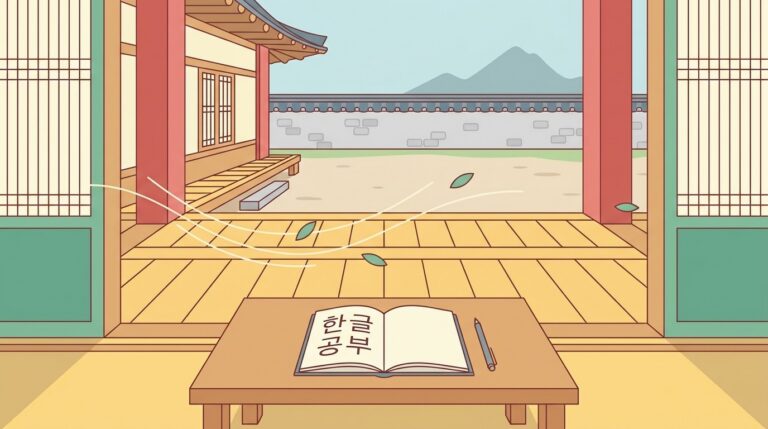
Picture this: It is late July in Seoul. The humidity clings to your skin like plastic wrap, and the heat radiating off the asphalt threatens to melt your sneakers. You seek refuge in an ancient Hanok village, slipping off your shoes to step onto the polished wooden floor of the central hall—the Daecheongmaru (대청마루). You expect the suffocating heat of an old wooden attic, but the moment you sit down, an astonishing phenomenon occurs: an invisible stream of cool air rushes over your ankles, caressing your neck and instantly evaporating your sweat. There is no buzzing air conditioning compressor, no electric fan—just pure, silent architectural alchemy.
Many advanced Korean learners find themselves tongue-tied when trying to articulate this sensory encounter. In modern Korean conversation, talking about interior spaces isn’t just about saying “방이 시원해요” (The room is cool); native speakers use nuanced, tactile idioms deeply rooted in our historical relationship with nature and airflow. If you’ve ever felt like your vocabulary flattens out when describing subtle sensory experiences or architectural elegance, you are not alone. Today, drawing from years of linguistic fieldwork and architectural heritage tours with advanced learners, we are unlocking the sophisticated C1 vocabulary and spatial mindset needed to speak fluently about traditional Hanok ventilation.
Phase 2: Top 3 Core Expressions in Depth
1. 바람길이 트이다 (Baramgiri teuida)
- Pronunciation: [Ba-ram-gi-ri teu-i-da] (Think of ba-ram like the whisper of wind, followed by giri like “geary”, and teuida with a crisp opening sound like t-wee-da)
- Meaning: Literal: “The wind path opens up.” / Nuanced: Used when an architectural passage or urban corridor allows a natural breeze to flow freely, or metaphorically when a bottleneck in communication or planning finally clears up.
- K-Culture Moment: In architectural documentaries or heritage lifestyle vlogs on YouTube, master carpenters (daemokjang) often tap the crossbeam and say: “뒤란과 마당 사이로 바람길이 시원하게 트였죠?” (See how the wind path opens up refreshingly between the back garden and the front courtyard?)
- Editor’s Insight: Gil (길) means road or path. Koreans view wind not as an ambient static condition, but as a traveler moving through designated corridors. When you say the path “opened” (teuida), you imply intentional design working in harmony with nature.
- Situation Spectrum: Casual: ⚠️ | Semi-formal: ✅ | Formal: ✅
- 🤔 Think About It: Does your native language view wind as an unpredictable element, or as an entity that follows built pathways?
2. 맞통풍이 치다 (Mat-tongpungi chida)
- Pronunciation: [Mat-tong-pung-i chi-da] (The mat- has a sharp stopped ‘t’ sound, and tong-pung rhymes with “song” and “pungent”)
- Meaning: Literal: “Cross-ventilation strikes/blows across.” / Nuanced: The dynamic sensation of air entering through one opening and exiting directly through the opposite side, creating a continuous cooling draft.
- K-Culture Moment: In contemporary real estate dramas or interior design shows, a homeowner will proudly slide open the front sliding lattice door (bunhapmun) and the rear windows, sighing: “창문을 마주 보게 열어두니 맞통풍이 쳐서 에어컨이 필요 없네요.” (Opening opposite windows lets the cross-ventilation sweep through, making AC completely unnecessary.)
- Editor’s Insight: The verb chida (치다) normally means “to strike” or “to hit.” Here, it captures the physical vigor of a swift gust of cross-breeze cutting straight through a space.
- Situation Spectrum: Casual: ✅ | Semi-formal: ✅ | Formal: ⚠️
- 🤔 Think About It: Why does Korean emphasize “counter” or “matching” (mat-) in airflow, whereas English simply refers to the structural setup of “cross-ventilation”?
3. 대청마루에 걸터앉다 (Daecheongmarue geolteoanda)
- Pronunciation: [Dae-cheong-ma-ru-e geol-teo-an-da] (Dae-cheong sounds like “day-ch-young”, and geol-teo-an-da has a linked /r/ sound: geol-ter-an-da)
- Meaning: Literal: “To perch/sit on the edge of the elevated main wooden hall.” / Nuanced: Adopting an informal, reflective posture on the threshold between indoors and outdoors, signaling rest, accessibility, and unhurried contemplation.
- K-Culture Moment: Seen in nearly every period drama (sageuk) or slice-of-life romance set in the countryside, such as Our Beloved Summer or Mr. Sunshine, where two characters share their deepest secrets while hanging their legs off the wooden hall floor toward the sunlit yard.
- Editor’s Insight: Notice the verb geolteoida (걸터앉다)—it means sitting with your thighs partially supported and your feet dangling down or touching the stone foundation. It represents a liminal state: you are neither fully inside the private room nor walking outside in the courtyard.
- Situation Spectrum: Casual: ✅ | Semi-formal: ✅ | Formal: 🚫
- 🤔 Think About It: How does sitting on an open threshold change human interaction compared to sitting on a closed-room couch?
Phase 3: Textbook Korean vs. Real Korean
Situation 1: Describing great airflow in a traditional structure
- 📖 교과서 한국어: “이 한옥은 창문 배치가 훌륭하여 공기 순환이 매우 원활합니다.” (I hanogeun changmun baechiga hullyunghayeo gonggi sunhwani maeu wonhwalhamnida. / “This Hanok has excellent window placement, so air circulation is very smooth.”)
- 🗣️ 진짜 한국어: “앞뒤 문을 다 들어 올리니까 바람이 숭숭 드나들어서 속까지 다 뻥 뚫리네요!” (Apdwi muneul da deureo ollinikka barami sungsung deunadeureoseo sokkkaji da ppeong tttulllineyo! / “Lifting up both the front and back doors lets the breeze whistle through, completely clearing my head!”)
- 💡 왜 다를까? Native speakers rely on vivid mimetic words like sungsung (숭숭, wind blowing through hollow gaps) and sensory somatic idioms like sogi ppeong ttulllida (feeling relieved/cleared inside) instead of dry engineering phrases like gonggi sunhwan (air circulation).
Situation 2: Remarking on natural cooling instead of modern air conditioning
- 📖 교과서 한국어: “실내 온도가 낮아서 에어컨을 켜지 않아도 시원합니다.” (Silnae ondoga najaseo eeokeoneul kyeoji anado siwonhamnida. / “Because the indoor temperature is low, it is cool even without turning on the air conditioner.”)
- 🗣️ 진짜 한국어: “대청마루 바닥에 등을 딱 대고 누우니까 지열도 안 올라오고 땀이 싹 가시네요.” (Daecheongmaru badage deungeul ttak daego nuunikka jiyeoldo an olllaogo ttami ssak gasineyo! / “Lying flat on the wooden hall floor keeps the ground heat away, and my sweat just evaporates instantly.”)
- 💡 왜 다를까? Koreans ground their comfort in tactile contact: deungeul ttak daeda (pressing one’s back firmly against the surface) and the dynamic departure of sweat (ssak gasida).
Phase 4: K-Culture Deep Dive & Non-Verbal Manners
4-1. Nunchi & Spatial Etiquette on the Daecheongmaru
Stepping onto a Daecheongmaru requires heightened spatial awareness (nunchi). Because the wooden planks (marupan) are tongue-and-groove or fitted without nails to allow seasonal contraction and expansion, heavy stomping is considered extremely rude and disrupts the acoustic tranquility of the Hanok.
* The Footwear Rule: Never step onto the edge of the Daecheongmaru with shoes on. Even touching the stone base (gidae) with socks while your heels rest on the ground is viewed as clumsy. Place your shoes neatly facing away from the hall before mounting.
* The Seating Posture: When conversing with elders or hosts, do not immediately sprawl out. Start by sitting cross-legged (yangbandari) or perching gracefully on the outer edge (maruteok). Only lie down if the host warmly says: “편하게 등 대고 한숨 돌리세요” (Feel free to lie down and catch your breath).
4-2. Cultural Code Analysis: The Thermal Microclimate and Chagyeong
Why is the Daecheongmaru so cool? It is all about thermodynamics and courtyard design. In front of the Daecheongmaru lies the Madang (마당)—a bare, treeless courtyard covered in light soil or crushed granite sand (masato). When the summer sun beats down on the Madang, the ground heats up rapidly, causing warm air to rise and creating a localized low-pressure zone.
Behind the Daecheongmaru, however, sits the Huwon (후원) or shaded rear garden, typically planted with leafy trees and nestled against a hillside. This area remains much cooler, creating high pressure. The hot rising air in the front courtyard pulls the cool, dense air from the rear mountain slope straight through the open Daecheongmaru. This design is intimately connected to the concept of Chagyeong (차경, “borrowing scenery”)—the open space doesn’t merely frame nature like a passive painting; it literally inhales nature’s atmosphere into the living room.
Phase 5: Real-Life Roleplay Scenario
Setting: You are spending a weekend at a restored 200-year-old Hanok guesthouse in Andong during an intense midsummer afternoon. Master Carpenter Mok, a gentle craftsman in his early 70s wearing relaxed hemp clothes (mosi), is inspecting the timber joints.
- Master Mok: 🎭 Wiping sweat from his brow and gesturing toward the lifted folding doors “서울 손님, 날이 무더운데 방에만 계시지 말고 여기 대청으로 나와 앉아 보세요.” (Seoul sonnim, nari mudeounde bang-eman gyesiji malgo yeogi daecheong-euro nawa anja boseyo. / “Guest from Seoul, it’s sweltering today; don’t stay cooped up in the room, come out and sit here in the grand hall.”)
- You: 🎭 Stepping up gingerly, placing your shoes parallel to the stepping stone “감사합니다, 어르신. 문을 위로 다 걸어 올리시니까 마루가 밖이랑 완전히 통하네요!” (Gamsahamnida, eoreusin. Muneul wiro da georeo ollisinikka maruga bakkirang wanjeonhi tonghaneyo! / “Thank you, sir. Lifting and hooking all the doors to the ceiling connects the hall seamlessly with the outside!”)
- Master Mok: 🎭 Chuckling softly and pointing toward the bamboo grove on the back hill “그렇지요. 저 뒤뜰 대숲에서 불어오는 찬 공기가 마당의 더운 공기를 밀어내면서 바람길이 절로 트이는 법입니다.” (Geureochiyo. Jeodwitteul daesup-eseo bureooneun chan gonggiga madang-ui deoun gonggireul mireonaemyeonseo baramgiri jeollo teuineun beobimnida. / “Exactly. The cold air blowing from that rear bamboo grove pushes out the hot air in the courtyard, naturally opening the wind path.”)
- You: 🎭 Letting out a sigh of relief as a breeze ruffles your hair “아, 정말이네요! 에어컨 바람처럼 차갑지 않고, 살갗에 닿는 감촉이 서늘해서 참 편안합니다.” (A, jeongmarineyo! E-eokeon baramcheoreom chagapji anko, salgate donneun gamchogi seoneulhaeseo cham pyeon-anhamnida. / “Ah, you’re right! It doesn’t bite like air conditioner wind; the touch against my skin is refreshingly cool and soothing.”)
- Master Mok: 🎭 Nodding approvingly at your refined phrasing “우리 조상들이 맞통풍 치는 이치 하나는 기가 막히게 집을 지었지요. 바닥 나무 결도 한번 쓸어 보세요.” (Uri josangdeuri mat-tongpung chineun ichi hananeun giga makige jibeul jieotjiyo. Badak namu gyeoldo hanbeon sseureo boseyo. / “Our ancestors were geniuses when it came to the principle of cross-ventilation. Try stroking the wood grain on the floor, too.”)
- You: 🎭 Gliding your palm over the smooth pine boards “대청마루 결이 울퉁불퉁하지 않고 매끄러운데도 발에 끈적하게 달라붙지 않아서 신기해요.” (Daecheongmaru gyeori ultungbultunghaji anko maekkeureoundedo bare kkeunjeokhage dallabutji anaseo sin-gihaeyo. / “The grain of the hall floor is smooth without feeling uneven, yet it’s amazing how it doesn’t stick to the soles of my feet at all.”)
- Master Mok: 🎭 Looking out toward the courtyard ridge “콩기름 먹여가며 백 년을 길들인 마루니까요. 마루턱에 걸터앉아서 풍경소리 듣고 있으면 시름이 다 잊힙니다.” (Konggireum meogyeogamyeo baeng nyeoneul gildeurin marunikkayo. Maruteoge geolteoanjaseo punggyeongsori deutgo isseumyeon sireumi da ijipnida. / “Because it’s a floor nurtured for a century with soybean oil coatings. Perching on the edge while listening to the wind chime makes all worries fade away.”)
- You: 🎭 Leaning back slightly with hands resting beside you, smiling “도시에서는 창문을 닫고만 살았는데, 집이 자연이랑 숨을 같이 쉰다는 게 뭔지 이제 알겠어요.” (Dosieseoneun changmuneul datgoman saranneunde, jibi jayeonirang sumeul gachi swindaneun ge mwonji ije algesseoyo. / “In the city, I lived with windows perpetually shut, but now I finally understand what it means for a house to breathe alongside nature.”)
🔀 Interactive Decision Branch
Master Mok offers to bring out cold watermelon slices. How do you respond to show cultural grace?
* Option A: “마루 바닥에 국물 흘리면 닦기 힘드니까 그냥 부엌에서 먹고 올게요.” (I’ll just eat in the kitchen since spilling juice on the wooden floor would be tough to wipe.)
* Option B: “어르신, 대청마루에 걸터앉아서 마당 보며 먹으면 꿀맛이겠네요. 쟁반 들고 오실 때 제가 도와드릴게요!” (Sir, perching on the edge of the hall while looking at the courtyard will taste heavenly. Let me help you carry the tray!)
* Option C: “네! 에어컨 안 켜도 마루가 시원하니까 여기서 먹는 게 식당보다 훨씬 낫네요.” (Yes! Since the hall is cool even without AC, eating here is way better than a restaurant.)
Feedback:
* Option A (Risk): While thoughtful, it sounds overly anxious and somewhat rejects the host’s hospitality. The oiled wood easily repels liquid if wiped quickly.
* Option B (Best): Flawless C1 integration! You employ maruteoge geolteoanjaseo, express cultural resonance with courtyard contemplation, and immediately offer assistance to an elder.
* Option C (Sub-optimal): Pragmatic, but transactional. It reduces an aesthetic cultural encounter down to just a cheap alternative to an air-conditioned restaurant.
Phase 6: 10-Second Emotional Shadowing Drill
- Sentence 1 [😌 Relieved & Meditative]:
문턱을 / 넘어서자마자 / 마루 밑으로 찬바람이 / 싹 감도네요.
(Munteogeul / neomeoseojamaja / maru miteuro chanbarami / ssak gamdoneyo.)
“The moment I step over the threshold / a crisp draft / gently coils around my feet.” -
Sentence 2 [😮 Amazed & Admiring]:
앞뒤 문을 / 다 개방하니까 / 바람길이 확 트여서 / 에어컨보다 시원해요!
(Apdwi muneul / da gaebanghanikka / baramgiri hwak teuyeoseo / eeokeonboda siwonhaeyo!)
“Opening both front and back doors / completely unblocks the wind path / making it cooler than any AC!” -
Sentence 3 [🍵 Warm & Contemplative]:
대청마루에 / 걸터앉아서 / 맞통풍을 맞고 있으니 / 머리가 맑아집니다.
(Daecheongmarue / geolteoanjaseo / mat-tongpungeul matgo isseuni / meoriga malgajimnida.)
“Perching on the edge of the hall / bathed in this cross-breeze / my mind clears up entirely.”
Phase 7: K-Culture Mini Dictionary
- 들문 (Deulmun) | Suspended Lifting Door
- Usage: Hanok doors fitted with ceiling hooks that swing entirely upwards to transform enclosed rooms into wide-open breezeways. In high-level cultural discourse, you use this to describe dynamic boundary changes between interior and exterior spaces.
- 차경 (Chagyeong) | Borrowing Scenery
- Usage: An East Asian landscape concept where pillars and window frames serve as a living picture frame capturing surrounding mountains or gardens. Used when analyzing architecture, photography, or high-end cafe aesthetics.
- 처마 (Cheoma) | Overhanging Eaves
- Usage: The angled roof edges that block steep summer sunlight while welcoming deep, low-angle winter sun. Essential when discussing sustainable or bioclimatic design features.
- 후원 (Huwon) | Rear Shaded Garden
- Usage: The cool, shaded garden area behind the living quarters that provides negative thermal pressure to drive the house’s cross-breeze. Often mentioned in historical palace tours (e.g., Changdeokgung Huwon).
Phase 8: Traveler’s Survival Kit
Top 3 Hanok Expressions
- 한옥의 통풍 구조가 참 과학적이네요. (Hanogui tongpung gujoga cham gwahakjeogineyo.)
- Pro Tip: Say this to Hanok docents or guesthouse owners. It immediately bridges architectural theory with respectful appreciation.
- 마루 바닥이 끈적이지 않고 정말 서늘해요. (Maru badagi kkeunjeogiji anko jeongmal seoneulhaeyo.)
- Pro Tip: Perfect for describing the unique sensation of breathable pine finished with vegetable oils under humid weather.
- 문 좀 활짝 열어서 맞통풍을 시켜도 될까요? (Mun jom hwaljjak yeoreoseo mat-tongpungeul sikyeodo doelkkayo?)
- Pro Tip: Use this polite request before swinging open opposite doors in traditional accommodations.
Editor’s Travel Note
When booking an authentic stay, skip generic lodging aggregators and check the Korea Tourism Organization Hanok Stay Certification Portal to find verified historic homes featuring genuine open Daecheong. For navigating narrow alleys in Bukchon or Jeonju where cars cannot enter, install the Naver Map English Navigation App. Remember: many wooden heritage sites prohibit wheeling hard-shell suitcases across wooden floors; always carry your baggage by hand onto the hall.
Phase 9: “One Step Deeper” (Humanities Essay)
Traditional Korean architecture does not define space by rigid barriers of concrete, but by permeable membranes that regulate energy and breath. The Daecheongmaru stands as an architectural manifestation of the Korean virtue of Bium (비움)—the intentional creation of emptiness so that nature may pass through unhindered. By deliberately leaving the front courtyard bare and elevating the central wooden deck, our forebears proved that comfort does not require subjugating nature through artificial cooling, but rather synchronizing our dwellings with wind currents and sunlight. In an age of climate anxiety and isolated apartment cubicles, the breathing floor of the Hanok reminds us that true luxury is feeling the mountain air slip softly between our toes.
💬 Your Turn: Have you ever stayed in a home that regulates temperature using purely natural materials and geometry? Drop your impressions or favorite traditional architectural features in the comments below!
Phase 10: FAQ & Common Pitfalls
Q: Isn’t the Daecheongmaru cold during the winter?
A: Yes! Traditionally, the Daecheongmaru was unheated and served strictly as a summer living space and transit hub. In winter, Koreans retreated to the Ondol (온돌) rooms, which utilized underfloor stone flues heated by firewood. Modern Hanok restorations often install concealed glass storm-doors or sub-floor hydronic coils beneath the deck to make it usable year-round.
Q: What is the linguistic difference between 마루 (Maru) and 바닥 (Badak)?
A: Badak refers generically to any flat floor surface (concrete, tile, earth, linoleum). Maru specifically designates an elevated wooden platform constructed with timber planks designed to permit airflow underneath. Calling a tiled apartment floor maru is colloquial shorthand, but in heritage contexts, maru always means wood suspended above the ground.
Q: Why isn’t trees planted in the front courtyard (Madang)?
A: Aside from defensive and spiritual reasons, it was primarily a thermodynamic necessity. Trees in the front yard would cast shade, preventing the soil from heating up. Without that hot, rising air in front, the vacuum suction needed to pull the cool breeze from the rear garden through the Daecheongmaru would disappear!
🚨 Common Mistakes Alert (Top 3)
| Incorrect / Clumsy Usage | Why It Fails | Correct Action |
|---|---|---|
| 에어컨 바람처럼 시원해요. | Misses the natural, soft quality of natural airflow. | Use “살갗에 닿는 바람이 서늘해요” (The breeze touching the skin is gently crisp). |
| 마루가 환기가 잘 돼요. | Hwangi (환기) sounds like smoke extraction or bathroom fans. | Use “맞통풍이 쳐서 바람길이 잘 나 있어요” (Cross-ventilation is striking and the wind path is clear). |
| Stepping on the wooden hall with bare wet feet. | Leaves water stains on untreated natural pine. | Always wear clean, dry socks or wipe your feet thoroughly on the threshold. |
Phase 11: Action Mission & Community Challenge
- 🥉 Bronze Level: Stand in front of your room window, open the opposite door, and say aloud: “맞통풍이 쳐서 바람길이 시원하게 트였어요!” (Practice 3 times focusing on the rhythm of teu-yeo-sseo-yo).
- 🥈 Silver Level: Post a photo of your favorite natural breeze spot or Hanok vacation snapshot on Instagram with the caption: #대청마루 느낌처럼 시원한 #바람길 and tag @DailyHangul.
- 🥇 Gold Level: On your next visit to a Hanok cafe or teahouse, ask the staff: “혹시 들문을 올려서 맞통풍을 느낄 수 있는 자리가 있을까요?” (Could there be a seat where the lifting doors are raised so I can feel the cross-breeze?).
- 🎮 K-Culture Mission: Watch Episode 3 of Our Beloved Summer or any Joseon period drama. Spot the exact scene where characters sit on the Daecheongmaru to converse and write down their body language in your study journal!
Phase 12: Interactive Quiz Challenge
1. Situational Judgment Quiz
You want to compliment a Hanok owner on how refreshing and cool the living hall feels due to the smart layout of opposite doors. Which sentence sounds most natural and sophisticated at the C1 level?
– (A) 공기 순환 설비가 참 기계적으로 잘 되어 있네요.
– (B) 앞뒤로 맞통풍이 시원하게 쳐서 더위가 싹 가시네요.
– (C) 창문이 크니까 밖이랑 똑같이 더워서 자연스러워요.
🔍 Click to Reveal Answer & Analysis
Correct Answer: (B)
Analysis: (A) sounds awkwardly mechanical (seolbi = equipment). (C) means it’s equally hot as outside, which is an insult! (B) demonstrates natural mastery of mat-tongpung and the expressive idiom deowiga ssak gasineyo.
2. Fill-in-the-Blank
한옥의 앞마당과 뒷숲의 온도 차이를 이용하면 집안에 시원한 ________이/가 트이게 됩니다.
(Hint: “The wind path”)
🔍 Click to Reveal Answer & Analysis
Correct Answer: 바람길 (Baramgil)
Analysis: The compound noun baramgil combined with teuida creates the quintessential Korean phrase for established ventilation corridors.
3. True or False Cultural Quiz
True or False? In traditional Hanok philosophy, planting large leafy trees directly in the sunlit front courtyard (Madang) was encouraged to maximize cool shade inside the Daecheongmaru.
🔍 Click to Reveal Answer & Analysis
Correct Answer: False!
Analysis: The front courtyard was deliberately kept barren of large trees so that the sun would heat the soil, triggering rising thermals that pull cool air from the shaded rear garden through the Daecheongmaru.







