

Breathing Easy Tonight: Navigating Sleep Apnea and Anti-Snoring Solutions in Korea
Phase 1: Empathy (Story-Driven Opening)
안녕하세요! 매일한글 에디터입니다. (Hello! It’s your Daily Hangul editor.)
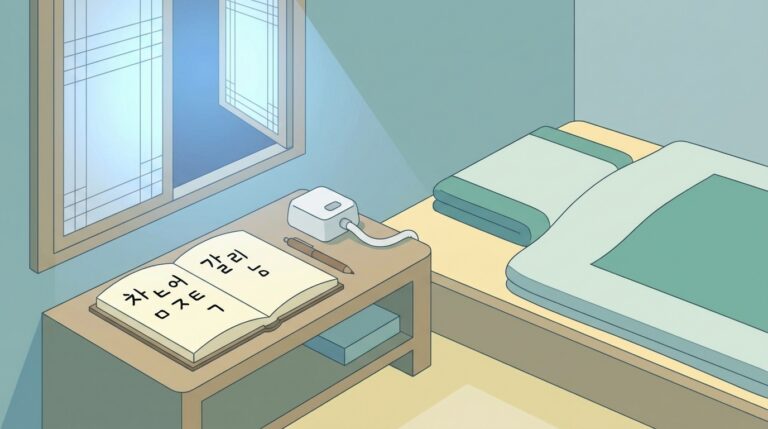
Picture this: You are staying at an atmospheric Hanok guesthouse in Jeonju or sharing a minimalist officetel in Mapo with your close Korean friends. The evening was filled with laughter, piping hot chimaek (치맥), and spirited debates about the latest K-Drama plot twist. But the next morning, you wake up feeling like a steamroller ran over your head. Your throat is sandpaper dry, your temples throb, and your travel companion gently, half-jokingly whispers, “어젯밤에 방에서 지진 난 줄 알았어!” (I thought an earthquake hit our room last night!). Beyond the friendly banter, you know the harsh reality: you felt yourself gasping for air at 3:00 AM, clutching your chest as your breath caught in your throat.
Sleep apnea (수면 무호흡증) is an exhausting, distressing condition, but dealing with it in a foreign medical environment can feel downright terrifying. At the C2 level, you can already debate Korean literature, analyze economic policies, or order fine dining effortlessly. Yet, stepping into a Seoul ear, nose, and throat clinic (이비인후과) or an advanced sleep laboratory to articulate complex nocturnal respiratory distress, polysomnography protocols, and oral advancement mechanics requires a completely different echelon of linguistic precision. Drawing from authentic patient consultations and real-world medical navigation experiences, this comprehensive guide will equip you with the sophisticated clinical vocabulary and nuanced cultural fluency needed to conquer sleep disorders in South Korea with total confidence.
Phase 2: Core Expressions (3-Key In-Depth Analysis)
1. 숨이 턱턱 막히다 (Sumi teok-teok mak-hida)
- Pronunciation: [Su-mi teok-teok ma-khi-da] (Think of the crisp, abrupt ‘t’ in stop, followed by a visceral, throat-catching ‘k’ sound for teok-teok).
- Meaning: Literal: Breath catching or clogging repeatedly | Actual Nuance: A vivid sensory description of choking sensations, airway obstruction during sleep, or suffocating physical pressure.
- K-Culture Moment: In medical dramas such as Hospital Playlist, when patients recount midnight awakenings, they bypass cold diagnostic labels and plead emotionally: “자다가 숨이 턱턱 막혀서 깼어요.” (I woke up in the middle of the night because I felt like I was literally suffocating.)
- Editor’s Insight: While lower-level textbooks rely on abstract phrases like “호흡이 곤란하다” (to have breathing difficulty), C2 speakers leverage mimetic words (uitaeeo). The duplication “턱턱” mimics the physical mechanical barrier vibrating and slamming shut in the pharynx.
- Situation Spectrum: Casual ✅ | Semi-formal ✅ | Formal ⚠️
- 🤔 Think About It: Why does Korean medical communication lean into vivid onomatopoeic/mimetic expressions to communicate somatic symptoms, whereas English often defers to clinical Latinate terms like dyspnea or asphyxiation?
2. 수면다원검사를 받다 (Sumyeon-dawon-geomsa-reul batda)
- Pronunciation: [Su-myeon-da-won-geom-sa-reul bat-da]
- Meaning: Literal: To undergo a multi-faceted sleep examination | Actual Nuance: Polysomnography (PSG)—the formal overnight diagnostic sleep study measuring EEG, pulse oximetry, airflow, and muscle movement.
- K-Culture Moment: Highlighted in reality observational shows like I Live Alone (나 혼자 산다), where celebrities visit specialized ENT clinics, getting plastered with dozens of sensor wires to analyze snoring and sleep stages.
- Editor’s Insight: In Korea’s healthcare matrix, requesting this exact technical procedure signals high medical literacy. National Health Insurance (국민건강보험) strictly regulates coverage for this test, making precise terminology essential when discussing diagnostic thresholds.
- Situation Spectrum: Casual ⚠️ | Semi-formal ✅ | Formal ✅
- 🤔 Think About It: In single-payer systems like Korea’s, patients frequently initiate requests for specialized diagnostic procedures by name rather than waiting for generalist gatekeeping. How does this reshape patient autonomy?
3. 양압기 순응도 평가 (Yang-ap-gi suneung-do pyeong-ga)
- Pronunciation: [Yang-ap-gi su-neung-do pyeong-ga]
- Meaning: Literal: Positive airway pressure compliance evaluation | Actual Nuance: The mandatory 90-day CPAP compliance period required by Korean National Health Insurance to qualify for ongoing subsidized machine rentals.
- K-Culture Moment: Health channels run by Korean doctors like Dr. Friends (닥터프렌즈) regularly emphasize that surviving the “순응도 기간” (compliance period) is the single most critical battleground for treating obstructive sleep apnea.
- Editor’s Insight: The keyword here is “순응” (compliance/adaptation). In advanced Korean, this denotes not blind obedience, but biometric and behavioral habituation to pressurized air.
- Situation Spectrum: Casual 🚫 | Semi-formal ✅ | Formal ✅
- 🤔 Think About It: Consider the societal philosophy behind condition-based insurance subsidies in Korea, where state support is tied to measured patient compliance and public health accountability.
Phase 3: Textbook Korean vs. Real-World Korean
Situation 1: Describing Intolerable Snoring to a Doctor or Partner
- 📖 Textbook Korean: “저는 밤에 코를 심하게 골아서 걱정입니다.” (Jeoneun bame koreul simhage goraseo geokjeong-imnida. / I am worried because I snore severely at night.)
- 🗣️ Real-World Korean: “제가 밤새 탱크 지나가는 소리로 코를 골아서 각방 쓸 지경이에요.” (Jega bamsae taengkeu jinaganeun soriro koreul goraseo gakbang sseul jigyeong-ieyo. / I snore like a tank rumbling by all night, to the point that we are about to sleep in separate rooms.)
- 💡 Why it differs: Koreans avoid flat adjectives like “심하게” (severely). Instead, they deploy sensory exaggeration (“tank passing”) and reference domestic reality (“각방 쓰다”—sleeping in separate rooms, a well-known cultural euphemism for sleep incompatibility).
Situation 2: Inquiring About Anti-Snoring Oral Appliances
- 📖 Textbook Korean: “코골이 방지 기구에는 어떤 것이 있습니까?” (Kogori bangji gigueneun eotteon geosi itsseumnikka? / What kinds of anti-snoring devices are there?)
- 🗣️ Real-World Korean: “양압기 말고 치과나 이비인후과에서 맞추는 구강 내 장치도 급여 적용이 되나요?” (Yang-ap-gi malgo chigwana ibiin-hugwaeseo matchuneun gugang nae jangchido geubyeo jeog-yong-i doenayo? / Aside from CPAP, are custom oral appliances made at the dentist or ENT covered under National Health Insurance?)
- 💡 Why it differs: C2 learners distinguish between cheap, over-the-counter mouthpieces and customized medical appliances (“구강 내 장치” / Mandibular Advancement Devices), while simultaneously inquiring about statutory reimbursement (“급여 적용”).
Phase 4: K-Culture Deep Dive & Non-Verbal Manners
4-1. Nunchi & Clinical Non-Verbal Etiquette
In Korean medical consultations, patients traditionally minimized nocturnal complaints due to an internalized stigma that heavy snoring merely reflects overwork or lack of stamina. When presenting your sleep apnea symptoms:
* Maintain humble yet direct eye contact. Slouching or dismissing your snoring as “just fatigue” (단순 피로) will lead clinicians to undervalue your discomfort.
* When reporting daytime hypersomnolence (주간 졸림증), present a calm, analytical demeanor. If you bring a sleep tracking log or recording from an app, show your screen deferentially with both hands, saying, “수면 녹음 기록을 확인해 주실 수 있을까요?” (Could you please review my sleep audio log?). This subtle gesture signals respect for their diagnostic authority while maintaining self-advocacy.
4-2. The Cultural Shift: From “Overwork Badge” to “Sleepnomics”
Historically in Korea’s hyper-competitive Ppalli-Ppalli (빨리빨리) culture, surviving on 4 hours of sleep was celebrated as a badge of grit (godok and yeoljeong). Snoring was often viewed through an affectionate yet inaccurate lens—proof that a father worked relentlessly for his family. Today, a monumental paradigm shift called Sleepnomics (슬립노믹스) has transformed society. Chronic fatigue and sleep apnea are now recognized as critical lifestyle risks impairing cognitive optimization. Seeking CPAP therapy or custom oral appliances is no longer stigmatized; it is seen as executive self-care.
Phase 5: Real-World Roleplay Scenario
- Setting: Consultation Room 1 at a premier ENT & Sleep Clinic in Gangnam, Seoul.
- NPC: Dr. Han Min-woo (한민우 원장), a meticulous sleep specialist with 15 years of clinical polysomnography experience.
Dialogue:
- Dr. Han: “어서 오세요. 문진표를 보니 수면 중 호흡 정지 증상으로 내원하셨네요. 구체적으로 어떤 불편함이 있으신가요?” (Eoseo oseyo. Munjinpyoreul boni sumyeon jung hoheup jeongji jeungsang-euro naewonhasyeonneyo. Guchejeog-euro eotteon bulpyeonhami itsseusingayo? / Welcome. Looking at your intake form, you visited due to pauses in breathing during sleep. What specific issues are you experiencing?)
🎭 Leaning forward, adjusting his spectacles, reviewing your intake form attentively. -
Learner: “네, 원장님. 자다가 숨이 턱턱 막혀서 화들짝 놀라 깨는 일이 잦고, 아침마다 입안이 바짝 마르고 두통이 심합니다.” (Ne, wonjangnim. Jadaga sumi teok-teok mak-hyeoseo hwadeuljjak nolla kkaeneun iri jatgo, achimmada iban-i bajjak mareugo dutong-i simhamnida. / Yes, Doctor. I frequently wake up startled because my breath catches in my throat, and every morning my mouth is parched and I have severe headaches.)
🎭 Speaking in a clear, sincere tone while lightly touching your temple to indicate discomfort. -
Dr. Han: “주간 졸림증이나 집중력 저하도 동반되나요? 동거인이 코골이가 끊기다가 ‘컥’ 하고 멎는다고 하던가요?” (Jugan jollimjeung-ina jipjungnyeok jeohado dongbandoenayo? Dong-geoin-i kogoriga kkeunkidaga ‘keok’ hago meotneundago hadeongayo? / Do you also experience daytime sleepiness or concentration drops? Has your partner reported your snoring abruptly stopping with a choking ‘gasp’?)
-
Learner: “네, 맞습니다. 숨이 멎었다가 한꺼번에 몰아쉬는 소리가 난다고 해서 주변 사람들도 밤잠을 설칠 정도입니다.” (Ne, matseumnida. Sumi meojeottadaga hankkeobeone moraswineun soriga nandago haeseo jubyeon saramdeuldo bamjameul seolchil jeongdo-imnida. / Exactly. They say I stop breathing and then gasp heavily, keeping everyone around me awake.)
🎭 Nodding ruefully with empathetic concern for your sleeping partners. -
Dr. Han: “전형적인 폐쇄성 수면 무호흡증 의심 소견입니다. 우선 정확한 AHI 지수 확인을 위해 수면다원검사를 진행하시죠.” (Jeonhyeongjeog-in pyoswaeseong sumyeon muhoheupjeung uisim sogyeon-imnida. Useon jeonghwakhan AHI jisu hwagin-eul wihae sumyeon-dawon-geomsa-reul jinhaenghasijyo. / These are textbook indications of obstructive sleep apnea. First, let’s schedule polysomnography to confirm your exact AHI index.)
-
Learner: “혹시 검사 결과에 따라 양압기 처방 외에 구강 내 장치 맞춤 제작도 고려해 볼 수 있을까요?” (Hoksi geomsa gyeolgwa-e ttara yang-ap-gi cheobang oe-e gugang nae jangchi matchum jejakdo goryeohe bol su itsseulkkayo? / Depending on test findings, could we consider a custom oral appliance alongside or instead of CPAP?)
-
Dr. Han: “물론입니다. 경도나 중등도라면 하악전진장치로도 기도를 충분히 확보할 수 있으니, 검사 후 해부학적 구조에 맞춰 최선의 옵션을 찾아봅시다.” (Mollonimnida. Gyeongdona jungdeungdoramyeon ha-ak-jeonjin-jangchirodo gidoreul chungbunhi hwakbohal su itsseuni, geomsa hu haebuhakjeok gujoe matchwo choeseon-ui opsyeon-eul chajabopsida. / Absolutely. If it is mild or moderate, a mandibular advancement device can adequately open your airway, so let’s determine the optimal option after assessing your anatomy.)
-
Learner: “친절한 설명 감사드립니다. 검사 일정 잡고 원내 수면 검사실 안내받겠습니다.” (Chinjeolhan seolmyeong gamsadeurimnida. Geomsa iljeong japgo wonnae sumyeon geomsasil annaebatgetseumnida. / Thank you for your thorough explanation. I will schedule the study and head over to the sleep lab receptionist.)
🎭 Bowing slightly from the waist as you conclude the consultation with poise.
🔀 Interactive Choice Branch
How would you respond if the doctor asks: “양압기 치료에 대해 평소 어떻게 생각하고 계셨나요?” (What have your impressions of CPAP therapy been so far?)
- Choice A: “인터넷에서 파는 2만 원짜리 실리콘 코골이 방지 마우스피스 써도 효과 똑같지 않나요?” (Can’t I just use a 20,000 KRW silicone anti-snoring mouthpiece bought online for the exact same result?)
- Choice B: “수면다원검사로 중증도를 확인한 후, 건강보험 급여가 지원되는 양압기 대여와 순응도 평가 절차를 밟고 싶습니다.” (After verifying my severity index via PSG, I want to pursue insurance-subsidized CPAP rental and complete the compliance evaluation protocol.)
- Choice C: “양압기 마스크는 거추장스러워서 절대 못 쓰겠으니, 그냥 비강 수술이나 구개인두 성형술을 당장 해주세요.” (CPAP masks are way too cumbersome so I will never use one; please perform nasal surgery or uvulopalatopharyngoplasty immediately.)
Branch Feedback:
* Choice A (Bad): ❌ Recommending cheap generic devices to an ENT expert signals disregard for TMJ joint disorders and teeth displacement. The doctor will caution you against irreversible malocclusion.
* Choice B (Best): 🌟 Flawless C2 clinical execution. It proves deep knowledge of the healthcare ecosystem, including NHI subsidies and compliance protocols.
* Choice C (Risk): ⚠️ Demanding immediate radical soft-tissue surgery without baseline data sounds combative. Modern sleep science prioritizes non-invasive pneumatic splinting over irreversible surgical interventions due to long-term relapse rates.
Phase 6: 10-Second Emotional Shadowing Drill
Master natural intonation, cadence, and respiratory pauses (/) across these three emotional states:
[😮💨 Expressing deep fatigue and physical suffocating distress]
자다가 / 숨이 턱턱 막혀서 / 몇 번이나 깨다 보니까 / 온몸이 두들겨 맞은 것처럼 / 하루 종일 멍해요.
(Jadaga / sumi teok-teok mak-hyeoseo / myeot beon-ina kkaeda bonikka / onmomi dudeulgyeo majeun geotcheoreom / haru jong-il meonghaeyo. / Waking up repeatedly with my breath choked in my throat… my whole body feels bruised, and I am in a daze all day long.)-
[🩺 Inquiring with authoritative, polite medical literacy]
제 폐쇄성 수면 무호흡증이 / 중등도 이상으로 진단될 경우 / 양압기 임대료에 대한 / 국민건강보험 급여 적용 기준이 / 어떻게 되나요?
(Je pyoswaeseong sumyeon muhoheupjeung-i / jungdeungdo isang-euro jindandoel gyeong-u / yang-ap-gi imdaeryoe daehan / gukmin-geon-gang-boheom geubyeo jeog-yong gijun-i / eotteoke doenayo? / If my obstructive sleep apnea is diagnosed as moderate to severe, what are the National Health Insurance coverage criteria for CPAP rental fees?) -
[💡 Relief tempered with sensible dental caution]
구강 내 장치를 맞추더라도 / 턱관절 장애나 / 치아 부정교합 같은 부작용을 예방하려면 / 정기적인 모니터링이 필수적이겠네요.
(Gugang nae jangchireul matchudeorado / teokgwanjeol jang-aena / chia bujeong-gyohap gateun bujagyong-eul yebangharyeomyeon / jeonggijeog-in moniteoring-i pilsujeog-igetenneyo. / Even when fitting an oral appliance, periodic dental monitoring will be essential to prevent side effects like TMJ disorders or malocclusion.)
Phase 7: K-Culture Mini Dictionary
- 무호흡-저호흡 지수 (Muhoheup-jeohoheup jisu / AHI – Apnea-Hypopnea Index): The gold-standard diagnostic metric measuring the number of respiratory cessations (apneas) or reductions (hypopneas) per hour of sleep. In Korea, an AHI score ≥ 15 (or ≥ 5 with comorbidities) unlocks subsidized CPAP rental.
- 하악전진장치 (Ha-ak jeonjin jangchi / Mandibular Advancement Device – MAD): A customized oral medical appliance created by dentists or ENTs that holds the lower jaw slightly forward, physically preventing tongue collapse against the soft palate.
- 주간 졸림 척도 (Jugan jollim cheokdo / Epworth Sleepiness Scale – ESS): A standardized self-assessment questionnaire administered at Korean sleep clinics to quantitatively gauge daytime sleepiness.
- 수면 분절 (Sumyeon bunjeol / Sleep Fragmentation): Frequent micro-arousals throughout the sleep cycle caused by oxygen desaturation. Korean doctors often use this term when explaining why patients sleep eight hours yet wake up utterly exhausted.
Phase 8: Survival Kit for Travelers
Survival Phrases TOP 3
- “약국에 코골이 완화용 비강 스프레이나 비강 확장 밴드 있나요?”
(Yak-guk-e kogori wan-hwa-yong bigang seupeureina bigang hwakjang baendeu itsseumnayo?)
Pro Tip: Fantastic for short-term mucosal congestion in dry hotel rooms when machines aren’t available. - “수면클리닉 예약하고 싶은데, 초진 당일에 바로 수면다원검사 입원이 가능한가요?”
(Sumyeon-keullinik yeyakhago sipeunde, chojin dang-ire baro sumyeon-dawon-geomsa ibwon-i ganeunghangayo?)
Pro Tip: Most major Korean sleep centers require a daytime preliminary exam before booking an overnight sleep study room. - “양압기 소모품인 나잘 마스크(Nasal Mask)와 튜브만 원내에서 비급여로 별도 구매할 수 있나요?”
(Yang-ap-gi somopum-in najal maseukeuwa tyubeuman wonnae-eseo bi-geubyeoro byeoldo gumaehal su itsseumnayo?)
Pro Tip: Lifesaver if your CPAP silicone cushion tears during travel across Korea.
Editor’s Travel Note
When seeking immediate respiratory or sleep specialists in Seoul or Busan, utilize the Goodoc hospital appointment booking app to locate certified sleep medicine specialists (수면인증의) nearby. Most tertiary and specialized ENT clinics accept international credit cards seamlessly at self-service kiosks (muin suhapgi). If you carry a foreign CPAP device, note that Korea uses Type C/F plugs at 220V/60Hz; check that your unit is dual-voltage (100–240V) to avoid frying your motor!
Phase 9: “One Step Deeper” (Reflective Inquiry)
In a communal society where group living has historically predominated—from traditional shared Ondol floors to mandatory military barracks and shared university dormitories—one’s nocturnal respirations are rarely viewed as merely private affairs. Loud snoring has historically provoked profound embarrassment because Korean interpersonal ethics are anchored in Baeryeo (배려)—active consideration for others’ peace of mind. By examining sleep apnea through this lens, we see why seeking advanced treatment in Korea is framed not solely as individual healthcare, but as a considerate act of social harmony.
💬 Your Turn: In your home country, is snoring primarily seen as an annoying personal trait, or is it treated as a critical cardiovascular health hazard requiring medical technology? Share your perspective in the comments below!
Phase 10: FAQ & Common Mistakes
Q: Can registered foreigners access National Health Insurance subsidies for CPAP in Korea?
A: Yes! Foreigners who have lived in Korea for more than 6 months and are enrolled in the National Health Insurance Corporation (NHIC) with an Alien Registration Card are entitled to the exact same coverage. Once diagnosed with moderate-to-severe OSA via polysomnography, your monthly CPAP rental fee drops to approximately 15,000 to 20,000 KRW, provided you pass the mandatory 90-day compliance evaluation.
Q: Should I visit an ENT (이비인후과), a Neurologist (신경과), or a specialized Dentist (치과)?
A: If your primary issue is anatomical upper-airway collapse, enlarged uvula/tonsils, or nasal deviation, start with an ENT (이비인후과). If your apnea is tangled with restless leg syndrome, central sleep apnea, or severe chronic insomnia, visit a Neurology sleep center (신경과 수면클리닉). For custom mandibular advancement splints without CPAP, consult an Oral Medicine Dentist (구강내과).
Q: What is the medical difference between OTC snoring mouthpieces and clinic-made oral appliances?
A: Over-the-counter boil-and-bite mouthpieces apply uncontrolled pressure to front incisors and cannot be titrated. This can permanently alter your dental occlusion and trigger severe temporomandibular joint (TMJ) arthrosis. Clinic-grade mandibular advancement devices (하악전진장치) are precisely cast from 3D scans with adjustable millimeter-titration screws.
🚨 Common Mistakes Warning Board
- Mistake 1: Asking for sleeping pills (수면제) to stop waking up from apnea.
Correct Action: Sedatives relax throat musculature even further, transforming mild hypopnea into dangerous full airway collapse. Demand a sleep study (수면다원검사), never sedatives, for obstructive choking. - Mistake 2: Conflating simple snoring (단순 코골이) with sleep apnea (수면 무호흡증) during clinic triage.
Correct Action: Make sure to explicitly emphasize pauses in breathing, morning dry mouth, and cognitive fogginess rather than just noise. - Mistake 3: Failing to meet the daily minimum hours during the 90-day CPAP compliance trial (순응도 평가 기간).
Correct Action: The NHIC mandates utilizing the device for at least 4 hours per night across 70% of days over a consecutive 30-day window within the initial 90 days. Falling below this revokes your government subsidy!
Phase 11: Action Missions
- 🥉 Bronze Mission (Solo Shadowing): Practice reading the 3 emotional shadowing drills from Phase 6 aloud until your delivery matches native intonation and rhythm without hesitation.
- 🥈 Silver Mission (Community Engagement): Post a short reflection in your Korean study journal or online language exchange app using the phrase “숨이 턱턱 막히다” in both a literal medical sense and a figurative daily stress context.
- 🥇 Gold Mission (Real-World Practice): Open a Korean portal map app, search for “수면이비인후과” (Sleep ENT) in your neighborhood, and read three patient reviews (방문자 리뷰) to identify technical terminology discussed in this guide.
- 🎮 K-Culture Quest: Watch an episode of an investigative health documentary like EBS 명의 (Best Doctors) focused on sleep disorders, and note how medical professionals use airway cross-section graphics to explain obstructive breathing.
Phase 12: Interactive Quiz Challenge
1. Situational Clinical Judgment
You are in an ENT consultation room. The specialist asks whether your airway feels blocked while sleeping. Which response exhibits natural, high-level (C2) medical Korean?
* (A) 그냥 소리가 크고 잠을 못 자요.
* (B) 자다가 기도가 좁아져서 숨이 턱턱 막히고 컥 하면서 깨는 무호흡 증상이 반복됩니다.
* (C) 양약국에서 코골이 방지 스티커 샀는데 별로예요.
2. Fill-in-the-Blank
수면 무호흡증 환자가 국민건강보험 지원을 받아 양압기(CPAP)를 지속해서 대여하려면, 최초 90일 동안 기기 사용 시간을 확인하는 ( ) 평가를 반드시 통과해야 합니다.
3. True / False Cultural Fact
True or False: In South Korea, over-the-counter anti-snoring mouthpieces bought on generic shopping apps are eligible for 80% National Health Insurance reimbursement.
🔍 Click to reveal answers and explanations
-
Answer: (B)
Explanation: Option B flawlessly integrates descriptive mimetic vocabulary (“숨이 턱턱 막히다”), physiological airway collapse (“기도가 좁아지다”), and accurate clinical terminology (“무호흡 증상”). Option A is too rudimentary, and Option C focuses on informal home remedies. -
Answer: 순응도 (Compliance / Suneung-do)
Explanation: The “순응도 평가” (compliance evaluation) is the mandatory statutory trial where patients must prove consistent usage to secure sustained government financial support. -
Answer: False
Explanation: Only prescription polysomnography-guided therapies and authorized CPAP rentals prescribed by certified physicians qualify for National Health Insurance benefits. Over-the-counter commercial devices are entirely out-of-pocket and not medically regulated for severe OSA treatment.






