

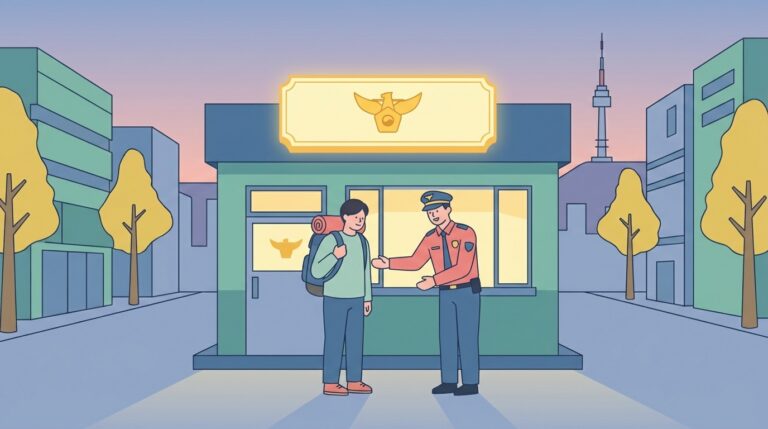
Phase 1: Empathy (Story-Immersive Opening)
안녕하세요! 매일한글 에디터입니다.
Imagine this: You are wrapping up a magical evening under the glowing neon signs of Hongdae. You spent the last hour watching an incredible street dance crew, sipping sweet iced tea, and soaking in the electric Seoul nightlife. Everyone told you that Korea is the safest place on earth—a country where people famously leave MacBooks and smartphones unattended on cafe tables for hours without a worry. So you felt completely at ease.
Then, as you reach into your tote bag to grab your transit card, your stomach drops into an icy void. Your wallet is gone. Your Alien Registration Card (or passport), your emergency cash, and your primary credit card—vanished. Did it fall out during the crowd crush? Did someone pickpocket you? A wave of panic rushes over you: How do I explain this to a police officer in Korean? Will they understand me? How do I get an official police report for my embassy or insurance?
Take a deep breath. You are not alone, and you are not helpless. Having guided international students and travelers through this exact harrowing experience for over a decade, I can assure you that Korea has one of the world’s most efficient civil response systems—complete with ubiquitous CCTV and integrated lost-and-found registries. In this B2 intermediate guide, we will look beyond simple textbook vocabulary to master the exact, nuanced Korean expressions you need to report theft or loss authoritatively and clearly. Let’s make sure you get your belongings back safely!
Phase 2: Core 3 Expressions In-Depth
1. 지갑을 소매치기당한 것 같아요 (Jigabeul somaechigidanghan geot gat-ayo)
- Pronunciation: jee-gahb-eul soh-mae-chee-gee-dahng-hahn got gaht-ah-yo (Think of “so matchy” + “dang” with a soft ending).
- Meaning: “I think my wallet was pickpocketed.” (Literal: “I think my wallet suffered pickpocketing.”)
- K-Culture Moment: You hear this line in thrilling crime K-Dramas like Signal or Taxi Driver, where an unsuspecting tourist or commuter realizes someone slipped a hand into their coat in a crowded subway station.
- Editor’s Insight: At the B2 level, notice the passive causative construction
-당하다(-danghada), which indicates suffering an undesirable action from someone else. Combining it with-ㄴ 것 같아요softens your accusation while still making your suspicion clear to the officer without sounding overly aggressive.- Situation Spectrum: Casual: ⚠️ | Semi-formal: ✅ | Formal: ✅
- 🤔 Think About It: In English, we simply say “I was pickpocketed.” Why do you think Korean uses indirect softening endings (
-ㄴ 것 같아요) even when reporting a potential crime?2. 분실물 접수증 좀 뗄 수 있을까요? (Bunsilmul jeopsujeung jom ttel su isseulkkayo?)
- Pronunciation: boon-sheel-mool jup-soo-jeung johm ddel soo ee-sseul-kkah-yoh (Rhymes with “tell” with a tense, snappy ‘tt’ sound).
- Meaning: “Could you please issue a lost property report receipt?”
- K-Culture Moment: A classic scene at an Incheon Airport police desk in travel vlogs, where a traveler needs an official certificate for their embassy to reissue an emergency passport.
- Editor’s Insight: Notice the verb 떼다 (tteda). While its literal meaning is “to detach or pull off,” in administrative Korean, it is widely used idiomatically to mean “to have a document issued or printed” (e.g., 서류를 떼다). Using this verb instantly signals intermediate fluency.
- Situation Spectrum: Casual: 🚫 | Semi-formal: ✅ | Formal: ✅
- 🤔 Think About It: Notice the polite filler 좀 (jom), meaning “a little.” Why do Koreans insert “a little” into an urgent administrative request?
3. 카드 결제 내역 확인하고 분실 신고부터 해야겠어요 (Kadeu gyeolje naeyeok hwaginhago bunsil singobuteo haeyagesseoyo)
- Pronunciation: kah-deu gyohl-jeh nae-yuhk hwahk-een-hah-goh boon-sheel sheen-goh-boo-tuh hae-yah-geht-ssuh-yoh.
- Meaning: “I should check my card transactions and report it lost first.”
- K-Culture Moment: In modern romantic comedies, you will often see a flustered protagonist sitting on the curb after a date, urgently pulling up their banking app while muttering this sentence to their friend.
- Editor’s Insight: This sentence pairs sequential connective
-고with prioritization particle-부터(“starting with”). It displays structured, pragmatic problem-solving in Korean rather than unorganized panic.- Situation Spectrum: Casual: ✅ | Semi-formal: ✅ | Formal: ⚠️
- 🤔 Think About It: In an emergency, structuring your intended actions with
-부터helps bystanders and helpers understand what step you are currently handling.
Phase 3: Textbook Korean vs. Real Korean
Situation 1: Explaining what happened at the police box
- 📖 교과서 한국어: 제 지갑을 잃어버렸습니다. 찾아주세요. (Je jigabeul ireobeoryeotseumnida. Chajajuseyo. – I lost my wallet. Please find it.)
- 🗣️ 진짜 한국어: 30분 전쯤에 홍대 버스킹 보다가 지갑을 도난당한 것 같아요. (Samsipbun jeonjjeume Hongdae beoseuking bodaga jigabeul donandanghan geot gat-ayo. – I think my wallet was stolen while watching busking in Hongdae about 30 minutes ago.)
- 💡 왜 다를까? Textbook phrases are blunt imperatives. Native speakers provide specific context, temporal markers (
-쯤에), ongoing background actions (-다가), and measured speculation (-ㄴ 것 같다) to help police check CCTV footage quickly.
Situation 2: Asking if anyone turned in a misplaced passport
- 📖 교과서 한국어: 제 여권이 여기에 있습니까? (Je yeogwoni yeogie itseumnikka? – Is my passport here?)
- 🗣️ 진짜 한국어: 혹시 파란색 여권 습득물 들어온 거 있나요? (Hoksi paransaek yeogwon seupdeungmul deureoon geo innayo? – By any chance, has any blue passport been turned in as a found item?)
- 💡 왜 다를까? Asking “Is my passport here?” puts the listener on the defensive. Using 습득물 (seupdeungmul – acquired/found property) and asking if anything “came in” (
들어온 거 있나요?) reflects actual administrative vocabulary used in Korean lost-and-found centers.
Phase 4: K-Culture Deep Dive & Non-Verbal Manners
4-1. 눈치 (Nunchi) & Gestures: Navigating the 파출소 (Pachulso / Police Box)
When you walk into a Korean 지구대 (jigudae – district unit) or 파출소 (pachulso – police box), your body language dictates how quickly the officers can assist you:
* Approach with deference, not frantic shouting: Even if your adrenaline is spiking, take off your sunglasses, step forward, bow slightly at 15 degrees, and use an introductory softening phrase like “저기요, 죄송한데…” (Excuse me, I’m sorry to bother you, but…).
* Keep your hands visible: Avoid pacing erratically or waving your arms over an officer’s desk. Place your hands together politely or show your digital ID on your phone screen with both hands.
* Clear chronology over emotion: Korean officers prioritize verifiable timelines for CCTV retrieval. Showing them an exact receipt timestamp or bus transit exit log on your transit card app speaks louder than words.
4-2. Cultural Code Analysis: The Reality of CCTV and Lost & Found in Korea
Foreign visitors frequently hear that Korea is so safe you can leave your phone on a subway seat and find it still there the next day. While honest citizens do turn in found items at astonishingly high rates, tourist hubs like Myeongdong, Dongdaemun, and Hongdae are not immune to opportunistic theft or accidental loss.
South Korea operates an extensive urban surveillance network, often termed CCTV 공화국 (Republic of CCTV). Furthermore, the National Police Agency runs LOST112, an integrated database where every recovered item across buses, subways, taxis, and streets is cataloged with photographs. Knowing how to request an official search or document opens the doors to this system.
Phase 5: Real-World Roleplay Scenario
Setting: A rainy Friday night inside the Mapo Hongik District Police Box (홍익지구대). Bright fluorescent lighting, radios crackling softly.
NPC: Officer Kim (경찰관 김 순경), a calm, professional officer with a notepad ready.
- Turn 1 (User):
저기요, 실례지만… 방금 지갑이랑 여권을 도난당한 것 같아서요.
(Jeogiyo, sillyejiman… banggeum jigab-irang yeogwon-eul donandanghan geot gat-aseoyo.)
“Excuse me, pardon me… but I think my wallet and passport were just stolen.”
🎭 Walks up to the service counter, bowing slightly with an anxious look. -
Turn 2 (Officer Kim):
아, 그러세요? 많이 당황하셨겠어요. 이쪽으로 앉으세요. 어디서 마지막으로 확인하셨어요?
(A, geureoseyo? Mani danghwanghasyeotgesseoyo. Ijjogeuro anjeuseyo. Eodiseo majimageuro hwaginhasyeosseoyo?)
“Oh really? You must be very shocked. Please sit over here. Where did you last check them?”
🎭 Pulls out a chair and opens a police incident intake form. -
Turn 3 (User):
한 20분 전에 9번 출구 근처 버스킹 공연 볼 때까지는 가방 안에 있었거든요.
(Han isipbun jeone gubeon chulgu geuncheo beoseuking gong-yeon bol ttaekkajineun gabang ane isseotgeodeunyo.)
“Until about 20 minutes ago when I was watching a busking show near Exit 9, they were definitely inside my bag.”
🎭 Shows the opened zipper of the backpack to explain. -
Turn 4 (Officer Kim):
혹시 카드 결제 알림이 오거나, 누군가 사용한 내역은 없나요?
(Hoksi kadeu gyeolje allimi ogeona, nugun-ga sayonghan naeyeogeun eomnayo?)
“Have you received any card transaction alerts or seen unauthorized charges?”
🎭 Clicks his pen and listens attentively. -
Turn 5 (User):
다행히 아직 결제된 내역은 없어서 바로 해외 결제 차단부터 해뒀어요.
(Dahaenghi ajik gyeoljedeon naeyeogeun eopseoseo baro hae-oe gyeolje chadanbuteo haedweosseoyo.)
“Fortunately, there are no charges yet, so I blocked international transactions first.”
🎭 Taps smartphone screen to confirm bank status. -
Turn 6 (Officer Kim):
대처를 아주 잘하셨네요. 그럼 우선 유실물 접수부터 하고, 근처 방범 CCTV 확인할 수 있는지 볼게요.
(Daecheoreul aju jalhasyeonneyo. Geureom useon yusilmul jeopsubuteo hago, geuncheo bangbeom CCTV hwaginhoebolgeyo.)
“You handled that very well. First, let’s file a lost/stolen property report, and I will see if we can check nearby security cameras.”
🎭 Passes a standardized incident declaration sheet. -
Turn 7 (User):
감사합니다. 저 그런데 대사관에 긴급 여권 신청하려면 분실 접수증도 필요한데 끊어주실 수 있나요?
(Gamsahamnida. Jeo geureonde daesagwane gingeup yeogwon sincheongharyeomyeon bunsil jeopsujeungdo piryohande kkeuneojusil su innayo?)
“Thank you. By the way, I need a lost report certificate to apply for an emergency passport at the embassy; could you issue that for me?”
🎭 Politely clasps hands together in an inquiring gesture. -
Turn 8 (Officer Kim):
네, 인적 사항이랑 소지품 특징 적어주시면 접수증 바로 발급해 드릴게요.
(Ne, injeok sahang-irang sojipum teukjing jeogeojusimyeon jeopsujeung baro balgeuphae deurilgeyo.)
“Yes, once you fill in your personal information and descriptions of the belongings, I will issue the certificate right away.”
🎭 Points politely to the name, nationality, and item description fields on the sheet.
🔀 Interactive Decision Branch
What should you do after Officer Kim hands you the incident form?
* Option A: Ask the officer to immediately walk with you back to the street to confront the crowd.
Feedback: Bad. Korean police cannot abandon the district station or search civilians without specific CCTV verification or immediate physical evidence.
* Option B: Complete the form meticulously, write down distinctive marks on your wallet, and request a copy of the report (접수증) for your embassy.
Feedback: Best! Detailed descriptions (brand, color, keyrings) enter the nationwide LOST112 system, and the report certificate is mandatory for emergency travel documents.
* Option C: Say nothing about your passport and only report the wallet because you don’t want to bother embassy personnel.
Feedback: Risk. Traveling or departing Korea without an active passport or official report will cause severe immigration complications at the airport.
Phase 6: 10-Second Emotion Shadowing Drill
Practice reading these out loud, observing the pause marks (/) and capturing the realistic emotion:
[😰 당황스럽고 다급하게 / Frantic & Flustered]
저기요, / 가방 지퍼가 열려 있는데 / 지갑이랑 여권이 사라졌어요!
(Jeogiyo, / gabang jipeoga yeollyeo inneunde / jigab-irang yeogwoni sarajyeosseoyo!)-
[🧊 침착하게 상황 설명 / Calm & Methodical]
카드 회사에 전화해서 / 지급정지 신청은 이미 마쳤습니다.
(Kadeu hoesae jeonhwahaeseo / jigeubjeongji sincheong-eun imi machyeotseumnida.) -
[🙏 정중하게 요청 / Polite Administrative Request]
대사관 제출용으로 / 분실 확인증 한 장만 / 발급해 주실 수 있나요?
(Daesagwan jechulyong-euro / bunsil hwaginjeung han jangman / balgeuphae jusil su innayo?)
Phase 7: K-Culture Mini Dictionary
- 유실물 종합포털 (Yusilmul Jonghap Poteol) / LOST112
Official police lost & found portal. Every police station, subway line, and taxi company registers items here with photos. Searching this database is standard procedure. - 지급정지 (Jigeubjeongji)
Payment freeze / Suspension of card transactions. The critical financial term to demand from your bank or credit card hotline immediately after an incident. - 분실 접수증 (Bunsil Jeopsujeung)
Official proof of loss report. The essential paperwork required by embassies to issue emergency passports and by travel insurance companies to process reimbursement. - 주한 대사관 (Juhan Daesagwan)
Foreign Embassy located in Korea. (e.g., 주한 미국 대사관 – Embassy of the USA in Korea). Your primary destination when a passport is irretrievably stolen.
Phase 8: Survival Kit for Travelers
Top 3 Immediate Survival Phrases
- 지갑을 분실했어요. (Jigabeul bunsilhaesseoyo.)
“I lost my wallet.”
Pro Tip: Use 분실했어요 instead of simple casual verbs when speaking to security guards, subway staff, or police desks. - 도난 신고 접수하러 왔어요. (Donan singo jeopsuhareo wasseoyo.)
“I came to file a theft report.”
Pro Tip: Stating your visit’s purpose with-러 왔어요immediately routes you to the correct desk without awkward pauses. - CCTV 확인 좀 부탁드려도 될까요? (CCTV hwagin jom butakdeuryeodo doelkkayo?)
“May I politely request to check the CCTV?”
Pro Tip: Civilians cannot directly browse private CCTV due to privacy laws (개인정보보호법), but police officers can review footage on your behalf.
Editor’s Travel Note
- Navigate to your nearest police box via the [Naver Map app download for iOS and Android] or search for 지구대 on KakaoMap.
- Check the official [Korean National Police Agency LOST112 portal] daily. Items often take 24–48 hours to transfer from local subway desks to the central police system.
- Keep digital color scans of your passport information page and flight itinerary saved in cloud storage offline.
Phase 9: “한 발 더 깊이” (A Step Deeper)
In South Korea, social trust is maintained not merely by individual goodwill, but through a comprehensive civic infrastructure of mutual accountability. When someone misplaces an item, the social expectation is not to pocket it, but to hand it over to a nearby store owner, bus driver, or police box. At the same time, because personal privacy laws (개인정보보호법) are strictly enforced, store owners cannot simply hand you their security camera hard drives without a police officer present. Navigating an emergency in Korea requires balancing trust in the community with respect for structured institutional procedures.
💬 Your Turn: Have you ever lost an important belonging while traveling in Korea or abroad? How did the local reporting process compare to your home country? Drop your story in the comments below!
Phase 10: FAQ & Avoiding Misunderstandings (FAQ Schema)
Q: Can I review the CCTV footage of a cafe or subway station myself?
A: Generally, no. Under Korea’s Personal Information Protection Act, private citizens cannot view CCTV footage containing faces of other individuals without their consent. However, if you visit the establishment accompanied by a police officer or have an officer request the footage, the owner can legally examine it.
Q: What is the difference between 파출소 (Pachulso) and 경찰서 (Gyeongchalseo)?
A: A 경찰서 is a central district police headquarters dealing with formal criminal investigations and processing. A 파출소 (or 지구대) is a neighborhood branch station handling immediate patrol, community safety, initial theft declarations, and lost items. For immediate local help, always head to the nearest 파출소 or 지구대.
Q: Does calling 112 work if I don’t speak fluent Korean?
A: Yes! When you dial 112, you can say “English, please” or “통역 부탁드립니다 (Tong-yeok butakdeurimnida)”. The 112 dispatch center will patch in a three-way translation call through the BBB Korea interpretation service or the Korea Tourism Organization (1330) hotline.
🚨 Common Mistakes Board
- ❌ Mistake 1: Panicking and accusing nearby staff directly of theft (“당신이 가져갔어요?”).
👉 Correct Action: State the factual occurrence neutrally using-ㄴ 것 같아요(“혹시 보관 중인 분실물이 있나요?”). - ❌ Mistake 2: Leaving the police station without the printed 분실 접수증 (Lost Property Certificate).
👉 Correct Action: Ensure you explicitly say “접수증 떼어 주세요” to secure proof for your embassy appointment. - ❌ Mistake 3: Assuming your items are gone forever within the first hour.
👉 Correct Action: Most found items on subway lines are turned in at the line’s terminus at the end of the shift. Check LOST112 for up to 3 days.
Phase 11: Action Missions & Community
- 🥉 Bronze Mission (Self Practice): Stand in front of a mirror and practice Turn 1 of our roleplay with accurate facial expression and clear pronunciation: “저기요, 죄송한데 지갑을 분실한 것 같아서요.”
- 🥈 Silver Mission (Social Challenge): Open the LOST112 website on your phone, find the search filter for your current/favorite neighborhood in Seoul, and take a screenshot of one recovered item category.
- 🥇 Gold Mission (Real Fluency): Next time you pass a 파출소 (Police Box), observe the signage. Memorize their official station title (e.g., OO 지구대) and identify where their emergency intercom is located.
- 🎮 K-Culture Mission: Watch an episode of a police-themed K-Drama (like Live or Rookie Cops) and listen for the words 습득물, 유실물, or 지구대.
Phase 12: Interactive Quiz Challenge
1. Situation Judgment Quiz
You notice your wallet missing after riding Subway Line 2. You arrive at the station master’s office. Which statement is the most natural, B2-level way to ask?
* (A) 야! 내 지갑 내놔!
* (B) 방금 2호선 열차에서 지갑을 두고 내린 것 같은데 혹시 습득된 게 있나요?
* (C) 지갑이 사라졌습니다. 당장 찾아주십시오.
👉 Click to reveal Answer & Explanation
Correct Answer: (B)
Explanation: Option (A) is rude, informal slang. Option (C) is an overly blunt command. Option (B) uses the natural intermediate construction -은 것 같다 alongside the polite professional noun 습득된 게 (found item).
2. Fill-in-the-Blank Quiz
Complete the sentence requesting an official document for the embassy:
* 대사관에 제출해야 해서 분실 ( ) 좀 뗄 수 있을까요?
👉 Click to reveal Answer & Explanation
Correct Answer: 접수증 (or 확인증)
Explanation: 분실 접수증 (Receipt of loss report) is the standard administrative paperwork issued by Korean police.
3. True or False Cultural Quiz
Statement: In Korea, you are legally entitled to look through a private business’s CCTV footage directly if you lost something inside their store.
👉 Click to reveal Answer & Explanation
Correct Answer: False
Explanation: Under Korean privacy laws, business owners face heavy penalties if they disclose CCTV recordings containing others’ private likenesses to civilians without a police officer present or official warrant.







