

Navigating the Void: Debating Contemporary Art’s Esotericism vs. Mass Appeal in High-Level Korean
Phase 1: 공감 (Immersive Opening)
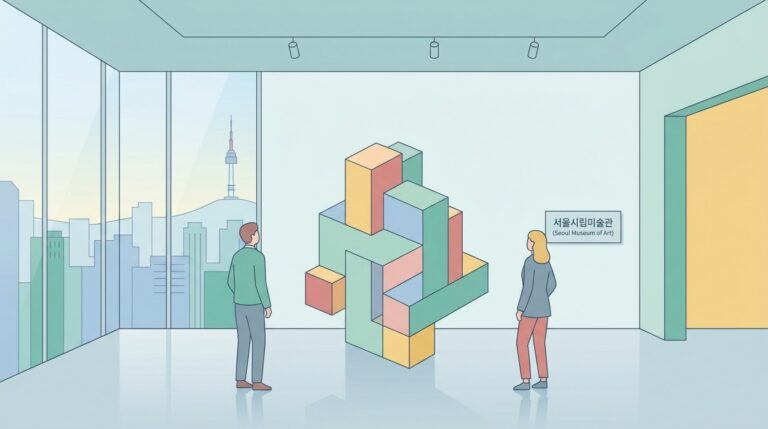
안녕하세요! 매일한글 에디터입니다. Picture this: You are standing in the sunlit pavilion of the National Museum of Modern and Contemporary Art (MMCA) in Samcheong-dong, Seoul. In front of you sits a plain wooden chair flanked by a pile of unpainted gravel. Beside you, visitors are nodding with intense, intellectual reverence. You read the gallery wall text, only to be confronted with terms like ‘존재론적 균열’ (ontological rupture) and ‘비장소성의 미학’ (aesthetics of non-placeness). You think to yourself: Is this profound, or is it simply an intellectual prank?
When you try to discuss this in Korean, however, your words falter. You know how to say “이해하기 어려워요” (It’s hard to understand), but at your advanced level, that feels terribly simplistic—borderline philistine. You want to articulate the subtle friction between impenetrable conceptual art and genuine public resonance, but without sounding like you disregard modern art entirely.
Over the past decade of coaching diplomats, graduate researchers, and art curators who learned Korean, I have seen even C2 speakers hit this exact wall. Contemporary art in South Korea has exploded—fueled by events like Frieze Seoul and RM of BTS inspiring millions of young gallery-goers—yet the cultural gap between academic art circles and everyday gallery visitors remains cavernous. This guide will equip you with the sophisticated rhetoric, socio-cultural nuance, and idiomatic precision needed to critique art exhibitions with intellectual grace.
Phase 2: 핵심 표현 3선 심층 분석 (In-Depth Core Expressions)
1. 꿈보다 해몽이다 (Kkumboda haemong-ida)
- Pronunciation: [Kkoom-boh-dah hae-mong-ee-dah] (Think of ‘Kkoom’ like a punchy ‘cool’ without the ‘l’, and ‘haemong’ echoing ‘hay-mong’)
- Meaning: Literally, “The dream interpretation is better than the dream itself.” In actual discourse, it conveys that the post-hoc rationalization, critique, or artistic statement is vastly more elaborate than the actual artwork warrants.
- K-Culture Moment: Frequently whispered by film critics on YouTube review channels (e.g., Movie Badass) when analyzing experimental indie films where a director’s brief abstract sequence triggers twenty pages of academic theorizing.
- Editor’s Insight: Use this when a piece of art appears hollow or minimalist, yet the curator’s wall plaque is drenched in European continental philosophy. It’s a witty, slightly cynical observation that signals you aren’t easily seduced by art-world jargon.
- Situation Spectrum: Casual ✅ | Semi-formal ✅ | Formal ⚠️ (Prefer ‘과도한 의미 부여’ in academic papers)
- 🤔 Think About It: Does your native tongue have an idiom that distinguishes genuine creative depth from verbal over-justification? Why does Korean culture value ‘dream reading’ (해몽) as an art of rhetorical rescue?
2. 대중의 눈높이와 겉돌다 (Daejung-ui nunnopi-wa geotdolda)
- Pronunciation: [Dae-joong-ui noon-noh-pee-wah geot-dohl-dah] (Rhymes smoothly; ‘geotdolda’ sounds like ‘gut-dohl-dah’, mimicking the motion of skimming the surface)
- Meaning: Literally, “To spin outward from the eye-level of the public.” Nuance: To completely fail to connect with or resonate with the general audience’s sensibility and lived experience.
- K-Culture Moment: Commonly printed in art columns of newspapers like The Hankyoreh or Kyunghyang Shinmun when critiquing taxpayer-funded public installations that local citizens find alienating or bizarre.
- Editor’s Insight: ‘눈높이’ (eye-level) implies empathy and mutual understanding, while ‘겉돌다’ describes gears failing to mesh. Combining them creates an incisive aesthetic critique that avoids calling the art “bad,” framing it instead as an issue of communicative failure.
- Situation Spectrum: Casual ⚠️ | Semi-formal ✅ | Formal ✅
- 🤔 Think About It: Notice the visual metaphor ‘눈높이’ (eye-level). In Korean cultural discourse, accessibility is rarely framed as “dumbing down,” but rather as meeting someone eye-to-eye.
3. 담론에 매몰되다 (Damron-e maemol-doeda)
- Pronunciation: [Dahm-rohn-eh mae-mohl-dweh-dah] (Crisp ‘dahm’, round ‘rohn’, followed by ‘mae-mohl’ sounding like ‘meh-mole’)
- Meaning: Literally, “To be buried alive in discourse.” Nuance: When an artist or exhibition becomes so obsessed with theoretical rhetoric that the tactile, sensory, and visceral quality of the art is extinguished.
- K-Culture Moment: Often debated in university art departments (홍대 or 한예종) among senior MFA students questioning whether their graduate critique panels care more about French philosophy citations than their painting craft.
- Editor’s Insight: This is pure C2 territory. It cuts straight to the core of institutional critique. Dropping this expression during a gallery talk shows that you not only understand the Korean language, but you also understand the institutional fatigue of modern academia.
- Situation Spectrum: Casual 🚫 | Semi-formal ✅ | Formal ✅
- 🤔 Think About It: How does your culture view art that requires a manual to decipher? Is visual art still visual if it must be read rather than felt?
Phase 3: 교과서 한국어 vs 진짜 한국어 (Textbook vs. Real Native Korean)
Situation 1: Critiquing an exhibition that feels too detached and abstract
- 📖 교과서 한국어: 이 전시는 너무 추상적이어서 보통 사람들이 이해하기 어렵습니다. (I jeonsineun neomu chusangjeog-ieoseo botong saramdeuri i-haehagi eoryeopseumnida.)
*— “This exhibition is too abstract, so it is difficult for regular people to understand.” - 🗣️ 진짜 한국어: 메시지가 지나치게 사변적이라 대중과의 접점을 찾지 못하고 겉도는 느낌이네요. (Mesijiga jinachige sabyeonjeog-ira daejung-gwa-ui jeopjeom-eul chatji mothago geotdoneun neukkim-ineyo.)
*— “The message is excessively speculative, giving the impression that it skims the surface without finding a touchpoint with the public.” - 💡 왜 다를까? Advanced native critique avoids blunt adjectives like “어렵다” (difficult). Instead, it employs conceptual terms like ‘사변적’ (speculative/detached from reality) and ‘접점’ (tangent point/common ground).
Situation 2: Remarking on a pretentious gallery catalog
- 📖 교과서 한국어: 작품 설명글이 너무 길고 모르는 단어가 많아요. (Jakpum seolmyeonggeuri neomu gilgo moreuneun daneoga manayo.)
*— “The artwork explanations are too long and have many unfamiliar words.” - 🗣️ 진짜 한국어: 텍스트의 권위에 지나치게 기대어 정작 시각적 감흥을 거세한 느낌이에요. (Tekseuteu-ui gwonwie jinachige gidae-eo jeongjak sigakjeok gamheung-eul geosehan neukkim-ieyo.)
*— “It feels as though it leans so heavily on the authority of text that it strips away any genuine visual resonance.” - 💡 왜 다를까? In refined critical circles, relying on wall texts is seen as a crutch; using vivid verbs like ‘기대다’ (to lean on) and ‘거세하다’ (to castrate/strip of vitality) captures intellectual dissatisfaction.
Phase 4: K-Culture 딥다이브 & 비언어적 매너 (Deep Dive & Non-Verbal Nuance)
4-1. 눈치 (Nunchi) & Art Gallery Body Language
In prestigious Seoul galleries across Samcheong-dong, Hannam-dong, or Cheongdam-dong, reacting dismissively with loud laughter or immediate confusion (“What is this junk?”) violates social equilibrium.
* The Gallery Stance: Korean art connoisseurs maintain a posture known as ‘관조’ (contemplative detachment). Stand with hands loosely clasped behind your back, lean forward by 10 degrees, tilt your head slightly (고개 갸웃거림), and let out a soft, aspirated “음…” (Mmm…) before voicing a critique.
* Balancing Critiques: When expressing skepticism, never start with negation. Acknowledge the artist’s structural intent first: “시도는 흥미로우나…” (While the attempt is intriguing…) before gently probing into the disconnect.
4-2. Cultural Code: The ‘RM Effect’ and Korea’s Exhibition Boom
South Korea has one of the highest per-capita museum attendance rates among young adults globally. The so-called ‘알엠 효과’ (RM Effect)—referencing BTS’s leader Kim Nam-joon, who regularly shares visits to masters like Kim Whanki, Yun Hyong-keun, and contemporary installation spaces—has demystified fine art for millions. However, this has spurred a fierce cultural debate: Are younger Koreans flocking to galleries for genuine aesthetic epiphany, or purely for ‘인증샷’ (social media proof shots)? Master this tension, and you master contemporary Korean cultural critique.
Phase 5: 실전 롤플레이 시나리오 (Interactive Roleplay Scenario)
Setting: An ultra-minimalist gallery opening in Hannam-dong. You are talking with 큐레이터 강민우 (Curator Kang Min-woo), an austere man in an oversized charcoal suit holding a glass of sparkling water.
- 강민우: 이번 전시는 미니멀리즘을 넘어선 ‘부재의 현존’을 조명하고 있습니다. 어떻게 보셨습니까? (Ibeon jeonsineun minimeollijeum-eul neomeoseon ‘bujae-ui hyeonjon’-eul jomyeonghago itseumnida. Eotteoke bosyeotseumnikka?)
— “This exhibition illuminates the ‘presence of absence’ beyond minimalism. What are your thoughts?”
🎭 (안경을 고쳐 쓰며 당신의 반응을 시험하듯 응시한다 / Adjusts his glasses and stares intently, as if testing your reaction) - 당신: 텅 빈 공간에 백색 소음만 채워둔 발상이 개념적으로는 꽤나 도발적이네요. (Teong bin gonggan-e baeksaek so-eumman chaewodun balsang-i gaenyeomjeog-eoroneun kkwaena dobaljeog-ineyo.)
— “The concept of filling an empty space solely with white noise is conceptually quite provocative.” - 강민우: 과찬이십니다. 하지만 일부 관객들은 ‘이것도 예술이냐’며 냉소적인 반응을 보이더군요. (Gwachanisimnida. Hajiman ilbu gwan-gaekdeureun ‘igeotto yesurinya’myeo naengsojeogin baneung-eul boideogunyo.)
— “You flatter us. Yet, some visitors have shown cynical reactions, questioning if this can even be called art.” - 당신: 현대 미술이 지닌 태생적 난해함을 고려하면 대중과의 간극은 필연적인 것 아닐까요? (Hyeondae misuri jinin taesaengjeok nanhaeham-eul goryeohamyeon daejung-gwa-ui gan-geug-eun piryeonjeogin geot anilkkayo?)
— “Given the intrinsic esotericism of contemporary art, isn’t a chasm with the public somewhat inevitable?” - 강민우: 그렇다고 대중의 기호에 영합할 수는 없지 않습니까. 작가의 고유한 미학적 실천이 먼저니까요. (Geureotdago daejung-ui gihoe yeong-haphal suneun eopji anseumnikka. Jakga-ui goyuhan mihakjeok silcheon-i meonjeonikkayo.)
— “Still, we cannot simply pander to public tastes, can we? The artist’s authentic aesthetic practice must come first.” - 당신: 물론이지만, 담론에만 매몰되다 보면 예술이 그들만의 리그로 고립될 위험도 크죠. (Mollon-ijiman, damron-eman maemoldoeda bomyeon yesuri geudeulman-ui rigeuro goripdoel wiheomdo keujyo.)
— “Certainly, but if one gets buried purely in discourse, there is a substantial risk that art becomes isolated into a league of their own.” - 강민우: 정곡을 찌르시는군요. 그렇다면 선생님께서는 예술성과 대중성의 교집합을 어디서 찾으십니까? (Jeonggog-eul jjireusineun-gunyo. Geureotdamyeon seonsaengnim-kkeseoneun yesulseong-gwa daejungseong-ui gyojiphab-eul eodiseo chajeusimnikka?)
— “You hit the nail on the head. In that case, where do you locate the intersection between artistry and popular accessibility?” - 당신: [Choose your path below!]
🔀 인터랙티브 분기점 (Branching Choice)
- Option A: “작품 자체의 직관적인 아우라가 텍스트 없이도 관객의 감각을 건드릴 수 있어야 합니다.” (The intuitive aura of the piece itself must be capable of stirring the spectator’s senses without relying on textual explanation.)
- Outcome (Best): Curator Kang nods deeply with genuine respect. You championed visual primacy without denigrating theory.
- Option B: “현대 미술은 사기 같아요. 솔직히 그냥 예쁜 그림이 최고 아닌가요?” (Contemporary art feels like a scam. Honestly, aren’t pretty pictures simply the best?)
- Outcome (Bad): An uncomfortable chill descends. Curator Kang offers a faint, polite grimace, sips his water, and turns away.
- Option C: “결국 마케팅과 유명세의 문제죠. 스타 작가가 만들면 낙서도 예술이 되니까요.” (Ultimately, it’s just a matter of marketing and fame. If a star artist makes it, even a scribble becomes art.)
- Outcome (Risk): Sparks a cynical debate about art market commercialism; accurate, but steers the talk toward money rather than aesthetics.
Phase 6: 10초 감정 섀도잉 드릴 (Emotional Shadowing Drill)
Master the rhythm, cadences, and pauses (/) like an authentic Korean critic.
[🤔 사색적이고 차분하게 / Contemplative and poised]
개념미술의 난해함이 / 대중과의 소통을 가로막는 / 높은 벽이 되어서는 안 됩니다.
(Gaenyeom-misur-ui nanhaehami / daejung-gwa-ui sotong-eul garomangneun / nopeun byeogi doeeoseoneun an doemnida.)
“The esotericism of conceptual art / must not become a high barrier / that blocks dialogue with the public.”-
[😏 날카롭고 위트 있게 / Incisive and slightly satirical]
화려한 미사여구로 치장했지만, / 솔직히 이건 / 꿈보다 해몽에 가까운 기획이네요.
(Hwaryeohan misayeoguro chijanghaetjiman, / soljikhi igeon / kkumboda haemong-e gakkaun gihoek-ineyo.)
“Though embellished with flowery rhetoric, / frankly speaking, this project / is closer to the interpretation surpassing the dream.” -
[🧐 진중하고 학구적으로 / Earnest and analytical]
작가의 내면적 사유가 / 대중의 보편적 정서와 만날 때 / 비로소 울림이 생깁니다.
(Jakga-ui naemyeonjeok sayuga / daejung-ui bopyeonjeok jeongseowa mannal ttae / biroso ullim-i saenggimnida.)
“Only when the artist’s inward contemplation / converges with the universal emotions of the public / does true resonance emerge.”
Phase 7: K-Culture 미니 사전 (Mini Dictionary)
- 난해함 (Nanhaeham) | Inscrutability / Esotericism
- Used beyond art to describe avant-garde literature, esoteric indie lyrics, or complex films (e.g., “봉준호 감독의 초기작은 지금보다 훨씬 난해했다”).
- 대중성 (Daejungseong) | Popular Accessibility / Mass Appeal
- The lifeblood of K-dramas and mainstream cinema; frequently paired against ‘작품성’ (artistic merit) in high-level debates.
- 그들만의 리그 (Geudeulman-ui rigeu) | A League of Their Own
- Metaphor for an insulated bubble or echo chamber where insiders pat each other on the back while ignoring the outside world.
- 담론 (Damron) | Discourse
- The quintessential academic word for societal or artistic paradigms (e.g., ‘현대 사회의 소비 담론’ – the consumption discourse of modern society).
Phase 8: 여행자를 위한 생존 키트 (Art Traveler’s Kit)
서바이벌 표현 TOP 3
- 도슨트 해설은 몇 시에 진행되나요? (Doseonteu haeseor-eun myeot si-e jinhaengdoenayo?)
- “What time does the docent-guided tour take place?”
- Pro Tip: Korean museum docents offer brilliant cultural context that wall labels omit.
- 이 작품은 오디오 가이드 해설 번호가 몇 번인가요? (I jakpum-eun odio gaideu haeseol beonhoga myeot beon-in-gayo?)
- “What number is this artwork on the audio guide?”
- 난해해 보이지만 직관적으로 끌리는 힘이 있네요. (Nanhaehae boijiman jikgwanjeog-euro kkeollineun him-i itneyo.)
- “It looks enigmatic, yet it possesses a pull that appeals intuitively.”
- Pro Tip: Use this to sound open-minded when touring gallery spaces with Korean friends.
Editor’s Travel Note
When venturing through Seoul’s primary art corridors—such as Sogyeok-dong around the MMCA Seoul or Hannam-dong near Leeum Museum of Art—book online tickets early. To locate independent, avant-garde artist spaces hidden inside traditional hanoks, rely on the Naver Map application for iOS and Android rather than international maps. For cutting-edge exhibition schedules, search through the Artbada exhibition guide portal before you set out.
Phase 9: “한 발 더 깊이” (Cultural Reflection Essay)
In Korean society, the balance between collectivity and individual expression remains delicately contested. Historically influenced by communal values, art that completely severs itself from public accessibility has often been viewed with suspicion—as an exercise in ego or excessive westernized individualism. Conversely, Korea’s dynamic modernization has nurtured an insatiable appetite for the vanguard, where esoteric forms become symbols of intellectual cosmopolitanism. Does true artistic evolution require leaving the crowd behind, or is art’s supreme mastery demonstrated precisely by making the profound unmistakably clear to all?
💬 Your Turn: What is your personal stance? Should contemporary art strive to lower its barriers for the public, or is its very duty to challenge and alienate us? Share your opinion in Korean or English in the comments below! (여러분의 생각을 댓글로 자유롭게 남겨주세요!)
Phase 10: FAQ & 오해 방지 (FAQ & Common Mistakes)
Q: Can I use ‘꿈보다 해몽이다’ directly in front of the artist?
A: Absolutely not! While it is an accepted intellectual idiom among critics, saying it directly to the artist implies their work has zero inherent worth and that they are essentially lying with words. Reserve it for third-person discussions with companions.
Q: What is the difference between ‘난해하다’ (nanhae-hada) and ‘어렵다’ (eoryeopda)?
A: ‘어렵다’ is a general term denoting difficulty (e.g., a hard math problem, a tough exam). ‘난해하다’ specifically refers to texts, theories, concepts, and artworks that are cryptically intricate, knotty, or resistant to straightforward parsing.
Q: How can I describe an artwork that I simply don’t like without sounding uncultured?
A: Avoid saying “이상해요” (It’s weird) or “별로예요” (It’s bad). Instead, say: “제게는 다소 실험적으로 다가오네요” (It comes across to me as somewhat experimental) or “작가의 의도를 파악하기에 저의 시각이 아직 닿지 못한 것 같습니다” (It seems my perspective hasn’t quite reached the point of grasping the artist’s intent). Polite, polished, and modest.
🚨 흔한 실수 (Common Mistakes) 경고판
- Saying “이 그림은 말이 안 돼요” (This painting doesn’t make sense):
- Issue: Sounds confrontational and childish.
- Correct Action: Use “개연성보다는 상징성에 초점을 맞춘 것 같아요” (It seems to focus on symbolism rather than narrative plausibility).
- Confusing ‘대중성’ (mass appeal) with ‘대중적’ (popular):
- Issue: Saying “이 전시는 대중적이 없다” (Grammatically incorrect).
- Correct Action: Use the noun form: “이 전시는 대중성이 부족하다” (This exhibition lacks mass appeal).
- Overusing “심오하다” (profound) indiscriminately:
- Issue: Calling everything ‘심오하다’ makes you sound like you are faking understanding.
- Correct Action: Ground your praise: “형식미가 돋보인다” (The formal beauty stands out) or “색채의 대비가 강렬하다” (The color contrast is intense).
Phase 11: 액션 미션 & 참여 유도 (Action Missions)
- 🥉 Bronze Mission (Solo Shadowing): Record yourself saying Phase 6’s second sentence (“화려한 미사여구로 치장했지만, 솔직히 이건 꿈보다 해몽에 가까운 기획이네요”) with appropriate satirical intonation.
- 🥈 Silver Mission (Social Exploration): Go onto Instagram, search the hashtag
#현대미술or#전시회리뷰, pick a challenging abstract installation, and write a one-sentence critique using the expression 대중과의 접점 (touchpoint with the public). - 🥇 Gold Mission (Real-World Debate): The next time you visit a museum or watch a Korean art critique, use 담론에 매몰되다 to debate whether the curator’s thesis helped or hindered your engagement.
🎮 K-Culture Mission: Watch an episode of an art documentary or browse an RM museum log on YouTube. Spot whether commentators mention ‘난해함’ or ‘대중성’, and note how their facial expressions shift when shifting between praise and critique!
Phase 12: 인터랙티브 퀴즈 챌린지 (Quiz Challenge)
Test your mastery of C2 aesthetic Korean! Click the spoiler toggles below to check your answers.
1. Situational Judgment:
You are at an art symposium. A speaker asserts that if a painting requires 50 pages of catalog text to justify why a blank white wall is monumental, the art has failed. Which idiom best summarizes this critique?
* (A) 눈 가리고 아웅이다
* (B) 꿈보다 해몽이다
* (C) 배보다 배꼽이 더 크다
👉 정답 및 해설 확인하기 (Click for Answer)
Answer: (B) 꿈보다 해몽이다
* Explanation: While (C) means the auxiliary cost exceeds the main value, (B) specifically targets rhetorical rationalization over substantive content in creative or symbolic contexts.
2. Fill in the Blank:
“이번 기획전은 지나치게 학술적인 ( )에 매몰되어, 관객이 직관적으로 느낄 수 있는 시각적 즐거움을 간과했다.”
* Hint: Meaning ‘discourse’ or ‘academic paradigm’.
👉 정답 및 해설 확인하기 (Click for Answer)
Answer: 담론 (Damron)
* Explanation: ‘담론에 매몰되다’ (to be buried in discourse) is the precise collocation used when theory overshadows artistic expression.
3. True or False Cultural Quiz:
In Korean art spaces, directly exclaiming “이건 도대체 무슨 의미인지 전혀 모르겠어요!” to an unfamiliar curator or artist is considered an acceptable, endearing sign of honesty.
👉 정답 및 해설 확인하기 (Click for Answer)
Answer: False
* Explanation: In Korean interpersonal etiquette (예의), publicly demonstrating utter incomprehension can embarrass the host or curator by implying their communicative ability failed. Nuanced framing is preferred.







