

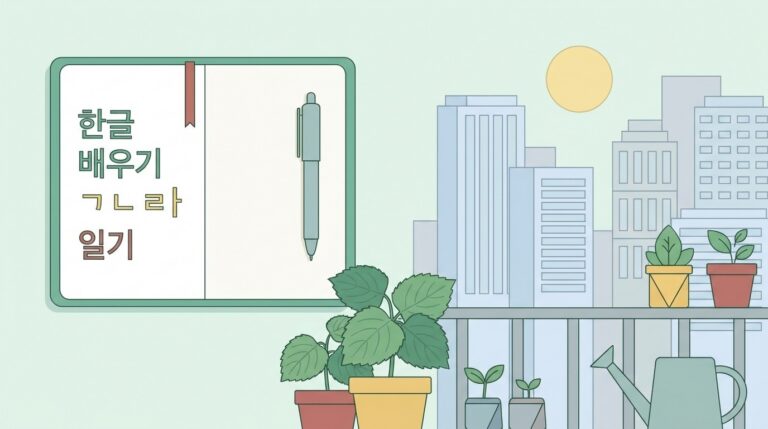
Green Thumb in a Seoul Apartment: Master the Art of Korean Balcony Gardening
Phase 1: Empathy (Story-Driven Opening)
안녕하세요! 매일한글 에디터입니다! (Hello! This is your Daily Hangul editor!)
Picture this: You have finally settled into a charming high-rise apartment in Seoul or a cozy officetel. Eager to embrace the local lifestyle, you hit up the local market, snag a handful of green onion seedlings, some perilla seeds, and decide to jump on the iconic Korean Pa-tech (파테크, green onion investment/farming) bandwagon. You place your pots on the veranda, beam at your miniature urban jungle, and water them faithfully. But within two weeks, tragedy strikes: your delicate sprouts shoot up tall, skinny, and pale like pale noodles, turning yellow before collapsing into mush. When you rush to the neighborhood nursery (hwawon, 화원) to ask for guidance, your textbook Korean fails you completely. Words like “식물에 물을 주었습니다” (I watered the plant) just do not convey the tragedy of waterlogged soil or etiolated seedlings.
Balcony gardening—known locally as 베란다 텃밭 가꾸기 (beranda teotbat gakkugi)—is a deeply cherished rite of passage in urban Korea. It combines self-sufficiency, therapeutic slow living, and clever architectural space management. To truly master plant care conversations in Korea at a C1 level, you need more than rudimentary botany words; you need sensory descriptors, cultural idioms, and the exact terms seasoned Korean plant-parents (sik-jip-sa, 식집사) throw around daily. This guide draws directly on real learner queries and seasoned Korean horticultural hacks so you can discuss soil, drainage, and balcony ecosystems with total native confidence!
Phase 2: Core Expressions in Depth
1. 쑥쑥 자라다 (Ssuk-ssuk jarada)
- Pronunciation: [Ssuk-ssuk ja-ra-da] (Imagine the punchy sound of snapping a fresh celery stalk: ‘ssuk’, repeated twice with rhythm!)
- Meaning: Literal: “To grow spurt by spurt” | Actual Nuance: To grow rapidly, vigorously, and visibly healthy overnight.
- K-Culture Moment: Often heard in family dramas or slice-of-life variety shows like I Live Alone (나 혼자 산다) when someone observes their companion plants or nephew shooting up noticeably between visits.
- Editor’s Insight: 쑥쑥 is an iconic Korean mimetic word (uiseong-eo) that conveys explosive, unhindered vitality. You can use it for children’s height, financial assets, and of course, thriving leafy greens.
- Situation Spectrum:
- Casual: ✅ (“우리 깻잎 쑥쑥 잘 큰다!”)
- Semi-formal: ✅ (“날씨가 따뜻해지니 모종들이 쑥쑥 자라네요.”)
- Formal: ⚠️ (Opt for ‘급격히 성장하다’ or ‘순조롭게 생육하다’ in scientific or formal reports.)
- 🤔 Think About It: In English, we say “growing like a weed,” which carries a mildly negative connotation. Why do you think Korean uses dynamic, affectionate onomatopoeia like 쑥쑥 to celebrate quick growth?
2. 손이 많이 가다 (Son-i mani gada)
- Pronunciation: [Son-i ma-ni ga-da] (Like ‘sohn-ee mah-nee gah-dah’)
- Meaning: Literal: “Hands go to it a lot” | Actual Nuance: High-maintenance; requiring constant attention, meticulous care, and fussing over.
- K-Culture Moment: Featured constantly when plant YouTubers or home improvement hosts explain why beginners should start with sturdy cherry tomatoes (bangul tomato) rather than finicky herbs: “로즈마리는 은근히 손이 많이 가요” (Rosemary secretly takes a lot of work).
- Editor’s Insight: In Korean culture, investing “hands” (손, son) represents personal devotion and affection. While it can mean tedious work, saying a plant 손이 많이 가다 often contains warmth, hinting at a labor of love.
- Situation Spectrum:
- Casual: ✅ (“이 화초는 예쁜데 은근히 손이 많이 가.”)
- Semi-formal: ✅ (“초보자분들에게는 손이 많이 가지 않는 품종을 추천해요.”)
- Formal: ✅ (“해당 작물은 재배 시 비교적 손이 많이 가는 편입니다.”)
- 🤔 Think About It: How does linking the concept of “hands” to effort reflect Korea’s tactile, high-involvement service and care culture?
3. 겉흙이 마르다 (Geot-heulg-i mareuda)
- Pronunciation: [Geot-heul-gi ma-reu-da] (Pronounce the ‘t’ smoothly into the aspirated ‘h’, sounding like ‘geo-teul-gi’)
- Meaning: Literal: “The surface soil dries out” | Actual Nuance: The universal litmus test for indoor plant hydration; the golden threshold indicating when it is safe to water without causing root rot.
- K-Culture Moment: The fundamental piece of advice repeated like a mantra in Korean plant community apps like Today’s House (오늘의집): “꼭 겉흙이 바짝 마른 후에 물을 듬뿍 주세요!” (Make sure to water thoroughly only after the topsoil dries out completely!)
- Editor’s Insight: Novices kill plants by overwatering (과습, gwaseup). At a C1 level, mastering the specific difference between 겉흙 (topsoil) and 속흙 (underlying root soil) establishes your authority as an experienced grower.
- Situation Spectrum:
- Casual: ✅ (“겉흙 마르면 그때 물 줘.”)
- Semi-formal: ✅ (“겉흙이 말랐을 때 흠뻑 주시는 게 안전해요.”)
- Formal: ✅ (“토양의 겉흙이 충분히 건조된 후 관수하십시오.”)
- 🤔 Think About It: Why do urban apartment dwellers develop hyper-specific vocabularies around humidity and soil dryness compared to outdoor field farmers?
Phase 3: Textbook Korean vs. Real Korean
Situation 1: Explaining that a seedling has become leggy due to low light
- 📖 교과서 한국어 (Textbook Korean):
햇빛이 부족해서 줄기가 길어졌습니다. (Haetbichi bujokhaeseo julgiga gireojyeotseumnida.)
“Because sunlight was insufficient, the stem became long.” - 🗣️ 진짜 한국어 (Real-World Korean):
빛을 못 받아서 싹이 완전히 웃자랐어요. (Bicheul mot badaseo ssagi wanjeonhi utjarasseoyo.)
“It didn’t get enough light, so the shoot grew totally leggy and weak.” - 💡 왜 다를까? (Why the difference?):
웃자라다 (utjarada) is an indispensable horticultural verb indicating unnatural, weak, elongated growth caused by insufficient sunlight or excess nitrogen. Native speakers never say “the stem became long”; they instantly identify it as 웃자람 (etiolation).
Situation 2: Warning a neighbor about root rot from overwatering
- 📖 교과서 한국어 (Textbook Korean):
물을 너무 많이 주면 뿌리가 썩어서 식물이 죽습니다. (Mureul neomu mani jumyeon ppuriga sseogeoseo singmuri jukseumnida.)
“If you give too much water, the roots rot and the plant dies.” - 🗣️ 진짜 한국어 (Real-World Korean):
통풍 안 되는 데서 물 자주 주면 바로 과습 와요. (Tongpung an doeneun daeseo mul jaju jumyeon baro gwaseup wayo.)
“If you water often in a spot without good airflow, you’ll get root rot from overwatering in no time.” - 💡 왜 다를까? (Why the difference?):
Koreans treat 과습 (excessive moisture/overwatering) almost like a clinical disease that “comes” (과습이 오다). Pairing it with 통풍 (aeration/ventilation) reflects the everyday reality of sealed Korean apartment verandas equipped with double-glazed windows.
Phase 4: K-Culture Deep Dive & Non-Verbal Manners
4-1. 눈치 (Nunchi) & Gestures in the Veranda Garden
When visiting a Korean friend’s home or inspecting seedlings at a traditional market (종묘상 or 화원):
* The Two-Knuckle Soil Probe: Do not simply pat the surface leaves. To demonstrate genuine plant intuition (눈치), lightly poke your index finger into the soil up to the first knuckle (손가락 한 마디). Nod knowingly and assess whether it feels damp (축축하다) or crumbly (포슬포슬하다).
* Veranda Ventilation Etiquette: In Korean apartments (아파트), verandas share structural drainage lines. Never let dirty irrigation runoff flood into the central drain without rinsing it away, as it can cause foul odors or clog communal lines. Always open the outer window slightly (맞바람 치게, to create a cross breeze) before complimenting someone’s balcony farm.
4-2. Cultural Codes: The Rise of “Sik-jip-sa” & “Pa-tech”
Urban isolation and soaring grocery prices spawned two massive post-pandemic lifestyle trends in Korea: 식집사 (Sik-jip-sa, a portmanteau of “plant” and “butler/caregiver”, modeling after cat owners calling themselves 집사) and 파테크 (Pa-tech, cultivating green onion roots bought from supermarkets).
Korean veranda gardening is not just about survivalist harvesting; it is an aesthetic and emotional statement called 플랜테리어 (Planterior = Plant + Interior). It is common practice to wrap harvested perilla leaves (깻잎) or tender lettuces (상추) in neat bundles tied with twine and share them with apartment neighbors—a heartfelt modern evolution of traditional 정 (Jeong, communal affection).
Phase 5: Real-World Roleplay Scenario
Setting: You are visiting “행복화원” (Happy Plant Nursery), a bustling local plant store run by an experienced green-thumb proprietor, 사장님 (Sajangnim).
- 사장님 (Owner): 어서 오세요! 베란다에 뭐 좀 들여놓으시게요? (Eoseo oseyo! Berandae mwo jom deuryeonoeusigeyo?)
(Welcome! Looking to bring something fresh onto your balcony?)
🎭 온화한 미소를 지으며 모종판을 정리한다(Smiles warmly while organizing seedling trays) -
Learner: 네, 사장님! 아파트 남동향 베란다에서 키우기 무난한 텃밭 작물 좀 보러 왔어요. (Ne, sajangnim! Apateu namdonghyang berandaeseo kiugi munanhan teotbat jakmul jom boreo wasseoyo.)
(Yes, boss! I came to see some vegetable crops that are easy to raise on a southeast-facing apartment balcony.)
🎭 진열된 모종들을 유심히 살피며 턱을 가볍게 괸다(Carefully inspects the display trays while lightly resting hand on chin) -
사장님 (Owner): 남동향이면 오전 해가 좋으니까 상추나 방울토마토가 제격이지. 근데 베란다 창문은 자주 열어두시나? (Namdonghyang-imyeon ojeon haega joeunikka sangchuna bangultomatoga je-gyeogiji. Geunde beranda changmuneun jaju yeoreodusina?)
(If it’s southeast-facing, morning sun is great, so lettuce or cherry tomatoes are perfect. But do you keep the balcony windows open often?) -
Learner: 출근할 때는 닫아두는데, 혹시 웃자라거나 과습 올까 봐 걱정돼요. (Chulgeunhal ttaeneun dadaduneunde, hoksi utjarageona gwaseup olkka bwa geokjeongdwaeyo.)
(I close them when commuting to work, but I’m worried they might get leggy or suffer from overwatering.)
🎭 걱정스러운 표정으로 상추 잎을 살짝 만져본다(Lightly touches a lettuce leaf with a worried expression) -
사장님 (Owner): 아이고, 용어를 제대로 아시네! 그럼 물빠짐 좋은 배양토 섞고, 겉흙 마른 거 확인하고 주면 끄떡없어요. (Aigo, yongeoreul jedaero asine! Geureom mulppajim joeun baeyangto seokgo, geotheuk mareun geo hwaginhago jumyeon kkeutteogeopseoyo.)
(Oh my, you really know your terminology! Then mix in well-draining potting soil, check that the topsoil is dry before watering, and it will be completely fine.)
🎭 호탕하게 웃으며 배양토 포대를 툭툭 친다(Laughs heartily, tapping a bag of potting soil) -
Learner: 다행이네요. 모종 심을 때 쓸 스티로폼 박스 밑에 배수 구멍만 뚫으면 되겠죠? (Dahaeng-ineyoyo. Mojong simeul ttae sseul seutiropom bakseu mite baesu gumeongman ttureumyeon doegetjyo?)
(What a relief. If I poke drainage holes in the bottom of a Styrofoam box to plant the seedlings, that should work, right?) -
사장님 (Owner): 그렇지! 바닥에 마사토 한 층 깔아주는 거 잊지 말고요. 그래야 뿌리가 숨을 쉬어. (Geureochi! Badage masato han cheung kkarajuneun geo itji malgoyo. Geuraeya ppuriga sumeul swieo.)
(Exactly! Don’t forget to spread a layer of coarse river sand at the bottom. That way the roots can breathe.)
🎭 엄지손가락을 치켜세운다(Gives a firm thumbs up) -
Learner: 꿀팁 감사합니다! 적상추랑 깻잎 모종 네 포기씩 주시고 배양토도 한 포대 챙겨주세요. (Kkool-tip gamsahamnida! Jeoksangchurang kkaennip mojong ne pogissik jusigo baeyangtodo han podae chaenggyeojuseyo.)
(Thank you for the golden tip! Please give me four seedlings each of red lettuce and perilla, and bundle one bag of potting mix too.)
🎭 밝게 인사하며 지갑을 꺼낸다(Bows pleasantly while taking out a wallet)
🔀 Interactive Choice Point
The shopkeeper asks if you need liquid nutrient fertilizer (액체 비료, or 액비). How do you respond?
- Option A: “아직 모종 단계니까 밑거름만으로 충분할 것 같아요. 조금 더 쑥쑥 자라면 그때 다시 사러 올게요!”
(Feedback: BEST! Shows precise developmental awareness—seedlings burn if over-fertilized too early—and uses the natural idiom ‘쑥쑥 자라다’ with polite deference.) - Option B: “식물이 아프면 안 되니까 지금 당장 제일 독한 비료로 전부 뿌려줄게요.”
(Feedback: BAD! Hyperbolic and horticultural suicide; heavy fertilizer will chemically scorch young roots immediately, prompting the owner to intervene.) - Option C: “그냥 수돗물만 주면 다 알아서 크는 거 아닌가요? 비료는 사기 같아요.”
(Feedback: RISK! Culturally abrasive; questioning the shopkeeper’s integrity while dismissing essential soil enrichment sounds needlessly confrontational.)
Phase 6: 10-Second Emotional Shadowing Drill
Match your breath to the slashes (/) and embody the emotional tag in brackets:
[😊 뿌듯하고 자랑스럽게 - Proud & Delighted]
“베란다 텃밭에서 / 매일 아침마다 / 싱싱한 쌈채소를 / 직접 수확하는 맛이 / 정말 쏠쏠해요!”
(Beranda teotbateseo / maeil achimmada / singsinghan ssamchaesoreul / jikjeop suhwakhaneun masi / jeongmal ssolssolhaeyo!)
“Harvesting fresh wrap greens directly / from my balcony garden / every morning / is honestly so rewarding!”-
[🥺 안타깝고 걱정스럽게 - Anxious & Worried]
“장마철이라 / 통풍이 제대로 안 됐는지 / 고추 모종에 / 진딧물이 생겨서 / 속상해 죽겠어요.”
(Jangmacheorira / tongpungi jedaero an dwaenneunji / gochu mojong-e / jindinmuri saenggyeoseo / soksanghae jukgesseoyo.)
“Because it’s the monsoon season / and ventilation wasn’t proper / aphids appeared on my chili pepper plant / and I’m totally heartbroken.” -
[💡 확신에 차서 조언하듯 - Confident & Advising]
“과습을 막으려면 / 무조건 겉흙이 바짝 마른 걸 확인하고 / 화분 밑으로 물이 흘러나올 때까지 / 흠뻑 주셔야 해요!”
(Gwaseubeul mageuryeomyeon / mujogeon geotheulgi bajjak mareun geol hwaginhago / hwabun miteuro muri heulleonaol ttaekkaji / heumppeok jusyeoya haeyo!)
“To prevent overwatering / you must always verify that the surface soil is bone-dry / and soak it thoroughly / until water drains out of the pot bottom!”
Phase 7: K-Culture Mini Dictionary
-
웃자라다 (Utjarada):
Translation: To grow leggy / to etiolate.
Real Usage: Crucial in urban Korean living where apartment balconies block upper ceiling light. When seedlings stretch anxiously searching for rays, Koreans diagnose: “빛 부족으로 웃자랐네” (It went leggy from lack of light). -
통풍 (Tongpung):
Translation: Ventilation / Air circulation.
Real Usage: The number one obsession of Korean plant enthusiasts. In high-density apartment blocks with double windows (이중창), lack of 통풍 is blamed for 90% of plant deaths, mold, and infestations. -
모종 (Mojong):
Translation: Seedling / Starter sprout.
Real Usage: Instead of planting seeds (씨앗) which take too long during short Korean springs, everyone buys 모종 sold in compact plastic egg-crate trays at subway station exits and traditional markets starting in April. -
분갈이 (Bungari):
Translation: Repotting.
Real Usage: Moving a growing root system into a larger vessel with fresh nutrient-rich soil. Asking a florist “분갈이용 흙 주세요” (Please give me soil for repotting) is standard spring vernacular.
Phase 8: Traveler & Expat Survival Kit
Top 3 Survival Expressions for Plant Lovers
-
“실내에서 키우기 가장 수월한 모종이 뭐예요?”
(Silnae-eseo kiugi gajang suweolhan mojongi mwoyeyo?)
Pro Tip: Perfect icebreaker at flower markets when you want low-maintenance crops suited for low-light verandas. -
“배수 구멍 있는 화분으로 보여주세요.”
(Baesu gumeong inneun hwabuneuro boyeojuseyo.)
Pro Tip: Aesthetic ceramic planter pots without drainage holes lead to instant plant death indoors; verify drainage (배수) before buying. -
“진딧물 생겼을 때 뿌리는 친환경 살충제 있나요?”
(Jindinmul saenggyeosseul ttae ppurineun chinhwangyeong salchungje innayo?)
Pro Tip: Essential when indoor pest outbreaks strike edible greens like perilla leaves.
Editor’s Travel Note
If you are in Seoul, skip tourist gift shops and take Subway Line 3 to Yangjae Station to explore the massive Yangjae Flower Market (양재 꽃시장). It is an exhilarating sensory experience. To navigate vendor stalls easily, download the Naver Map app download and search for “양재화훼공판장”. Most vendors gladly accept domestic credit cards and T-Money transport card retail payments, but having a few 10,000 KRW bills ready can help you negotiate an extra free seedling (덤, deom)!
Phase 9: “A Step Deeper” (Reflective Cultural Insight)
In modern South Korea, where over 60% of the population resides in high-density apartment complexes (아파트 단지), the glass-enclosed veranda occupies a poetic liminal space. It is neither purely outdoors nor strictly interior domestic space; it is a buffer against highway noise, a thermal air cushion during freezing winters, and the only sliver of natural earth an urbanite controls. Transforming this tiled corridor into a vegetable garden is an act of reclaiming nature within hyper-dense concrete grids. When neighbors gift homegrown greens across hallway boundaries, the ancient agrarian community spirit (Pumasi, 품앗이) quietly survives beneath the neon skyline.
💬 Your Turn: What does urban gardening look like in your home country? Does your language have an emotional word equivalent to the energetic vitality of 쑥쑥 (ssuk-ssuk)? Share your story in the comments below!
Phase 10: FAQ & Common Mistakes
Q: Can I use soil gathered from a public park or apartment flower bed?
A: 절대 안 됩니다 (Absolutely not)! Outdoor soil from Korean city parks often contains dormant insect eggs, fungus gnats (뿌리파리), and parasites that will explode inside your warm apartment veranda. Always purchase sterilized horticultural potting mix (원예용 상토 or 배양토) from a nursery or online.
Q: Why do my perilla leaves (깻잎) taste tough and bitter compared to restaurant ones?
A: Korean veranda glass heavily filters natural ultraviolet light. When perilla leaves experience erratic watering or lack of natural wind, their cell walls thicken to protect themselves. Open your windows wider to simulate wind resistance, which encourages tender, aromatic leaf development.
Q: What is the most resilient vegetable for a beginner’s Seoul veranda?
A: 대파 (Asian large green onions) and 적상추 (red leaf lettuce). Green onions will regrow simply placed in water or damp soil, while red lettuce tolerates indoor light swings much better than delicate European herbs.
🚨 Common Mistakes Warning Board
- Mistake 1: Watering on a rigid schedule (e.g., “Every Sunday at 10 AM”).
Correct Action: Korean indoor humidity varies drastically from dry spring (20%) to summer monsoon (90%). Water strictly according to soil dryness (겉흙 상태), never calendar alarms. - Mistake 2: Leaving standing water in the drainage tray (화분 받침).
Correct Action: Empty the saucer 15 minutes after watering. Retained water suffocates lower root hairs, inviting rapid rot (뿌리 썩음). - Mistake 3: Misusing “화초” (ornamental flower) when talking about edible produce.
Correct Action: Use 텃밭 작물 (kitchen garden crops) or 채소/모종 (vegetables/seedlings). Saying you are “eating your 화초” sounds like you are nibbling decorative houseplants!
Phase 11: Action Missions & Community Engagement
- 🥉 Bronze Mission (Solo Practice): Check a plant near you right now. Say aloud in Korean: “겉흙이 말랐는지 확인해보자!” (Let’s check if the topsoil has dried!) and perform the finger test.
- 🥈 Silver Mission (Social Share): Snap a photo of a windowsill plant or balcony garden. Post it on Instagram or your learning diary with the caption: “우리 집 초록이들 쑥쑥 자라는 중! 🌿 #식집사 #베란다텃밭”
- 🥇 Gold Mission (Real-World Application): Next time you visit a local Korean market, greenhouse, or florist, politely ask the vendor: “베란다에서 키우기 좋은 모종 추천해 주실 수 있나요?” (Could you recommend a good seedling to raise on a balcony?)
- 🎮 K-Culture Media Mission: Watch an episode of tvN’s Three Meals a Day (삼시세끼) or any vlog tagged with #룸투어 (Room Tour) on YouTube. Spot how many times they mention 식물 (plant), 통풍 (ventilation), or show homegrown scallions in their kitchen!
Phase 12: Interactive Quiz Challenge
1. Situational Judgment: You noticed that your young perilla seedling has developed a super long, spindly stem, but its leaves remain tiny and pale. How do you describe this situation to a Korean florist?
* (A) 모종이 너무 쑥쑥 자라서 걱정이에요.
* (B) 볕을 제대로 못 받아서 싹이 웃자란 것 같아요.
* (C) 물을 안 줘서 과습이 온 것 같아요.
2. Fill in the Blank: 화분에 물을 줄 때는 시계 날짜를 보지 말고, 반드시 손가락으로 ( )이 말랐는지 찔러봐야 과습을 예방할 수 있습니다.
3. True or False: In high-rise Korean apartments, opening windows to secure 통풍 (airflow) is just as critical as sunlight to prevent pests like aphids and fungus gnats.
* [True / False]
👉 Click to Reveal Answers & Explanations!
-
Answer: (B)
Explanation: Spindly, weak growth due to insufficient light is precisely termed 웃자라다. (A) implies healthy, rapid growth, while (C) contains a logical contradiction (overwatering doesn’t happen from withholding water). -
Answer: 겉흙 (Topsoil / Surface soil)
Explanation: The golden principle of apartment gardening is checking whether the 겉흙 has dried before watering again. -
Answer: True
Explanation: Stagnant air inside sealed verandas causes fungal blooms and suffocates root systems. Experienced 식집사 prioritize 통풍 above all else!







