

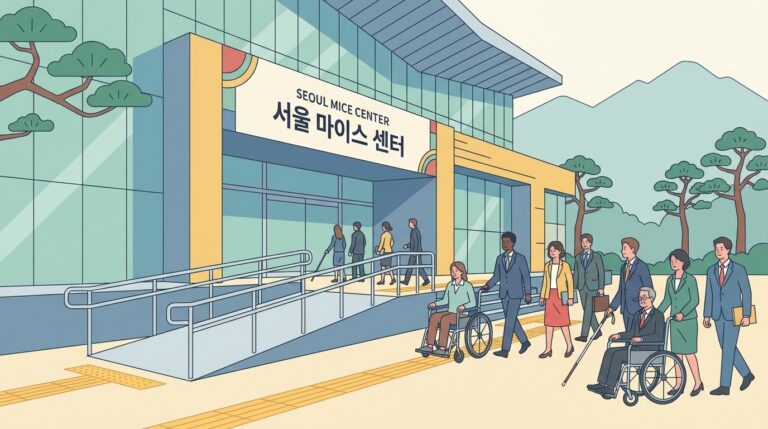
Mastering Barrier-Free Tourism & MICE Korean: The Ultimate C2 Guide to Inclusive Travel Infrastructure
Phase 1: Empathy (Immersive Opening)
안녕하세요! 매일한글 에디터입니다. (Hello! This is your Daily Hangul editor.)
Picture this: You are co-chairing an international MICE symposium at the iconic Dongdaemun Design Plaza (DDP) in Seoul. The delegates include global dignitaries, researchers, and attendees with diverse physical abilities. In the conference hall, you spot a foreign delegate using an electric wheelchair, hesitating near an elevated exhibition ramp while an anxious venue manager scrambles to explain the auxiliary lift route. You rush over to bridge the gap—but suddenly, the clinical vocabulary you learned in standard business textbooks fails you. Do you say “장애인 전용” (for disabled persons only) without sounding outdated? How do you articulate “multimodal universal design pathways” without coming off as overly bureaucratic or awkwardly detached?
This is the high-stakes friction point where professional MICE operations meet human empathy. In contemporary South Korea, the discourse around travel has shifted dramatically from mere “tourist hospitality” to civic accessibility. Advanced (C2) Korean speakers aren’t just expected to order food or negotiate room rates; they are expected to navigate socio-technical policy frameworks, practice situational nunchi (눈치), and champion civic dignity. Drawing on real insights from field consultants and MICE project managers in Seoul, this guide equips you with the nuanced, high-register Korean required to lead barrier-free (무장애 관광) initiatives with natural authority and genuine cultural warmth.
Phase 2: Top 3 Core Expressions In-Depth
1. 이동 약자의 동선을 면밀히 살펴보다 (Idong yakja-ui dongseon-eul myeonmilhi salpyeoboda)
- Pronunciation: [ee-dong yak-jah-eui dong-seon-eul myeon-meel-hee sal-pyeo-boh-dah] (Think of dongseon sounding like “dong-sun”, meaning the natural flow of movement, and myeonmilhi sounding like a swift “myeon-meal-hee”).
- Meaning: Literally: “To closely inspect the movement path of mobility-impaired persons.” Nuance: Conducting a holistic, dignified accessibility audit of spatial navigation routes.
- K-Culture Moment: Echoing the meticulous planning scenes in corporate K-Dramas like Queen of Tears or King the Land, where high-end hospitality directors review convention hall layouts prior to VIP arrivals.
- Editor’s Insight: Instead of using older, potentially marginalizing terms, the professional phrase 이동 약자 (idong yakja — persons with reduced mobility, including wheelchair users, seniors, parents with strollers, and injured travelers) is the industry gold standard in Korean tourism policy today.
- Situation Spectrum: Casual: 🚫 | Semi-formal: ⚠️ | Formal: ✅
- 🤔 Think About It: Notice how the Korean language groups diverse accessibility challenges under the systemic umbrella of “spatial movement” (dongseon) rather than individual medical conditions. How does this shift responsibility from the individual to the urban environment?
2. 배리어프리 인프라를 대폭 확충하다 (Baerieopeuri inpeura-reul daepok hwakchunghada)
- Pronunciation: [bah-ree-uh-pree in-peu-rah-reul dae-pok hwak-choong-hah-dah] (Baerieopeuri is the Korean loanword adaptation of “barrier-free”, pronounced with crisp, open vowels).
- Meaning: Literally: “To substantially expand barrier-free infrastructure.” Nuance: Decisively scaling up universal design, tactile paving, accessible transit, and inclusive facilities across public or commercial sectors.
- K-Culture Moment: Frequently headlined in Seoul Metropolitan Government press releases and urban development documentaries reviewing projects like the Cheonggyecheon accessibility redesign or modern K-Pop concert accessibility initiatives.
- Editor’s Insight: The adverb 대폭 (daepok — drastically/substantially) pairs seamlessly with 확충하다 (hwakchunghada — to expand capacity). At C2, combining Sino-Korean power collocations shows that you command high-level administrative discourse.
- Situation Spectrum: Casual: 🚫 | Semi-formal: ⚠️ | Formal: ✅
- 🤔 Think About It: Loanwords like “배리어프리” (barrier-free) often enter Korean administrative lexicons to neutralize domestic stigmas while signaling alignment with global UN standards. Does your native language borrow terms to redefine civil rights concepts?
3. 물리적·심리적 문턱을 낮추다 (Mullijeok·simnijeok munteok-eul natchuda)
- Pronunciation: [mool-lee-jeok shim-nee-jeok moon-teok-eul naht-choo-dah] (Munteok rhymes roughly with “moon-tuck”, meaning the wooden threshold or doorsill of a traditional Korean house).
- Meaning: Literally: “To lower both physical and psychological door-thresholds.” Nuance: Eliminating tangible architectural obstacles alongside unconscious societal prejudices.
- K-Culture Moment: Often heard in keynotes delivered by culture ministers, or reflected in socially conscious dramas like Our Blues and Extraordinary Attorney Woo, addressing both physical entryways and societal biases.
- Editor’s Insight: Traditional Korean Hanok architecture features prominent wooden door thresholds (munteok). Using this metaphor resonates emotionally with native speakers, transforming a cold policy discussion into a warm humanistic commitment.
- Situation Spectrum: Casual: ⚠️ | Semi-formal: ✅ | Formal: ✅
- 🤔 Think About It: Why does Korean rhetoric persistently couple physical hurdles (물리적) with psychological ones (심리적)? It reflects a deep-seated cultural belief that space directly shapes interpersonal relationality.
Phase 3: Textbook Korean vs. Real Korean
Scenario 1: Inquiring about ramp access at a UNESCO Heritage venue during a MICE summit
- 📖 교과서 한국어 (Textbook Korean):
“장애인을 위한 휠체어 길이 있습니까?”
(Jang-aein-eul wihan hwilche-eo gir-i itsseumnikka? / “Is there a wheelchair road for disabled people?”) - 🗣️ 진짜 한국어 (Real Native C2 Korean):
“휠체어나 유아차 진입이 수월한 무장애 관람 동선이 마련되어 있을까요?”
(Hwilche-eona yu-acha jin-ib-i su-weol-han mujang-ae gwallam dongseon-i maryeondwee-eo isseulkkayo? / “Is there an established barrier-free viewing pathway that facilitates effortless access for wheelchairs and strollers?”) - 💡 왜 다를까? (Why is it different?): The textbook phrasing isolates wheelchair users and sounds overly diagnostic. Sophisticated industry professionals use inclusive terms like 무장애 동선 (barrier-free transit route) and pair wheelchairs with strollers (유아차), normalizing accessibility as a benefit for all visitors.
Scenario 2: Suggesting structural venue improvements during a MICE steering committee
- 📖 교과서 한국어 (Textbook Korean):
“장애인 화장실과 엘리베이터 시설을 고쳐야 합니다.”
(Jang-aein hwajangsil-gwa ellibe-iteo siseor-eul gochyeoya hamnida. / “We must fix the disabled restrooms and elevator facilities.”) - 🗣️ 진짜 한국어 (Real Native C2 Korean):
“참가자들의 접근성 보장을 위해 유니버설 디자인 관점에서 편의시설을 전면 재정비할 필요가 있습니다.”
(Chamgajadeur-ui jeopgeunseong bojang-eul wihae yunibeoseol dijain gwanjeom-eseo pyeon-uisiseor-eul jeonmyeon jaejeongbihal piryoga itsseumnida. / “To ensure universal accessibility for all participants, it is imperative to thoroughly overhaul the amenity facilities through the lens of Universal Design.”) - 💡 왜 다를까? (Why is it different?): Simply stating “we must fix” (고쳐야 합니다) sounds crude and accusatory in executive settings. C2 speakers frame upgrades around forward-looking paradigms like 유니버설 디자인 (Universal Design) and systemic institutional processes like 전면 재정비 (comprehensive overhaul).
Phase 4: K-Culture Deep Dive & Non-Verbal Etiquette
4-1. 눈치 (Nunchi) & Physical Decorum
In Korean accessibility etiquette, the highest expression of nunchi is 시선의 절제 (visual restraint) paired with 선제적 배려 (preemptive consideration). Staring intently at someone navigating a ramp or struggling with an automated door—even with benevolent concern—can inadvertently cause social discomfort (부담감).
* Eye-Level Alignment (눈높이 맞추기): When consulting an attendee using a mobility device, gently incline your upper torso or step back slightly to establish natural, horizontal eye contact rather than looking down.
* Two-Handed Directional Gestures: Never point with a single index finger when indicating accessible lifts or ramps. Extend your entire right hand, palm facing upward, gently supported at the wrist or forearm by your left hand: “이쪽 경사로로 편히 모시겠습니다” (Ijjok gyeongsaro-ro pyeonhi mosigesseumnida — “Allow me to guide you comfortably toward this ramp”).
4-2. Cultural Code Analysis: The Evolution of Accessible K-Travel
From the barrier-free trails across Jeju’s Olle Paths to the comprehensive remodeling of Gyeongbokgung Palace with seamless bluestone ramps, modern South Korea treats accessibility as a hallmark of advanced nationhood (선진국 위상). The Seoul Danurim Accessible Tourism Center (서울다누림관광센터) is a real-world embodiment of this ethos. In MICE, accessibility is no longer viewed as an afterthought for compliance; it directly dictates a venue’s international rating and ESG (Environmental, Social, and Governance) credentials. Demonstrating mastery of these sociolinguistic codes proves you are culturally integrated into contemporary Korean values.
Phase 5: Real-Life Roleplay Scenario
- Setting: The VIP Operations Center inside COEX Convention & Exhibition Center, Gangnam, Seoul.
- Characters:
- Alex (You): Senior Inclusive Tourism & MICE Operations Consultant.
- Director Park (박 국장): Head of the Seoul International Tourism Expo Organizing Committee.
[Scene Start]
Turn 1
* Director Park: Alex 위원님, 이번 세계 MICE 총회 등록 데스크 동선 점검 결과는 어떻게 나왔습니까?
(Alex wiwon-nim, ibeon segye MICE chonghoe deungnok deseukeu dongseon jeomgeom gyeolgwaneun eotteoke nawasseumnikka?)
“Consultant Alex, what are the findings from the registration desk pathway inspection for the World MICE Assembly?”
* 🎭 행동 지문: 태블릿 PC의 동선 분석 도면을 정돈하며 차분한 표정으로 보고 서류를 건넨다.
Turn 2
* Alex (You): 전반적인 동선은 쾌적하지만, 북문 진입로 쪽 단차로 인해 휠체어 이용자의 우회 거리가 지나치게 깁니다.
(Jeonbanjeog-in dongseon-eun kwaejeokhajiman, bungmun jin-imno jjok dancharo inhae hwilche-eo iyongja-ui u-hoe georiga jinachige gimnida.)
“While the overall circulation is pleasant, the threshold difference at the North Entrance forces wheelchair users into an excessively long detour.”
Turn 3
* Director Park: 아, 그쪽은 역사 보존 구역이라 구조 변경이 까다로운데… 임시 가설물 설치가 가능할까요?
(A, geujjog-eun yeoksa bojon gu-yeog-ira gujo byeon-gyeong-i kkadaro-unde… imsi gaseolmul seorchiga ganeunghalkkayo?)
“Ah, that sector is a designated historical preservation zone, making structural modifications tricky… Would a temporary installation be feasible?”
Turn 4
* Alex (You): 네, 배리어프리 인증 기준에 부합하는 경사각 1:12의 완만한 임시 램프를 가설하면 이동권과 미관을 모두 충족할 수 있습니다.
(Ne, baerieopeuri injeung gijun-e buhaphaneun gyeongsagak il-dae-sib-i-ui wanmanhan imsi rampeu-reul gaseolhamyeon idonggwon-gwa migwan-eul modu chungjokhal su itseumnida.)
“Yes, erecting a gentle temporary ramp adhering to the 1:12 slope barrier-free certification standard will safeguard mobility rights while preserving spatial aesthetics.”
Turn 5
* Director Park: 일리가 있네요. 청각 및 시각 정보 취약 계층을 위한 보조 기기 대여 데스크는 어디로 배치했습니까?
(Illiga inne-yo. Cheonggak mit sigak jeongbo chwiyak gyecheung-eul wihan bojo gigi daeyeo deseukeu-neun eodiro baechihanikka?)
“That makes complete sense. Where have we positioned the assistive technology rental desk for attendees with sensory impairments?”
Turn 6
* Alex (You): 안내 데스크 바로 우측에 배치하여 동선 낭비를 줄이고, 수어 통역사와 촉지각 안내판을 상시 배치하도록 조치했습니다.
(Annae deseukeu baro ucheuk-e baechihayeo dongseon nangbi-reul jurigo, su-eo tong-yeoksa-wa chokjigak annaepan-eul sangsi baechihadorok jochihan-yeotseumnida.)
“We situated it immediately to the right of the main information desk to eliminate navigation waste, ensuring sign language interpreters and tactile maps are permanently staffed.”
Turn 7
* Director Park: 훌륭합니다. 전시 공간 내 저시력자를 위한 유도 블록 연계 상태도 빈틈없이 챙겨주십시오.
(Hullyunghamnida. Jeonsi gonggan nae jeosiryeokja-reul wihan yudo beullok yeon-gye sangtae-do binteum-eopsi chaenggyeojusipsio.)
“Outstanding. Please also ensure that tactile guide paving for low-vision attendees inside the exhibition halls is seamlessly integrated.”
Turn 8
* Alex (You): 염려 놓으십시오, 국장님. 모든 참관객이 차별 없이 총회를 만끽할 수 있도록 현장 점검을 끝까지 완수하겠습니다.
(Yeomryeo no-eusipsio, gukjang-nim. Modeun chamgwan-gaeg-i chabyeol eopsi chonghoe-reul mankkikhal su itdorok hyeonjang jeomgeom-eul kkeutkkaji wansuhagesseumnida.)
“Rest assured, Director. I will carry out inspections through to the end so that all attendees can savor this assembly without exclusion.”
🔀 Interactive Branching Choice
During the live walk-through, you discover that the main stage podium only has steps, and the scheduled VIP keynote speaker uses a wheelchair. How do you respond to Director Park?
- Option A: “국장님, 당장 단상 옆에 리프트를 추가 설치하거나 발표자 연단을 무대 아래로 내려 평등한 눈높이를 구현해야 합니다.” (Director, we must immediately install a lift beside the podium or bring the lectern down to ground level to ensure equal visual footing.)
- Option B: “국장님, 무대 위로 올라가는 계단이 있으니 경호팀 인력을 배치해서 휠체어를 들어 올리도록 할까요?” (Director, since there are stairs to the stage, should we station security staff to lift the wheelchair up?)
- Option C: “시간이 없으니 이번 발표만 휠체어 타신 분은 스크린 영상으로 대체하는 게 어떨까요?” (Since time is short, why don’t we substitute this presentation with a pre-recorded video on screen?)
Branch Feedback:
- Option A (Best): 🏆 Flawless C2 leadership. It respects the speaker’s dignity, avoids patronizing physical intervention, and exemplifies progressive universal event design.
- Option B (Bad): 🚫 High risk. Physically lifting an adult in a wheelchair without express prior consent compromises safety and can be deeply humiliating in modern Korean corporate etiquette.
- Option C (Risk): ⚠️ Catastrophic public relations risk. Marginalizing an invited keynote speaker violates fundamental civil and protocol standards.
Phase 6: 10-Second Emotional Shadowing Drill
Sharpen your professional cadences! Pay attention to breath stops (/) and emotional intentionality.
[🏛️ 단호하고 전문적으로 / Resolute & Authoritative]
“무장애 인프라는 / 단순한 시혜적 복지가 아니라 / 모두를 위한 도시 경쟁력의 핵심입니다.”
(Mujang-ae inpeura-neun / dansunhan sihyejeok bokjiga anira / modu-reul wihan dosi gyeongjaengnyeog-ui haeksim-imnida.)
“Barrier-free infrastructure / is not merely philanthropic charity / but the core pillar of urban competitiveness for all.”-
[🤝 따뜻하고 정중하게 / Empathetic & Reassuring]
“어르신과 보행 약자께서도 / 불편함 없이 관람하실 수 있도록 / 보조 인력을 상시 배치해 두었습니다.”
(Eoreusin-gwa bohaeng yakjakkeseodo / bulpyeonham eopsi gwallamhasil su itdorok / bojo inryeog-eul sangsi baechihye dueotseumnida.)
“To ensure that both seniors and walking-impaired visitors / can enjoy the exhibition without distress / assistive staff have been stationed at all times.” -
[💡 통찰력 있고 설득력 있게 / Insightful & Persuasive]
“물리적 문턱을 허무는 순간 / MICE 산업의 잠재적 가치 역시 / 비약적으로 도약할 것입니다.”
(Mullijeok munteog-eul heomuneun sun-gan / MICE san-eob-ui jamjaejeok gachi yeoksi / bi-yakjeog-euro do-yakhal geosimnida.)
“The moment we dismantle physical barriers / the latent value of the MICE industry / will experience a quantum leap.”
Phase 7: K-Culture Mini Dictionary
-
무장애 관광 (Mujang-ae gwan-gwang)
- Translation: Barrier-Free Tourism.
- Context: The formal policy term used by municipal authorities and tourism boards across South Korea describing travel environments devoid of physical, linguistic, and sensory hindrances.
- 이동 약자 (Idong yakja)
- Translation: Mobility-Impaired Individuals / Persons with Reduced Mobility.
- Context: The refined, rights-affirming term replacing stigmatizing legacy expressions. Encompasses disabled people, elderly travelers, pregnant women, and young children in baby carriages.
- 점자 블록 (Jeomja beullok)
- Translation: Tactile Paving / Braille Blocks.
- Context: The bright yellow textured tiles installed throughout Korea’s metro stations, pedestrian crossings, and MICE halls. In advanced discussions, distinguishing between linear blocks (유도 블록, path guides) and dotted blister blocks (점형 블록, warning stops) demonstrates forensic situational precision.
- 유니버설 디자인 (Yunibeoseol dijain)
- Translation: Universal Design.
- Context: Widely used in Korean business and urban planning without translation to denote design that creates products and environments inherently usable by everyone, regardless of age, ability, or status.
Phase 8: Traveler’s Survival Kit
Top 3 High-Register Survival Phrases
- “휠체어 탑승이 가능한 리프트 차량 배차가 가능할까요?”
(Hwilche-eo tapseung-i ganeunghan ripeuteu charyang baechaga ganeunghalkkayo?)- Pro Tip: Use this when reserving city-sponsored accessible taxis (장애인 콜택시) or MICE VIP shuttle vans.
- “전시관 내에 단차 없는 완만한 우회로가 어디인지 확인 부탁드립니다.”
(Jeonsigwan nae-e dancha eomneun wanmanhan u-hoeroga eodi-inji hwag-in butakdeurimnida.)- Pro Tip: The term 단차 (dancha — step level/curb height) is understood immediately by facility engineers and venue marshals.
- “시각장애인을 위한 음성 안내기나 오디오 도슨트가 구비되어 있습니까?”
(Sigakjang-aein-eul wihan eumseong annaegina odio doseonteuga gubidoeeo itsseumnikka?)- Pro Tip: Cultural institutions like Leeum Museum and the National Museum of Modern and Contemporary Art (MMCA) provide dedicated multi-sensory smart guides.
Editor’s Travel Note: MICE Navigator
If you are planning an event or traveling with family members with mobility challenges, bookmark the official Seoul Danurim Accessible Tourism Center portal. You can inspect certified wheelchair-accessible restaurants, borrow motorized wheelchair battery chargers, and reserve specialized accessible tour vans. Furthermore, when using the KakaoMap mobility app download page, toggle the “Wheelchair-friendly transit route” layer for subways to immediately visualize which stations feature elevator-level transfer connections versus mechanical stair lifts.
Phase 9: “한 발 더 깊이” (One Step Deeper)
In South Korea’s rapidly evolving civic landscape, the concept of 배려 (baeryeo — considerate benevolence) is undergoing a major conceptual upgrade toward 권리 (gwonri — constitutional rights). Traditionally, Korean hospitality emphasized individual kindness—someone stepping in to carry a stroller down the stairs. Today, modern Koreans increasingly recognize that true inclusion means engineering an urban space where nobody needs to depend on the benevolence of strangers in order to move freely. When you use expressions like “무장애 인프라 확충” (expanding barrier-free infrastructure), you aren’t just reciting institutional jargon; you are affirming your solidarity with this progressive societal shift.
💬 Your Turn: Have you observed how public accessibility is approached in your own city compared to South Korea’s tech-driven MICE hubs? Share your thoughts below in Korean using the term 문턱을 낮추다!
Phase 10: FAQ & Avoiding Misunderstandings
Q: Is it considered rude to say “장애인” (disabled person) in public business settings?
A: No, 장애인 (jang-aein) is the legally recognized, polite noun for a person with a disability in South Korea. However, in infrastructural, spatial, and MICE contexts, industry leaders prefer broader and more situational terms like 이동 약자 (idong yakja — persons with reduced mobility) or 교통 약자 (gyotong yakja), because these phrases emphasize access challenges created by urban infrastructure rather than identifying people exclusively through medical diagnoses.
Q: What is the difference between “장애인 화장실” and “다목적 화장실”?
A: Traditionally, accessible restrooms were labeled “장애인 화장실” (Accessible Restroom for Disabled Persons). In modern MICE venues and premium complexes like Incheon International Airport or DDP, the label is progressively changing to 다목적 화장실 (damokjeok hwajangsil — multi-purpose restroom) or 가족 배려 화장실 (gajok baeryeo hwajangsil), accommodating parents with infants, elderly companions, and individuals with personal assistants regardless of gender.
Q: How do I politely decline when someone tries to over-assist my companion with a disability?
A: Use this respectful, polite formula: “배려해 주셔서 진심으로 감사드립니다. 저희가 스스로 이동할 수 있도록 조금만 지켜봐 주시겠습니까?” (Baeryeohe jusyeoseo jinsim-euro gamsadeurimnida. Jeohuiga seuseuro idonghal su itdorok jogeumman jikyeobwa jusigesseumnikka? — “Thank you so much for your kind consideration. Would you mind watching over us for a moment so we can move independently?”).
🚨 Common Mistakes Alert
- Mistake: Using “정상인” (jeongsang-in — normal person) to contrast with someone with a disability.
- Correct Action: Always use 비장애인 (bijang-aein — non-disabled person). Contrasting disability with “normality” is a major linguistic faux pas in contemporary Korea.
- Mistake: Referring to tactile paving as “노란 블록” (noran beullok — yellow blocks) in formal briefings.
- Correct Action: Use the professional terms 점자 블록 (jeomja beullok — tactile paving) or 시각장애인 유도 블록 (sigakjang-aein yudo beullok).
- Mistake: Saying “유모차” (yumocha — literally “mother’s carriage”).
- Correct Action: Adopt the gender-neutral, modern civic standard 유아차 (yu-acha — infant carriage), officially endorsed by the Seoul Metropolitan Government.
Phase 11: Action Missions
- 🥉 Bronze Mission (Solo Mastery): Record yourself reading the 10-second shadowing drills in Phase 6. Focus on pausing naturally at the slash marks (
/) while maintaining a confident, low-pitched executive cadence. - 🥈 Silver Mission (Social Engagement): Find a photo of a Korean tourist attraction or venue (like COEX, Namsan Tower, or a historical palace) on social media. Leave a Korean comment evaluating its accessibility using the phrase: “무장애 동선이 인상적이네요!” (The barrier-free flow of movement is impressive!).
- 🥇 Gold Mission (Real-World Application): During your next trip to Korea or in an international MICE seminar, ask a venue concierge or booth manager: “휠체어나 유아차 진입을 위한 완만한 동선이 마련되어 있을까요?”
- 🎮 K-Culture Media Mission: Watch an episode of a modern Seoul-based drama (e.g., Crash Landing on You, Agency, or Extraordinary Attorney Woo). Spot every instance of tactile yellow paving or automatic ramps in the urban background and note down how characters interact with these spaces.
Phase 12: Interactive Quiz Challenge
1. Situational Judgment:
You are delivering a presentation to municipal tourism planners. Which sentence demonstrates the highest C2-level command when proposing infrastructure expansion?
* A) 장애인들이 불쌍하니까 엘리베이터를 빨리 만들어 줘야 합니다.
* B) 이동 약자의 보행권 확보와 무장애 관광 인프라 확충은 도시 경쟁력 제고의 필수 요건입니다.
* C) 외국인 관광객이 오면 휠체어 길을 많이 청소해야 합니다.
🔍 정답 및 해설 (Click to view answer)
정답: B
* 해설: Option B elegantly combines high-level policy collocations (이동 약자, 보행권 확보, 무장애 관광 인프라 확충, 도시 경쟁력 제고). Option A is excessively patronizing, while Option C is grammatically basic and misses the socio-technical point entirely.
2. Fill-in-the-Blank:
전통 한옥이나 고궁의 미관을 해치지 않으면서도 계단 ( )를 해소하기 위해 경사로를 신설했습니다.
* A) 동선 (Dongseon)
* B) 단차 (Dancha)
* C) 인프라 (Inpeura)
🔍 정답 및 해설 (Click to view answer)
정답: B (단차 – Height difference/curb step)
* 해설: 단차 refers specifically to the elevation discrepancy or step curb that prevents smooth wheeled movement. Solving height differences (단차를 해소하다) is an indispensable collocation in civil engineering and MICE planning.
3. True or False Cultural Quiz:
In modern Korean public administration, the phrase 비장애인 is preferred over 일반인 or 정상인 when referring to individuals without disabilities.
* (True / False)
🔍 정답 및 해설 (Click to view answer)
정답: True
* 해설: Correct! Referring to non-disabled people as “normal” (정상인) or “general public” (일반인) implies that having a disability is abnormal or exclusionary. 비장애인 (non-disabled person) is the standard respectful term.







