

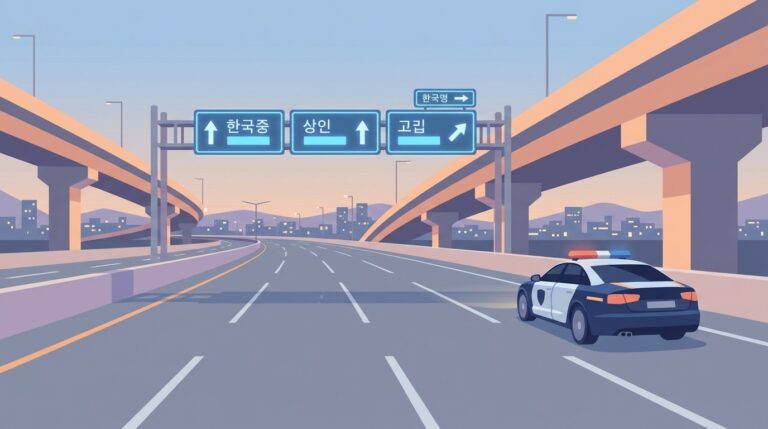
Navigating Korea’s Highway Lane Enforcement: The Ultimate C2 Guide
Phase 1: 공감 (Empathy & Immersive Opening)
안녕하세요! 매일한글 에디터입니다.
Imagine this scenario straight out of a slick K-drama chase sequence: It is midnight on the Gyeongbu Expressway. You have rented a pristine Genesis GV80 to drive your Korean in-laws or business partners down to Busan. The asphalt stretches wide, the navigation system murmurs soothingly, and you are coasting effortlessly at exactly 100 km/h in the leftmost lane (1차로). Suddenly, an unassuming black Hyundai sedan pulls up behind your rear bumper, activates a hidden digital display behind its rear window, and blares a piercing siren. It is an 암행순찰차 (unmarked highway patrol car).
You pull over to the shoulder, confident that you were not speeding. Yet, the officer walks up and asks: “선생님, 1차로에서 계속 정속 주행하신 이유가 있으십니까?” (Sir, may I ask why you maintained constant cruising speed in Lane 1?)
Welcome to Korea’s hyper-systemized expressway discipline. The National Police Agency has cracked down fiercely on 고속도로 지정 차로제 위반 (violations of designated lane usage). For advanced C2 learners, driving in Korea is no longer just about reading directional road signs or understanding simple GPS prompts; it demands a granular understanding of administrative traffic laws, real-time verbal self-defense, and legal-grade vocabulary. Based on actual queries from our foreign corporate executives and long-term expatriates, this masterclass equips you with authentic, nuanced Korean to navigate expressway policing with peerless composure.
Phase 2: 핵심 표현 3선 심층 분석 (Top 3 Core Expressions)
1. 지정 차로제 위반으로 단속되셨습니다. (Jijeong charoje wiban-euro dansokdoesyeosseumnida.)
- Pronunciation: [Jee-jeong cha-ro-je wee-ban-eu-ro dan-sok-doe-syeot-seum-nee-da] (Think: “Jee-jong” flowing smoothly into “Dan-soke”)
- Meaning: “You have been pulled over for violating the designated lane regulation.”
- K-Culture Moment: Heard verbatim in real-life police documentary clips or investigative journalism programs like 한문철 TV (Han Moon-chul TV) when dashboard footage of highway crackdowns is reviewed by traffic attorneys.
- Editor’s Insight: The word 단속 (enforcement/crackdown) implies an organized, systemic sweep by authorities rather than a random stop. The honorific passive construction
~되셨습니다reflects standard administrative speech, blending firm institutional authority with polite customer-facing protocol. - Situation Spectrum:
- Casual: 🚫
- Semi-formal: ⚠️
- Formal: ✅
- 🤔 Think About It: In many Western jurisdictions, staying in the left lane without impeding others is often overlooked unless traffic backs up. In Korea, however, lane occupancy is treated as a strict categorical imperative. How does this reflect the Korean social value of collective order over individual discretion?
2. 1차로는 주행 차로가 아니라 추월 차로입니다. (Il-charoneun juhaeng charoga anira chuwol charoimnida.)
- Pronunciation: [Il-cha-ro-neun joo-haeng cha-ro-ga a-nee-ra choo-wol cha-ro-im-nee-da] (Pronounce ‘chuwol’ like ‘chew-all’ said swiftly)
- Meaning: “Lane 1 is strictly an overtaking lane, not a cruising lane.”
- K-Culture Moment: Frequently quoted on expressway electronic variable-message signs (VMS) glowing in bright amber over the highway, and echoed by veteran taxi drivers grumbling about novice drivers on long hauls.
- Editor’s Insight: Contrast the two Sino-Korean roots: 주행 (走行 – cruising/traveling) vs. 추월 (追越 – chasing and surpassing). Lingering in Lane 1 after passing another car constitutes 정속 주행 (cruising at a constant speed), which Korean law strictly penalizes in Lane 1.
- Situation Spectrum:
- Casual: ✅ (to warn a friend)
- Semi-formal: ✅
- Formal: ✅
- 🤔 Think About It: Notice the linguistic dichotomy between driving and passing. Why does Korean administrative grammar assign exclusive functional identities to highway lanes instead of treating them as multi-purpose conduits?
3. 암행순찰차에 캠코더로 현장 채증되었습니다. (Amhaeng-sunchalcha-e kaemkodeoro hyeonjang chaejeungdoesyeosseumnida.)
- Pronunciation: [Am-haeng sun-chal-cha-eh kaem-ko-deo-ro hyeon-jang chae-jeung-doe-syeot-seum-nee-da] (Rhymes with ‘sun-chul’ followed by sharp ‘chae-jeung’)
- Meaning: “Your violation was filmed and recorded as on-site legal evidence by an unmarked patrol unit.”
- K-Culture Moment: A line delivered by plainclothes highway officers stepping out of seemingly civilian sedans equipped with concealed emergency LEDs during high-speed traffic stops.
- Editor’s Insight: The legal noun 채증 (採證) is high-register bureaucratic Korean for “collecting corroborative evidence.” When an officer drops this term, it signifies that disputing the facts on subjective grounds is legally futile because video proof is already logged.
- Situation Spectrum:
- Casual: 🚫
- Semi-formal: ⚠️
- Formal: ✅
- 🤔 Think About It: The word 암행 (暗行) derives from Joseon Dynasty undercover royal inspectors (암행어사). How does the preservation of historical terminology in modern law enforcement influence the public’s perception of state authority?
Phase 3: 교과서 한국어 vs 진짜 한국어 (Textbook vs. Real Native Korean)
Situation 1: Warning your driver friend who is hogging Lane 1
- 📖 교과서 한국어: 1차선에서 계속 운전하시면 법률을 위반하게 됩니다. (If you continue driving in Lane 1, you will violate the law.)
- 🗣️ 진짜 한국어: 1차로에서 그렇게 계속 정속 주행하면 바로 칼단속 걸려요. 얼른 차선 바꿔요! (If you cruise like that in Lane 1, you’ll be ticketed instantly in this blitz. Switch lanes right now!)
- 💡 왜 다를까?: Native speakers distinguish 차선 (lane marking line) from 차로 (traffic lane corridor), and use colorful colloquial prefixes like 칼단속 (razor-sharp, unsparing crackdown) to convey immediate police urgency.
Situation 2: Spotting an undercover patrol vehicle behind you
- 📖 교과서 한국어: 뒤에 따라오는 검은색 경찰차를 조심하세요. (Be careful of the black police car following behind.)
- 🗣️ 진짜 한국어: 뒤에 저거 제네시스 세단, 암행순찰차 같은데요? 비상등 켜고 복귀합시다. (That Genesis sedan behind us looks like an unmarked patrol car. Hit the hazard lights and merge back.)
- 💡 왜 다를까?: Korean undercover units are often high-end domestic models (Genesis G70, Sonata N-Line). Natives name the specific vehicle type and instinctively advise using 비상등 (hazard blinkers) as non-verbal communication.
Phase 4: K-Culture 딥다이브 & 비언어적 매너 (K-Culture Deep Dive & Non-Verbal Protocol)
4-1. 눈치 (Nunchi) & Highway Non-Verbal Manners
If you find yourself intercepted by highway police or need to clear Lane 1 rapidly:
* The Universal Apology (비상등 매너): Immediately turn on your hazard lights (깜빡이) for 3 to 5 flashes. In Korean automotive semiotics, this is not a distress beacon; it is a universally recognized bow that says: “I acknowledge my error, thank you for your patience, and I am merging promptly.”
* Hand Position & Demeanor: When pulled over by an officer, keep both hands visible on the top quadrant of the steering wheel. Do not exit the car unless explicitly instructed. Lower your window halfway before the officer approaches, nod respectfully with a light bow of the head, and use the humble referent “제가 규정을 미처 숙지하지 못했습니다” (I was not adequately cognizant of the regulations) rather than defensive protests.
4-2. 문화 코드 분석: The “한문철 TV” Dashcam Phenomenon
In South Korea, nearly 95% of civilian vehicles are fitted with dual-channel, high-definition dashcams (블랙박스). The hyper-popular YouTube show run by traffic attorney Han Moon-chul (한문철 TV) has turned the entire driving populace into amateur traffic wardens. Citizens routinely submit dashcam recordings to the police smartphone application (스마트국민제보) to report Lane 1 campers for designated lane violations. Driving in Korea thus means operating under a peer-policed panopticon where social accountability is recorded in 4K resolution.
Phase 5: 실전 롤플레이 시나리오 (High-Stakes Real-World Roleplay)
Setting: Shoulder of Yeongdong Expressway, near Gangneung. Rainy night. Flashing red-and-blue covert beacons reflect against the wet asphalt.
Characters:
* 알렉스 (Alex): Foreign multinational executive holding a Korean driver’s license (C2 speaker).
* 박 경위 (Inspector Park): Seasoned Highway Patrol Officer with a tablet and bodycam.
박 경위: 선생님, 안녕하십니까. 고속도로 순찰대 박민우 경위입니다. 면허증 제시 부탁드립니다.
(Seonsaengnim, annyeonghasimnikka. Gosokdoro sunchaldae Park Min-woo gyeong-wimnida. Myeonheojeung jesi butakdeurimnida.)
“Good evening, sir. Inspector Park Min-woo from Highway Patrol. Please present your driver’s license.”
🎭 차분하게 모자를 고쳐 쓰고 보디캠을 가리키며
알렉스: 넷, 여기 국제면허증과 한국 운전면허증입니다. 혹시 제가 속도위반을 했습니까?
(Ne, yeogi gukjemyeonheojeung-gwa hanguk unjeonmyeonheojeung-imnida. Hoksi jega sokdowibaneul haesseumnikka?)
“Yes, here are my international driving permit and Korean driver’s license. Did I happen to exceed the speed limit?”
🎭 정중하게 양손으로 면허증을 건네며
박 경위: 속도는 규정 내이셨으나, 1차로 지정 차로제 위반으로 단속되셨습니다. 추월 완료 후에도 2차로로 복귀하지 않고 4킬로미터 이상 단독 주행하셨습니다.
(Sokdoneun gyujeong nae-isyeosseuna, il-charo jijeong charoje wiban-euro dansokdoesyeosseumnida. Chuwol wanryo hue-do i-charoro bokgwihaji anko sa-kilromiteo isang dandok juhaenghasyeosseumnida.)
“Your speed was within legal limits; however, you were pulled over for violating designated lane regulations. After overtaking, you failed to merge back into Lane 2 and drove exclusively in Lane 1 for over four kilometers.”
🎭 휴대용 단속 단말기의 채증 영상을 보여주며
알렉스: 아, 야간이라 통행량이 거의 없어서 추월 차로의 지정 의무를 미처 헤아리지 못했습니다. 규정을 숙지하지 못한 제 불찰입니다.
(A, yagan-ira tonghaengryang-i geoui eopseoseo chuwol charoui jijeong uimureul micheo he-ariji mothaesseumnida. Gyujeong-eul sukjihaji mothan je bulchal-imnida.)
“Ah, because traffic was virtually nonexistent tonight, I failed to observe the mandatory lane designation. It is my oversight for not being fully mindful of the regulations.”
🎭 담담하고 기품 있게 고개를 끄덕이며
박 경위: 고속도로 지정차로제는 소통 원활과 대형 사고 방지를 위한 핵심 규정입니다. 암행순찰차 영상 채증으로 범칙금 4만 원에 벌점 10점 부과 대상입니다.
(Gosokdoro jijeongcharoje-neun sotong wonhwal-gwa daehyeong sago bangjireul wihan haeksim gyujeong-imnida. Amhaeng-sunchalcha yeongsang chaejeung-euro beomchikgeum sa-man wone beoljeom sip-jeom bugwa daesang-imnida.)
“The designated lane system is a vital regulation intended to facilitate traffic flow and prevent catastrophic collisions. Based on recorded undercover video evidence, this incurs a 40,000 KRW penalty and 10 demerit points.”
🎭 스티커(통고처분서)를 발부하며
알렉스: 네, 지적해 주셔서 감사합니다. 이번 계기로 법규를 엄격히 준수하도록 하겠습니다. 혹시 납부는 가상계좌로 바로 가능한지요?
(Ne, jijeokhae jusyeoseo gamsahamnida. Ibeon gyegiro beopgyureul eomgyeoki junsuhadorok hagesseumnida. Hoksi napbuneun gasang-gyejwaro baro ganeunghanji-yo?)
“Understood, thank you for pointing this out. I will ensure strict adherence going forward. May I pay the fine immediately via a virtual bank account?”
🎭 담담히 수긍하며 침착하게 질문한다
박 경위: 예, 발부서 하단에 기재된 가상계좌로 열흘 내 납부하시면 됩니다. 빗길이니 안전 운행하십시오.
(Ye, balbuseo hadane gijaedoen gasang-gyejwaro yeolheul nae napbuhasimyeon doemnida. Bitgirini anjeon unhaenghasipsio.)
“Yes, you may remit payment within ten days to the virtual account printed at the bottom of the notice. The roads are slick, so drive safely.”
🎭 거수경례를 가볍게 올리며
알렉스: 고생 많으십니다. 안전 근무하십시오.
(Gosaeng maneusimnida. Anjeon geunmuhasipsio.)
“Thank you for your hard work. Stay safe on duty.”
🎭 고개 숙여 인사한 뒤 비상등을 켜고 차로 복귀를 준비하며
🔀 인터랙티브 분기점 (Choose Your Response)
When the officer informs you: “1차로 지정 차로제 위반으로 단속되셨습니다.”
- 선택지 A: “제가 과속한 것도 아니고 밤이라 뒤에 차도 없었는데 왜 잡으시는 겁니까? 너무 과한 단속 아닙니까?”
(Why pull me over when I wasn’t speeding and there were no cars behind me at night? Isn’t this excessive?) - 선택지 B: “죄송합니다, 한국 도로교통법상 추월 후 즉시 복귀 원칙을 순간적으로 간과했습니다. 처분에 따르겠습니다.”
(Apologies; I momentarily overlooked the immediate return principle under Korean traffic law. I will comply with your citation.) - 선택지 C: “외국인이라 법을 전혀 몰랐어요! 한 번만 봐주시면 안 될까요?”
(I am a foreigner and didn’t know the law at all! Couldn’t you let me off just this once?)
💡 Decision Analysis:
- A (High Risk / Worst): Contesting objective video evidence with subjective emotional arguments instantly alienates Korean officers. It can escalate routine administrative citations into contentious roadside disputes.
- B (Best Choice – Elite C2 Level): Acknowledging the precise legal nuance (추월 후 복귀 원칙 – return principle post-overtaking) showcases extraordinary cultural fluency and linguistic competence. Officers will process you quickly and with reciprocal respect.
- C (Bad Choice): Pleading foreign status (외국인 카드) triggers bureaucratic fatigue. Korean law holds all valid license holders strictly accountable to domestic traffic statutes regardless of nationality.
Phase 6: 10초 감정 섀도잉 드릴 (Emotional Shadowing Drill)
Practice these high-utility sentences by matching the emotional tone and vocal cadence indicated by the slash marks (/ = pause):
[👮♂️ 정중하고 확고한 공권력의 어조 / Polite Authority]
“1차로는 / 주행을 위한 공간이 아니며, / 추월 완료 즉시 / 2차로로 복귀하셔야 합니다.”
(Il-charoneun / juhaeng-eul wihan gonggan-i animyeo, / chuwol wanryo jeuksi / i-charoro bokgwihasyeoya hamnida.)-
[🙇♂️ 과오를 품격 있게 인정하는 어조 / Dignified Acknowledgment]
“지정 차로제 원칙을 / 순간적으로 간과했습니다. / 지적해 주셔서 감사하며, / 즉시 시정하겠습니다.”
(Jijeong charoje wonchigeul / sunganjeogeuro gangwahaesseumnida. / Jijeokhae jusyeoseo gamsahamyeo, / jeuksi sijeonghagesseumnida.) -
[⚠️ 동승자에게 긴박하게 경고하는 어조 / Urgent In-Car Caution]
“뒤따라오는 차량 / 암행순찰차야. / 지체하지 말고 / 우측 깜빡이 켜고 차선 바꿔!”
(Dwittaraoneun charyang / amhaeng-sunchalchaya. / Jichehaji malgo / ucheuk kkamppak-i kyeogo chaseon bakkwo!)
Phase 7: K-Culture 미니 사전 (Core Legal & Driving Vocabulary)
-
추월차로 (Chuwol-charo)
Literal: Overtaking Lane.
Usage: On Korean highways with two or more lanes per direction, Lane 1 is categorically designated as the passing lane for passenger cars. Staying in this lane longer than required to complete an overtaking maneuver is legally classified as an infraction. -
정속주행 (Jeongsok-juhaeng)
Literal: Driving at a constant speed.
Usage: While “cruise control” sounds safe, cruising at the speed limit without clearing Lane 1 is called 1차로 정속주행 (cruising in Lane 1) and is the number one target of modern highway enforcement sweeps. -
암행순찰차 (Amhaeng-sunchalcha)
Literal: Secret Royal Inspector Patrol Car (Unmarked Police Cruiser).
Usage: Standard unmarked sedans equipped with hidden radars, high-definition camcorders, and flashing grille strobe lights designed to patrol expressways discreetly to curb illegal lane usage and reckless driving. -
범칙금 vs 과태료 (Beomchik-geum vs Gwa-taeryo)
Literal: Penal fine (with demerit points) vs Administrative fine (without points).
Usage: If pulled over on-site by an officer, you receive a 범칙금 (which attaches demerit points to your driver’s record). If photographed by an automated speed/lane camera, the registered vehicle owner receives a 과태료 (a slightly higher monetary fine, but zero demerit points).
Phase 8: 여행자를 위한 생존 키트 (Traveler’s Survival Kit)
서바이벌 표현 TOP 3:
- “제가 고속도로 지정차로 규정을 미처 확인하지 못했습니다.”
(Jega gosokdoro jijeongcharo gyujeong-eul micheo hwaginhaji mothaesseumnida.)
Pro Tip: The high-tier adverb 미처 (not up to that point/yet) conveys that your failure was an unintentional lapse rather than deliberate contempt for the law. - “가상계좌 가상번호를 문자로도 전송받을 수 있습니까?”
(Gasang-gyejwa gasangbeonhoreul munjaro-do jeonsongbadeul su isseumnikka?)
Pro Tip: Requesting SMS confirmation for penalty remittances ensures you do not misplace the physical citation slip. - “추월 후 즉시 하위 차로로 복귀하겠습니다.”
(Chuwol hu jeuksi hawi charoro bokgwihagesseumnida.)
Pro Tip: The term 하위 차로 (lower-priority / rightward lane) exhibits mastery of technical road vocabulary.
Editor’s Travel Note:
- Navigation Configuration: Always turn on audio alerts in domestic Korean navigation systems. Make sure to complete the [T-map highway designated lane navigation app installation] to receive live voice warnings such as “지정 차로 단속 구간입니다. 2차로로 주행하세요” (Designated lane enforcement zone ahead. Please travel in Lane 2).
- Hi-Pass (하이패스) Toll Caution: Do not slam your brakes if you accidentally enter a blue Hi-Pass lane without an onboard transponder card. Keep driving through smoothly. Toll cameras will photograph your plate, and you can conveniently settle the toll later via the official [Korea Expressway Corporation toll settlement portal] or at convenience stores across the country.
Phase 9: “한 발 더 깊이” (Philosophical Essay & Thought Provoker)
Korean highway regulations mirror the country’s collective socio-spatial philosophy. In South Korea, space is rarely conceived as a neutral, unrestricted void for unrestricted individual liberty; rather, public space is an optimized social contract. Lane 1 is not simply “fast pavement”; it is designated public property held strictly in trust for temporary transitional movements. To linger there is socially categorized as an act of public selfishness—an obstruction of social throughput. This hyper-rational spatial order is the highway equivalent of standing to the right on a Seoul subway escalator so that hurried commuters may walk up the left.
💬 Your Turn: How does traffic lane etiquette in your home country reflect its cultural attitudes toward personal autonomy versus civic discipline? Share your reflections below!
Phase 10: FAQ & 흔한 실수 경고판 (FAQ Schema & Mistake Mitigation)
Q: Can I cruise in Lane 1 if I am driving at the maximum posted highway speed limit?
A: 절대 안 됩니다 (Absolutely not). Under Korean road traffic legislation, Lane 1 on multi-lane expressways is exclusively reserved for passing. Even if you are driving at the exact maximum legal speed (e.g., 100 km/h or 110 km/h), holding your position in Lane 1 when you are not actively overtaking adjacent traffic constitutes a designated lane violation.
Q: Are there exceptions where cruising in Lane 1 is legally permissible?
A: 예, 정체 시에는 가능합니다 (Yes, during heavy traffic congestion). If traffic congestion slows expressway vehicle flow below 80 km/h, Lane 1 converts automatically from an overtaking lane into a general travel lane, allowing drivers to cruise without penalty until normal flow resumes.
Q: What is the exact fine and penalty point allocation if caught?
A: For standard passenger sedans, designated lane violations caught on-site by highway patrol or unmarked cruisers result in a 범칙금 of 40,000 KRW and 10 demerit points (벌점 10점). If logged via dashcam report or unstaffed camera, an administrative fine (과태료) of 50,000 KRW is issued without points.
🚨 외국인 운전자가 저지르는 흔한 실수 TOP 3 (Common Mistakes)
| Mistake | Why It Happens | Correct Action (올바른 대처법) |
|---|---|---|
| 1. Confusing 차선 with 차로 | Direct translation of “lane” leads learners to say 1차선. | Use 차로 (traffic corridor) for driving spaces; reserve 차선 for painted asphalt lines. |
| 2. Lingering in Lane 1 with Cruise Control | Believing “speed limit compliance equals total legal immunity.” | Complete your overtaking maneuver swiftly and 복귀 (merge back) to Lane 2 immediately. |
| 3. Disputing Officer Video Records | Cultural tendency to argue circumstantial intent at the roadside. | Acknowledge legal facts politely using terms like 불찰 (oversight) and request payment procedures smoothly. |
Phase 11: 액션 미션 & 참여 유도 (Action Missions)
- 🥉 Bronze Mission (Self-Drill): Read Phase 6’s three shadowing drill sentences out loud five times using voice memos. Pay special attention to the difference between 차선 (painted line) and 차로 (lane corridor).
- 🥈 Silver Mission (Social Engagement): Tell us in the comments: Have you ever spotted an 암행순찰차 on a Korean highway? Describe the car model and what happened!
- 🥇 Gold Mission (Real-World Application): Next time you drive or ride in a car along a Korean expressway, spot the overhead VMS digital sign that displays “1차로는 추월차로” and explain the rule to your passenger entirely in advanced Korean.
- 🎮 K-Culture Media Mission: Search YouTube for an episode clip of “한문철 TV 1차로 정속주행”. Watch how the attorney analyzes dashcam footage and identify at least three legal terms you learned in this guide!
Phase 12: 인터랙티브 퀴즈 챌린지 (Interactive Quiz Challenge)
Test your mastery of advanced Korean highway operations!
Quiz 1: 상황 판단 (Situational Judgment)
당신은 영동고속도로(편도 2차로) 1차로에서 시속 100km(제한속도)로 주행 중입니다. 2차로에는 아무런 차량이 없습니다. 이때 올바른 행동은 무엇일까요?
1. 제한속도를 준수하고 있으므로 1차로를 계속 유지한다.
2. 뒤에서 빠른 차가 올 때까지 1차로로 주행한다.
3. 추월 대상 차량이 없으므로 즉시 방향지시등을 켜고 2차로로 복귀한다.
4. 비상등을 켜고 1차로에서 속도를 더 높인다.
🔍 정답 및 해설 보기 (Click to Reveal)
정답: 3번
해설: 고속도로 1차로는 오직 ‘추월’을 위한 차로입니다. 2차로에 주행 차량이 없다면 추월 상황이 아니므로 즉시 2차로로 복귀(하위 차로 주행)해야 합니다. 이를 지키지 않으면 정속 주행이라도 ‘지정 차로제 위반’으로 단속 대상이 됩니다.
Quiz 2: 빈칸 채우기 (Fill in the Blank)
경찰관이 위반 사실을 통보할 때, 현장에서 비디오 캠코더나 순찰차 카메라로 증거를 수집했음을 나타내는 고급 법률 행정 단어는 무엇일까요?
* 문장: “선생님의 위반 행위는 암행순찰차량에 의해 현장 [ ? ] 되었습니다.”
🔍 정답 및 해설 보기 (Click to Reveal)
정답: 채증 (채증되었습니다 / 採證)
해설: ‘채증(증거를 채집함)’은 한국 경찰과 수사 기관이 위법 현장의 증거를 영상 등으로 확보할 때 사용하는 격식 높은 전문 행정 용어입니다.
Quiz 3: True or False 문화 퀴즈
고속도로 정체로 인해 차량 주행 속도가 시속 80km 미만으로 떨어졌을 때도 1차로로 주행하면 지정 차로제 위반으로 단속된다. (True / False)
🔍 정답 및 해설 보기 (Click to Reveal)
정답: False
해설: 도로교통법 시행규칙에 따라, 차량 정체로 인해 시속 80km 미만으로 통행할 수밖에 없는 부득이한 경우에는 1차로(추월차로)를 주행 차로로 활용할 수 있습니다.






