

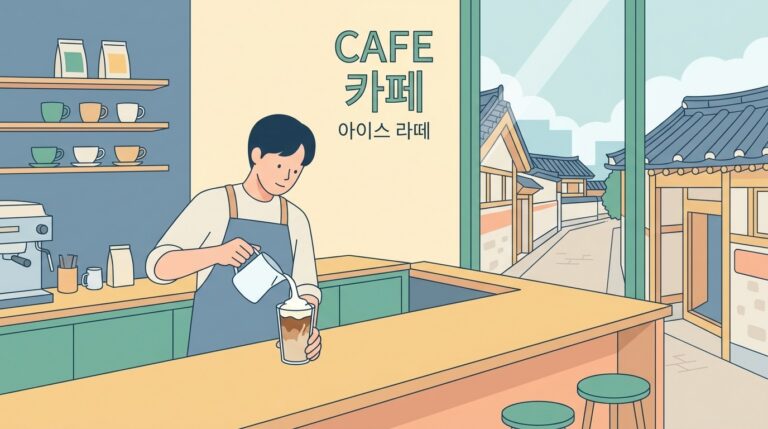
Crafting Your Masterpiece: The Art of Developing a Korean Cafe Signature Drink
Phase 1: Empathy (Storytelling Opening)
안녕하세요! 매일한글 에디터입니다. (Hello! This is your Daily Hangul editor.)
Picture this: You are standing in the sleek, concrete-accented R&D kitchen of a trendy cafe nestled in the labyrinthine alleys of Seongsu-dong. The espresso machine is hissing, artisanal syrups are lined up like chemistry vials, and your Korean business partner takes a sip of your newly concocted black sesame Einspänner. You hold your breath, waiting for culinary praise. Instead, they tilt their head, tap their chin, and say: “음, 맛은 있는데… 밸런스가 좀 무너진 것 같아요. 끝에 텁텁함도 남고, 뭔가 시그니처다운 확실한 킥이 부족해요.” (Mmm, it’s tasty, but… the balance feels a bit off. There’s a dry aftertaste, and it lacks that signature kick.)
Your mind races. You know coffee, but how do you debate sensory layers, texture, and menu branding in nuanced, C1-level Korean without sounding like a textbook robot? Developing a signature menu in South Korea isn’t just about combining ingredients; it is an intense cultural dialogue about mouthfeel, Instagram aesthetics, and delicate palate harmonies. Based on the real trials of our advanced learners launching indie roasteries in Seoul, this guide is your definitive blueprint to debating, refining, and launching that killer signature drink like a seasoned beverage director.
Phase 2: Top 3 Core Expressions
1. 밸런스를 잡다 (Baelleonseu-reul japda)
- Pronunciation: [Bael-leon-seu-reul jap-da] (Think of balance pronounced with a crisp Korean ‘b/p’ sound, followed by jap-da, sounding like ‘chop-dah’ with a soft ‘j’).
- Meaning: Literally “to grab the balance,” practically “to achieve harmony between competing sensory notes (acidity, sweetness, and bitterness).”
- K-Culture Moment: Seen in survival cooking shows like Culinary Class Wars or high-end cafe consulting vlogs on YouTube when a master barista fine-tunes an extraction profile so the fruity acidity doesn’t overpower the milk fat.
- Editor’s Insight: In advanced Korean business contexts, you don’t just say “맛을 맞추다” (adjust the taste). 밸런스를 잡다 signals that you evaluate the beverage holistically—considering how body, temperature, and aroma interplay.
- Situation Spectrum:
- Casual: ✅ (단맛이랑 산미 밸런스 좀 잡아봐.)
- Semi-formal: ✅ (우유 지방과 에스프레소의 밸런스를 잡는 게 핵심이에요.)
- Formal: ✅ (이번 시그니처 라인업의 전반적인 밸런스를 신중히 잡았습니다.)
- 🤔 Think About It: In English, we often say “balance the flavors,” but Korean uses the active verb 잡다 (to catch/hold). Why do you think Korean culinary culture conceptualizes harmony as something elusive that must be captured?
2. 킥을 주다 (Kik-eul juda)
- Pronunciation: [Kik-eul ju-da] (Sounds like the English word kick followed by eul joo-dah).
- Meaning: Literally “to give a kick,” practically “to add an unexpected focal ingredient or flavor twist that makes a menu memorable.”
- K-Culture Moment: Frequented by food trendsetters on Instagram and trendy beverage developers in Hannam-dong when explaining why adding pink salt to cold foam or a touch of smoked cardamom to Earl Grey transforms a boring drink into a sellout hit.
- Editor’s Insight: Borrowed from the English “kick,” in Korean culinary slang it specifically refers to that distinct, proprietary punch that turns a standard latte into an irreplaceable “signature.” Without a 킥, your drink is just another coffee.
- Situation Spectrum:
- Casual: ✅ (여기에 바질 시럽으로 킥을 주면 대박일 듯!)
- Semi-formal: ✅ (끝 맛에 핑크 솔트로 킥을 주는 방안을 고민 중입니다.)
- Formal: ⚠️ (Use 차별화된 포인트를 주다 in high-stakes corporate investor pitches).
- 🤔 Think About It: Korean cafe culture thrives on rapid trend cycles. Does your native culture prize a sudden sensory surprise (킥) in traditional recipes, or does it value adherence to classical orthodoxy?
3. 텁텁함을 덜어내다 (Teopteophameul deoreonaeda)
- Pronunciation: [Teop-teop-ham-eul deo-reo-nae-da] (Pronounce teop like the first syllable of ‘tough’ with a popping ‘p’ at the end, and deoreonaeda like ‘duh-raw-nae-dah’).
- Meaning: Literally “to scoop away the graininess/dryness,” practically “to eliminate a heavy, cloying, or chalky mouthfeel after swallowing.”
- K-Culture Moment: A critical criterion on Korean food review shows. If a matcha latte or nutty cream latte leaves a film or dryness in the mouth, critics immediately call it out using this phrase.
- Editor’s Insight: 텁텁하다 is an untranslatable sensory word expressing that unpleasant, powdery, coated feeling on your tongue after consuming heavy dairy, cheap cocoa, or over-extracted tannins. Mastering 덜어내다 demonstrates your culinary refinement.
- Situation Spectrum:
- Casual: ✅ (파우더 대신 농축액을 써서 텁텁함을 덜어내자.)
- Semi-formal: ✅ (크림의 텁텁함을 덜어내기 위해 콜드브루 베이스를 썼습니다.)
- Formal: ✅ (유지방의 텁텁함을 덜어내고 깔끔한 후미를 구현했습니다.)
- 🤔 Think About It: Korean distinguishes between dozens of tactile mouthfeels (예: 텁텁하다, 깔끔하다, 칼칼하다, 눅진하다). What does this hyper-specific sensory lexicon tell us about the Korean palate?
Phase 3: Textbook Korean vs. Real Korean
Situation 1: Giving constructive feedback on a recipe prototype
- 📖 교과서 한국어 (Textbook): 이 커피는 맛이 너무 강하고 뒤에 남는 느낌이 안 좋습니다. (I keopineun masi neomu ganghago dwie namneun neukkimi an joseumnida. / “This coffee has too strong of a taste and the feeling left behind is not good.”)
- 🗣️ 진짜 한국어 (Real-World C1): 맛의 무게감은 좋은데, 후미가 좀 무겁고 텁텁해서 마시고 난 뒤에 물을 찾게 돼요. (Maseui mugegameun joeunde, humiga jom mugeopgo teopteophaeseo masigo nan dwie mureul chatge dwaeyo. / “The body is nice, but the aftertaste is heavy and dry, so it makes you reach for water right away.”)
- 💡 왜 다를까? (Why the difference?): Advanced professionals acknowledge the positive intent (맛의 무게감은 좋은데) before diagnosing the mouthfeel defect using technical terms like 후미 (aftertaste) and visceral metaphors (물을 찾게 되다).
Situation 2: Suggesting an experimental flavor pairing
- 📖 교과서 한국어 (Textbook): 여기에 다른 새로운 재료를 넣어보는 것이 어떨까요? (Yeogie dareun saeroun jaeryoreul neoheoboneun geosi eotteolkkayo? / “How about putting other new ingredients here?”)
- 🗣️ 진짜 한국어 (Real-World C1): 여기에 스모키한 얼그레이 폼을 얹어서 향으로 확실한 킥을 줘보는 건 어때요? (Yeogie seumokihan eolgeurei pomeul eonjeoseo hyangeuro hwaksilhan kikeul jwoboneun geon eottaeyo? / “How about layering a smoky Earl Grey foam on top to give it a decisive aromatic punch?”)
- 💡 왜 다를까? (Why the difference?): Real beverage developers don’t just ask to “add something”; they specify the textural layer (폼을 얹다) and the precise sensory vehicle (향으로 확실한 킥).
Phase 4: K-Culture Deep Dive & Non-Verbal Manners
4-1. Sensory Nunchi & Recipe Tasting Etiquette
In Korea’s specialty coffee scene, tasting a partner’s or senior roaster’s prototype is a high-stakes cultural dance. Never state a blunt “별로예요” (It’s bad). Instead, exercise Nunchi (눈치) through deliberate tasting physical cues:
1. The Double Slurp & Visual Pause: Bring the testing cup to eye level first, admiring the visual layers (그라데이션, gradation). After cupping or sipping, close your eyes for 2–3 seconds to reflect on the finish before speaking.
2. The Two-Handed Cup Handover: Always return the tasting beaker or glass using both hands or with your right hand supported at the forearm by your left wrist. It shows deference to the R&D labor.
3. The Cushioning Critique: Before pointing out flaws, praise the visual presentation (비주얼) or initial aroma (첫 향). For example: “첫 모금의 텍스처는 예술인데, 삼키고 나서 산미가 살짝 튀네요.” (The texture on the first sip is art, but after swallowing, the acidity pops out a bit too sharply.)
4-2. Cultural Code: The “Visual Shock” & Narrative Branding
Korean cafes don’t just sell caffeine; they sell immersive cultural escapes. A signature menu in Seoul requires two non-negotiable elements:
* 인스타그래머블 (Instagrammability): The drink must undergo a visual transition—such as cream slowly cascading down glass walls or a syrup blooming like ink in cold milk. If it doesn’t look stunning on camera, the recipe isn’t ready.
* 스토리텔링 (Storytelling): Customers crave narrative ingredients. Rather than just “matcha,” it must be 제주 유기농 말차 (Jeju organic matcha); rather than “chestnut,” it’s 공주 알밤 (Gongju sweet chestnut). Your recipe is judged by its geographic provenance and emotional resonance.
Phase 5: Real-Life Roleplay Scenario
Setting: The tasting lab of an indie roasting atelier in Euljiro, Seoul.
Characters:
* You: A passionate foreign entrepreneur opening a concept cafe in Seoul.
* Min-seok (민석): A meticulous, award-winning head roaster and beverage consultant.
Min-seok: [진지하게 잔을 건네며] 이번에 새로 잡은 참깨 크림 라떼 샘플이에요. 비율을 살짝 손봤는데 한번 테이스팅해 보세요.
(Ibeone saero jabeun chamkkae keurim latte saempleieyo. Biyureul saljjak sonbwanneunde hambeon teiseutinghae boseyo.)
“This is the sesame cream latte sample we recalibrated. I tweaked the ratio slightly; please go ahead and taste it.”
🎭 행동 지문: 두 손으로 잔을 내밀며 기대감 어린 눈빛으로 바라본다.
You: [잔을 받아 코 끝으로 향을 음미하며] 고소한 너티 향이 확 올라오네요. 어디 한번 마셔볼게요.
(Gosohan neoti hyangi hwak ollaoneyo. Eodi hambeon masyeobolgeyo.)
“The savory, nutty aroma rises instantly. Let me take a sip.”
🎭 행동 지문: 잔을 살짝 돌려 크림과 에스프레소 층을 확인한 뒤 한 모금 넘긴다.
You: 음, 크림의 쫀쫀한 질감은 정말 완벽한데요? 에스프레소 바디감이랑 잘 맞물려요.
(Eum, keurimui jjonjjonhan jilgameun jeongmal wanbyeokhandeyo? Eseupeureso badigamirang jal manmullyeoyo.)
“Mmm, the dense, chewy texture of the cream is truly flawless! It meshes nicely with the espresso’s body.”
🎭 행동 지문: 만족스러운 미소를 짓고 고개를 끄덕인다.
Min-seok: [조심스럽게 살피며] 그렇죠? 그런데 제가 보기엔 삼키고 난 뒤 끝 맛이 조금 걸리는데, 어떠세요?
(Geureochyo? Geureonde jega bogien samkigo nan dwi kkeut masi jogeum geollineunde, eotteoseyo?)
“Right? But from my perspective, the aftertaste after swallowing catches on my palate a bit. What do you think?”
🎭 행동 지문: 턱을 괴고 상대방의 디테일한 피드백을 기다린다.
You: 맞아요! 첫 모금은 임팩트가 강한데, 뒤로 갈수록 참깨 페이스트의 텁텁함이 혀에 남아요.
(Majayo! Cheot mogeumeun impaekteuga ganghande, dwiro galsurok chamkkae peiseuteuui teopteophami hyeoe namayo.)
“Exactly! The first sip has a strong impact, but as it finishes, the dryness of the sesame paste clings to the tongue.”
🎭 행동 지문: 잔의 가장자리를 가리키며 진지한 톤으로 분석한다.
Min-seok: 정확하게 짚으셨네요. 페이스트 양을 줄이자니 고소함이 죽고, 늘리자니 밸런스가 무너지고… 어떻게 밸런스를 잡으면 좋을까요?
(Jeonghwakhage jipeusyeonneyo. Peiseuteu yangeul jurijani gosohami jukgo, neullijani baelleonseuga muneojigo… Eotteoke baelleonseureul jabeumyeon joeulkkayo?)
“You pinpointed it precisely. If we reduce the paste, we lose the nuttiness; if we increase it, the balance collapses… How should we achieve harmony here?”
🎭 행동 지문: 노트에 펜을 끄적이며 고민스러운 표정을 짓는다.
🔀 Interactive Decision Point (분기점)
What do you propose to solve this culinary dilemma?
- Choice A: “페이스트를 완전히 빼고 그냥 일반 바닐라 라떼로 출시하는 게 어떨까요? 안전하게 가요.”
- Choice B: “농축 우유를 베이스로 바꾸고, 천일염을 한 꼬집 넣어서 텁텁함을 덜어내고 단짠의 킥을 줘보면 어떨까요?”
- Choice C: “커피 추출 시간을 길게 늘려서 에스프레소 쓴맛을 더 강하게 만들어 텁텁함을 덮어버리죠!”
Branch Feedback:
* Choice A (Bad): Giving up on your signature flavor defeats the purpose of opening a distinct Korean cafe. Min-seok will lose respect for your creative vision!
* Choice B (Best!): Perfect C1 culinary thinking! Adjusting the liquid base (농축 우유) to carry fat smoothly while using salt (천일염 한 꼬집) to cut bitterness/dryness and introduce the beloved 단짠 (sweet-and-salty) kick demonstrates elite menu development instinct.
* Choice C (Risk): Over-extracting espresso (추출 시간을 길게 늘리다) introduces harsh tannins and astringency, worsening the tongue-coating dryness instead of fixing it.
Phase 6: 10-Second Emotion Shadowing Drill
Read aloud along the slash marks (/), matching the emotional guidance to develop authentic musicality in your Korean.
[🤔 진지하고 분석적인 톤으로 / Thoughtful & Analytical]
“크림의 질감은 쫀쫀해서 좋은데, / 끝에 남는 텁텁함을 / 어떻게 덜어낼지가 관건이네요.”
(Keurimui jilgameun jjonjjonhaeseo joeunde, / kkeute namneun teopteophameul / eotteoke deoreonaeljiga gwangeonineyo.)
“The cream’s dense texture is lovely, / but how we strip away the lingering dryness / is the real linchpin.”-
[🤩 번뜩이는 아이디어가 떠올랐을 때 / Excited Revelation]
“여기에 훈연한 솔트 크럼블을 살짝 올려서 / 식감이랑 향으로 / 확실한 킥을 줘보는 건 어떨까요?!”
(Yeogie hunyeonhan solteu keureombeureul saljjak ollyeoseo / sikgamirang hyangeuro / hwaksilhan kikeul jwoboneun geon eotteolkkayo?!)
“What if we sprinkle smoked salt crumble on top / to deliver a decisive kick / through both texture and aroma?!” -
[☕ 차분하고 단호한 프로페셔널의 톤 / Calm & Decisive Expertise]
“산미가 튀지 않도록 / 추출 온도를 1도만 낮추고, / 베이스의 밸런스를 다시 잡아보죠.”
(Sanmiga twiji antorok / chuchul ondoreul ildo-man natchugo, / beiseuui baelleonseureul dasi jababojo.)
“To keep the acidity from sticking out, / let’s drop the extraction temperature by just one degree, / and recapture the balance of the base.”
Phase 7: K-Culture Mini Dictionary
-
시그니처 (Sigeunicheo) | Noun | Signature Menu Item
Real-World Usage: In Korea, customers rarely ask “What’s good?” Instead, they ask: “이 집 시그니처가 뭐예요?” (What is this house’s signature?). It defines the brand’s identity and is usually priced higher than standard espresso drinks. -
단짠단짠 (Danjjandanjjan) | Slang / Sensory Term | Sweet-and-Salty Synergy
Real-World Usage: A combination of 달다 (sweet) and 짜다 (salty). In signature drinks, adding rock salt to cold cream or caramel creates an irresistible dopamine loop that makes Korean consumers finish the cup. -
비주얼 깡패 (Bijueol Kkangpae) | Slang | Visual Powerhouse (Drop-Dead Gorgeous Appearance)
Real-World Usage: Literally translates to “visual gangster.” Used to describe a menu item whose visual presentation is so overwhelming and photogenic that it guarantees viral organic marketing on social media. -
입안에 감돌다 (Ibane Gamdolda) | Idiomatic Expression | To Linger Delicately on the Palate
Real-World Usage: Used in professional sensory analysis to describe a long, elegant finish: “삼키고 난 뒤에도 은은한 베르가못 향이 입안에 감돌아요.” (Even after swallowing, the delicate scent of bergamot lingers softly in the mouth).
Phase 8: Traveler & Entrepreneur Survival Kit
Top 3 Survival Expressions for Cafe Entrepreneurs
- “시그니처 원두의 배전도를 조금만 낮춰 주실 수 있나요?”
(Sigeunicheo wonduui baejeondoreul jogeum-man natchwo jusil su innayo?)
Pro Tip: Use this when collaborating with wholesale roasters to request a lighter roast profile (배전도를 낮추다) to retain floral notes. - “파우더보다 베이스 액상 시럽의 잔여감이 훨씬 적네요.”
(Paudeoboda beiseu aeksang sireobui janyeogami hwolssin jeongneyo.)
Pro Tip: Essential when sourcing ingredients at supply trade shows; notes that liquid syrups leave less chalky residue (잔여감) than powders. - “테이크아웃 잔에서도 이 레이어가 유지될까요?”
(Teikeuaut janeseodo i reieoga yujidoelkkayo?)
Pro Tip: Korean take-out culture is massive. Always test whether visual beverage layers hold up in PET take-out cups before launching.
Editor’s Travel & Sourcing Note
When developing signature drinks, escape the tourist traps and visit the wholesale baking and packaging hub in Jung-gu, Seoul. You can pinpoint every packaging and syrup supplier via the Bangsan Market Specialty Packaging Alley on Naver Map. Note that wholesale merchants expect fast, precise orders, so carry cash or local bank transfer capabilities (계좌이체) if you do not hold a Korean domestic business credit card.
Phase 9: “한 발 더 깊이” (One Step Deeper)
In South Korea, a cafe is never merely a beverage dispensary; it serves as a third living space, a visual gallery, and a personal statement of taste. The societal obsession with developing “시그니처 메뉴” reflects the intense speed of the country’s trend economy (트렌드 주기). Because standard Americanos have become an interchangeable commodity, the Korean consumer rewards micro-innovations—a unique cream ratio, an artisanal infusion, or a culturally nostalgic ingredient reimagined through modern gastronomy. To build a successful cafe in Korea is to participate in an ongoing collective dialogue about aesthetic perfection and relentless sensory reinvention.
💬 Your Turn: What local ingredient from your home country would you dare to introduce into a Seoul-style signature cream latte, and how would you market its “kick” in Korean? Drop your creative recipe in the comments below!
Phase 10: FAQ & Common Mistakes
Q: Can I use the word “독특하다” (unique) to compliment a partner’s signature recipe?
A: Be careful! While “독특하다” means unique, in culinary critique it often borders on “peculiar” or “weird” (e.g., “맛이 좀 독특하네요…” can imply it tastes bizarre). Instead, use sophisticated praise like “개성이 뚜렷하다” (It has a distinct personality) or “차별화된 포인트가 확실하다” (The differentiating point is clear).
Q: What is the exact difference between “바디감” and “목넘김” in drink development?
A: “바디감” (body/weight) refers to the density, viscosity, and thickness of the liquid as it rests on the tongue. “목넘김” (swallowing sensation/finish) refers specifically to how smoothly or refreshingly the beverage glides down the throat without catching or irritating.
Q: How do I ask a supplier to make an ingredient less sweet without sounding rude?
A: Rather than saying “너무 달아서 못 쓰겠어요” (It’s too sweet to use), say: “원재료 본연의 향을 살리기 위해 당도를 살짝만 낮춘 커스텀이 가능할까요?” (Would it be possible to customize this with slightly reduced sweetness to elevate the natural aroma of the raw ingredient?).
🚨 Common Mistakes Warning Board
- Mistake: Calling every custom drink “스페셜 메뉴” (Special Menu).
Correct Action: Use 시그니처 메뉴 (Signature Menu). “스페셜 메뉴” sounds like a discount lunch promotion, whereas “시그니처” denotes your brand’s flagship masterpiece. - Mistake: Translating “aftertaste” solely as “뒷맛” in formal business settings.
Correct Action: While “뒷맛” is fine casually, use the professional culinary hanja-term 후미 (後味, Humi) when analyzing sensory extraction sheets with roasters. - Mistake: Saying “맛이 섞이다” (flavors get mixed) when praising complexity.
Correct Action: “섞이다” sounds like an accidental mess. Say “풍미의 레이어가 조화롭게 어우러지다” (the layers of flavor harmonize beautifully).
Phase 11: Action Mission
- 🥉 Bronze Mission (Solo Practice): Stand in front of your home espresso maker or favorite coffee cup. Record a 30-second voice memo describing the taste using 밸런스, 목넘김, and 후미 without using the word “맛있다” once!
- 🥈 Silver Mission (Social Engagement): Snap a photo of a drink you tasted today. Post an Instagram story using the caption: “끝맛의 텁텁함을 덜어내고 확실한 킥을 준 시그니처!” and tag @DailyHangul.
- 🥇 Gold Mission (Real-World Execution): Walk into an indie roastery in Korea. Ask the barista: “이 시그니처 메뉴는 어떤 킥으로 밸런스를 잡으셨나요?” (What kick did you use to balance this signature drink?) and listen closely to their answer.
- 🎮 K-Culture Mission: Watch an episode of a Korean cafe startup vlog or beverage tasting review. Count how many times the reviewers use the sensory descriptors 쫀쫀하다 (dense/elastic) and 깔끔하다 (clean finish).
Phase 12: Interactive Quiz Challenge
Test your beverage development Korean mastery! Click the dropdown toggles to reveal the answers.
Question 1: Situational Judgment
You are tasting a newly developed black sesame latte prototype. The initial sip is rich and aromatic, but after swallowing, a dry, chalky powder texture clings to your palate. What is the most professional C1-level critique?
A) “맛이 너무 이상해서 못 삼키겠어요.”
B) “첫 향의 고소함은 뛰어난데, 후미에 남는 텁텁함을 조금만 덜어내면 완벽할 것 같아요.”
C) “이 음료는 실패작이니까 그냥 아메리카노나 팝시다.”
🔍 Check Answer & Explanation
Correct Answer: B
Explanation: Option B follows proper Korean Nunchi and professional R&D critique manners by acknowledging the sensory success (첫 향의 고소함) before offering an exact, actionable technical solution using 텁텁함을 덜어내다.
Question 2: Fill-in-the-Blank
Complete the sentence using the most natural beverage development terminology:
“단맛과 산미가 따로 놀지 않도록, 콜드브루 베이스로 전체적인 (________)를 단단하게 잡았습니다.”
A) 깡패 (Kkangpae)
B) 밸런스 (Baelleonseu)
C) 텁텁함 (Teopteopham)
🔍 Check Answer & Explanation
Correct Answer: B (밸런스)
Explanation: When harmonizing sweet and acidic notes that “clash separately” (따로 놀다), the standard collocation is 밸런스를 잡다 (to achieve sensory balance).
Question 3: Cultural True or False
Statement: In modern Korean cafe trends, a beverage that tastes world-class but has an ordinary, flat visual appearance will easily become a viral signature menu item.
🔍 Check Answer & Explanation
Correct Answer: False (F)
Explanation: In Korean cafe culture, aesthetic presentation (비주얼/인스타그래머블) is equally as critical as taste. Signature menus require distinct visual appeal—such as textural layers, dramatic color contrasts, or unique glassware—to encourage social media virality.







