

The Unwritten Rules of Seollal Money: How Much to Give and How to Exchange Crisp Bills in Korea
Phase 1: 공감 (Empathy & Cultural Immersion)
안녕하세요! 매일한글 에디터입니다. Picture this: It is the bright, chilly morning of Seollal (설날 – Lunar New Year) in Seoul. The soothing scent of boiling beef broth and sliced rice cakes from tteokguk (떡국) fills the living room. Suddenly, the living room clears, and your younger cousins or nieces and nephews drop cleanly to their knees to perform sebae (세배), the formal deep bow honoring elders. Your heart skips a beat. You reach into your coat pocket, but a cold panic sets in: How much cash am I actually expected to give? Is handing over slightly creased banknotes pulled straight from a corner ATM a terrible social blunder? Why was your Korean co-worker obsessing over getting ‘singwon’ from the bank three days ago?
Navigating holiday monetary propriety in Korea is an intricate socio-cultural dance where filial piety, financial generosity, and non-verbal etiquette intersect. Handing over cash is never merely a monetary transaction; it is an emotional and ritualistic barometer of your maturity and respect. Based on a decade of steering advanced expats through Korean familial waters, this definitive guide provides the cultural grounding and C2-level linguistic precision you need to master sebaetdon etiquette and bank exchanges like a true Seoulite.
Phase 2: 핵심 표현 3선 심층 분석 (3 Core Expressions In-Depth)
1. 신권으로 교환해 주세요 (Sin-gwoneuro gyohwanhae juseyo)
- Pronunciation: [Sin-gwon-eu-ro gyo-hwan-hae ju-se-yo] (Think: “Seen-gwon-oo-roh gyo-hwan-heh joo-seh-yo” — crisp ‘s’, soft glide on ‘gyo’)
- Meaning: Literal: “Please exchange (this) for newly minted bills.” | Nuanced: An indispensable, seasonal banking request made right before major holidays to obtain uncirculated, razor-sharp banknotes specifically for gifting.
- K-Culture Moment: Seen in holiday family dramas where exhausted branch tellers sigh as lines wrap around the block because grandmothers and uncles demand brand-new ten-thousand-won bills.
- Editor’s Insight: The word 신권 (新券, sin-gwon) signifies far more than “clean paper.” Presenting uncirculated money represents pristine beginnings, purifying the energy of the coming year. Handing someone a crumpled banknote from a convenience store ATM during Seollal subtly signals a lack of preparation (seong-ui, 성의).
- Situation Spectrum: Casual: ⚠️ (sounds too operational for friends) | Semi-formal: ✅ | Formal: ✅
- 🤔 Think About It: In many Western cultures, a crisp bill is merely a nice aesthetic touch; in Korea, it denotes moral diligence. How does your native culture balance physical presentation versus the monetary sum when giving gifts?
2. 약소하지만 성의껏 준비했습니다 (Yaksokhajiman seong-uikkeot junbihaessseumnida)
- Pronunciation: [Yak-so-ha-ji-man seong-ui-kkeot jun-bi-haet-seum-ni-da] (Pronounce ‘seong-ui’ smoothly as “seong-eet” or “seong-wit” with a double ‘k’ emphasis on ‘kkeot’)
- Meaning: Literal: “It is meager, but I prepared it with all my sincerity.” | Nuanced: A high-register, self-effacing formula used when presenting monetary gifts or honoraria to elders or parents to convey supreme respect without boasting.
- K-Culture Moment: The moment an eldest son or accomplished daughter-in-law slides an elegant silk envelope across the floor to the grandparents after the ceremonial bows.
- Editor’s Insight: At a C2 level, uttering “돈 받으세요” (Please receive this money) is considered crude and jarring. Korean honorific discourse operates on the art of gyeomyang (겸양, self-deprecation). Minimizing your own gift as “약소하다” (meager) while emphasizing the intentional care (성의, seong-ui) elevates the gesture into high literature.
- Situation Spectrum: Casual: 🚫 | Semi-formal: ⚠️ | Formal: ✅
- 🤔 Think About It: Why does Korean etiquette mandate linguistic self-diminishment when offering substantial monetary gifts? What does this say about social hierarchy and humility?
3. 덕담 한마디 건네다 (Deokdam hanmadi geonneda)
- Pronunciation: [Deok-dam han-ma-di geon-ne-da] (Crisp ‘k’ stop in ‘deok’, rhythmic cadence on ‘han-ma-di’)
- Meaning: Literal: “To pass along a word of virtue/blessing.” | Nuanced: To offer benevolent, auspicious verbal wishes for the upcoming year, which fundamentally legitimizes and accompanies the monetary gift.
- K-Culture Moment: An uncle handing a red-and-gold envelope to a college student, pausing to say thoughtful words about their health or upcoming exams instead of interrogating them about employment.
- Editor’s Insight: Sebaetdon without deokdam is viewed as sterile, purely transactional payment. However, modern Korean society draws a sharp line between genuine deokdam (encouragement) and jansori (잔소리, unsolicited nagging regarding marriage or career). True mastery lies in delivering uplifting, pressure-free affirmations.
- Situation Spectrum: Casual: ✅ | Semi-formal: ✅ | Formal: ✅
- 🤔 Think About It: How does your native language demarcate well-wishing from intrusive familial advice during festive holidays?
Phase 3: 교과서 한국어 vs 진짜 한국어 (Textbook vs. Real-World Korean)
Situation 1: At the bank counter requesting crisp banknotes
- 📖 교과서 한국어: 새 지폐를 주실 수 있습니까? (Sae jipye-reul jusil su isseumnikka? / “Can you give me new paper money?”)
- 🗣️ 진짜 한국어: 설 세뱃돈용으로 쓸 건데, 빳빳한 신권으로 교환 가능할까요? (Seol sebaetdonyongeuro sseul geonde, bpat-bpat-han sin-gwoneuro gyohwan ganeunghalkkayo? / “I’ll be using these for Seollal gift money; would it be possible to exchange them for crisp new bills?”)
- 💡 왜 다를까? Textbook Korean treats currency as mere utility. Native speakers specify the social purpose (설 세뱃돈용) and intuitively utilize the tactile mimetic word 빳빳한 (crisp, stiff, wrinkle-free), immediately signaling communicative authenticity to the bank teller.
Situation 2: Discussing the holiday monetary “going rate” with peers
- 📖 교과서 한국어: 아이들에게 돈을 얼마나 주어야 합니까? (Aideul-ege doneul eolmana jueoya hamnikka? / “How much money must one give to children?”)
- 🗣️ 진짜 한국어: 요즘 초등학생 조카들 세뱃돈 시세가 대략 어떻게 형성돼 있어요? (Yojeum chodeunghaksaeng jokhadeul sebaetdon sisega daeryak eotteoke hyeongseongdwae isseoyo? / “What is the rough going market rate for elementary school nieces and nephews these days?”)
- 💡 왜 다를까? Educated native adults rarely ask in flat terms of “how much.” Instead, they humorously yet practically refer to 시세 (market price / going rate) and 형성되다 (to take shape / be established), acknowledging that holiday gifts fluctuate with contemporary inflation.
Phase 4: K-Culture 딥다이브 & 비언어적 매너 (Cultural Nuance & Non-Verbal Manners)
4-1. 눈치 (Nunchi) & Somatic Etiquette
- The Double-Hand Golden Rule (두 손 전달): Never extend an envelope with one hand. Place your right hand firmly under or holding the envelope, while your left hand gently supports your right forearm or wrist. Keep your head slightly bowed.
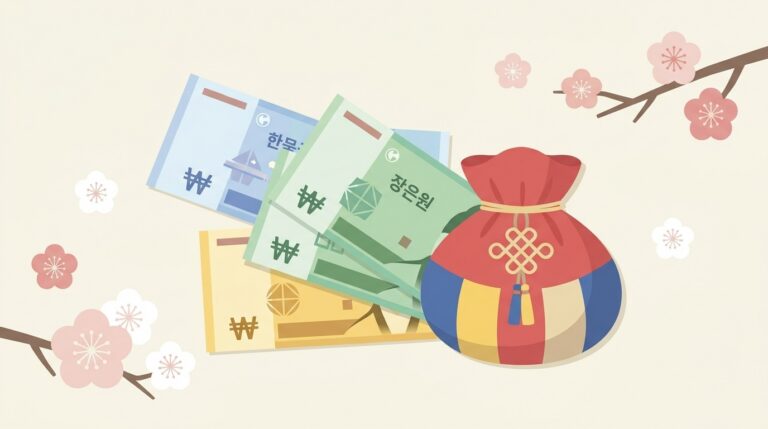
- The Envelope Barrier (봉투의 예의): Raw banknotes should never be handed over naked. Always enclose sebaetdon in a clean white envelope, a traditional pastel silk bokjumeoni (복주머니), or an aesthetic seasonal holiday envelope. Seal it lightly, or tuck the flap in without licking or gluing it shut.
- The Gracious Delay: When receiving sebaetdon, never rip the envelope open or check the amount in front of the giver. Bow, express profound thanks, and slip it discreetly into your inner pocket or bag.
4-2. Cultural Code Analysis: The Socioeconomics of Sebaetdon
In contemporary K-Dramas (such as Reply 1988 or modern weekend family dramas), you frequently see two persistent cultural tropes: the generational struggle of adults quietly calculating their bank balances before family reunions, and the classic comedic trope: “엄마가 커서 돌려줄게, 맡겨 둬!” (Eommaga keoseo dollyeojulge, matgyeo dwo! — “Mom will hold onto your money and give it back when you’re older!”).
Behind the humor lies a shifting financial reality. Modern Koreans generally operate on unspoken consensus brackets:
* Pre-school / Early Elementary: 10,000 KRW
* Middle / High School: 50,000 KRW (The standard single yellow Shin Saimdang bill)
* College Students / Job Seekers: 50,000 ~ 100,000 KRW
* Parents / Grandparents (용돈): 100,000 ~ 300,000+ KRW
While mobile remittances via KakaoPay are ubiquitous in daily life, doing so for Seollal sebae is still widely viewed as cold and thoughtless unless geographical distance makes an in-person meeting impossible.
Phase 5: 실전 롤플레이 시나리오 (Mastery Dialogue Simulation)
Setting: A bustling commercial bank branch in Gwanghwamun, two business days before Seollal.
Characters: Julian (a culturally seasoned foreign executive) and Banker Park (a sharp, courteous bank teller).
- Banker Park: 어서 오세요, 고객님. 어떤 업무 도와드릴까요? (Eoseo oseyo, gogaeknim. Eotteon eommu dowadeurilkkayo? / “Welcome, sir. How may I assist you today?”)
- Julian: 🎭 [Politely bowing his head slightly] 안녕하세요, 계장님. 명절 앞두고 많이 바쁘시죠? 설 세뱃돈으로 쓸 신권 교환 때문에 왔습니다. (Annyeonghaseyo, gyejangnim. Myeongjeol apdugo mani bappeusijyo? Seol sebaetdonyongeuro sseul sin-gwon gyohwan ttaemune watseumnida. / “Hello. Must be quite busy right before the holidays, right? I came to exchange for some crisp new bills to use as Seollal gift money.”)
- Banker Park: 🎭 [Smiling warmly at the natural opening] 아, 그러시군요! 요즘 신권 수요가 워낙 몰려서 권종별로 1인당 교환 한도가 제한되어 있는데 괜찮으실까요? (A, geureosigunyo! Yojeum sin-gwon suyoga wonak mollyeoseo gwonjongbyeollo il-indang gyohwan handoga jehandwae inneunde gwaenchaneusilkkayo? / “Ah, I see! Demand for new bills has surged so much recently that we have per-person caps depending on the denomination. Would that be alright?”)
- Julian: 🎭 [Nodding with understanding] 네, 규정은 익히 알고 있습니다. 5만 원권 네 장이랑 1만 원권 열 장으로 부탁드려도 될까요? (Ne, gyujeongeun ikki algo isseumnida. O-man-won-gwon ne jang-irang il-man-won-gwon yeol jang-euro butakdeuryeodo doelkkayo? / “Yes, I am well aware of the regulations. Could I request four 50,000-won notes and ten 10,000-won notes?”)
- Banker Park: 네, 마침 5만 원권 신권 수량이 딱 남아 있네요. 여기 빳빳한 신권으로 총 30만 원 준비해 드렸습니다. (Ne, machim o-man-won-gwon sin-gwon suryangi ttak nama inneyo. Yeogi bpat-bpat-han sin-gwoneuro chong samsip-man-won junbihae deuryeosseumnida. / “Yes, fortunately we have just enough 50,000-won new bills left. Here is your crisp total of 300,000 KRW.”)
- Julian: 🎭 [Accepting the bills with two hands] 세심하게 챙겨주셔서 정말 감사합니다. 새해 복 많이 받으세요! (Sesim-hage chaeng-gyeojusyeoseo jeongmal gamsahamnida. Saehae bok mani badeuseyo! / “Thank you so much for taking such considerate care. Happy New Year!”)
- Banker Park: 🎭 [Bowing back respectfully] 고객님도 명절 따뜻하게 잘 보내시고, 새해 복 많이 받으십시오! (Gogaeknimdo myeongjeol ttatteuthage jal bonaesigo, saehae bok mani badeusipsio! / “May you also have a warm holiday, and a very prosperous New Year!”)
- Julian: 🎭 [Tucking the envelope safely into his coat] 네, 덕분에 기분 좋은 명절이 될 것 같습니다. (Ne, deokbune gibun joeun myeongjeori doel geot gatseumnida. / “Thank you, it will be a pleasant holiday thanks to you.”)
🔀 인터랙티브 분기점 (Interactive Cultural Fork)
After receiving the crisp notes at the counter, Julian notices the bank lobby offers free decorative holiday envelopes. What should he do next?
- Choice A: Take ten envelopes without asking and quickly shove the loose money into them while leaning against the teller counter.
- Feedback (Bad): Flashing cash openly at a bank counter disrupts banking etiquette and appears indiscreet.
- Choice B: Walk over to the communal writing desk, take the needed envelopes, and neatly insert the bills while keeping the figures discreet.
- Feedback (Best): Perfect execution of spatial mindfulness and discretion.
- Choice C: Decide envelopes are unnecessary waste and hand the bare cash directly to family members later on.
- Feedback (Risk): Handing bare cash during Seollal is considered rude and thoughtless in traditional family settings.
Phase 6: 10초 감정 섀도잉 드릴 (Emotional Shadowing Drill)
Master the subtle cadence, pausing (/), and vocal tone of high-context Korean delivery:
[😊 온화하고 격조 높게 / Warm, dignified, and sincere]- 약소하지만 / 성의껏 준비했으니 / 올 한 해 건강하게 / 보내셨으면 좋겠습니다.
- (Yaksokhajiman / seong-uikkeot junbihaesseuni / ol han hae geonganghage / bonaesyeosseumyeon joket-seumnida.)
- “Though it is modest / I prepared it with all my sincerity / so I hope you spend / this upcoming year in great health.”
[😅 멋쩍지만 유쾌하게 / Slightly self-effacing yet witty]- 조카들이 훌쩍 커서 / 이제 세뱃돈 시세 맞추기도 / 제법 빠듯하네요!
- (Jokhadeuri huljjeok keoseo / ije sebaetdon sise matchugido / jebeop ppadeuthaneyo!)
- “My nieces and nephews have grown so fast / that keeping up with the going gift rate / is honestly quite a squeeze!”
[🤝 정중하고 단호하게 배려하며 / Courteous and considerate]- 덕담만으로도 충분히 감사하니 / 봉투는 정말 / 마음만 감사히 받겠습니다.
- (Deokdamman-eurodo chungbunhi gamsahani / bongtuneun jeongmal / ma-eumman gamsahi batget-seumnida.)
- “Your blessings alone are more than enough / so as for the envelope / I will respectfully accept only your kind intentions.”
Phase 7: K-Culture 미니 사전 (Mini Dictionary)
- 신권 (Sin-gwon, 新券): Newly minted, uncirculated banknotes. Essential seasonal inventory requested at commercial banks prior to Seollal and Chuseok.
- 덕담 (Deokdam, 德談): Auspicious well-wishes recited by elders during holiday gatherings to bring good fortune, optimal health, and peace.
- 복주머니 (Bokjumeoni, 福-): A traditional Korean silk drawstring pouch embroidered with auspicious symbols, traditionally used to hold New Year’s gifts or gift money.
- 시세 (Sise, 時勢): Market rate or current price. Informally used by modern Koreans to discuss the expected, inflation-adjusted gift sum for social obligations.
Phase 8: 여행자를 위한 생존 키트 (Traveler’s Survival Kit)
Top 3 Survival Phrases
- 신권 교환은 몇 장까지 가능한가요? (Sin-gwon gyohwaneun myeot jangkkaji ganeunghangayo?)
- Pro Tip: Commercial banks strictly limit the number of new notes per individual right before Seollal. Use this to clarify exchange limits.
- 세뱃돈 봉투 혹시 어디에 비치되어 있나요? (Sebaetdon bongtu hoksi eodie bichidoeeo innayo?)
- Pro Tip: Most major banks place complimentary festive envelopes on the lobby stationery stands during the week before the holiday.
- 마음만 감사히 받겠습니다. (Maeumman gamsahi batgetseumnida.)
- Pro Tip: The premier phrase to politely decline an envelope from an elder when etiquette requires you to protest at least once.
Editor’s Travel Note
- Banking Deadlines: Korean commercial banks run out of sin-gwon inventory 2 to 3 days prior to the holiday. Visit branches during the morning hours mid-week. Check real-time wait times and nearby locations using the Naver Map branch finder.
- Bank of Korea Exchanges: If commercial banks run dry, the Bank of Korea (한국은행) headquarters in Jung-gu, Seoul offers direct public exchange services during designated holiday windows, subject to official identification.
Phase 9: “한 발 더 깊이” (Cultural Essay)
In contemporary capitalist discourse, currency is an impersonal, fungible instrument designed for clinical exchange. Yet in the traditional Korean framework, monetary gifts within the family sphere undergo an alchemical transformation into Jeong (정, affection and communal bonding). Waiting in line at the bank to exchange frayed notes for sin-gwon, enclosing them within a sealed envelope, and presenting them with lowered posture is an intentional cultural ritual: it purges the raw transactional nature of money, elevating it into a token of ancestral continuity and familial duty. When an elder hands sebaetdon to a youth, they are not distributing an allowance; they are bestowing social capital alongside verbal blessings (deokdam), symbolically financing the recipient’s moral and material fortitude for the year ahead.
💬 Your Turn: Have you ever experienced an exchange where money transcended its material value to carry profound emotional or spiritual weight in your own culture? Share your reflections below!
Phase 10: FAQ & 흔한 실수 방지 (FAQ & Common Mistakes)
Q: Can I just give digital money via KakaoPay or bank transfer if I cannot attend the family gathering?
A: Yes, but context dictates everything. If distance or work prevents you from attending Seollal in person, sending a thoughtful digital gift envelope via KakaoPay or a bank transfer accompanied by a personalized long-form text message or video call is widely accepted today. However, doing so while physically present in the same room is considered disrespectful.
Q: Is there an unlucky amount of money to give for Sebaetdon?
A: Unlike weddings or funerals where odd-numbered increments (30,000, 50,000, 70,000 KRW) are preferred, sebaetdon is largely denomination-driven. Avoid giving 40,000 KRW due to traditional tetraphobia (the number 4 sounding like sa, 死, death). The standard increments are clean units of 10,000, 50,000, or 100,000 KRW.
Q: What if the local bank branch is completely out of newly minted bills (신권)?
A: Do not panic. Simply request the cleanest, uncreased bills the teller or ATM has available (최대한 깨끗한 지폐). If the bills are slightly bent, iron them gently on low heat beneath a thin cloth or place them inside a heavy book overnight before inserting them into festive envelopes.
🚨 Common Mistakes Board
| Mistake | Cultural Risk | Correct Native Action |
|---|---|---|
| Handing bare bills without an envelope | Perceived as crass, transactional, and rushed | Always place cash inside a decorative or plain white envelope. |
| Opening the envelope immediately upon receipt | Signals greed and a focus on money over the elder’s presence | Bow, offer thanks, and slide the envelope into your bag/pocket unopened. |
| Using one hand to pass the gift to an elder | Signals hierarchical disrespect or dismissiveness | Hand over the envelope using two hands with elbows bent and head lowered. |
Phase 11: 액션 미션 & 참여 유도 (Action Missions)
- Bronze Mission (Solo Mastery): Practice saying “빳빳한 신권으로 교환 부탁드립니다” aloud three times in front of the mirror, matching the precise intonation rhythm from Phase 6.
- Silver Mission (Social Connection): Ask a Korean friend or your language partner: “요즘 한국에서는 조카들 세뱃돈 시세가 보통 얼마예요?” and compare their answer to the numbers discussed in Phase 4.
- Gold Mission (Real-World Execution): Visit a local Korean bank branch prior to the upcoming holiday or purchase a traditional bokjumeoni at an Insadong market stall, preparing a genuine New Year’s envelope for an elder or acquaintance.
- 🎮 K-Culture Mission: Watch a Seollal special episode of an entertainment show (such as Hangout with Yoo or I Live Alone) and spot how cast members playfully negotiate sebaetdon and exchange deokdam.
Phase 12: 인터랙티브 퀴즈 챌린지 (Interactive Quiz)
Test your real-world holiday judgment. Can you achieve a perfect score?
- Situational Judgment: You are celebrating Seollal with your Korean partner’s family. A high school nephew finishes his sebae bow to you. You reach for your wallet. What is the most culturally seamless amount and presentation?
- A) Two slightly crumpled 10,000 KRW notes handed directly by hand.
- B) A crisp 50,000 KRW banknote inside an envelope, presented with warm words of encouragement.
- C) A KakaoPay transfer of 30,000 KRW with no envelope.
- Fill-in-the-Blank: Complete the formal, self-effacing phrase used when presenting a holiday monetary gift to parents:
- “[ _______ ] 성의껏 준비했습니다. 새해 복 많이 받으세요.”
- True / False: It is customary and polite in Korean etiquette to open your sebaetdon envelope immediately in front of the family to show genuine excitement over the amount.
👉 Click here to reveal answers and deep explanations
- Answer: B. For a high school student, the standard market consensus is 50,000 KRW. Presenting it in an envelope with two hands alongside a thoughtful deokdam is the gold standard of etiquette.
- Answer: 약소하지만 (Yaksokhajiman). Full sentence: 약소하지만 성의껏 준비했습니다. (Though it is modest, I prepared it with all my sincerity.)
- Answer: False. Opening the envelope immediately in front of the giver is considered bad manners. Always wait until you are in private or after the formal gathering concludes before viewing the contents.







