

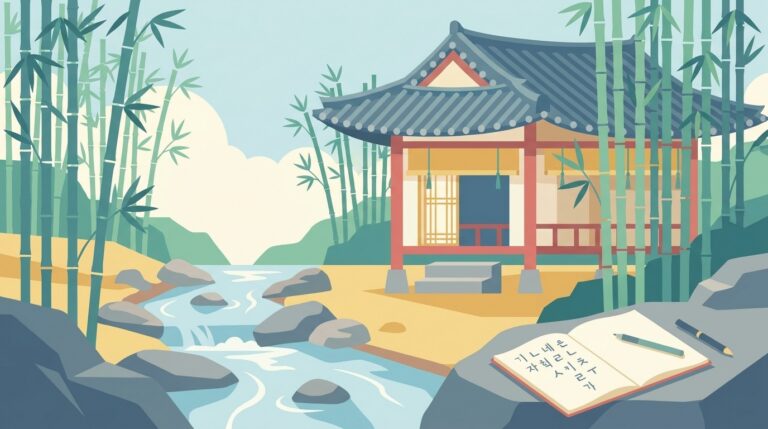
Phase 1: 공감 (Immersive Opening)
안녕하세요! 매일한글 에디터입니다. Have you ever stood in Damyang’s Soswaewon and felt puzzled by its seemingly rugged layout? While European gardens conquer wilderness with strict geometry, Korean traditional gardens welcome nature as an equal companion. A C2 learner recently told me: ‘I passed TOPIK Level 6, yet when asked about traditional pavilions, I could only mumble 자연이 예뻐요 (Nature is pretty).’ It is a classic plateau: possessing sophisticated grammar while lacking the philosophical lexicon to articulate subtle spatial aesthetics. This master guide, refined through heritage curators’ insights, equips you with the nuanced, high-register vocabulary needed to discuss nature-compliant architecture with genuine cultural resonance.
Phase 2: 핵심 표현 3선 심층 분석 (In-Depth Analysis of 3 Key Expressions)
1. 자연을 거스르지 않다 (Jayeoneul geoseureuji anta)
- Pronunciation: [Jah-yeo-neul geo-seu-reu-ji an-ta] (Think of the rolling flow of ‘go search’ softened into ‘geo-seu’).
- Meaning: Literally “not defying nature”; practically used to articulate architectural non-interventionism and organic adaptation.
- K-Culture Moment: In architectural documentaries or period dramas like Mr. Sunshine, master carpenters refuse to flatten crooked pillars, explaining that true elegance lies in honoring timber grain.
- Editor’s Insight: This phrase embodies Daoist and Neo-Confucian Muwi-jayeon (무위자연). In conversation, invoking this moves your critique from mere visual appreciation to existential philosophy.
- Situation Spectrum: Casual ⚠️ / Semi-formal ✅ / Formal ✅
- 🤔 Think About It: Does your native language view nature as an obstacle to civilize, or an ecosystem to merge with seamlessly?
2. 차경(借景)의 미학 (Chagyeong-ui mihak)
- Pronunciation: [Cha-gyeong-ui mi-hak] (Resembles ‘Cha’ like tea, joined with the crisp ending of ‘young’ and ‘me-hock’).
- Meaning: Literally “the aesthetics of borrowed scenery”; framing external mountains and skies through an open pavilion window rather than enclosing artificial flora inside high walls.
- K-Culture Moment: Seen when historical drama protagonists sit inside a pavilion (정자), looking past open wooden lattices at distant mist-shrouded peaks.
- Editor’s Insight: Unlike Western gardens that build private paradises inside boundaries, Korean gardens treat the boundary as an open window to the surrounding cosmos.
- Situation Spectrum: Casual 🚫 / Semi-formal ✅ / Formal ✅
- 🤔 Think About It: How does “borrowing” external beauty differ ethically and artistically from “owning” a manicured park?
3. 인위(人爲)를 배제하다 (Inwireul baejehada)
- Pronunciation: [In-wi-reul bae-je-ha-da] (The crisp syllable ‘In-we’ followed by ‘bae-jeh’).
- Meaning: Literally “to exclude artificiality”; deliberately rejecting ostentatious human contrivance.
- K-Culture Moment: Art historians evaluating Chosun Dynasty literati gardens (byeoseo wonlim) often commend pavilions that leave uneven riverbed stones untouched.
- Editor’s Insight: It does not mean neglect or roughness; it signifies the utmost refined restraint—doing only what is necessary to shelter human contemplation.
- Situation Spectrum: Casual ⚠️ / Semi-formal ✅ / Formal ✅
- 🤔 Think About It: Can true artistic mastery be proven by restraint rather than dramatic ornamentation?
Phase 3: 교과서 한국어 vs 진짜 한국어 (Textbook vs. Real-World Nuance)
Situation 1: Appreciating the distant mountain framed by pavilion pillars
- 📖 교과서 한국어: 창문 밖으로 산과 나무가 보여서 풍경이 참 아름답습니다. (Changmun bakkeuro sangwa namuga boyeoseo punggyeongi cham areumdapseumnida. / “The mountains and trees outside the window look very pretty.”)
- 🗣️ 진짜 한국어: 기둥 사이로 펼쳐진 풍광이 한 폭의 그림 같아 차경의 미학이 절로 느껴지네요. (Gidung sairo pyeolchyeojin punggwangi han pogui geurim gata chagyeong-ui mihagi jeollo neukkyeojineyo. / “The landscape framed between the pillars resembles a scroll painting, vividly demonstrating the aesthetics of borrowed scenery.”)
- 💡 왜 다를까?: C2 Korean demands figurative, evocative phrasing. Moving beyond “아름답다” to architectural terms like “차경” captures cultural depth immediately.
Situation 2: Noting a pavilion perched atop uncarved rock foundations
- 📖 교과서 한국어: 환경을 파괴하지 않고 돌 위에 건물을 지었습니다. (Hwangyeongeul pagwehajianko dol wie geonmureul jieosseumnida. / “They built the building on the rocks without destroying the environment.”)
- 🗣️ 진짜 한국어: 기단 하나 인위적으로 깎지 않고 자연 지세에 순응하여 조영한 솜씨가 돋보입니다. (Gidan hana inwijeogeuro kkakji anko jayeon jisee suneunghayeo joyeonghan somssiga dotboimnida. / “The craftsmanship stands out by accommodating the natural topography without contriving any artificial pedestal.”)
- 💡 왜 다를까?: Words like “지세에 순응하다” (adapting to terrain) and “조영하다” (erecting architectural landscaping) reflect genuine academic and critical polish.
Phase 4: K-Culture 딥다이브 & 비언어적 매너 (Deep Dive & Non-Verbal Manners)
4-1. Nunchi & Pavillion Etiquette
When stepping onto the wooden floor (maru, 마루) of an open pavilion at sites like Soswaewon, do not rush to photograph everything at eye-level. Take off your footwear quietly, position them neatly toward the entrance steps, and lower yourself onto the wooden platform. True appreciation in Korean traditional gardens occurs seated. Gaze outward through the gaps between pillars at eye level (jwa-sik perspective). This low vantage reveals how the eaves align with distant hilltops. Speak in measured, low tones so the sound of the stream remains the primary acoustic presence.
4-2. Cultural Code Analysis: The Hermit Scholar’s Retreat
Soswaewon was constructed by Yang San-bo (양산보) following the political purges of the Joseon era. Retiring to nature was not escapism; it was an act of moral self-cultivation (Susin, 수신). The garden possesses no central axis or imposing marble fountain. Instead, stone walls contain carved drainage apertures so mountain streams flow naturally across courtyards. In Sageuk dramas, whenever scholars retreat to mountain pavilions, they are engaging with this exact spatial philosophy of harmony and unyielding moral purity.
Phase 5: 실전 롤플레이 시나리오 (Roleplay Scenario)
- Setting: The breezy Gwangpunggak pavilion in Soswaewon on an autumn afternoon.
- Character: Curator Park (박 명인), a veteran architectural preservationist holding a wooden sketchbook.
Curator Park: 어서 오세요. 소쇄원에 처음 발을 들이셨을 때 어떤 인상을 받으셨습니까? (Eoseo oseyo. Soswaewone cheoeum bareul deurisyeosseul ttae eotteon insangeul badeusyeosseumnikka? / “Welcome. What impression did you receive when you first stepped into Soswaewon?”)
You: 🎭 신발을 가지런히 정돈하고 마루에 단정히 앉으며 화려한 서양 정원과 달리, 인위적인 조경을 찾아보기 힘들다는 점이 인상적이었습니다. (Hwaryeohan seoyang jeongwongwa dalli, inwijeogin jogyeongeul chajabogi himdeuldaneun jeomi insangjeogieosseumnida. / 🎭 Arranging shoes neatly and sitting gracefully on the wooden platform “Unlike extravagant Western gardens, it was impressive that artificial landscaping is hardly noticeable.”)
Curator Park: 허허, 정확히 꿰뚫어 보셨네요. 담장 아래 바위 틈으로 물길이 드나드는 것은 보셨습니까? (Heoheo, jeonghwakhi kkwettureo bosyeonneyo. Damjang arae bawi teumeuro mulgiri deunadeuneun geoseun bosyeotseumnikka? / “Haha, you saw straight through to its core. Did you happen to notice the waterway passing through the rock crevice under the wall?”)
You: 🎭 냇물이 흐르는 담장 하단을 손으로 가리키며 네, 담장을 세우되 자연 수로를 막지 않고 지세를 그대로 품어 안았더군요. (Ne, damjangeul seu-ude jayeon suroleul makji anko jise-reul geudaero pumeo an-atdeogunyo. / 🎭 Pointing towards the bottom of the wall where the creek runs “Yes, while erecting a wall, they avoided blocking the stream and embraced the natural contours of the earth.”)
Curator Park: 바로 그것입니다. 이것이 바로 우리 선조들이 추구한 상생의 공간 철학이지요. (Baro geogeosimnida. Igeosi baro uri seonjodeuri chuguhan sangsaeng-ui gonggan cheolhag-ijiyo. / “That is precisely it. That is the spatial philosophy of coexistence pursued by our ancestors.”)
You: 🎭 마루 너머로 소나무 숲을 응시하며 건물 안에서 바깥 풍경을 바라보니, 자연을 소유하기보다 차경의 미학으로 향유했다는 생각이 듭니다. (Geonmul aneseo bakkat punggyeongeul baraboni, jayeoneul soyuhagiboda chagyeong-ui mihageuro hyang-yuhan saenggagi deumnida. / 🎭 Gating past the platform towards the pine grove “Viewing the outdoor scenery from inside the building, I feel they enjoyed nature through borrowed scenery rather than ownership.”)
Curator Park: 그 깊이를 헤아려 주시니 참으로 반갑군요. 정자 처마 곡선과 능선이 겹쳐지는 지점도 눈여겨보셨나요? (Geu gip-ireul hearyeo jusini chameuro bangapgunyo. Jeongja cheoma gokseongwa neungseoni gyeopchyeojineun jijeomdo nun-yeogeobosyeonnayo? / “It is refreshing that you comprehend such depth. Have you observed where the roof eaves align with the mountain ridge?”)
You: 🎭 미소를 띠며 고개를 끄덕인다 네, 인공 구조물이 자연의 흐름을 방해하지 않고 완벽히 동화되는 경지입니다. (Ne, ingong gujomuri jayeonui heureumeul banghaehaji anko wanbyeokhi donghwadoeneun gyeongji-imnida. / 🎭 Nodding with an appreciative smile “Yes, it achieves a sublime state where artificial structures never interrupt the flow of nature but assimilate into it.”)
🔀 인터랙티브 분기점 (Interactive Choice)
Curator Park asks: “이 정원을 현대 도시 공간에 응용한다면 어떤 점을 배워야 할까요? (What should modern urban spaces learn from this garden?)” Which response demonstrates true C2 elegance?
* Choice A: 현대 건축물도 녹지 공간을 많이 확보해서 화초를 많이 심어야 합니다. (Hyeondae geonchukmuldo nokji gongganeul mani hwakbohaeseo hwachoreul mani simeoya hamnida.)
* Choice B: 도시를 완전히 지우고 전통 양식으로 기와지붕을 얹는 복고풍으로 회귀해야 합니다. (Dosireul wanjeonhi jiugo jeontong yangsigeuro giwajibungeul eonneun bokgopungeuro hoegwihaeya hamnida.)
* Choice C: 무조건적인 개발을 지양하고, 대지의 맥락과 자연을 거스르지 않는 공간적 겸양을 배워야 합니다. (Mujogeonjeogin gaebareul jiyanghago, daejiui maengnakgwa jayeoneul geoseureuji anneun gongganjeok gyeomyangeul baeweoya hamnida.)
- Feedback:
- Choice A (Risk): Grammatically accurate, but intellectually pedestrian; fails to convey high-level architectural aesthetics.
- Choice B (Bad): Superficial interpretation focusing on decorative imitation rather than underlying philosophy.
- Choice C (Best): Brilliant C2 mastery! Uses sophisticated concepts like 대지의 맥락 (topographical context) and 공간적 겸양 (spatial humility).
Phase 6: 10초 감정 섀도잉 드릴 (10-Second Emotion Shadowing Drill)
Practice these lines out loud, paying attention to emotional intent and phrasing marks (/):
[🌿 경탄하며 감조하듯 - Reverent & Wondering]
“바위 하나 / 깎아내지 않고, / 자연 지세에 온전히 / 몸을 얹었군요.” (Bawi hana / kkak-anaeji anko, / jayeon jisee onjeonhi / momeul eonjeotgunyo.)-
[🤔 깊은 철학적 통찰을 담아 - Philosophical Insight]
“울타리를 치지 않고 / 먼 산의 풍광을 빌려온 / 차경의 미학이 / 실로 경이롭습니다.” (Ultarireul chiji anko / meon sanui punggwangeul billyeoon / chagyeong-ui mihagi / sillo gyeong-iropseumnida.) -
[✨ 감동 어린 어조로 - Deep Empathy & Appreciation]
“인위적인 기교를 배제하고 / 비움으로써 / 자연과 완벽한 합일을 / 이루어 냈네요.” (Inwijeogin gigyoreul baejehago / biumeuroseo / jayeongwa wanbyeokhan habireul / irueo naenneyo.)
Phase 7: K-Culture 미니 사전 (Mini Dictionary)
- 차경 (借景 – Chagyeong) | Borrowed Landscape | The refined traditional technique of integrating external geographic elements (mountains, trees, skies) into one’s private view through architectural apertures without owning or cordoning off the land.
- 물아일체 (物我一體 – Murilche) | Unity of Subject and Nature | A state where psychological separation between the human observer and the natural environment dissolves, foundational to traditional Korean aesthetics.
- 비원림 (別墅園林 – Byeoseo Wonlim) | Literati Retreat Garden | Private estates established in secluded valleys by Joseon scholars away from bureaucratic intrigue, designed purely for philosophical introspection.
- 순응 (順應 – Suneung) | Compliance / Organic Adaptation | Subordinating human will and artificial constructs to prevailing geographic, climatic, and topological conditions.
Phase 8: 여행자를 위한 생존 키트 (Traveler’s Survival Kit)
서바이벌 표현 TOP 3 (Survival Phrases)
- 이 정자에서 가장 이상적인 조망점이 어디인가요? (I jeongja-eseo gajang isangjeogin jomangjeomi eodi-ingayo? / “Where is the most ideal vantage point in this pavilion?”)
- Pro Tip: Use this when interacting with cultural guides; it immediately signals sophisticated aesthetic interest.
- 자연 훼손 없이 원형 그대로 보존된 곳인가요? (Jayeon hweson eopsi wonhyeong geudaero bojon-doen gosingayo? / “Is this site preserved in its original form without ecological alteration?”)
- Pro Tip: Useful when inquiring about historical authenticity in regional cultural heritage sites.
- 차경을 온전히 감상하려면 어느 계절이 제격인가요? (Chagyeongeul onjeonhi gamsangharyeomyeon eoneu gyejeori je-gyeog-ingayo? / “Which season is quintessential for taking in the borrowed scenery?”)
- Pro Tip: Prompts rich recommendations about snowscapes or autumn leaves from local caretakers.
Editor’s Travel Note
When heading to remote Joseon masterpieces like Soswaewon or Bogildo Seyeonjeong, public transit requires precise timing. Download the 네이버 지도 앱 다운로드 to cross-reference rural bus lines departing from Gwangju or Damyang terminal. For express train transfers, secure your KTX seat using the 코레일톡 예매 서비스. Footwear tip: Wear comfortable shoes that slip on and off easily, as Korean pavilions require removing shoes before ascending the wooden maru.
Phase 9: “한 발 더 깊이” (Philosophical Insight)
In Western classical landscape traditions exemplified by the Palace of Versailles, gardens demonstrate humankind’s dominion over wild chaos through geometric topiary and symmetrical fountains. In contrasting starkness, Korean gardens regard human creation as a guest (손님) within nature’s perennial residence. Architecture bows down to preexisting streams, embracing boulders rather than chiseling them away. This non-confrontational aesthetic reflects an ethical conviction: genuine civilizational sophistication is measured by human forbearance toward the living earth.
💬 Your Turn: Does traditional architecture in your home culture celebrate dominance over natural topography, or harmonize with it like Soswaewon? Share your perspective in the comments below! (모국의 정원 문화와 한국의 자연 순응적 태도를 비교해 댓글로 들려주세요!)
Phase 10: FAQ & 오해 방지 (FAQ & Common Mistakes)
Q: Is Soswaewon considered an imperial garden like Changdeokgung’s Huwon?
A: No. While Changdeokgung Huwon is an exquisite royal secret garden, Soswaewon is a classic byeoseo wonlim (literati retreat garden) built by an exiled or retired Neo-Confucian scholar, emphasizing humble simplicity and philosophical asceticism over grand palace prestige.
Q: Why do traditional Korean pavilions lack walls and glass windows?
A: Traditional pavilions (jeongja) were conceived not as enclosed rooms to keep nature out, but as structural open-air frames intended to bring the surrounding season inside via borrowed scenery (chagyeong).
Q: Can foreign travelers sit freely on the wooden floors of heritage pavilions?
A: Generally yes, provided shoes are removed and no warning signs (e.g., 문화재 보호구역 / 출입금지) prohibit entry. Sitting quietly and observing the vista is the historically authentic way to experience them.
🚨 흔한 실수 (Common Mistakes) 경고판
- Calling Korean gardens “Japanese style” (일본식 정원):
- Mistake: Assuming all East Asian dry or moss gardens are identical.
- Correct Action: Japanese gardens often rely on meticulous miniaturization and artificial rake patterns (karesansui), whereas Korean gardens emphasize keeping raw, uncurated natural elements unmanipulated.
- Using elementary descriptors for cultural landscapes:
- Mistake: Repeating “풍경이 예쁘네요” (The view is pretty).
- Correct Action: Elevate your speech to “자연 지세와의 조화가 돋보입니다” (The harmony with the natural terrain is outstanding).
- Walking onto the maru with footwear:
- Mistake: Stepping on the wooden platform while wearing shoes.
- Correct Action: Always check the stone threshold (didimdol); remove shoes and step up in stockinged feet.
Phase 11: 액션 미션 & 참여 유도 (Action Missions)
- 🥉 Bronze Mission (Solo): Read the Phase 6 Shadowing Drill out loud three times, focusing on natural pauses at slashes (
/). - 🥈 Silver Mission (Social): Take a photo of an open window or natural vista in your city and post it with the caption: “오늘 나만의 차경(借景)의 미학을 발견하다.”
- 🥇 Gold Mission (Real World): Visit a Hanok cafe or historic site, sit on the wooden floor, and comment to a Korean companion: “인위적인 요소를 배제하고 자연에 순응한 배치가 인상적이네요.”
🎮 K-Culture Mission: Watch a historical K-Drama episode (e.g., Mr. Sunshine or The King’s Affection). Identify a scene set in an open mountain pavilion, and observe how the camera uses the pavilion pillars as a frame to capture the mountain behind the characters.
Phase 12: 인터랙티브 퀴즈 챌린지 (Interactive Quiz Challenge)
1. 상황 판단 퀴즈 (Situational Judgment)
An architectural curator asks you why the stone wall at Soswaewon has a hollow gap underneath rather than a solid concrete base. What is the most culturally nuanced answer?
* (1) 공사 비용이 부족해서 미처 완공하지 못했습니다.
* (2) 빗물과 계곡물이 자연 지세를 따라 거침없이 흘러가도록 배려한 자연 순응적 설계입니다.
* (3) 도둑이 드나들기 쉽게 만든 통로입니다.
정답 및 해설 (Click to view answer)
정답: (2)
해설: The opening in the wall accommodates the mountain stream, reflecting the non-invasive principle of Korean architecture (자연을 거스르지 않는 조영 철학).
2. 빈칸 채우기 퀴즈 (Fill-in-the-Blank)
전통 정원은 담장 안을 인위적으로 꾸미기보다, 외부의 산과 하늘을 액자처럼 빌려와 즐기는 ( )의 미학을 중시합니다.
* Hint: Two Korean characters derived from Hanja (借景).
정답 및 해설 (Click to view answer)
정답: 차경
해설: 차경 (借景, Borrowed Landscape) means borrowing the surrounding scenery into one’s architectural perspective.
3. 문화 퀴즈 True or False (Culture T/F)
소쇄원과 같은 별서원림은 엄격한 좌우 대칭과 기하학적 인공 연못을 중앙에 배치하는 것을 최고의 가치로 삼았다. (True / False)
정답 및 해설 (Click to view answer)
정답: False
해설: Korean literati gardens reject rigid symmetry and geometrical artificiality in favor of organic adaptation to natural terrain.







