

The Ultimate Guide to Picking Korean Convenience Store Snacks Like a Local
Phase 1: Empathy & Story-Driven Opening
안녕하세요! 매일한글 에디터입니다. (Hello! I’m your Daily Hangul editor!)
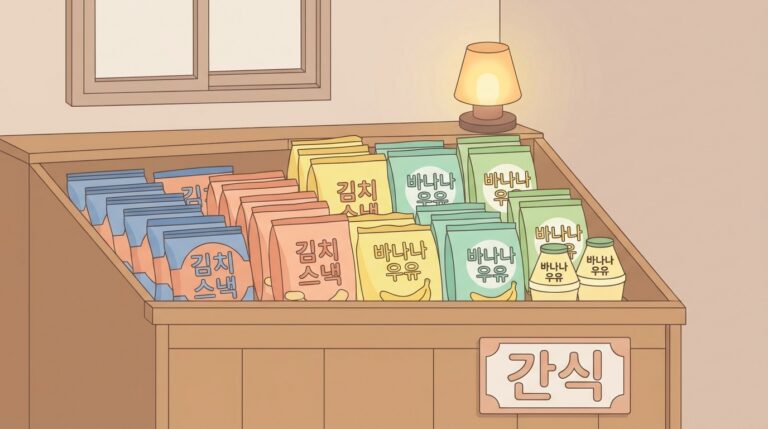
Picture this: It’s 11:30 PM in Hongdae. After a long flight and walking ten thousand steps through neon-lit streets, your stomach lets out a loud rumble. You slide open the glass doors of a bright GS25 convenience store. That classic chime rings—ding-dong! The air smells faintly of warm steamed buns and instant ramyeon broth. You walk toward the snack aisle, your mouth watering for something sweet and crispy.
Suddenly, your heart freezes. Wall-to-wall shelves burst with shiny foil bags: Honey Butter Chips, Turtle Chips, banana puffs, crunchy squid sticks, and mysterious rice crackers. The clerk is quietly tidying boxes behind the counter. You desperately want to know which bag is sweet, which one is fiery spicy, and whether that little yellow sticker means you get a free snack. But what do you actually say? Do you whisper awkward English, pull out translation apps with shaky hands, or grab random bags and hope for the best?
You’re not alone! Over 80% of our beginner learners tell us their very first real-life Korean hurdle wasn’t customs or hotels—it was picking snacks at a K-convenience store (편의점). Today, we’re giving you the exact friendly phrases real Koreans use every single day. Master these, and you’ll step up to the snack shelves like a true Seoul local!
Phase 2: Core Expressions Deep Dive
1. 이거 맛있어요? (Igeo mas-isseoyo?)
- Pronunciation: [I-geo ma-si-sseo-yo] (Sounds like: ee-guh mah-she-so-yo with a rising tone at the end)
- Meaning: Literal: “Is this delicious?” | Real Nuance: “Is this good? / Do you recommend this?”
- K-Culture Moment: Think of romantic K-dramas like Weightlifting Fairy Kim Bok-joo where the leads hang out in front of convenience store tables, pointing at new snacks while debating what to eat.
- Editor’s Insight: You don’t need complicated grammar to ask for an opinion. Simply point your finger at any snack bag and ask this with an inquisitive smile! Koreans love sharing food opinions.
- Situation Spectrum: Casual: ✅ | Semi-formal: ✅ | Formal: ⚠️
- 🤔 Think About It: In English, we usually ask “Is this good?” or “Do you like this?” In Korean, the word ‘맛있다’ (to have taste/delicious) is used universally to evaluate food. Food culture is so vital that everyday satisfaction revolves around taste itself!
2. 뭐가 제일 잘 나가요? (Mwoga jeil jal nagayo?)
- Pronunciation: [Mwo-ga je-il jal na-ga-yo] (Sounds like: mwo-gah jay-eel jal nah-gah-yo)
- Meaning: Literal: “What goes out the best?” | Real Nuance: “What is the best-seller here?”
- K-Culture Moment: In variety shows like Omniscient Interfering View, celebrities often ask CVS clerks or highway rest-stop workers this exact sentence to pick the trendiest local treats.
- Editor’s Insight: If you ask “What do you recommend?” clerks might feel pressured. But asking which one “goes out well” shifts the burden to store sales statistics, making it super easy for shy part-time workers to answer instantly.
- Situation Spectrum: Casual: ✅ | Semi-formal: ✅ | Formal: ⚠️
- 🤔 Think About It: Notice the verb ‘나가다’ (to exit/go out). Products literally “exit the shelf quickly” when they’re popular. It reveals Korea’s dynamic, fast-moving retail rhythm!
3. 이거 투 플러스 원이에요? (Igeo tu-peullaseu-won-ieyo?)
- Pronunciation: [I-geo tu peul-la-seu won-i-e-yo] (Sounds like: ee-guh too-peul-lah-seu-won-ee-eh-yo)
- Meaning: Literal: “Is this 2+1?” | Real Nuance: “Is this buy-two-get-one-free?”
- K-Culture Moment: College students in youth dramas calculating late-night exam study snacks always cluster around the 1+1 (One-plus-one) or 2+1 promo tags.
- Editor’s Insight: Sometimes promotional tags remain on shelves even after the promo month ends. Asking this while holding up your snacks ensures you won’t miss out on grabbing your free extra bag from the shelf.
- Situation Spectrum: Casual: ✅ | Semi-formal: ✅ | Formal: 🚫
- 🤔 Think About It: Korea uses Konglish (Korean-English blend) numbers for retail promotions. Knowing that numbers like “Two plus one” work flawlessly in Hangul phonetics bridges cultural barriers instantly!
Phase 3: Textbook Korean vs. Real Korean
Situation 1: Asking if a snack is sweet
- 📖 교과서 한국어: 이 과자는 단맛입니까? (I gwajaneun danmas-imnikka? – “Is this snack of sweet taste?”)
- 🗣️ 진짜 한국어: 이거 달아요? (Igeo darayo? – “Is this sweet?”)
- 💡 왜 다를까? Textbook Korean overuses noun forms and rigid formal endings like ‘-입니까’. Real Koreans use snappy sensory adjectives like ‘달아요?’ (sweet) or ‘짜요?’ (salty).
Situation 2: Asking the clerk for advice
- 📖 교과서 한국어: 어떤 과자를 추천해 주시겠습니까? (Eotteon gwajareul chucheonhae jusigesseumnikka? – “Would you be willing to recommend a snack?”)
- 🗣️ 진짜 한국어: 어떤 게 제일 맛있어요? (Eotteon ge jeil mas-isseoyo? – “Which one is the tastiest?”)
- 💡 왜 다를까? Asking for formal recommendations (‘추천’) sounds like ordering at a Michelin-star restaurant. In a casual CVS, asking what tastes best is friendly and natural.
Phase 4: K-Culture Deep Dive & Non-Verbal Manners
4-1. 눈치 (Nunchi) & Gestures at the Snack Aisle
When choosing snacks in Korea, your non-verbal cues speak volumes:
* The Two-Handed Handover: When bringing snacks to the counter, don’t throw them down. Place them gently on the checkout mat. When paying with your card, hold it with both hands or support your right wrist with your left hand. It signals warmth and respect.
* Eye-Checking the Shelf Tag: Look for colorful stickers below the price tag: ‘1+1’ (Buy 1 Get 1), ‘2+1’ (Buy 2 Get 1), or ‘덤’ (Bonus freebie). If you bring only two bags of a 2+1 deal, the clerk will use Nunchi to motion toward the shelf so you can grab your free third bag.
4-2. Culture Code: The “단짠” (Sweet & Salty) Obsession
Korea has elevated snacking into an art form known as 단짠 (Danjjan)—the holy harmony of Dan (sweet) and Jjan (salty). From sweet honey-butter potato chips to caramel-pretzels, Koreans love alternating flavors so their palate never gets bored. If you visit a CVS with Korean friends, they will intentionally pick one savory chip bag and one chocolate sweet biscuit to create the ultimate snacking balance!
Phase 5: Real-World Roleplay Scenario
Setting: 11:45 PM at a CU store near Sinchon Station. Fluorescent lights glow over endless snack displays.
NPC Character: Min-woo (민우), a friendly university student working the night shift, wearing CU’s signature purple vest.
- Turn 1 (You): (Holding two different chip bags, approaching shyly) 저기요, 이거 맛있어요? (Jeogiyo, igeo mas-isseoyo? / Excuse me, is this good?)
- Turn 2 (Min-woo): 🎭 smiles and nods enthusiastically 아, 꼬북칩이요? 그거 진짜 달콤하고 바삭해요! (A, Kkobukchip-iyo? Geugeo jinjja dalkomhago basakhaeyo! / Ah, Turtle Chips? Those are really sweet and crunchy!)
- Turn 3 (You): 🎭 pointing to the other bag with interest 그럼 이건요? 뭐가 제일 잘 나가요? (Geureom igeon-yo? Mwoga jeil jal nagayo? / Then how about this one? Which one is the best-seller?)
- Turn 4 (Min-woo): 요즘은 그 초코맛이 제일 잘 나가요. 학생들 인기 1위예요! (Yojeum-eun geu choko-mas-i jeil jal nagayo. Haksaengdeul ingi il-wi-yeyo! / Lately that chocolate flavor sells the best. It’s number one among students!)
- Turn 5 (You): 🎭 checking the yellow tag under the shelf 이거 2+1이에요? (Igeo tu-peullaseu-won-ieyo? / Is this 2+1?)
- Turn 6 (Min-woo): 네, 맞아요! 하나 더 가져오시면 돼요. (Ne, maj-ayo! Hana deo gajyeo-osimyeon dwaeyo. / Yes, that’s right! You can bring one more from the shelf.)
- Turn 7 (You): 🎭 running back to grab the third bag and setting them down 고맙습니다! 봉투 하나 주세요. (Gomapseumnida! Bongtu hana juseyo. / Thank you! Please give me one plastic bag.)
- Turn 8 (Min-woo): 🎭 beeping barcodes 네! 총 3,400원입니다. (Ne! Chong sam-cheon-sa-baek-won-imnida. / Yes! That’s 3,400 won in total.)
🔀 Interactive Branch Point: What will you say next?
- Option A: 카드 결제할게요! (Kadeu gyeolje-halgeyo! – “I will pay by card!”)
- Feedback [Best]: Clear, polite, and standard. Min-woo will immediately activate the card terminal for you!
- Option B: 깎아주세요! (Kkakka-juseyo! – “Please give me a discount!”)
- Feedback [Bad]: Never bargain in a Korean convenience store. Prices are fixed by the POS barcode system, and it will only cause awkward confusion.
- Option C: 영수증은 괜찮아요. (Yeongsujeung-eun gwaenchanayo. – “The receipt is okay/not needed.”)
- Feedback [Risk]: While common among locals, say it after paying, otherwise the clerk might pause the checkout transaction waiting for your payment.
Phase 6: 10-Second Emotion Shadowing Drill
Train your vocal muscles with native rhythm! Repeat these sentences matching the emotional cues:
[😊 호기심 가득하고 밝게 / Curious & cheerful]- 저기요, / 이거 / 맛있어요? (Jeogiyo, / igeo / mas-isseoyo?)
- Beat: Excuse me, / is this / tasty?
[🤩 기대감에 차서 / Eager & excited]- 어떤 게 / 제일 / 잘 나가요? (Eotteon ge / jeil / jal nagayo?)
- Beat: Which one / the very most / sells well?
[💡 발견해서 반갑게 / Delightful discovery]- 아! / 이거 / 2+1이에요? (A! / igeo / tu-peullaseu-won-ieyo?)
- Beat: Ah! / Is this / two-plus-one?
Phase 7: K-Culture Mini Dictionary
- 단짠 (Danjjan) | Sweet and salty combination | Used widely to describe irresistible snacks, popcorn, chicken seasonings, and dessert pretzels.
- 원플러스원 (1+1 / Won-peullaseu-won) | Buy One Get One Free | The holy grail of Korean CVS deals. If you see this sign, grab two items and you’ll only pay for one.
- 신상 (Sinsang) | Brand new release | Short for ‘신상품’ (new product). Korean convenience stores release trendy limited-edition snacks weekly. Look for the ‘신상’ tag!
- 꿀조합 (Kkuljohap) | Honey combination (Best combo) | Refers to legendary food pairings, such as matching spicy Buldak ramyeon with a sweet Choco Pie or banana milk.
Phase 8: Survival Kit for Travelers
TOP 3 Survival Phrases at CVS Counters:
- 봉투 필요하세요? (Bongtu piryohaseyo?)
- Translation: “Do you need a bag?”
- Pro Tip: Bags cost 100~200 won in Korea by law. Reply with: “네, 주세요” (Ne, juseyo – Yes, please) or “괜찮아요” (Gwaenchanayo – No thanks / I’m good).
- 영수증 버려주세요. (Yeongsujeung beoryeo-juseyo.)
- Translation: “Please throw away the receipt.”
- Pro Tip: Keep checkout smooth by telling the clerk upfront if you don’t need the paper receipt.
- 카드 결제할게요. (Kadeu gyeolje-halgeyo.)
- Translation: “I will pay with card.”
- Pro Tip: Nearly all Korean convenience stores are 100% cashless friendly. You can tap international credit cards, T-Money, or Apple Pay.
Editor’s Travel Note:
Never get stranded hunting for snacks! Make sure to install the Naver Map app download guide before landing, as Google Maps does not provide accurate walking routes in Korea. Search for “편의점” (convenience store) to find open 24/7 locations within a 2-minute walk from any hotel!
Phase 9: 한 발 더 깊이 (One Step Deeper)
In many Western cultures, a convenience store is merely a quick pit stop to grab gas or a soda. In South Korea, convenience stores are vibrant community spaces. Outside nearly every storefront, you will find plastic outdoor tables and chairs where college friends gather after midnight, salary workers decompress over a sweet snack, and couples share ice cream cups. Snacking in Korea is an inherently social ritual of connection—sharing a 2+1 snack bag is one of the simplest, sweetest acts of Jeong (정, emotional affection) you can experience.
💬 Your Turn: Have you ever tried a Korean snack? Which one are you dying to taste first: Honey Butter Chips, Choco Pie, or spicy Tteokbokki crackers? Tell us in the comments below!
Phase 10: FAQ & Common Mistakes
Q: Can I buy just one item if it has a 2+1 sticker?
A: Yes! The 2+1 tag is an optional promotion. You can buy a single bag at regular price, but you’ll get the best value if you bring all three to the counter together.
Q: Can I mix different flavors for a 2+1 promotion?
A: Usually yes, provided they are the same brand and same price tier (for example, Turtle Chips Chocolate flavor + Turtle Chips Corn Soup flavor). If you are unsure, show them to the clerk and ask: “교차 돼요?” (Gyocha dwaeyo? – “Can I cross-mix flavors?”).
Q: Do clerks get annoyed if I ask questions in beginner Korean?
A: Not at all! Convenience store clerks in Korea are used to hurried customers. Hearing a polite, enthusiastic “이거 맛있어요?” with a smile will brighten their shift.
🚨 Common Mistakes Warning Board:
- Mistake 1: Taking only 2 bags during a 2+1 deal. You will pay for two and miss out on your free third snack! Always check the shelves or ask.
- Mistake 2: Eating inside before paying. Unlike some countries where opening a bottle in line is tolerated, you must scan and pay for every snack before tearing open the packaging.
- Mistake 3: Throwing trash into one single bin. Look beside the store door for separate recycling bins: 플라스틱 (Plastic), 캔 (Can), and 일반쓰레기 (General Waste).
Phase 11: Action Missions
- 🥉 Bronze Mission (Solo Drill): Look at a snack packaging in your pantry right now. Point your finger and say out loud three times: “이거 맛있어요?” (Igeo mas-isseoyo?).
- 🥈 Silver Mission (Social Share): Take a photo of your favorite Asian snack, tag @DailyHangul on Instagram or TikTok, and caption it with “뭐가 제일 잘 나가요?”.
- 🥇 Gold Mission (Real World): Visit an H-Mart, local Korean grocer, or a Seoul CVS. Ask the clerk directly: “이거 2+1이에요?” or purchase a snack using only Korean phrases!
- 🎮 K-Culture Mission: Watch any episode of a slice-of-life K-drama (like Hospital Playlist or Reply 1988). Spot the exact moment characters share snacks together and notice what words they use!
Phase 12: Interactive Quiz Challenge
Question 1 (Situational Judgment)
You want to know what the absolute best-selling, most popular chip is on the shelf. What should you ask the clerk?
* A) 이거 단맛입니까? (I gwajaneun danmas-imnikka?)
* B) 뭐가 제일 잘 나가요? (Mwoga jeil jal nagayo?)
* C) 깎아주세요! (Kkakka-juseyo!)
Question 2 (Fill-in-the-Blank)
To ask “Is this buy-two-get-one-free?”, complete the phrase:
“이거 ______이에요?”
Question 3 (True or False)
True or False: In Korea, plastic shopping bags are always free of charge at convenience stores.
👉 Click to reveal the quiz answers & explanations!
- Answer 1: B) 뭐가 제일 잘 나가요? (This is the most natural way to ask what sells best and is popular among customers!).
- Answer 2: 투 플러스 원 (tu-peullaseu-won) (“이거 투 플러스 원이에요?” is the exact phrase!).
- Answer 3: False! (By environmental law, Korean stores must charge 100~200 won for disposable bags. Always bring a tote or ask “봉투 하나 주세요!”).







