

Phase 1: Empathy & Story Opening
안녕하세요! 매일한글 에디터입니다. (Hello! This is your Daily Hangul editor.)
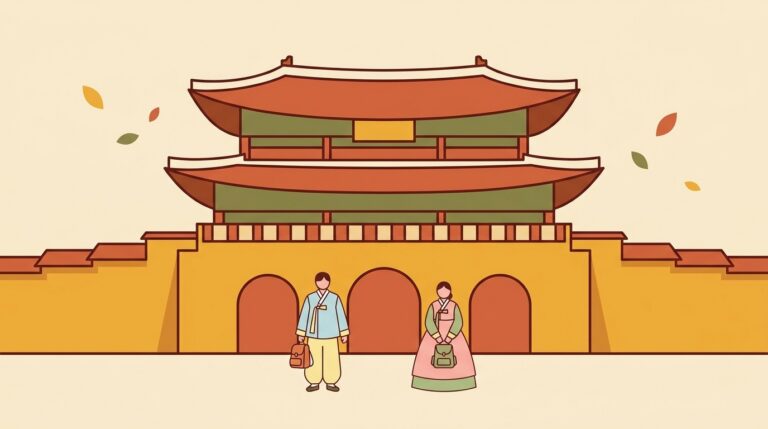
Picture this: You step out of the subway station, and suddenly the bustling skyscrapers of central Seoul part like the Red Sea to reveal the awe-inspiring Gwanghwamun Gate. The autumn breeze carries the sound of distant traditional drums, and people stroll past in vibrant, flowing silk Hanboks, looking straight out of a hit historical K-drama like The King’s Affection. Your heart races with excitement—until you reach the ticket booth.
Suddenly, your mind goes blank. How do you ask for tickets? Do you really get free admission if you wear a Hanbok? What if the clerk speaks rapid-fire Korean and you freeze? Don’t worry, my friend! We have coached hundreds of beginner learners through this exact moment. With just a handful of friendly, natural A2-level Korean phrases, you will navigate Gyeongbokgung Palace smoothly, politely, and with total confidence.
Phase 2: Core Expressions Deep Dive
1. 경복궁 티켓 두 장 주세요 (Gyeongbokgung tiket du jang juseyo)
- Pronunciation: [Gyeong-bok-gung tee-ket doo jahng joo-seh-yo] (Analogy: Think of ‘tea-cat’ for 티켓 and ‘do-jang’ like a martial arts dojang)
- Meaning: Literal: “Gyeongbokgung ticket two sheets please give.” / Real Nuance: “Two tickets for Gyeongbokgung Palace, please.”
- K-Culture Moment: The iconic scene in travel vlogs and dramas where two best friends buy their entry passes before exploring secret palace courtyards.
- Editor’s Insight: In Korean, flat paper objects like tickets use the counter word 장 (jang). While you could technically say “두 개 주세요 (du gae juseyo)”, using 두 장 (du jang) makes you sound instantly fluent and natural.
- Situation Spectrum: Casual ⚠️ | Semi-formal ✅ | Formal ✅
- 🤔 Think About It: Korean counts items based on their physical shape (sheets, bottles, people). How does this compare to how your native language categorizes objects?
2. 한복 입으면 무료예요? (Hanbok ib-eumyeon muryo-yeyo?)
- Pronunciation: [Hahn-boak eeb-eu-myeon moo-ryo-ye-yo] (Analogy: ‘Eeb-oo’ like taking a nibble, followed by ‘moo’ like a cow + ‘ryo’)
- Meaning: Literal: “Hanbok if wear, is it free?” / Real Nuance: “Is admission free if I wear a Hanbok?”
- K-Culture Moment: Travelers walking proudly through Heungnyemun Gate without spending a single won, feeling like royal royalty in Joseon dynasty Korea.
- Editor’s Insight: 무료 (muryo) means “free of charge.” The grammatical ending -(으)면 (-(eu)myeon) means “if / when.” You can reuse this pattern anywhere in Korea (e.g., 학생이면 무료예요? – Is it free if I am a student?).
- Situation Spectrum: Casual ⚠️ | Semi-formal ✅ | Formal ✅
- 🤔 Think About It: Korea waives palace admission for Hanbok wearers to keep traditional culture alive in daily modern spaces. Does your culture have policies that celebrate heritage like this?
3. 사진 좀 찍어 주실 수 있나요? (Sajin jom jjig-eo jusil su innayo?)
- Pronunciation: [Sah-jin johm jji-goh joo-shil soo een-nah-yo] (Analogy: ‘Sah-jeen’, then a soft ‘johm’, with a snappy double ‘jj’ sound)
- Meaning: Literal: “Photo a little take can you give?” / Real Nuance: “Could you please take a photo of me/us?”
- K-Culture Moment: Asking a fellow visitor near Geunjeongjeon Hall, who ends up crouching on the stone ground to take 30 angles so you get the ultimate picture!
- Editor’s Insight: The tiny word 좀 (jom) translates to “a little bit,” but functionally it works like a politeness shield that softens your request so you never sound demanding.
- Situation Spectrum: Casual 🚫 | Semi-formal ✅ | Formal ✅
- 🤔 Think About It: Politeness in Korean relies heavily on softening formulas. Removing “좀” makes the sentence sound stiff and transactional.
Phase 3: Textbook Korean vs. Real Korean
Situation 1: Asking which way to go at the palace gate
- 📖 교과서 한국어 (Textbook): 어디로 가야 합니까? (Eodiro gaya hamnikka? / Where must I go?)
- 🗣️ 진짜 한국어 (Real-life): 어느 쪽으로 가요? (Eoneu jjogeuro gayo? / Which way should I go?)
- 💡 왜 다를까?: The textbook ~합니까 ending sounds like an official military report. Real Koreans use the polite ~요 ending in friendly, everyday conversations.
Situation 2: Asking if you can take photos
- 📖 교과서 한국어 (Textbook): 사진 촬영이 가능합니까? (Sajin chwaryeong-i ganeunghamnikka? / Is photography permitted?)
- 🗣️ 진짜 한국어 (Real-life): 여기 사진 찍어도 돼요? (Yeogi sajin jjigeodo dwaeyo? / Can I take photos here?)
- 💡 왜 다를까?: 촬영 (chwaryeong) is formal Sino-Korean vocabulary suited for signage or legal forms. In spoken Korean, people naturally say 사진 찍다 (sajin jjikda).
Phase 4: K-Culture Deep Dive & Non-verbal Manners
4-1. 눈치 (Nunchi) & Palace Etiquette
- The Two-Hand Rule (두 손): When handing your credit card or cash to the ticket seller, always present it with both hands, or support your right forearm with your left hand. Tossing a card with one hand is seen as dismissive.
- The 15-Degree Bow: After receiving your ticket or map, give a gentle nod with a light 15-degree bow while saying: “감사합니다! (Gamsahamnida! / Thank you!).”
4-2. Cultural Code: Sageuk & Living History
In Korea, historical sites are not dusty relics locked behind velvet ropes. Through historical K-dramas (Sageuk / 사극), royal palaces are celebrated as living storybooks. Walking Gyeongbokgung in traditional clothing isn’t viewed as dress-up or cosplay; it is a genuine celebration of Joseon Dynasty aesthetics and Korean culture.
Phase 5: Real Roleplay Scenario
Setting: The main ticket booth outside Gyeongbokgung Palace. You are talking with Min-woo (민우), a friendly palace staff member.
- Turn 1 (민우): 어서 오세요! 몇 분이세요? (Eoseo oseyo! Myeot bun-iseyo?) [🎭 Welcoming with a polite bow]
- Turn 2 (You): 안녕하세요! 성인 두 명이에요. (Annyeonghaseyo! Seong-in du myeong-ieyo.) [🎭 Smiling warmly]
- Turn 3 (민우): 네, 한복은 안 입으셨네요! 티켓 발권해 드릴까요? (Ne, hanbok-eun an ib-eusyeotneyo! Tiket bal-gwonhae deurilkkayo?) [🎭 Pointing gently to the counter monitor]
- Turn 4 (You): 네, 경복궁 티켓 두 장 주세요. (Ne, Gyeongbokgung tiket du jang juseyo.) [🎭 Handing your payment card with two hands]
- Turn 5 (민우): 네, 6,000원 결제 도와드렸습니다. (Ne, yuk-cheon-won gyeolje dowa-deuryeotseumnida.) [🎭 Handing back the card with both hands]
- Turn 6 (You): 감사합니다. 혹시 영어 지도 있나요? (Gamsahamnida. Hoksi yeongeo jido innayo?) [🎭 Looking at the brochures desk]
- Turn 7 (민우): 네, 여기 영어 리플릿 있습니다. 즐거운 관람 되세요! (Ne, yeogi yeongeo ripeullit isseumnida. Jeulgeoun gwanram doeseyo!) [🎭 Handing the palace map with a smile]
- Turn 8 (You): 친절하게 안내해 주셔서 감사합니다! (Chinjeolhage annaehae jusyeoseo gamsahamnida!) [🎭 Giving a thankful nod and stepping inside]
🔀 Interactive Decision Branch
What if you rented a Hanbok before coming to the booth? What should you say?
* Option A: “한복 입으면 무료예요?” (Hanbok ib-eumyeon muryo-yeyo? / Is it free if I wear Hanbok?)
* Feedback (Best): Perfect! The clerk will smile, verify your attire, and guide you directly through the gate without waiting.
* Option B: “야, 그냥 들어가도 돼?” (Ya, geunyang deureogado dwae? / Hey, can I just go in?)
* Feedback (Bad): High social risk! “야 (ya)” is informal slang used only between very close friends of the same age.
* Option C: “돈 안 내요.” (Don an naeyo. / I’m not paying money.)
* Feedback (Risk): Sounds blunt and confrontational. Always phrase your question politely with “무료예요?”.
Phase 6: 10-Second Emotion Shadowing Drill
Practice these natural rhythm pauses marked with /:
- [😊 기쁘고 설레게 / Excited & Happy]
경복궁에 / 드디어 / 왔어요! (Gyeongbokgunge / deudieo / wasseoyo! / I finally arrived at Gyeongbokgung!) - [🙋♂️ 차분하고 공손하게 / Calm & Polite]
성인 두 명 / 티켓 주세요. (Seong-in du myeong / tiket juseyo. / Tickets for two adults, please.) - [✨ 호기심 가득 찬 목소리로 / Curious & Bright]
한복 입으면 / 무료 맞아요? (Hanbok ib-eumyeon / muryo majayo? / Is it right that it is free if wearing Hanbok?) - [📸 다정하고 정중하게 / Gentle & Courteous]
사진 좀 / 찍어 주실 수 있나요? (Sajin jom / jjig-eo jusil su innayo? / Could you please take a photo?)
Phase 7: K-Culture Mini Dictionary
- 수문장 교대의식 (Sumunjang gyodaeuisik) | Royal Guard Changing Ceremony | The dramatic historical ceremony re-enacted daily at Gwanghwamun Gate (usually at 10:00 and 14:00).
- 한복 (Hanbok) | Traditional Korean clothing | Wearing a full Hanbok set grants you 100% free entrance to Seoul’s grand royal palaces.
- 궁궐 (Gunggwol) | Royal Palace | The historical palace complex where Joseon monarchs resided and governed.
- 인생샷 (Insaeng-syat) | Once-in-a-lifetime photo | A slang compound of “인생 (life)” and “샷 (shot),” referring to the picture of your dreams against Gyeonghoeru Pavilion.
Phase 8: Traveler Survival Kit
Top 3 Palace Survival Phrases
- 화장실 어디예요? (Hwajangsil eodiyeyo?) [Where is the restroom?]
- Pro Tip: The palace grounds span over 100 acres. Visit the restrooms located near the main gates before wandering deep into the inner courtyards.
- 몇 시에 닫아요? (Myeot sie dad-ayo?) [What time do you close?]
- Pro Tip: Last admission is strictly one hour before closing time. Arrive early to avoid being turned away.
- 출구가 어디예요? (Chulguga eodiyeyo?) [Where is the exit?]
- Pro Tip: Gyeongbokgung connects to the National Folk Museum on the east and Cheong Wa Dae on the north. Knowing your exit saves hours of walking.
Editor’s Travel Note
- Transit Navigation: Take Seoul Subway Line 3 to Gyeongbokgung Station (경복궁역) and head out via Exit 5. It leads straight into the palace plaza!
- App Tip: Google Maps does not give accurate walking routes in Korea. Search and navigate seamlessly with the 네이버 지도 앱 다운로드 (Naver Map app) for real-time station exits and walking routes.
Phase 9: 한 발 더 깊이 (One Step Deeper)
When you visit Gyeongbokgung, you will see centuries-old wooden architecture standing proudly alongside 21st-century glass skyscrapers. Korean historical spaces are not treated as relics of a distant, disconnected past. Instead, by wearing traditional clothes, joining ceremonies, and speaking mindful Korean, locals and visitors weave the past into the living present. Politeness here is not just about grammatical rules—it is about respecting the shared harmony of the space.
💬 Your Turn: If you could visit Gyeongbokgung right now, would you rent a traditional Joseon King Hanbok, or modern pastel silk Hanbok? Share your dream look in the comments below!
Phase 10: FAQ & Mistake Prevention
Q: Is Gyeongbokgung Palace closed on Mondays?
A: No! Gyeongbokgung is closed on Tuesdays. (Note: Changdeokgung and Deoksugung close on Mondays, so plan your palace tours accordingly).
Q: Does modern-style rental Hanbok qualify for free admission?
A: Yes! Both traditional historical Hanbok and modern themed/pastel Hanboks qualify, provided you wear both the top (Jeogori) and bottom (Chima/Baji) pieces properly.
Q: Can I bring coffee or takeout food inside the palace?
A: No. Bottled water is permitted, but open cups and takeout food are prohibited inside royal palace grounds to protect the historic wooden architecture.
🚨 흔한 실수 (Common Mistakes) 경고판
- Mistake: Addressing the staff with informal pronouns like “너 (neo)” or “야 (ya)”.
- Correct Action: Keep sentences in polite ~요 or ~주세요 style.
- Mistake: Arriving on a Tuesday and expecting the gates to open.
- Correct Action: Double-check operating days before traveling, or head to Changdeokgung on Tuesdays instead.
- Mistake: Tossing payment cards on the counter with one hand.
- Correct Action: Present cards and tickets using both hands with a gentle head nod.
Phase 11: Action Missions
- 🥉 Bronze Mission (Solo Drill): Stand in front of your mirror and practice saying “경복궁 티켓 두 장 주세요” 5 times with a clear voice.
- 🥈 Silver Mission (Social Share): Post a photo of your favorite Korean drama palace scene on your Instagram story with the caption: “경복궁 가고 싶어요! (I want to go to Gyeongbokgung!)”
- 🥇 Gold Mission (Real-world Challenge): When visiting Seoul, walk up to the ticket window and buy your admission pass entirely in Korean without switching to English!
- 🎮 K-Culture Mission: Watch an episode of a royal Korean drama and spot how characters bow and address officials with respect.
Phase 12: Interactive Quiz Challenge
Question 1: Situational Judgment
You are standing at the Gyeongbokgung ticket booth with a friend. How do you politely ask for two tickets?
* A) 티켓 두 개 내놔. (Tiket du gae naenwa.)
* B) 경복궁 티켓 두 장 주세요. (Gyeongbokgung tiket du jang juseyo.)
* C) 티켓 있어? (Tiket isseo?)
Question 2: Fill-in-the-Blank
Complete the phrase to ask if wearing Hanbok gives free entry:
“한복 입으면 [ ]예요?”
Question 3: True or False
True or False: Gyeongbokgung Palace is closed every Monday.
👉 Click here to check the answers & explanations!
- Q1 Answer: B (A is rude demand; C is informal speaking to a friend).
- Q2 Answer: 무료 (muryo). Full phrase: 한복 입으면 무료예요? (Is it free if I wear Hanbok?).
- Q3 Answer: False. Gyeongbokgung is closed on Tuesdays, while other palaces like Changdeokgung close on Mondays!







